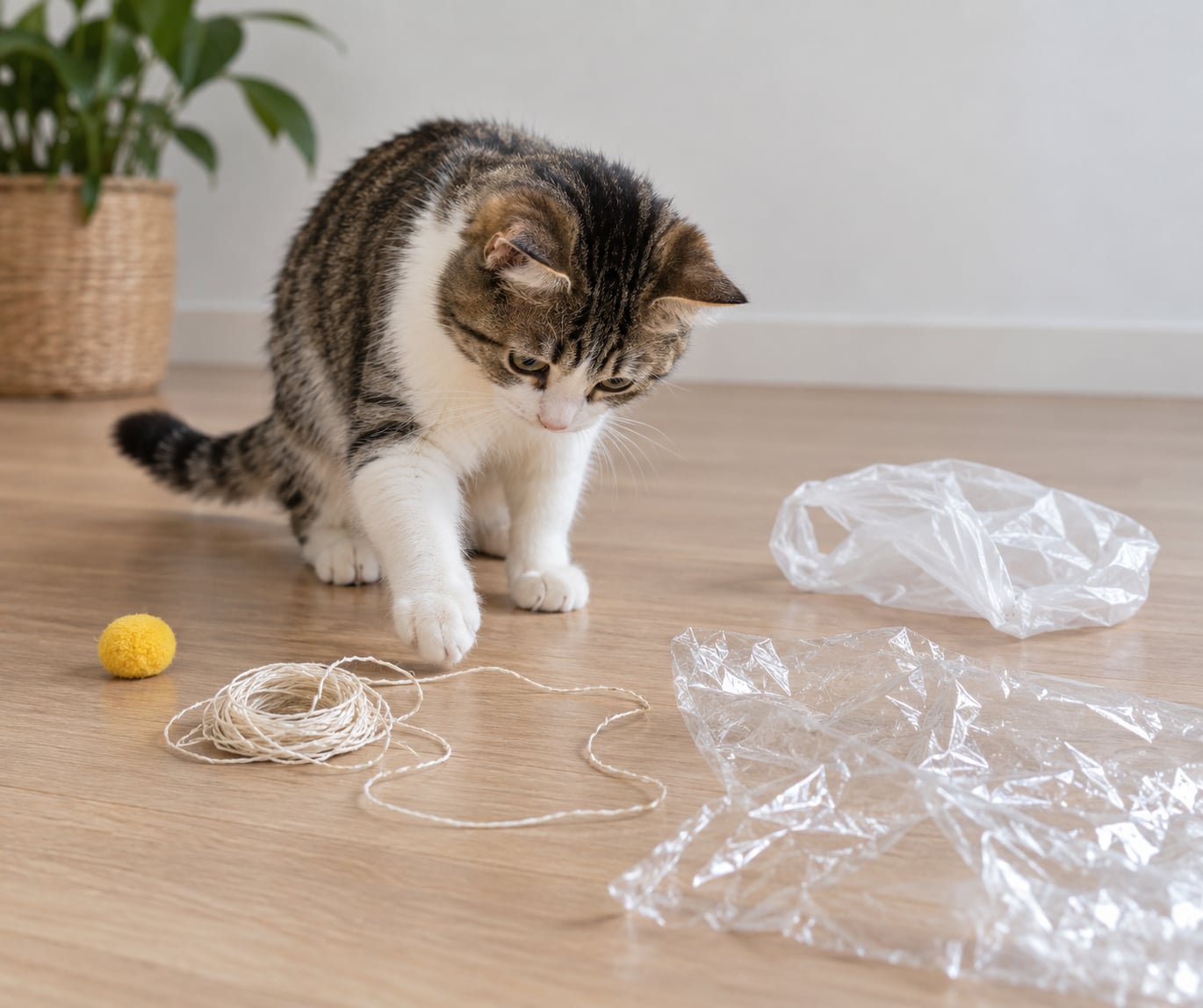
If you have caught your cat chewing or swallowing plastic, string or thread, the short answer is that cats mouth and swallow non-food objects for a whole cluster of overlapping reasons: curiosity, texture, unmet hunting and shredding instinct, boredom, stress, oral discomfort, and sometimes an underlying illness. The behaviour is called pica. The good news is that string and plastic mean very different levels of risk, and most cases of pica in young cats settle as they mature. The bad news is that swallowed string can cause a surgical emergency, so the swallowing matters more than the chewing.
This guide explains what your cat is likely doing, which household materials carry the most danger, what warning signs mean you should stop waiting, and what to change at home. It is educational and does not replace an examination by your own veterinarian, who knows your cat’s history and can assess your cat directly.
Table of Contents
- Why Does My Cat Eat Plastic and String?
- Normal chewing versus true pica
- How common is it
- What Kinds of Plastic and String Are Most Dangerous?
- The same habit puts these in reach too
- What Are the Warning Signs of an Intestinal Blockage?
- How long before symptoms show
- What Should You Do If Your Cat Swallowed String or Plastic?
- What to bring or have ready for the visit
- Why Might Your Cat Be Swallowing These Materials?
- Sudden onset in an adult cat deserves attention
- How Can You Prevent Your Cat from Eating Plastic and String?
- Safe things to offer instead
- When Is This a Veterinary Emergency?
- Frequently Asked Questions
- Will my cat pass plastic or string on its own?
- Should I make my cat vomit after swallowing plastic?
- Why is it dangerous to pull string from a cat’s mouth or anus?
- How much string is an emergency for a cat?
- When should I take my cat to the veterinarian after eating plastic?
- How can I stop my cat from eating string without punishment?
- Conclusion: Remove the Material and Call a Veterinarian
Why Does My Cat Eat Plastic and String?
Pica is a behaviour in which a cat repeatedly eats or swallows items that are not food, such as plastic, string, fabric, paper, hair ties or plant matter. A one-off nibble of a cardboard box is ordinary cat behaviour. Repeatedly chewing and swallowing the same materials is pica, and it is worth taking seriously because of what those materials do inside the gut.
Owners ask this constantly, and the honest answer is that researchers still do not have one explanation. Pica is a symptom rather than a disease in itself. It can show up because of hunger, an unfinished hunting sequence, too little to do, a stressful home, mouth pain, a diet gap, or illness such as hyperthyroidism, anaemia, diabetes or gastrointestinal disease. In many cats there is no identifiable cause at all, and it simply shows up as a habit.
Normal chewing versus true pica
Chewing is how cats investigate, sharpen teeth and practice biting. Chewing a cardboard edge and spitting it out is chewing. Chewing, swallowing and then searching the room for more is pica, and it is the swallowing you need to worry about.
- Normal chewing: the cat mouths the item, plays with it, drools a little, loses interest, and moves on.
- Pica: the cat returns to the same material repeatedly, looks for it when you hide it, and swallows pieces you did not see it take.
How common is it
The Bristol Cat Study, published in the peer-reviewed journal Animals, followed more than 2,200 cats and found that around 25 percent showed some form of pica. Behaviour peaked between about six and seven months of age, and roughly half of the affected cats had stopped by 18 to 19 months. Cats that moved house at around one year showed a higher risk of developing it.
That finding is the single most reassuring thing on this page. If your kitten is six months old and tearing at hair ties, the odds are genuinely good that he simply grows out of it. If your three-year-old has started doing it this month, that is a different story, and it deserves a vet visit.
What Kinds of Plastic and String Are Most Dangerous?
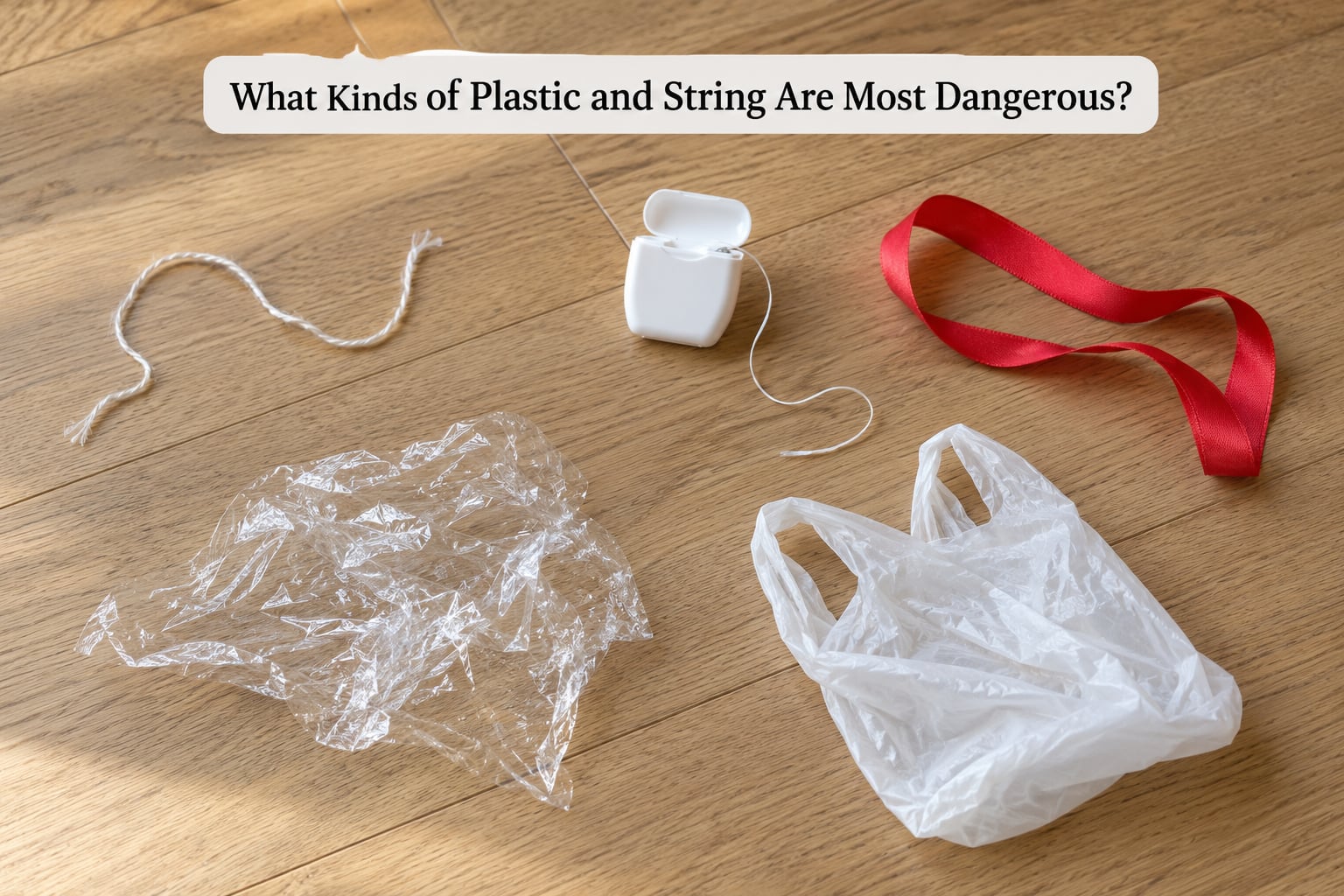
Not all plastic is equally dangerous, and the difference between string and a scrap of film is bigger than most owners expect. String, thread and dental floss can behave like a linear foreign body: the bowel contracts around the material and the string stays tethered at one end while the gut moves, which can cut into the intestinal wall. Hard plastic is more likely to lodge and block. Thin film is the one that most often passes.
| Material | Why it is risky | How urgent it is |
|---|---|---|
| Sewing needle, thread still attached | Sharp object plus a tether; can perforate the gut from inside | Same day, at the latest |
| Long string, yarn, dental floss, ribbon | Acts as a linear foreign body and can saw through the bowel wall | Same day, urgent |
| Thin film: cling wrap, packaging film, plastic bags | Blocks or winds into a bundle; can also cause choking | Contact a vet the same day |
| Hard plastic: clips, corners, packaging | May lodge and cause a partial or full obstruction | Contact a vet the same day |
| Small soft fragment | Most often passes on its own | Monitor and call if symptoms appear |
| Rubber bands, hair ties | Elastic, can stretch in the gut and cause an obstruction | Contact a vet the same day |
The same habit puts these in reach too
A cat that eats plastic will happily eat other things you keep in the house, and some of those are more dangerous than the plastic. Worth a sweep of the usual spots:
- Lily leaves and petals, which are acutely poisonous to cats. Check any bouquet that comes into the house.
- Needles, pins and fishing line left in sewing baskets or on the floor.
- Electrical cords, which can cause electrical burns to the mouth, chewed with no visible wound outside.
- Fabric softener sheets and dryer sheets, which are attractive for their softness and scent.
- Packing tape and sticky labels on delivery boxes, left within reach of a work surface.
- Foam, polystyrene and Christmas tinsel, which are light enough to swallow easily.
What Are the Warning Signs of an Intestinal Blockage?
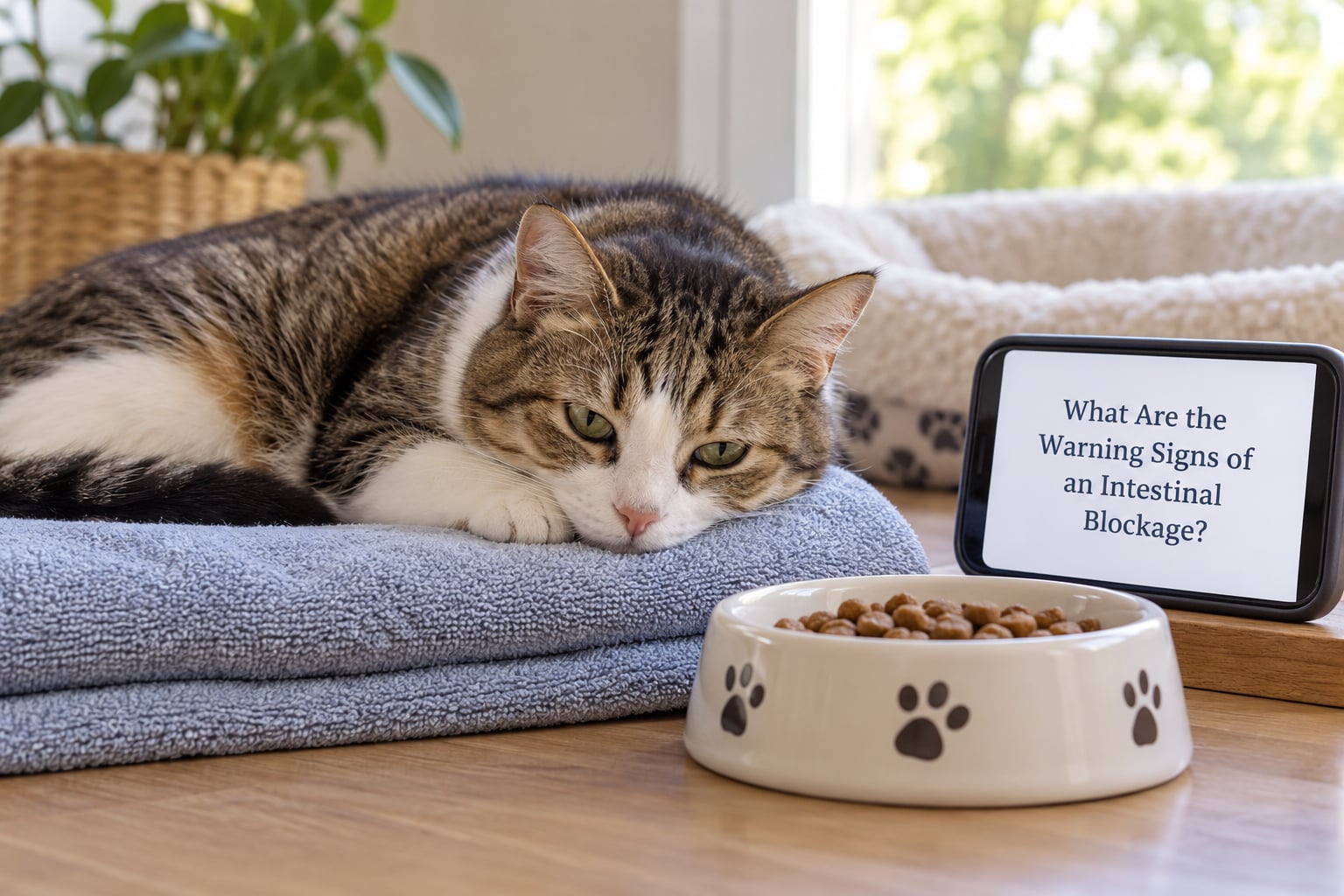
A blocked cat often looks completely normal for the first few hours, which is exactly why this behaviour is worrying. Owners frequently report that the cat ate something in the night and seemed fine all the next day. Here are the signs that should end the waiting.
- Repeated vomiting or retching, especially bringing up water or foam rather than food.
- Gagging, drooling, or pawing at the mouth.
- Refusing food and water when the cat normally eats well.
- A swollen, hard or painful belly, or flinching when you lift or touch the abdomen.
- Lethargy, hiding, or a sudden collapse.
- No stool for a day or more, or diarrhoea that is thin and watery.
- Blood in the vomit or stool.
- String, thread or plastic visibly protruding from the mouth or the anus.
- Repeated unsuccessful attempts to pass urine. This one has nothing to do with the plastic and needs immediate attention.
How long before symptoms show
For hard plastic or a swallowed needle, symptoms can appear within hours. With string, thread and film plastic, owners often report 12 to 48 hours of normal behaviour before vomiting starts, because the material first has to travel. Owners on cat forums describe cats passing a whole spool of embroidery thread intact, which does happen, but it is not something to plan around.
A reasonable home observation window is a few hours of quiet watching, and only if your cat has no symptoms at all and the material was a small soft fragment. That window does not apply to string, thread, floss, ribbon, needles, bags, film or anything hard and sharp. For those, call the clinic the same day and let them tell you whether to bring the cat in now or watch for a few hours.
What Should You Do If Your Cat Swallowed String or Plastic?
Here is the protocol for the next ten minutes, in order. It matters because the two most common reflexes, pulling the string and making the cat vomit, are both the wrong move without a vet on the phone.
- Do not pull string from the mouth, the throat or the anus. If it is taut and you pull, you can draw the anchored end deeper or drag it through the bowel wall. This is the single most important instruction on the page.
- Do not induce vomiting. Cats cannot vomit on command, attempts often fail, and forcing it can cause injury. More importantly, vomiting is the wrong tool for a linear foreign body, because the material can re-anchor further down the gut.
- Do not give human medication. No hydrogen peroxide, no paracetamol, no leftover pills, no oil or oil-based laxatives. Cats metabolise many common human drugs badly, and the timing is often wrong for the material involved.
- Pick up the rest of the material. Put the remaining string, packaging and film away before anything else so you can rule out a second swallow while you are on the phone.
- Look, then note, what happened. Try to work out what it was, how long ago, roughly how much and whether the cat has vomited, eaten or passed stool since. That list speeds up the appointment.
- Call your veterinarian or a 24-hour emergency hospital. Say the material and the time. They will tell you whether to come straight in or monitor, and they can give you a safe plan for the hours ahead.
What to bring or have ready for the visit
Photographs of the packaging, the torn box or a photo of the whole roll of thread tell your vet more than your description does. So does the packaging itself, which can carry ingredient or chemical information that changes the approach.
Write down whether your cat has eaten, drunk, vomited or passed stool since the incident, and how many times. Note any change in appetite, energy or posture. If your cat is on medication already, have the list ready. Owners who arrive with these details make faster decisions under pressure, and faster decisions matter in this particular scenario.
Why Might Your Cat Be Swallowing These Materials?
There are two families of causes, and separating them early saves time. Behavioural and environmental causes are far more common. Medical causes are less common but more important to rule out, particularly in a cat with no previous history of chewing non-food items.
| Cause | Why your cat does it | What to check |
|---|---|---|
| Predatory and play instinct | Chewing and shredding is part of the hunting sequence that never gets completed indoors | Add wand play and food puzzles so the sequence finishes |
| Boredom or under-stimulation | A cat with nothing to hunt, chase or investigate chews whatever is available | Two short play sessions a day, rotating toys, a perch by a window |
| Stress or anxiety | Moving house, a new baby, a new pet or neighbours at the window raise arousal | Changes in routine, hiding, over-grooming, litter box changes |
| Preference for texture and taste | Some plastics have a slightly greasy or sweet smell that cats latch onto once they start | Chosen materials, whether it starts after one specific item |
| Oral pain or dental disease | Cats chew to relieve gum pain, and broken teeth make chewing uncomfortable | Broken or missing teeth, red or bleeding gums, eating on one side |
| Diet gap or early weaning | Separated from the mother too young, or on a diet short of something, so chewing stands in for nursing | Age at weaning, current food, any recent diet change |
| Breed tendency | Siamese, Burmese and Oriental types are more prone to fabric-based pica, called wool-sucking | Breed, or a close relative in the household with the same habit |
| Compulsive behaviour | A repetitive cycle of chew, swallow and search that repeats regardless of outcome | Ritualised, almost unbreakable pattern, often worse at night |
| Medical: hyperthyroidism, anaemia, diabetes, GI disease | Nausea, oral discomfort and appetite changes make non-food items more appealing | Thirst, weight change, vomiting, appetite change, drinking more |
Sudden onset in an adult cat deserves attention
Owners frequently ask why their cat is suddenly eating plastic when it never did before. Pica that appears out of nowhere in a mature cat is a reason to book a veterinary appointment rather than a reason to buy a bigger storage box. New mouth pain, an undiagnosed thyroid problem, anaemia or gastrointestinal disease can all start the habit, and several of them are treatable.
The same goes for a cat whose pica suddenly intensifies or who begins hiding food. An animal that has always had this habit and is otherwise well is a different case from one whose behaviour changes this week.
How Can You Prevent Your Cat from Eating Plastic and String?
Prevention works in two directions. You shrink the cat’s access to the problem materials, and you redirect the behaviour towards something safer and more satisfying. Doing only the first half tends to produce a bored cat who finds the next available thread.
- Secure the trash. Use a lidded bin with a pedal rather than an open bag on the floor. Owners who switched to pedal bins report the garbage chewing stopping quickly.
- Store the risky items properly. Thread, needles, floss and yarn go in a closed drawer or a high drawer, not in an open sewing basket.
- Sweep the floor daily. Most swallowed string is loose thread from bedding, curtains or a rug edge. A ten-second check of skirting boards and under the sofa catches a lot of it.
- Strip packaging before it lands. Remove tape and labels from delivery boxes, or put the whole box outside in a sealed bag for recycling once you have cut it open.
- Cover cords where they run. Cord covers or sleeves on chargers and TV cables remove an electrical hazard as well as a chewing target.
- Play, then feed. Two short sessions of wand play ending in a small meal reproduce the hunt-catch-eat sequence that satisfies the instinct driving much of the chewing.
- Keep the routine predictable. Predictable feeding times and quiet resting spots reduce the stress that turns chewing into compulsive chewing.
- Give every cat its own resources. In multi-cat homes, litter boxes equal cats plus one, plus separate feeding and drinking stations.
- Book a checkup if the habit continues. Persistent pica deserves a vet appointment, and a veterinary behaviourist or cats-only clinic is the next step if the environment changes are not enough.
Safe things to offer instead
The substitution only works if the replacement is something your cat can actually get at. Supervise anything new, particularly chew toys with detachable parts, and remove anything that cracks, frays or sheds once it is worn.
| Substitute | What it satisfies | Safety note |
|---|---|---|
| Cat grass | Chewing and grazing | Offered as a potted plant; wash the pot and soil before bringing it home |
| Food puzzle or foraging feeder | Hunting, problem solving, eating | Start with something easy and raise the difficulty as your cat succeeds |
| Lick mat or slow feeder | Oral engagement and pacing | Check the size is larger than the cat’s head and supervise the first uses |
| Silver vine | Interest, play and a focus for attention | Use outside a play session, not as a substitute for it |
| Cat-safe chew toys | The chewing itself | Inspect each week and remove damaged toys; never leave string-attached toys unattended |
| Cardboard and corrugated scratchers | Chewing and shredding | Keep out of reach during unsupervised hours if your cat swallows pieces |
Some cats benefit from a deterrent applied to the targeted object rather than to the cat, such as a bitter-tasting spray sold for this purpose. Follow the label, reapply as directed, and never aim anything at your cat’s face.
When Is This a Veterinary Emergency?
Go to an emergency veterinary hospital now, without waiting to see whether the symptoms settle, if your cat has repeated vomiting or retching, cannot keep water down, has a swollen or painful abdomen, collapses, becomes suddenly weak, shows blood in vomit or stool, or has string or thread visibly hanging from the mouth or anus.
Call the same day, rather than waiting for an emergency sign, if your cat swallowed string, thread, floss, ribbon, a needle, a plastic bag, packaging film, or any hard or sharp piece, or if you suspect a second swallow while you were not watching. Those materials can cause a surgical emergency even when the cat seems completely normal.
A small soft fragment of plastic with no symptoms at all is the one situation where short-term monitoring at home is usually reasonable, provided you have removed the material and your vet knows what happened. Ask your clinic for a specific time to call back rather than guessing at it yourself.
Frequently Asked Questions
Will my cat pass plastic or string on its own?
Small soft fragments of plastic often pass on their own within a day or two, and owners do report cats passing longer material intact. String, thread, floss, ribbon and needles are the exception, because they can stay anchored and cut into the bowel wall. Never rely on passage when the material is thread-like or sharp. Monitor for vomiting, lethargy, a painful belly and reduced stool, and call your vet if anything changes.
Should I make my cat vomit after swallowing plastic?
No. Cats cannot vomit on command, and forcing it can cause additional injury. It is also the wrong tool for string, because vomiting can push the material deeper and re-anchor it further along the gut. Some veterinary hospitals use medication to empty the stomach in selected cases, but only after examining the cat and deciding that it is safe. That decision belongs to your vet, not to you.
Why is it dangerous to pull string from a cat’s mouth or anus?
Because a length of string can be anchored at one end, inside the mouth or deeper in the gut, while the rest sits outside. Pulling applies traction to the anchored end, which can drag it through the intestinal wall or cut a long tear along it. The visible piece may also be tied to a needle. Cut the free exterior portion close to the body if you can, leave the rest untouched, and get to a veterinary hospital.
How much string is an emergency for a cat?
Any amount is worth calling about, and the length matters less than whether there is a needle or a knot attached. A single thread can act as a linear foreign body because the bowel grips it while the gut keeps moving. The material being long, thin and strong is the combination that causes the serious injuries. Treat every string, floss and yarn incident as same-day, and let the clinic decide whether your cat needs to be seen immediately.
When should I take my cat to the veterinarian after eating plastic?
Go now for repeated vomiting, retching, drooling, a swollen or painful belly, collapse, blood in vomit or stool, or string visible at the mouth or anus. Call the same day if your cat swallowed a bag, packaging film, thread, floss, ribbon, a needle or anything hard and sharp, even when the cat seems fine. Symptoms can take 12 to 48 hours to appear with string, so a quiet cat is not a reassurance in that case.
How can I stop my cat from eating string without punishment?
Scolding or spraying does not work on pica and damages trust, so start by removing the material instead: lidded bins, closed thread drawers, daily floor checks and stripped delivery boxes. Then give the behaviour somewhere better to go, with wand play ending in a meal, a food puzzle, a lick mat or cat grass. Predictable routines and one litter box per cat plus one cut stress, which is often what drives the chewing in the first place.
Conclusion: Remove the Material and Call a Veterinarian
If your cat is eating plastic and string, the first thing to do is pick up every remaining piece of material in the house so a second swallow cannot happen while you are sorting the first one. Then leave anything already swallowed exactly where it is. Do not pull string from either end, do not try to make your cat vomit, and do not reach for human medication.
Call your veterinarian or a 24-hour emergency hospital and tell them what was swallowed and when. String, thread, floss, ribbon, needles, bags and film are same-day calls even when your cat seems completely fine, because those are the materials that turn into surgery. Once that call is made, work through the prevention steps: secure trash, close the sewing drawer, sweep the floor daily and give the hunting instinct something better to do. Get the cat checked if the behaviour continues, and start there if it appeared suddenly in an adult cat.