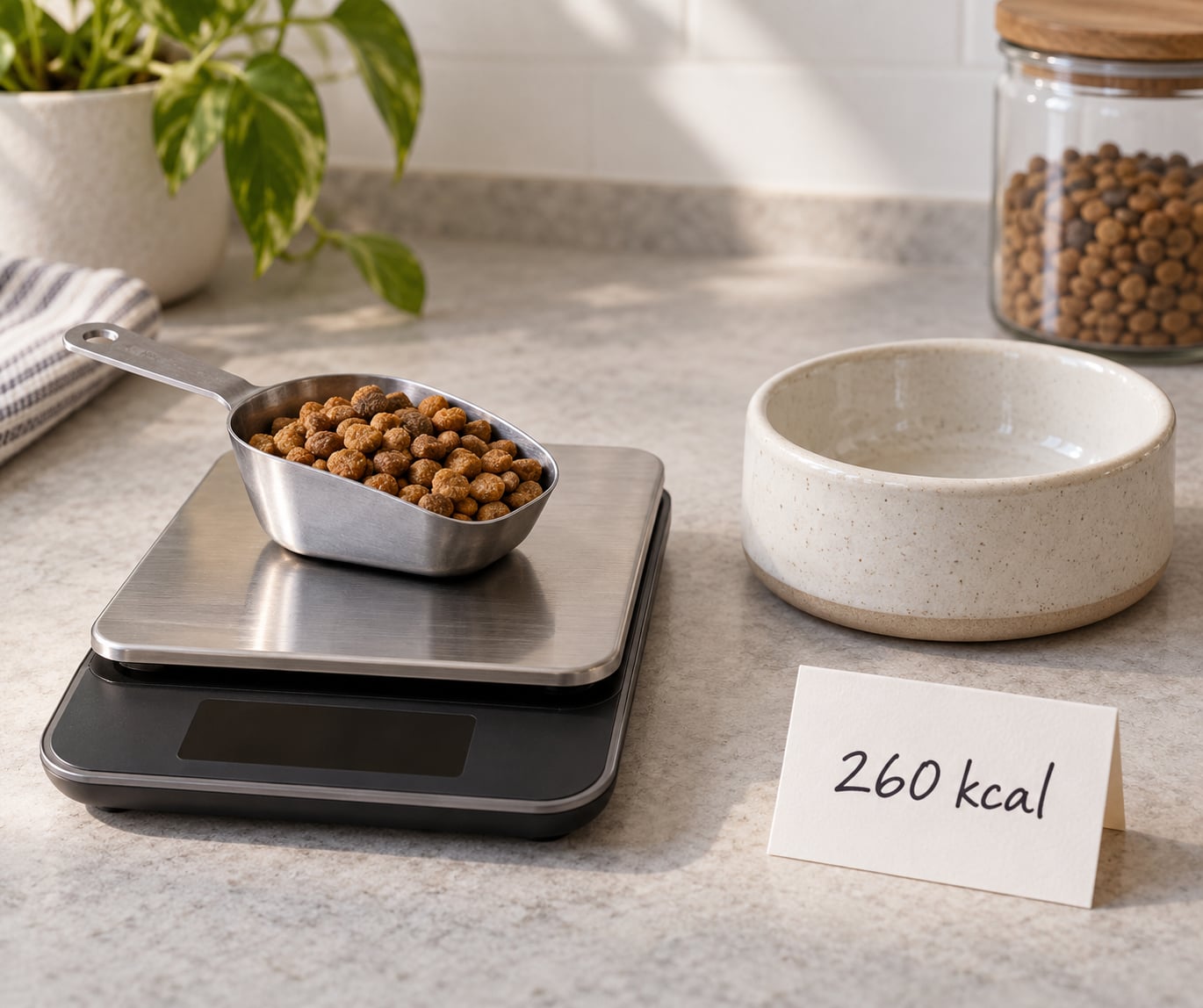
How much to feed a cat per day by weight comes down to one number: daily calories. An indoor adult cat weighing 4.5 kg (10 lb) usually needs about 260 kcal a day, and that figure scales with weight, life stage and body condition. Divide the calories by your food’s kcal per cup or kcal per gram and you have the portion in grams.
The catch is that the feeding guide printed on the bag is an average for a generic cat. Plenty of owners find the bag number leads to steady weight gain, and starting at about 80% of it, then adjusting by body condition, is what finally works. Cats are individuals, and their energy needs can sit plus or minus 50% around any calculated estimate.
This guide gives you a weight-to-calorie chart, the formula nutritionists actually use, portion math for dry food, wet food and both together, and a way to check the result by feel rather than by scale alone. Talk to your own veterinarian before starting, especially if your cat is a kitten, pregnant, overweight or has kidney, urinary or dental problems.
Table of Contents
- How Much to Feed a Cat per Day by Weight: Quick Reference
- What Do Cats Need to Eat Each Day?
- How to Calculate a Cat’s Daily Food Amount
- How to Calculate a Cat’s Daily Food Amount step by step
- How Much Should Kittens, Adult Cats, and Senior Cats Eat?
- Does Dry Food, Wet Food, or Treats Change the Answer?
- How to Tell If Your Cat Is Getting the Right Amount
- Frequently Asked Questions
- Is 1/2 cup of food a day enough for a cat?
- How much should I feed my 8 pound cat a day?
- Should I leave dry food out for my cat overnight?
- Is 3 ounces of wet food a day enough for a cat?
- How much dry and wet food should a cat eat per day?
- How many calories does a 20 lb cat need a day?
- Bottom Line
How Much to Feed a Cat per Day by Weight: Quick Reference
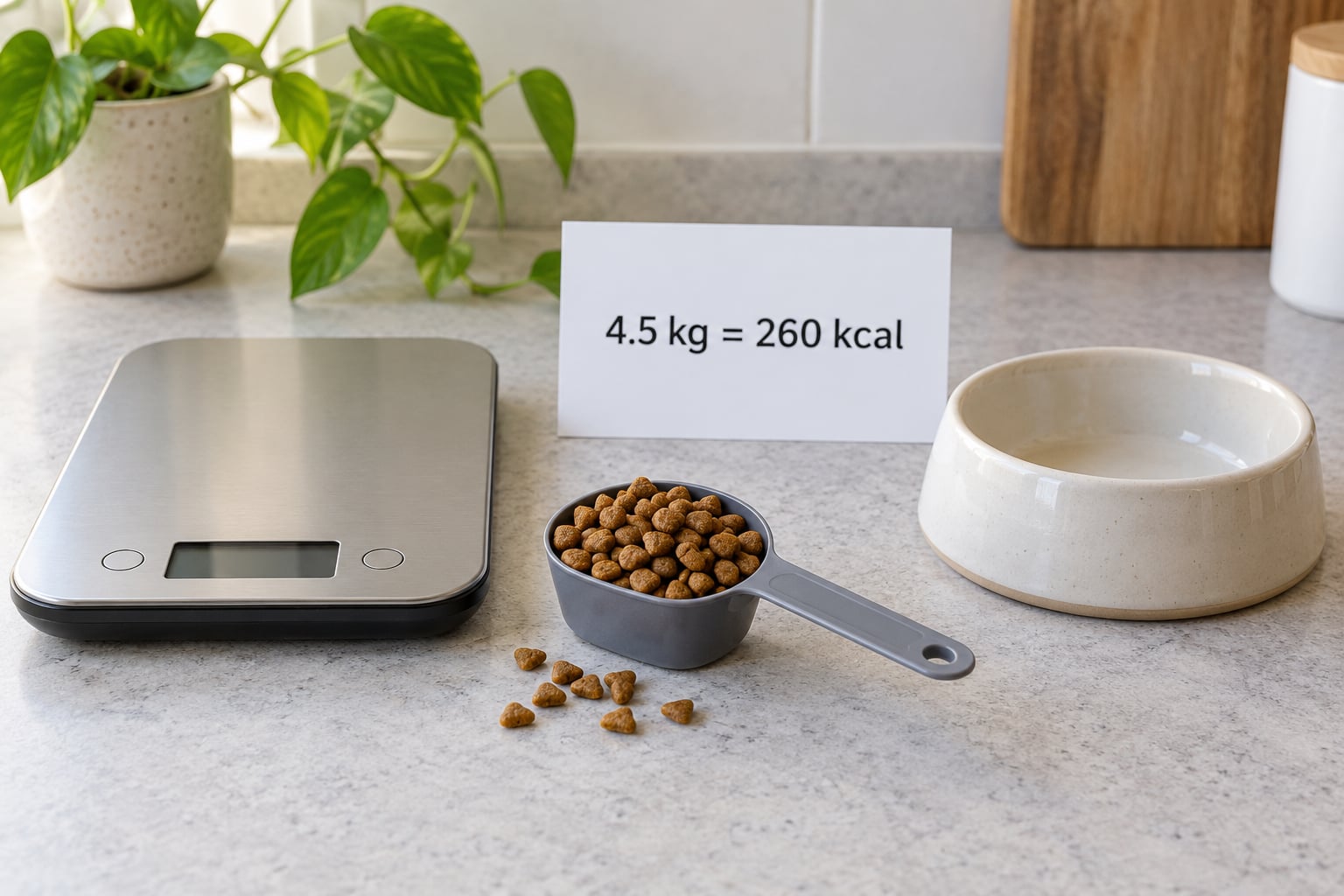
Here is the short answer most people need: feed your cat about 200 to 250 kcal a day if it weighs 4 kg or so, about 300 kcal at 5.5 to 6 kg, and roughly 440 kcal at 9 kg. The table below converts those calories into dry food grams and wet food cans for neutered adult cats, which are the majority of cats people keep.
| Cat weight (lb / kg) | Resting need (kcal) | Neutered adult 1.2x | Intact adult 1.4x | Weight loss 0.8x | Dry food at 3.6 kcal/g | Wet cans at 100 kcal |
|---|---|---|---|---|---|---|
| 6 lb / 2.7 kg | 148 | 177 | 207 | 118 | 49 g | 1.8 cans |
| 8 lb / 3.6 kg | 183 | 220 | 256 | 146 | 61 g | 2.2 cans |
| 10 lb / 4.5 kg | 216 | 260 | 303 | 173 | 72 g | 2.6 cans |
| 12 lb / 5.4 kg | 248 | 298 | 348 | 198 | 83 g | 3.0 cans |
| 14 lb / 6.4 kg | 282 | 338 | 395 | 226 | 94 g | 3.4 cans |
| 16 lb / 7.3 kg | 311 | 373 | 436 | 249 | 104 g | 3.7 cans |
| 20 lb / 9.1 kg | 367 | 440 | 513 | 293 | 122 g | 4.4 cans |
Two things about that chart matter. The first column of results is the cat’s resting energy requirement, the calories a body burns just staying alive, and the next three columns apply different life-stage or weight-management factors to it. The dry food column assumes a food with 3.6 kcal per gram, which is close to the 3,400 to 3,800 kcal per kg found in most dry cat foods, and the wet column assumes a standard 85 g can at about 100 kcal.
Notice that the kcal per cup on your bag will probably not be 3.6 kcal per gram. A dry food listing 1,450 kcal per cup usually weighs about 400 g per cup, so you would feed around a third to half of a cup a day for a 4.5 kg cat. If your food is denser or lighter than that, do the division with your own numbers.
Treat these as starting points, not targets. Weigh your cat at the start and again in four weeks, and adjust from there. A cat that has gained or lost more than half a kilo over that period needs a different number, and one that is losing muscle on a senior diet needs a different kind of food, not simply fewer calories.
What Do Cats Need to Eat Each Day?
Cats are obligate carnivores, which means they must get certain nutrients from animal tissue and cannot make them from plant sources on their own. Taurine is the one most owners hear about. Cats also need preformed vitamin A rather than beta-carotene, arachidonic acid for fat, and a steady supply of protein.
What they need day to day is simpler than the science behind it: a complete and balanced diet in the right life stage, measured to their energy needs, plus clean water at all times. Complete and balanced is a regulated phrase. Look for the nutritional adequacy statement on the bag or can, which names either the AAFCO feed trial rule or the AAFCO nutrient profile for the life stage, such as growth or adult maintenance.
Wet food, dry food and a mix of both all work if the food is complete and balanced and the calories add up to what the cat needs. There is no single format that suits every cat, and this is worth saying plainly because owners often treat the question as a moral one. Dry food is calorie-dense, cheap per calorie and easy to measure, which makes it useful for weight management and multi-cat households. Wet food carries roughly 75% water, which supports urinary health, and many cats eat more of it because of the aroma and texture.
Water is the part people skip. Cats evolved in dry, hot conditions and drink by choice rather than by thirst, so wet food contributes meaningfully to daily fluid intake while a dry-only cat may need several widely separated water bowls to drink enough. Moving wet food into the diet is a common first step owners make when a cat shows urinary problems, alongside a veterinarian’s advice.
How to Calculate a Cat’s Daily Food Amount
The calculation everyone uses in veterinary nutrition is the resting energy requirement, or RER: 70 multiplied by body weight in kilograms raised to the power of 0.75. The result is a starting number for a cat lying still, and you then multiply it by a factor for life stage or for weight loss to get a realistic daily intake.
The power of 0.75 is not decorative. It reflects the fact that bigger animals have proportionally less surface area to lose heat, so each extra kilo adds fewer calories than the last. That is why a 9 kg cat needs roughly 440 kcal while a 4.5 kg cat needs 260, not 520.
| Situation | Factor | What it means in practice |
|---|---|---|
| Growing kitten | 2.5x | Rapid growth, needs several meals a day |
| Neuter adult, indoor | 1.2x | The most common starting point |
| Intact adult, active | 1.4x | Whole, young, or an outdoor cat |
| Senior, low activity | 1.0x to 1.2x | Watch muscle, not just fat |
| Weight loss plan | 0.8x | Slow, supervised loss with a vet |
| Pregnant or nursing | 1.6x to 2x | Rises sharply in late gestation and lactation |
Neutering is the biggest single change most cats go through. Spaying and neutering reduce metabolic rate, and the same food at the same grams produces more fat after the procedure. Owners often notice weight gain within a few months and wrongly assume the food changed, when the requirement moved instead.
How to Calculate a Cat’s Daily Food Amount step by step
Here is how much to feed a cat per day by weight in practice, using a healthy 4 kg neutered adult as the example. Break it into four steps and repeat them any time the weight or the food changes.
Step 1. Convert pounds to kilograms. A 4 kg cat weighs 8.8 lb. If your cat is listed in pounds, divide by 2.2, because the formula is built on metric weight.
Step 2. Calculate the resting need. Raise 4 to the power of 0.75, which gives about 2.83. Multiply 70 by 2.83 and you land at roughly 198 kcal of resting need.
Step 3. Apply the life-stage factor. For a neutered indoor adult, multiply by 1.2 and you get about 238 kcal, which most people round to a practical 240. If the cat is intact and very active, multiply by 1.4 instead and you get about 277 kcal.
Step 4. Convert calories into food. Read the kcal per cup or kcal per kg from the label and divide. A dry food at 3.6 kcal per gram needs about 66 g a day. A wet food at 0.9 kcal per gram needs about 265 g, which is roughly three 85 g cans. A half-and-half approach, such as two small cans of wet food plus a measured portion of dry, works fine as long as the two halves total the same 240 kcal.
Then subtract the treats. Every treat counts, and if your cat gets 40 kcal of dental chews in a day, the meal portions come down by 40 kcal rather than staying the same. Treats should stay under about 10% of the daily total.
How Much Should Kittens, Adult Cats, and Senior Cats Eat?
Kittens need far more energy per kilo than adults, and they need it in small, frequent meals. A growing kitten uses roughly 2.5 times its resting need, so a 2 kg kitten can need around 240 kcal spread over four or five feedings. Small stomachs are the real constraint, not appetite.
After six months the growth curve flattens and the factor drops toward 1.6 to 2 times resting need. By around twelve months most cats are eating as adults. Switching a kitten to adult food too early throws in more calories than growth requires, and most breeders and vets recommend keeping kitten food until the growth plates close, which in most cats happens near one year.
Adult cats sit at about 1.2 times resting need for a neutered indoor cat and up to 1.4 for an intact or working cat. Portions stay constant here even as the cat ages, which surprises people who expect a fixed number forever.
Senior cats are where weight alone misleads. From roughly ten years on, cats often lose muscle while keeping the same weight, or look heavier because of reduced activity while actually losing lean mass. Holding the same calories protects the muscle; switching to a lower-calorie senior food can push an older cat underweight without fixing anything. A senior-specific food with more protein per calorie usually helps more than cutting the portion.
| Age | Meals per day | Notes |
|---|---|---|
| 8 to 16 weeks | 4 to 5 | Kitten food, free access or set meals both work |
| 4 to 6 months | 3 to 4 | Start measuring portions to prevent adult obesity |
| 6 to 12 months | 3 | Growth slows, calorie factor drops |
| Adult 1 to 10 years | 2 to 3 | Measured meals beat free-feeding for most cats |
| Senior 10 years plus | 2 to 3, smaller | Watch muscle condition and dental comfort |
| Pregnant or nursing | Several, or free access | Plan with a veterinarian, food change late in pregnancy |
Pregnancy and lactation are the two situations where the general table stops being useful. A pregnant cat eats more, especially in the final weeks, and a nursing queen needs enough to produce milk for a litter that can be five or six kittens. Switching food late in pregnancy can upset digestion, so the food change is usually planned with your vet rather than made on your own.
Does Dry Food, Wet Food, or Treats Change the Answer?
Yes, and this is where most confusion lives. The calorie target for a cat does not change because you changed format, but the number of grams does, because calorie density varies by a factor of three or more across foods. A dry food at 3.6 kcal per gram delivers 250 kcal in about 70 g, while a wet food at 0.8 kcal per gram needs 310 g to deliver the same thing.
| Dry food | Wet food | |
|---|---|---|
| Calories per gram | About 3.4 to 3.8 | About 0.7 to 1.1 |
| Water content | About 10% | About 75% |
| Grams for 250 kcal | About 70 g, roughly a third of a cup | About 280 g, roughly three 85 g cans |
| Easiest to measure | Kitchen scale | Can size or a labelled portion |
| Best suited to | Weight management, multi-cat homes | Hydration, urinary health, picky eaters |
| Main drawback | Low water, easy to overfeed | Cost, and many cats graze instead of finishing |
Wet food cans vary a lot more than owners expect. A 100 kcal can and a 60 kcal can look identical on the shelf, so read the label rather than counting cans. Two practical rules help: put the daily amount in one measured container and remove it at the end of the day, and refrigerate anything left over rather than leaving it out. Wet food left in a warm bowl for hours is both unappealing and a food safety problem.
Combination feeding is where most real households land, and a split owners commonly settle on is half wet, half measured dry rather than full portions of both. A 250 kcal adult cat might get two 85 g cans of wet food at 100 kcal each plus 14 g of dry food for the remaining 50 kcal. Adjust the split to what your cat prefers, as long as the total stays on target.
Treats are the quietest source of excess calories. A single commercial treat piece can carry 5 to 15 kcal, and a cat given a handful of them twice a day can add 80 kcal without anyone noticing. Keep the day’s treat calories written down and subtract them from the meal amount, or buy a bag of single-piece treats so the count is obvious.
Food changes need their own plan. Most cats tolerate a switch over seven to ten days: 25% new food for two days, 50% for two days, 75% for two days, then the new food alone. Cats with sensitive stomachs take the full fourteen days, and going faster is the usual reason a diet change ends in vomiting.
Some foods simply have no place in a cat’s bowl. Chocolate, onions, garlic, chives, grapes, raisins, alcohol, caffeine and xylitol are all toxic to cats, and raw dough containing yeast expands in the stomach and can rupture it. This applies to anything a cat might steal from a counter, a bin or an open bag, which is a good reason to keep those items closed rather than relying on the cat’s judgment.
How to Tell If Your Cat Is Getting the Right Amount
Weight on a scale is a useful trend line and a poor snapshot. A cat that is slightly heavy may be carrying fat on top of perfectly good muscle, while an older cat at the same weight may be losing muscle. Body condition scoring catches both cases, and it takes about thirty seconds with your hands.
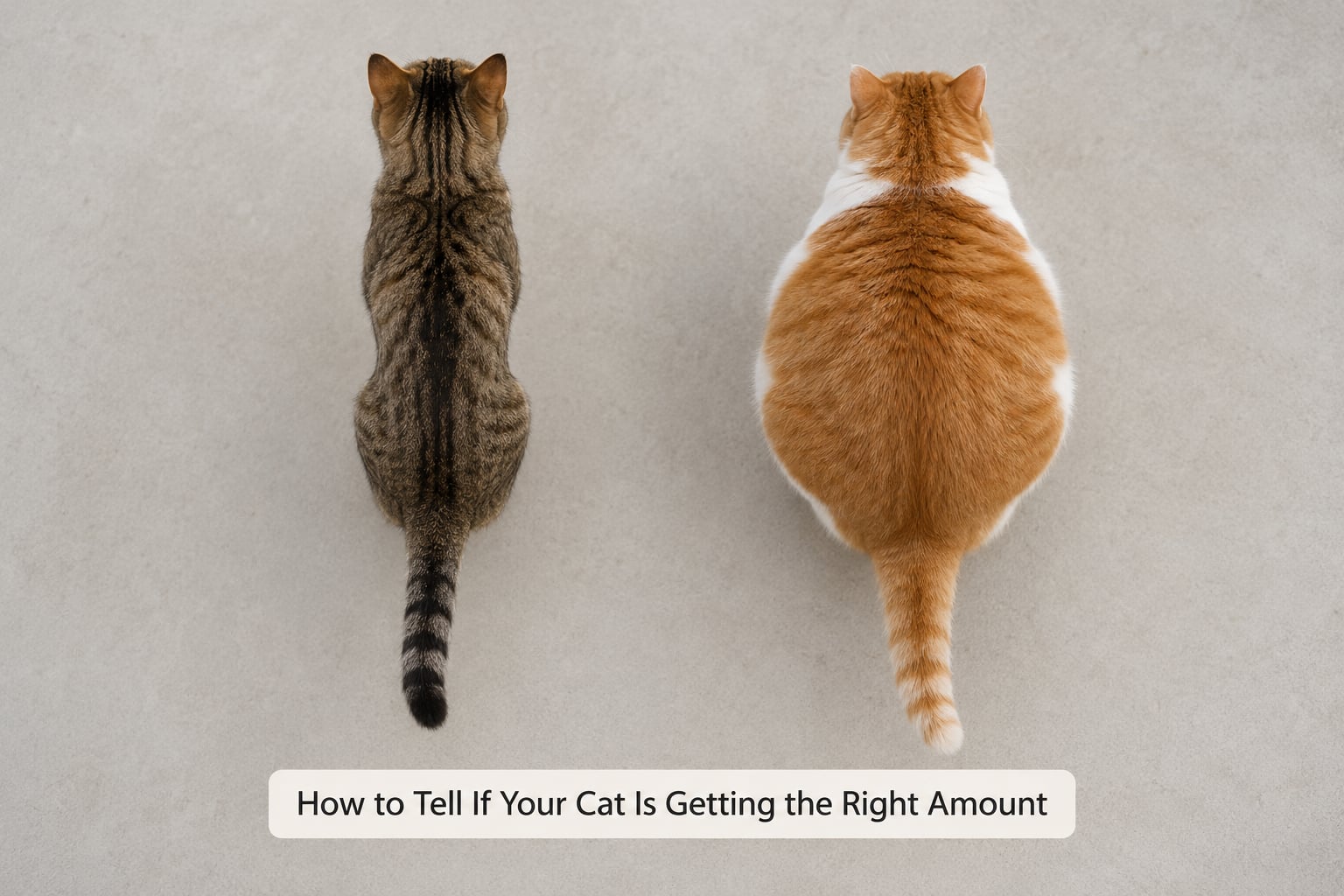
Run your hands along the ribcage from the spine toward the belly, then look at the cat from directly above, then from the side. That combination of ribs, waist and abdominal tuck is the whole test. Cats score from 1 to 9 on the WSAVA body condition scale, with 5 in the middle being ideal.
A body condition score of 5 feels like this: ribs are palpable under a thin layer of fat, you can see a clear waist when you look down from above, and there is a visible abdominal tuck when you look from the side. That is the picture you are aiming for regardless of the number on the scale.
At a 3 to 4 the ribs and spine are prominent, the waist is narrow from above, and the hip bones and shoulder blades stick out. That is a cat that needs more calories, or a vet’s attention. At a 7 to 9 the ribs disappear under fat, there is no waist from above, the abdomen hangs or bulges, and the cat may be unable to jump. Both ends of the scale need a plan rather than a small adjustment.
So how do you adjust? If the body condition score drifts down, raise the daily calories by about 10% and recheck in two weeks. If it drifts up, take 10% off the meal portion while leaving the treat allowance alone, since that is where the excess usually hides. Small changes protect the muscle and the digestive system, and a sudden cut on a cat that already restricts its intake can trigger hepatic lipidosis, a serious and potentially fatal liver condition.
Weight loss for an overweight cat should stay at roughly 0.5% to 1% of body weight per week, which for a 5 kg cat is 25 to 50 g a week. Anything faster than that risks the cat losing muscle and organs along with the fat. Weigh weekly in the same conditions and record the numbers, because the trend line is the only thing that tells you whether the plan works.
Some signals mean stop adjusting at home and book an appointment. Rapid weight loss, vomiting, a change in drinking or urination, refusing food for more than a day, dropping food from the mouth, hiding, or a cat that has gone off food entirely can all point to kidney disease, diabetes, dental pain, hyperthyroidism or hepatic lipidosis. Cats hide illness well, so a cat that eats noticeably less than usual is telling you something even if it looks fine.
Multi-cat households need a bit more structure than the calculation itself. Microchip feeders or feeding collars in separate rooms are the reliable way to give one cat a measured portion without another one clearing the bowl, and feeding the hungriest cat first stops the fast eater from finishing the slower cat’s meal. Wet food left out for grazing should be limited to a short window each day rather than all night.
Frequently Asked Questions
Is 1/2 cup of food a day enough for a cat?
Half a cup of dry food is roughly 200 g and lands near 720 kcal, which is enough for a small adult cat but well over what most 4 to 5 kg neutered cats need. Typical dry foods sit around 350 to 400 g per cup, so check yours. A 4.5 kg neutered adult usually needs about 260 kcal, closer to a third of a cup a day.
How much should I feed my 8 pound cat a day?
An 8 lb neutered adult cat needs about 220 kcal a day. That works out to roughly 61 g of dry food at 3.6 kcal per gram, or a little over half a cup, or around two 85 g cans of wet food. If the cat is intact and very active, aim nearer 256 kcal. Check body condition every few weeks and adjust from there.
Should I leave dry food out for my cat overnight?
You can, but most cats do better with measured meals. Free-feeding tends to push heavier cats over their energy needs because many cats eat more than they need when food is always there. Leaving food out also invites insects and makes it harder to notice that your cat has stopped eating. Two or three measured meals, with a small measured portion available overnight, is a good middle ground.
Is 3 ounces of wet food a day enough for a cat?
Three ounces is about 85 g, and a typical can of that size carries 70 to 100 kcal. That covers a small or senior cat but not a healthy 4.5 kg adult, which needs around 260 kcal. Kittens and pregnant or nursing cats need much more. Always read the calories per can, because the same size can range widely between brands.
How much dry and wet food should a cat eat per day?
Split the calorie target however you like. For a 250 kcal adult, two 85 g cans of wet food at 100 kcal each plus about 14 g of dry food for the remaining 50 kcal is a common split. Measure the dry portion with a kitchen scale rather than a cup, and count the calories in both parts before adding treats.
How many calories does a 20 lb cat need a day?
A 20 lb cat weighing 9.1 kg has a resting need near 367 kcal. A neutered adult at the 1.2 factor needs about 440 kcal a day, and an intact active cat at 1.4 needs around 513 kcal. In dry food terms that is roughly 122 g. A cat that size is usually carrying extra fat, so work with your vet on whether the target should be lower.
Bottom Line
Start with the calorie figure for your cat’s weight and life stage, divide it by the calories in your food, and measure the result every day. Then put your hands on the cat twice a month: ribs easy to feel, waist visible from above, a small tuck from the side. Adjust by about 10% at a time, keep treats under a tenth of the total, and take any sudden change in weight or appetite straight to a veterinarian.