How to care for a cat after spay surgery comes down to three jobs: keep her calm, restrict her movement, and check the belly incision twice a day for the next 10 to 14 days. Most cats heal without any trouble at all, and the complications that do happen — an infected incision, a popped stitch, a wound that reopens — are painful, expensive to fix, and almost entirely preventable with steady aftercare. This guide walks through the first two weeks, phase by phase, so you know what normal looks like and what means call the clinic tonight.
A note before we start: this is general recovery information, not a treatment plan for your cat. Your veterinarian’s discharge sheet always wins. If their instructions differ from anything here, follow theirs and call the clinic with questions.
Table of Contents
- What You Need
- Step-by-Step: How to Care for a Cat After Spay Surgery
- 1. Prepare a Quiet Recovery Space
- 2. Follow the Veterinary Instructions and Check the Incision
- 3. Limit Activity and Prevent Jumping
- 4. Support Eating, Drinking, and Medication
- 5. Day-by-Day Recovery: What to Do Each Phase
- 6. Know When to Contact the Veterinarian
- Common Mistakes
- Frequently Asked Questions
- How long does a cat need to rest after being spayed?
- Can I remove the cone after my cat is spayed?
- How long should a cat stay indoors after spay surgery?
- Can I bathe my cat after a spay?
- Why is my cat not eating after being spayed?
- Conclusion
What You Need
Most of the work happens in the twelve hours before you pick her up. Get these things sorted in advance and the first night is far calmer.
- A secure carrier for the trip home and for short outings later. Line the bottom with a towel you do not mind losing.
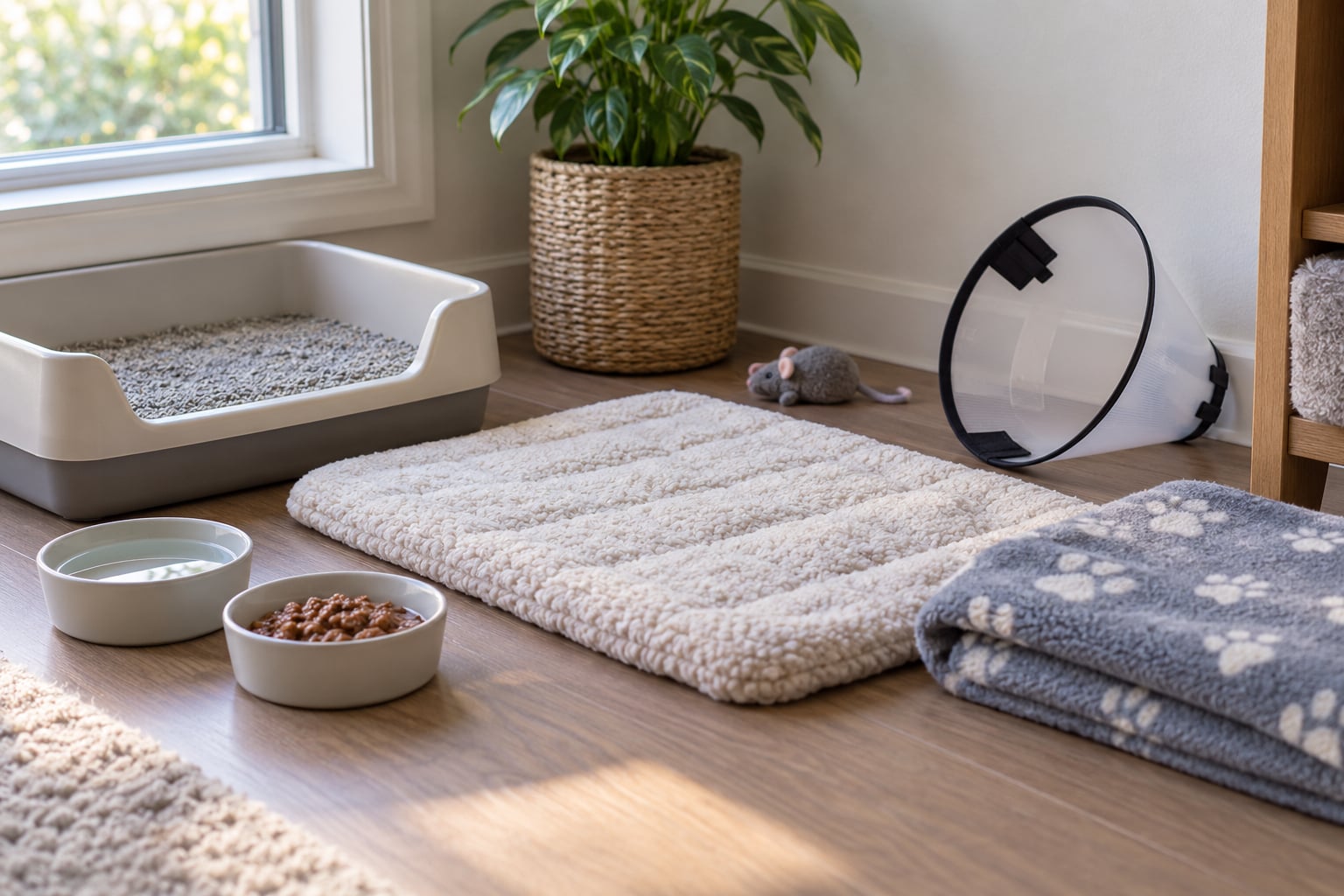
- One small, quiet room with no stairs, no other pets, and no windows that open. A bathroom or spare bedroom works well.
- A low-sided litter box with dust-free litter. Clumping litter or shredded paper is kinder than pellets or scented litter while the incision heals.
- Food and water at floor level. No raised bowls, no jumping required to eat.
- The cone or surgical recovery suit your clinic gave you, plus a spare if she manages to escape it.
- Soft, washable bedding and a couple of quiet toys that stay on the ground.
- Prescribed medications with the dosing written down. Ask the clinic to label the bottles if the handwriting is not obvious.
- The clinic’s phone number, including the after-hours or emergency line, saved in your phone.
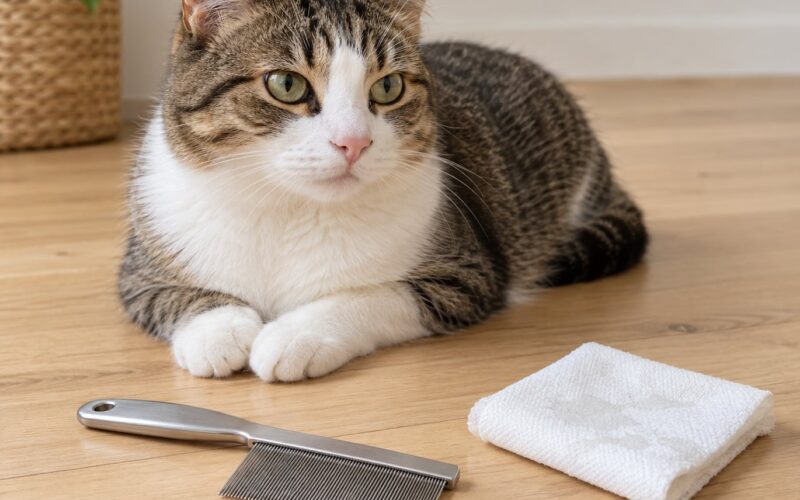
- Your phone camera, so you can photograph the incision twice a day and compare it to yesterday.
Grab the discharge paperwork too. Ask before you leave whether the sutures are dissolvable or need removing, whether a recheck visit is scheduled, and what pain medication she is on.
Step-by-Step: How to Care for a Cat After Spay Surgery
1. Prepare a Quiet Recovery Space
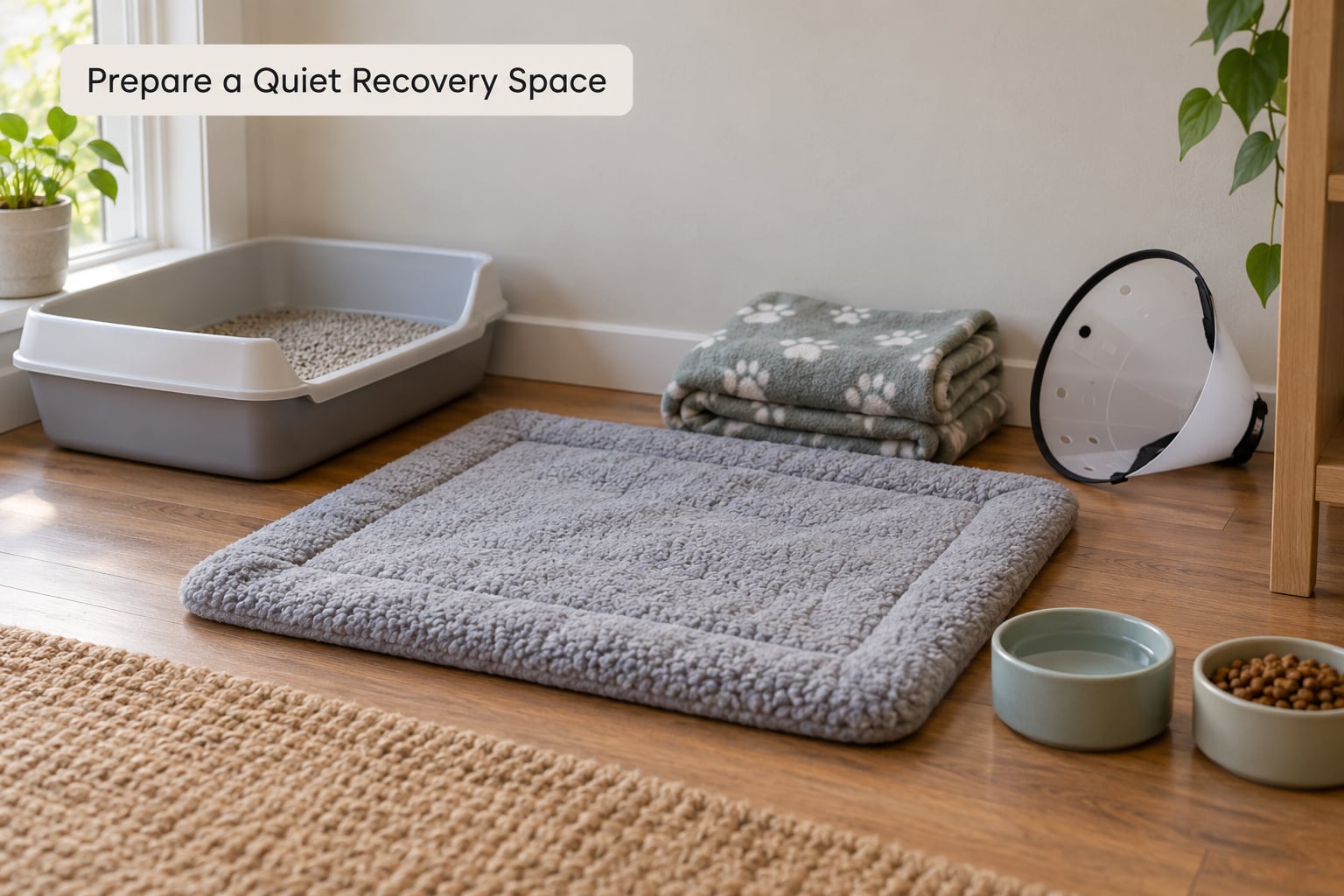
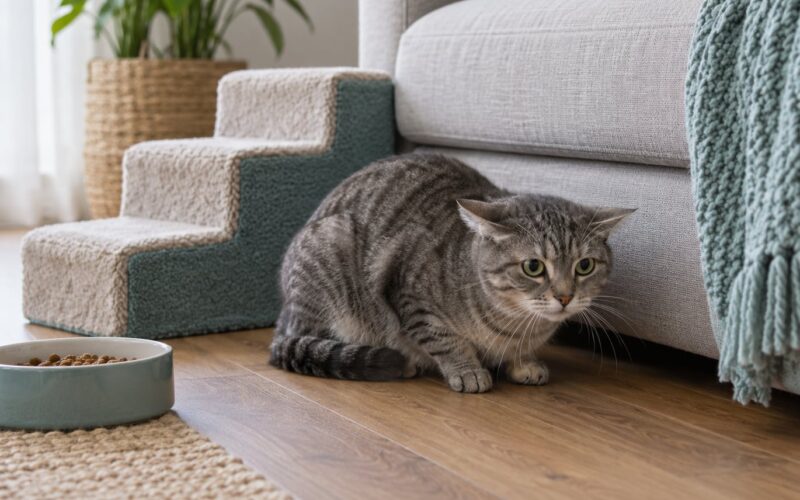
One room is enough, and it should be the least interesting room in the house. Block off cat trees, shelves, windowsills and any route to the stairs with a baby gate or a stack of stable boxes. Nothing in that room should require her to jump, and nothing should reward her for trying.
In a multi-cat household, this part matters more than most people expect. Companions groom wounds instinctively, and an overweight cat bouncing off a recovering one does more damage than the surgery itself. Feed the recovering cat separately, ideally in a room the others cannot enter, and put the other cats’ food and bowls somewhere else entirely for the first week.
For a high-energy kitten, confinement in one room is genuinely hard work. A few hours of carrier time each day with a lick mat or a folded towel helps burn off restlessness without any impact on the incision. Puzzle feeders you place on the floor are better than anything requiring a leap.
2. Follow the Veterinary Instructions and Check the Incision
Your vet’s discharge sheet outranks anything in this article, including numbers you read on a forum at midnight. Read it once when you get home and keep it on the fridge.
Check the incision twice a day — morning and evening — by parting the fur gently with your fingers. Look at it, take a photo, and compare it with the one from twelve hours earlier. Changes over hours matter far more than what a single look tells you.
| What you see | Usually normal | Call the clinic |
|---|---|---|
| Redness | A thin pink line along the incision edge in the first few days | Redness spreading into the surrounding skin, or darkening red |
| Swelling | A little puffiness that does not increase day to day | Swelling that grows, feels hot to the touch, or is clearly firmer each day |
| Discharge | Clear or pinkish weeping early on, a small amount of dried blood, a dry scab at day 10 to 14 | Thick, yellow, green or bloody discharge that keeps coming back |
| Smell | No unusual odor | A foul smell from the incision or the whole room |
| The wound itself | Closed, dry, slightly scabbed, holding firm when you touch nearby skin gently | A gap, gaping edges, or a lump under the skin that enlarges or feels hard and hot |
| Behavior | Sleeping a lot, a little quieter than usual for two or three days | Hiding constantly, crying, or not responding to the pain medication |
A small hard spot under the incision is often scar tissue or a suture knot feeling firm under the skin. It is not a reason to panic if it is not growing and the skin over it is normal. A spot that gets bigger, hotter or more tender is a different story.
Owners ask about stitches constantly, so here is the short version. Dissolvable sutures break down on their own over roughly two to four weeks and need no appointment. Non-dissolvable sutures, staples or surgical glue are different: staples need removing, and external stitches need a quick appointment, usually around day 10 to 14. If you are not certain which she has, part the fur and look, or just ask the clinic.
3. Limit Activity and Prevent Jumping
This is the part owners cut short, and it is the part that causes most of the problems. Restriction runs 10 to 14 days, based on what your veterinarian tells you. No jumping onto counters, cat trees, sofas or windowsills. No running, no climbing, no stairs, no wrestling with another cat, no chasing toys across the room.
You will hear two different numbers in different places: 7 days from some clinic sheets and 10 to 14 days from others. Both exist because incision size, the cat’s age and the vet’s own comfort level differ. The safe read is that visible healing is not the same as internal healing, so hold the full window your own vet gave you. If she seems perfectly fine by day 2, that is anesthesia wearing off, not a healed belly.
What actually happens if she jumps? The most common outcome is nothing. The next most common is a swollen, angry incision that takes longer to settle. After that comes a popped suture, and worst case the wound reopens — dehiscence — which means infection, a re-stitch and sometimes a second surgery under anesthesia. That is the whole argument for two boring weeks.
Supervision has to fit real life. Most owners say a carrier is the only thing that reliably works for a determined kitten. Short periods in the carrier with treats, rather than a whole day shut in a crate, give her a break without giving her the run of the house.
4. Support Eating, Drinking, and Medication
Expect grogginess, wobbliness, nausea and vocal complaining for the first 24 to 48 hours. Offer water as soon as she is home, then start with small, bland meals. Owners report appetite returning anywhere between a day and two days, so a quiet stomach on surgery night is common and usually not a problem.
Feed her the food she already knows, in small portions. Going straight back to a rich or novel diet after anesthesia invites vomiting. And this is a good moment to think about portions generally: a spayed cat’s metabolism drops, and weight gain is common in the following months. Starting sensible portions now makes that far easier than fighting it later. Switch back to her normal diet as her appetite returns, and ask your vet about calorie needs once she is fully healed.
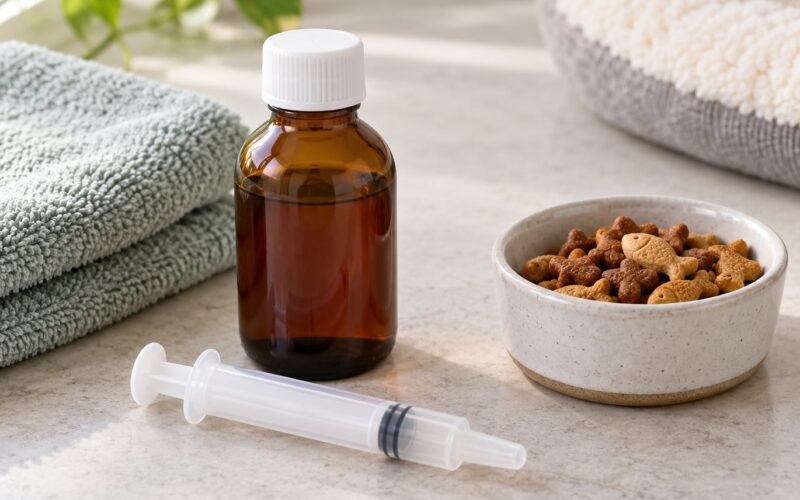
Give pain relief and antibiotics exactly as prescribed, on the schedule written on the label. Clinics commonly use feline-appropriate medications such as meloxicam, Onsior or gabapentin, and the dose is calculated for your cat’s weight. Never work out a dose yourself, and never give acetaminophen, ibuprofen, aspirin or any human painkiller. Acetaminophen in particular is toxic to cats and can destroy red blood cells and liver tissue in a single dose.
Keep the incision dry. No baths, no swimming, no grooming that pulls at the fur around the wound. If she is long-haired, the clinic can clip the area so nothing catches in the sutures. If she has a medical reason that requires bathing sooner, ask the clinic first.
5. Day-by-Day Recovery: What to Do Each Phase
| Days | What is happening | What you do |
|---|---|---|
| Day 1 | Anesthesia wearing off; groggy, wobbly, possibly nauseous and vocal | Stay home. Small amounts of food, water available, quiet room, check the incision twice. No stairs or climbing. |
| Days 2-3 | Appetite returning; cat feels better and wants to move | Continue confinement. Short carrier sessions, floor-level play only. Start logging incision photos. |
| Days 4-7 | Peak risk of boredom and of the cat testing her limits | Cone stays on. Still no jumping or stairs. Twice-daily incision checks. Adjust portions if she is eating enthusiastically. |
| Days 8-10 | Incision tightening; energy climbing back up | Only widen her space if your vet agrees. Some stitches come out around day 10 to 14. |
| Days 11-14 | Surface healing nearly complete, stitches due for removal if non-dissolvable | Attended recheck if scheduled. Cone comes off only when the site is fully closed and your vet agrees, not because she seems annoyed by it. |
On the cone question, most clinics say a minimum of 7 to 10 days and up to 14 if the incision was larger. Cats hate the cone, and many owners take it off the moment the cat seems uncomfortable. That is how licking turns into a reopened wound. If she is acting withdrawn, that is often the cone, not a complication — but check with your clinic and ask about a soft collar or a surgical recovery suit as a more tolerated alternative.
6. Know When to Contact the Veterinarian
Call the clinic the same day if she refuses food for more than 24 to 48 hours, vomits repeatedly, will not urinate or strains in the litter box, seems painful or does not settle after her pain medication, or if the incision is increasingly red, hot, swollen, wet or badly scented.
Go to an emergency vet immediately, without waiting for a call back, if she has trouble breathing, collapses, cannot keep her head up, bleeds actively from the incision, has a suddenly gaping or open wound, or leaks fluid from the wound when you press gently around it. Cats hide pain badly, so a cat who has gone quiet and stays hidden is reason to phone, even when the incision looks fine.
Common Mistakes
- Taking the cone off too early. If she licks even for a few minutes, saliva softens the sutures and the skin can reopen. Keep it on for the full period your vet gave you.
- Letting her run and jump because she seems fine. Feeling good and healing internally are not the same thing.
- Giving human pain medicines. Acetaminophen, ibuprofen and aspirin can be fatal to cats.
- Bathing the incision or wiping it with antiseptic. Clean means dry and undisturbed. Antibacterial wipes can irritate fresh sutures.
- Assuming every spay recovery follows the same schedule. Kitten size, incision length and individual healing all change the timeline.
- Leaving her alone too early. If you cannot supervise her, use the carrier rather than the whole house.
- Using catnip or a sedative to keep her calm. Neither is reliable and both complicate what your vet sees when she is groggy.
Last reviewed for accuracy in October 2026. If anything about your cat’s recovery does not match this guide, your own veterinarian is the right call, not a forum thread.
Frequently Asked Questions
How long does a cat need to rest after being spayed?
Most cats need 10 to 14 days of restricted activity after a spay. That means no jumping, running, stairs or climbing during the whole window, not just until she seems back to normal. Interior tissue continues healing after the surface looks closed, so a cat that feels fine on day 3 is not ready for the cat tree. Follow the timeline your own veterinarian gives you, since incision size and the cat’s age change the schedule.
Can I remove the cone after my cat is spayed?
Not before your veterinarian says so. Most clinics ask for a minimum of 7 to 10 days and up to 14 when the incision was larger. A few minutes of licking softens the sutures and the skin can reopen, which means a recheck or a re-stitch. If the hard plastic collar is causing real distress, ask your clinic about a soft collar or a surgical recovery suit rather than removing it on your own.
How long should a cat stay indoors after spay surgery?
Keep her indoors for the entire 10 to 14 day recovery window and ideally longer if your veterinarian recommends it. Outdoor access adds jumping, climbing and encounters with other cats, all of which stress a healing belly incision. If you need to let her out, use the carrier for short periods in a safe spot rather than opening the door, and bring her straight back in.
Can I bathe my cat after a spay?
No baths until the incision is fully closed and your veterinarian approves it, usually at least 10 to 14 days. Water, shampoo and vigorous toweling can soften sutures, pull the incision open and introduce infection. Keep the area dry instead, and if your cat is long-haired ask the clinic to clip the fur around the wound so it does not mat into the sutures.
Why is my cat not eating after being spayed?
Nausea from the anesthetic, pain and stress all put an appetite off for the first day or two. Offer water as soon as she is home, then small portions of the bland food she already knows, rather than a rich meal. If she has eaten almost nothing for more than 24 to 48 hours, keeps vomiting, or seems to be in pain, call your veterinarian rather than waiting it out.
Conclusion
Start with the discharge sheet, because your veterinarian’s instructions are the ones that matter. Set up one quiet room before she comes home, keep the cone on for the full window you were given, restrict jumping and climbing for 10 to 14 days, and look at that incision twice a day while taking a photo each time so change is easy to spot.
Most of the next two weeks is quiet housekeeping: small meals, water always available, medication on schedule, litter box close by. If you see spreading redness, growing swelling, foul discharge, a hard hot lump, an opening wound, or a cat that stops eating, call the clinic early. Catching a small problem on day 3 is far easier than catching it on day 10.