Feline leukemia (FeLV) and FIV are two different retroviruses that weaken a cat’s immune system, and confusing them is the single most common source of worry for cat owners. FeLV spreads through ordinary contact like grooming, shared bowls and litter boxes, while FIV spreads mainly through deep bite wounds. Neither virus infects people, and a positive result is not a death sentence. Here is what feline leukemia and FIV really mean for the cats in your home, updated for 2026.
I’ve watched owners panic over a shelter test result, then find out their cat had a vaccine-induced antibody instead of infection. The tests exist, the information is good, and most positive cats live ordinary indoor lives. What follows is the guide I wish every new cat owner had before the phone call.
Table of Contents
- Feline Leukemia and FIV: What Is the Difference?
- How Do Feline Leukemia and FIV Spread?
- What Signs Do Infected Cats Develop?
- How Are FeLV and FIV Tested?
- Does Vaccination Protect Cats From Feline Leukemia?
- How Do FeLV and FIV Affect Everyday Care?
- Can FeLV-Positive or FIV-Positive Cats Live Together Safely?
- What Should Owners Do When a Test Result Is Positive?
- Frequently Asked Questions
- Can a FeLV or FIV test be false negative?
- Is it safe to have vaccinated and unvaccinated cats together?
- Can a kitten inherit FeLV or FIV from its mother?
- Can cats with FIV or FeLV live a normal life?
- Is feline leukemia the same as human leukemia?
- Should a cat with a positive FeLV or FIV result be euthanized?
- Key Takeaways for Cat Owners
Feline Leukemia and FIV: What Is the Difference?
They are separate viruses with different habits, and treating them as one disease leads to bad decisions. FeLV is a gamma-retrovirus that infects bone marrow and can trigger cancers. FIV is a lentivirus, a close but distinct relative of human HIV, that slowly wears down immune function without usually causing cancer.
Neither virus crosses into humans. The concern people sometimes have about feline leukemia and FIV being contagious to people is unfounded; you cannot catch either from a cat, and casual contact with one is safe.
| Point of difference | Feline leukemia (FeLV) | FIV |
|---|---|---|
| Virus family | Gamma-retrovirus | Lentivirus |
| Main route of spread | Saliva, grooming, shared bowls and litter boxes, bite wounds, mother to kitten | Deep bite wounds mainly; rarely through mother to kitten |
| Typical clinical effect | Immune suppression, anemia, lymphoma, infection | Gradual immune decline, chronic gum inflammation, recurring infection |
| Typical outlook | Wide range, from cleared infection to progressive disease | Often many healthy years with indoor care |
| Vaccine available | Yes, reduces risk but does not prevent all infection | No |
| Risk to other indoor cats | Low if vaccinated, kept indoors and not sharing bite-prone play | Very low if cats do not fight |
The practical takeaway: FeLV asks “is my cat exposed to saliva?” and FIV asks “do my cats bite each other?” Different questions, different fixes.
How Do Feline Leukemia and FIV Spread?
FeLV transmission is everyday contact. The virus lives in saliva, so grooming, eating and drinking from shared dishes, and sharing litter boxes all put a susceptible cat in contact with enough virus to become infected. Outdoor access raises the odds because an infected neighborhood cat can bite your cat, and queens pass the virus to kittens in utero or through milk.
FIV transmission is mostly bite to bite, which is why it clusters in cats that fight over territory or mates. Male outdoor cats are the group most often affected. Mother to kitten transmission happens but is less common than with FeLV.
What does not spread either virus: petting, sitting together, grooming between compatible cats, sharing a bed, or eating from the same bowl for FIV. Casual contact is not a typical route. The exception is FeLV, where shared bowls and litter boxes genuinely do matter, so separate resources are the easy fix.
What Signs Do Infected Cats Develop?
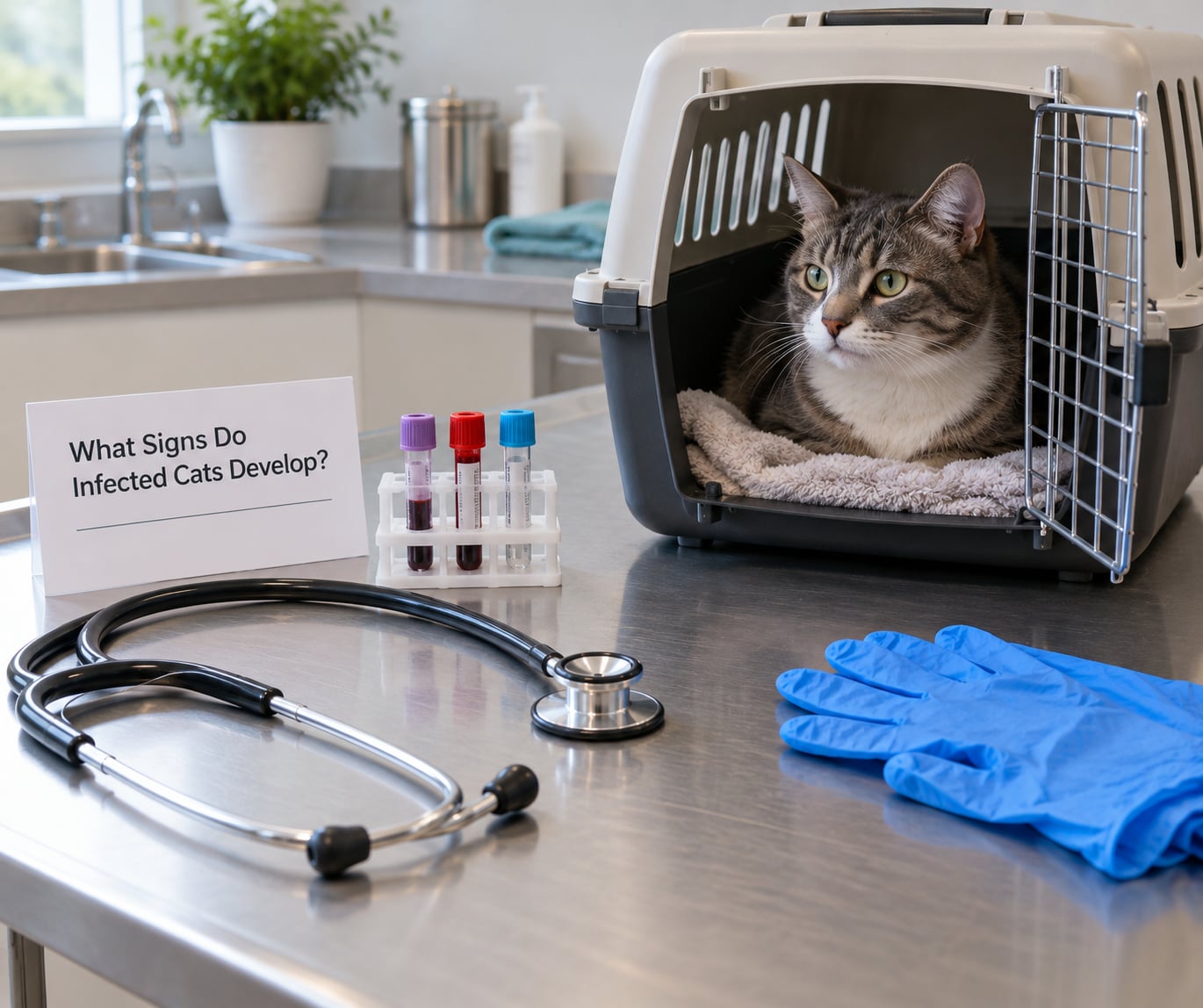
Some cats never look sick at all, which is exactly why testing beats guessing. When signs do appear, they tend to build slowly and look like many other illnesses.
Early changes owners notice most often:
- Appetite that drops off, or eating less than usual
- Weight loss and a dull, rough coat
- Low-energy spells that do not improve with rest
- Gums that look pale, or repeated fever
- Sneezing, watery eyes, or discharge that keeps coming back
Changes that need a veterinary appointment quickly:
- Swollen lymph nodes in the jaw, legs or rear
- Inflamed gums and mouth ulcers that keep recurring, known as stomatitis
- Ongoing diarrhea or weight loss that does not respond to a diet change
- Lethargy that comes and goes for weeks
- Trouble eating, which in cats is always urgent
None of these signs can tell you which virus, or whether a virus is involved at all. A veterinarian decides that with blood tests and an exam.
How Are FeLV and FIV Tested?
FeLV and FIV are detected with different tests, and neither is diagnosed on a single snap judgment. This is the practical testing sequence I would ask a clinic about.
- Ask for both tests at intake. Many clinics run a combined FeLV/FIV screening test on a drop of blood, which detects virus antigen or antibodies in about 15 minutes.
- Confirm any positive FeLV result. A second test, often an indirect fluorescent antibody (IFA) test or a PCR test that looks for viral genetic material, separates true infection from a false positive or vaccine-related reaction.
- Test every new cat separately. A kitten or a cat from a multi-cat shelter can test negative while incubating the virus.
- Retest kittens after maternal antibodies fade. Most vets repeat the test at 12 to 16 weeks, because antibodies passed in the mother’s milk can hide a young cat’s infection before that point.
- Re-test after any known exposure. A bite wound or a shared outdoor run calls for a follow-up test on the timeline your vet sets, even if the first result was negative.
- Add routine bloodwork. Positive cats get periodic complete blood counts and chemistry panels to catch anemia and organ changes early.
Terms worth having straight: an ELISA test screens for virus particles or antibodies, an IFA test confirms FeLV infection, and a PCR test detects provirus, the virus’s genetic material copied into the cat’s cells. Viremia simply means virus is circulating in the blood, and it is what turns a regressive infection progressive.
Does Vaccination Protect Cats From Feline Leukemia?
An FeLV vaccine reduces the risk of infection, and the commonly used killed vaccines are considered to prevent infection in roughly 90 percent of vaccinated cats under normal conditions. It is not a shield: an unvaccinated or incompletely vaccinated cat can still become infected, and vaccination never changes the need for testing.
The series usually starts after eight weeks of age, given twice two to four weeks apart, then boosted a year later. Your vet will weigh it against exposure risk, and for a strictly indoor cat with no new arrivals, some clinics treat it as optional. For a cat with outdoor access, a new kitten in the home, or boarding and boarding-style group housing, most recommend it.
There is no FIV vaccine. One existed in the 1990s and was withdrawn, so protection against FIV comes entirely from avoiding bites and separating fighting cats. That is a common point of confusion: owners assume a positive cat can be vaccinated into safety, and it cannot.
How Do FeLV and FIV Affect Everyday Care?
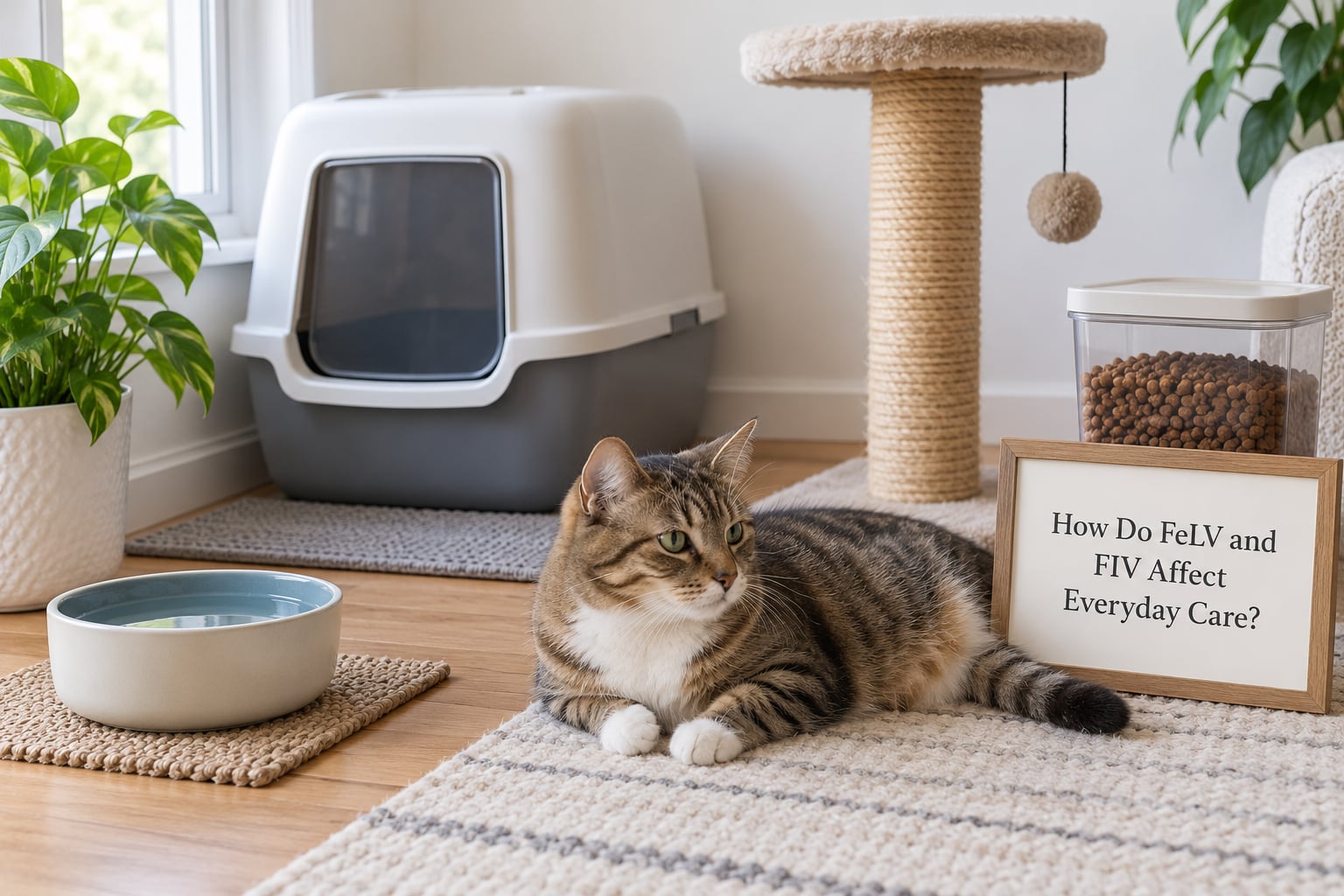
A positive cat needs ordinary cat care done consistently and well, with more frequent check-ins. Cats hide illness, so the routine matters more than any single intervention.
- Twice-yearly exams. More than the annual visit most cats get, because immune problems show up early on bloodwork.
- A complete, balanced diet. Wet food helps with hydration, and cats with FIV in particular benefit from moisture. Never feed raw food to a positive cat; bacterial contamination is riskier when immunity is low.
- Dental care as a priority. Recurring gingivitis and stomatitis are among the most common quality-of-life problems in positive cats.
- Year-round parasite prevention on the schedule your vet sets.
- A quiet, stable environment. New animals, moves and renovations trigger flare-ups more often than owners expect.
- Prompt attention to small changes. Skipping meals, hiding more than usual, or a dull coat for a few days deserves a call, not a wait.
Never give a positive cat human medication. There is no human antiretroviral treatment for feline disease, and common pain relievers such as ibuprofen or acetaminophen are dangerous for cats in any circumstance. All medication and supplements come from your veterinarian.
Can FeLV-Positive or FIV-Positive Cats Live Together Safely?
Yes, in many households. Compatible cats, particularly females and cats that grew up together, rarely fight, and peaceful cats living together is not how either virus spreads.
What makes it work:
- A veterinary assessment of every cat’s status before introductions
- FeLV vaccination for any non-infected cat, plus a plan to catch the rare vaccine failure
- Separate food and water bowls, and separate litter boxes when FeLV is in the home
- Separate resting spaces high enough that nobody shares one perch
- Watching closely during introductions and separating at the first sign of stalking or swatting
Owners on adoption forums describe mixed-status households that have worked for years with nothing more than separate bowls and litter stations. The households that struggle are the ones with several outdoor cats, or where one cat has never learned to tolerate a newcomer. In those cases, a separate room and slow reintroductions are the honest answer.
What Should Owners Do When a Test Result Is Positive?
Take a breath and work through a sequence rather than reacting. Owners who call their vet the same day usually get better outcomes than those who wait and hope.
- Request confirmatory testing if the result was a screening test, especially for FeLV.
- Schedule an exam with baseline bloodwork to see whether the cat is currently well.
- Review vaccination and parasite prevention for every cat in the home.
- Test the other cats, and re-test on your vet’s timeline if any exposure happened.
- Set up separate resources if FeLV is involved, and check for tension between cats that was already there.
- Track quality of life with simple notes on eating, play, litter box habits and grooming each week.
Get to a clinic the same day if your cat stops eating, has labored breathing, collapses, or cannot urinate. A blocked urethra in a male cat is an emergency regardless of any virus status.
Frequently Asked Questions
Can a FeLV or FIV test be false negative?
Yes, in early infection, and more often in kittens. A cat exposed in the past few weeks may not have produced detectable antigen or antibodies yet, and a kitten under about four months can be masked by maternal antibodies. A negative result does not fully exclude FeLV when exposure is plausible. Most vets retest after a known exposure, retest kittens at 12 to 16 weeks, and confirm positive screens with an IFA or PCR test before making care decisions.
Is it safe to have vaccinated and unvaccinated cats together?
It is safer than most owners expect, and the FeLV vaccine is designed for exactly this situation. Vaccinated cats that are healthy, indoor, and not bite-prone pose a low risk to one another. The exceptions matter more than the rule: very young kittens, cats with mouth disease, outdoor cats that fight, and any cat with an unknown or unvaccinated status. Test everyone first, vaccinate the non-infected cats, and separate bowls and litter boxes when any cat is FeLV positive.
Can a kitten inherit FeLV or FIV from its mother?
FeLV is transmitted vertically fairly often, either in utero or through the mother’s milk. FIV transmission to kittens is less common but documented. Maternal antibodies also complicate testing, since they can produce a false result in either direction before a kitten is around four months old. That is why litters from a positive queen are tested at intake and again at 12 to 16 weeks, and why breeders or shelters with known positive cats should share that history with you.
Can cats with FIV or FeLV live a normal life?
Most of them do. Indoor-only FIV-positive cats often live into their teens with routine care, because FIV reduces immune function gradually rather than causing rapid decline. FeLV varies far more: a cat with an abortive or regressive infection can live a normal lifespan, while progressive FeLV carries a much poorer outlook, especially in kittens. What matters most is where the cat sits on that spectrum, and that requires confirmatory testing and follow-up bloodwork.
Is feline leukemia the same as human leukemia?
No, despite the name. Feline leukemia is a retroviral infection that can lead to cancers such as lymphoma, but the virus itself is specific to cats and cannot infect people. Human leukemia has several unrelated causes, including genetic changes and certain chemotherapy agents. The similarity is only in the outcome: immune suppression, anemia and cancer. Nothing about living with an FeLV-positive cat puts your family at risk.
Should a cat with a positive FeLV or FIV result be euthanized?
Not automatically, and not based on a single screening test. Most FeLV-positive cats with regressive infections and most FIV-positive cats have years of good quality life ahead of them. Euthanasia becomes a reasonable conversation when quality of life drops persistently, when the cat stops eating or cannot be made comfortable, or when care costs become unsustainable. Bring your vet a record of eating, activity and grooming over recent weeks so the decision is based on the cat in front of you, not on a lab value.
Key Takeaways for Cat Owners
FeLV and FIV are different viruses with different risks, and the actions that matter most are simple.
- Test every new cat for both FeLV and FIV, and confirm positive FeLV screens with an IFA or PCR.
- Repeat kitten tests at 12 to 16 weeks, since maternal antibodies cause misleading early results.
- Keep FeLV vaccination current when your cat’s lifestyle calls for it, and remember no FIV vaccine exists.
- Separate food and litter resources when FeLV is present, and prevent bite injuries between cats.
- Feed complete and balanced food, never raw, and never give a cat human medication.
- Give positive cats twice-yearly exams and a stable, low-stress indoor routine.
- Judge quality of life week to week, not from a single test result.
Most cats carrying either virus are not sick cats waiting to die. They are cats whose owners found out early, kept them indoors, and stayed a step ahead. Talk with your veterinarian about testing now, especially as 2026 goes on.