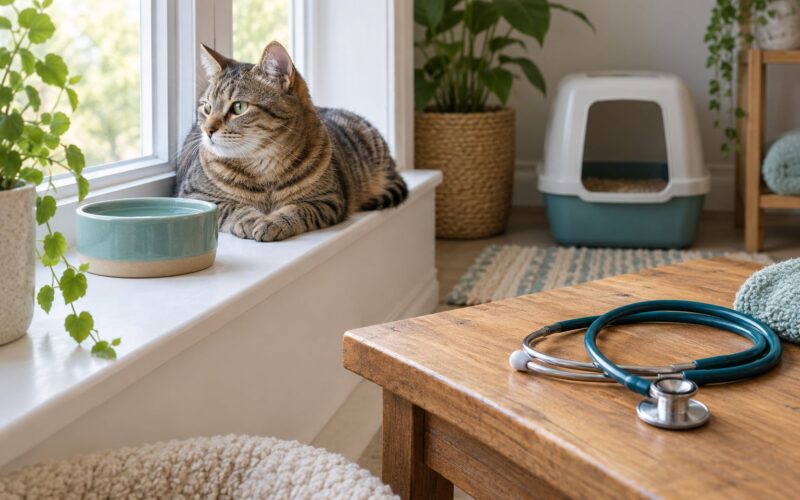
Signs a cat is in pain that owners miss are almost never dramatic. They are small departures from routine: a cat that stops jumping onto the sofa, eats more slowly, grooms less, or picks a new spot to sleep. Cats mask discomfort by instinct, so the reliable signal is a change from that individual cat’s own normal pattern.
If you are reading this because something feels off and you cannot name it, you are not failing at ownership. Cats are built to look fine. Your job is to notice the change and describe it, not to work out the cause.
Table of Contents
- Why Cats Hide Signs of Pain
- Signs a cat is in pain that owners miss in daily routines
- Posture and Movement Changes That Deserve Attention
- Arthritis: the most common hidden cause
- Appetite, Drinking, and Elimination Changes
- Behavioral and Facial Signals Owners May Dismiss
- How to Notice Pain by Comparing Normal and Unusual Behavior
- Pain flare-ups versus a steady decline
- When to Contact a Veterinarian
- Getting a sore cat to the clinic safely
- Frequently Asked Questions
- Can a cat be in pain and still purr?
- How can I tell if my cat is in pain when it does not limp?
- Is my cat just getting older, or is something wrong?
- My cat is hiding but still eating. Is that pain?
- How do veterinarians measure pain in cats?
- How long can a cat go without eating before it is an emergency?
- What to Do First
Why Cats Hide Signs of Pain
Cats are both hunters and hunted, and showing weakness in that middle position is dangerous. A cat that admits it hurts signals to everything larger that it is easier to catch today than next week, and to other animals that it may no longer be worth the company.
The masking is not a character flaw. It is hard-wired, and it does not switch off just because the cat lives indoors with a full food bowl and a locked door. A safe sofa does not convince a cat’s nervous system that injury is no longer a risk.
That behaviour turns ordinary pain into a puzzle. Instead of limping, a cat eats less, sleeps in unfamiliar places, or becomes briefly irritated when lifted. Instead of crying out, it simply stops doing something it used to do every day.
So the rule is simple: one isolated oddity means little, and a repeated change from your cat’s own baseline means a lot. You do not need to identify the condition. You need to decide whether the pattern has shifted, and then let a veterinarian work out why.
Signs a cat is in pain that owners miss in daily routines
The missed signs cluster into a handful of everyday categories:
- Movement, posture and balance, including jumping, stairs and where the cat chooses to rest.
- Facial expression, especially eyes, ears, muzzle and whiskers.
- Appetite, drinking and how long a meal takes.
- Litter box habits, including straining and accidents outside the box.
- Sleep position and the amount of time spent sleeping in daylight.
- Grooming, either suddenly obsessive over one area or plainly neglected.
- Social behaviour, including hiding, withdrawal or new irritability.
- Vocalization, both unusual silence and unusual noise.
Most owners notice one of these in isolation and explain it away. The pattern is what carries the information.
Posture and Movement Changes That Deserve Attention
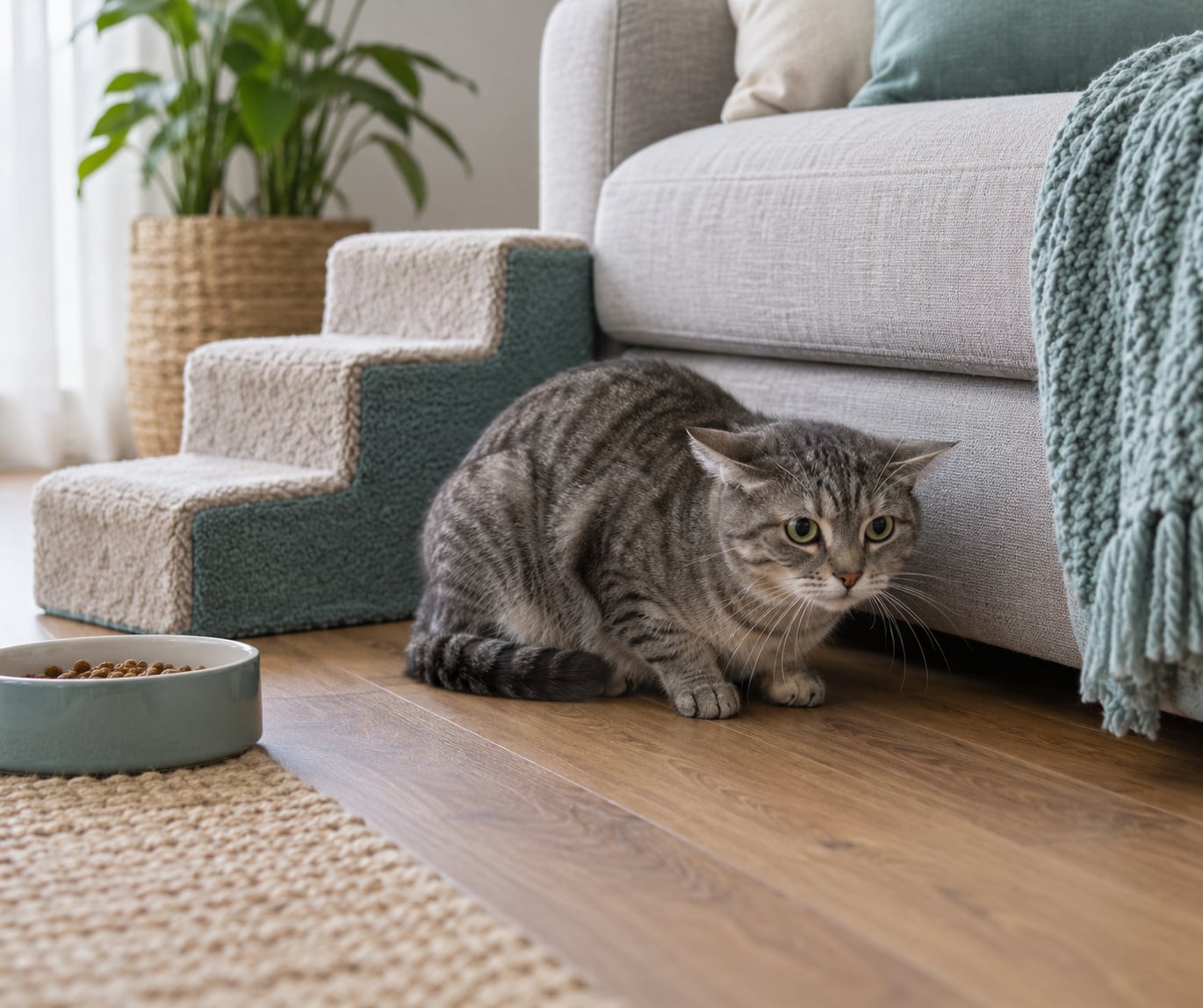
A cat in discomfort often sits with a rounded, hunched back and a tucked-up belly rather than the loose loaf shape most cats settle into. Watch how it stands up from a long sleep: a cat that pauses, braces, and works itself up with its front legs is protecting something.
Jump avoidance is the most useful movement clue owners report. A cat that has always gone from floor to countertop in one motion now crouches, hesitates at the base, and lands heavily. The same applies to stairs, where you may see a cat hop up step by step instead of taking them in sequence.
Watch the width of the steps. Shortened steps, a hind leg held stiffly, or a cat that sits down mid-walk and then continues can all point to joint or back discomfort.
The misleading case is a cat that never limps at all. Back pain, dental pain, kidney disease and urinary problems all produce posture changes without affecting the legs, and a cat that is hurting will usually keep moving because activity is the safer option. It is not stoicism or bravery. It is the same instinct that hides the pain in the first place.
Sudden movement changes deserve same-day attention. A cat that will not put weight on a leg, drags a back leg, or cannot jump at all may have an injury, and something in the spine or an obstruction in the urinary tract is a genuine emergency.
Arthritis: the most common hidden cause
Osteoarthritis is the cause behind a large share of the mobility changes owners notice, and it is frequently missed because it is intermittent. A cat with sore joints may move comfortably for a day or two, stiffen again after a nap, and look fine again in the evening.
Arthritis tends to show up in places rather than in the limbs. Cats jump down from height rather than up, so a cat that has quietly stopped climbing may be protecting its spine and shoulders. Overweight cats carry more load through the same joints, and indoor-only cats are the least likely group to notice a gradual decline because their world got smaller at the same time.
Flare-ups often follow a change in routine: new furniture heights, a move, a fall, or a stretch of cold weather. A cat that suddenly cannot reach a favourite spot after months of easy access is telling you something specific.
Appetite, Drinking, and Elimination Changes
Eating is where owners most reliably catch pain early, because the meal happens every day and it is visible. A cat that eats less may be hiding dental pain, a sore jaw, or nausea, and periodontal disease is a common and treatable source of both. Longer meals, chewing on one side, and food dropped on the floor are the same story told more quietly.
Drinking changes are less obvious. A cat that empties its water bowl several times a day, or drinks straight from a tap it has never cared about before, may be signalling kidney disease, diabetes or thyroid problems. Cats in mild pain also drink more, so increased thirst is not automatically a good sign.
Litter box changes deserve close attention. A cat that strains and produces very little urine, or cries in the box, may have a urinary blockage, which is one of the few true emergencies in this whole topic. Soiling outside the box, or urinating over the edge, is often a signal that using the box has become painful rather than a decision to misbehave.
| What you see | Worth noting | Why it deserves attention | How urgent |
|---|---|---|---|
| Eating less, or taking visibly longer over a meal | Whether one side is favoured, whether food is left behind | Dental pain, mouth ulcers or nausea | Routine to same day if it stops entirely |
| No eating for 24 hours | Any other change alongside it | Cats deteriorate quickly without food | Same day, treat as urgent |
| Drinking noticeably more | Bowl refills, new interest in running water | Kidney, thyroid or blood sugar changes | Book soon, sooner with other signs |
| Straining in the litter box with little or no urine | How long it was straining, any vocalizing | Possible urinary blockage | Emergency, right now |
| Going outside the box or over the edge | Box type, litter type, recent changes | Discomfort associated with elimination | Book an appointment |
| Accidents in the house | Whether it is new or happens with vomiting too | Pain, or illness affecting elimination | Book an appointment |
This table is a sorting aid, not a diagnosis. Only a veterinarian can examine your cat, run bloodwork or take an X-ray and tell you what is actually going on.
Behavioral and Facial Signals Owners May Dismiss
Grooming is the clearest two-way signal. A cat that over-grooms one area is sending pain somewhere it cannot reach directly, sometimes licking a hip, a lower back or the base of the tail, and the spot beneath can be bald, raw or scabbed. A cat that under-grooms simply stops, and the coat goes dull and matted along the back and flanks where the cat could no longer twist comfortably to reach it. Overgrown claws often belong to the same picture, since a cat that will not use a scratching post loses the ability to keep claws short.
Play and social behaviour change too. Cats in pain stop initiating, they become harder to handle, and they move away from a lap they used to seek out. A cat that has always been a lap cat now watches from the doorway. New aggression, especially when you reach for a sore hip or a painful tail base, is a common late signal.
Hiding is where owners are most likely to talk themselves out of seeing the change. In a multi-cat household a withdrawing cat simply looks like a cat being a cat. Then a face gives the game away.
Flattened ears, half-closed or narrowed eyes, a tense or flattened muzzle, whiskers held forward or pinned tight, and a head held below shoulder level or turned away are the five features of the Feline Grimace Scale, a validated tool developed for assessing pain in cats. Scoring the face before and after a vet decides on pain relief is how professionals measure whether a treatment is working, and a familiar baseline photo makes your own comparison far easier.
Vocalization catches people off guard. A cat that has never been vocal suddenly complains, or a cat that normally mutters becomes a yowler. And a cat in pain can purr, sometimes purr more than usual, because purring is a behaviour cats also use to self-soothe. Sound alone proves nothing about comfort.
Chronic pain also reaches past the body. Cats that hurt for months show a lower stress threshold, more anxiety, worse sleep, and a duller attention span. A cat you would describe as becoming unfriendly may be reacting to a sore spine rather than to anything you did.
How to Notice Pain by Comparing Normal and Unusual Behavior
Most owners do not miss these signs because they are careless. They miss them because they have no baseline to compare against, and a decline measured against nothing looks like nothing.
You can build one in about five minutes tonight. Note when your cat eats and how long it takes, where it sleeps, whether it uses the scratching post, how it moves between rooms, and what its normal litter box routine is. It does not have to be precise, just current.
Then make the habit concrete. Film thirty seconds of your cat walking across the room once a month, at the same spot in the same light. Shoulders that rise, a head that stays low, a hind leg that hesitates, or a cat that stops midway and sits are far easier to see on video than in memory, and comparing two clips turns a vague worry into something a veterinarian can act on.
Use the rule of three on anything you are unsure about: a change that persists for days, that gets worse, or that you find yourself explaining away to somebody else, deserves a phone call.
| Change | Comfortable explanation | Reason to call the vet |
|---|---|---|
| Sleeps more and softer | A warm, safe spot, and older cats sleep more | Together with hiding, appetite loss or a hunched posture |
| Jumps less | Careful, and confident on the ground | Hesitates before the jump, or scrambles down instead of leaping |
| Sits on the floor instead of the sofa | Cooler floor, better view of the room | Only ever the floor now, with a rigid back or slow rising |
| Grumpy sometimes | A cat with normal boundaries | Grimacing at being touched where it used to be fine |
| Skips the scratching post | Outgrew it, prefers the carpet | Claws visibly overlong, nails curling toward the pads |
Two home rules are worth stating plainly. Do not try to test for pain by pressing on your cat, since cats hide discomfort well enough to make that unreliable, and it erodes trust. And never give human pain relief such as ibuprofen, paracetamol or aspirin to a cat. These are seriously toxic to cats, and a small tablet can be lethal.
Pain flare-ups versus a steady decline
Arthritis usually arrives in waves, and the waves are the reason it hides so well. After a nap, a cat may be stiff, slow to stand, and reluctant to use its usual spot, then look completely normal by evening. A steady decline looks different: the cat accepts less and less, refuses the same things each day, and never returns to its previous normal.
A change linked to a specific day, a specific movement or a specific piece of furniture is worth naming to your vet. Vague worry is harder to investigate, and a date is worth more than a description.
When to Contact a Veterinarian
Go the same day, or straight to an emergency service, if your cat is straining in the litter box and producing little or no urine. Cat urethral obstruction is a life-threatening condition that builds over hours, and it is not something to watch overnight.
Also treat as urgent: a cat that has eaten nothing for 24 hours, a cat that is breathing fast or with effort at rest, a collapse, repeated vomiting, an inability to stand or to place weight on a leg, an obvious injury, major bleeding, or a sudden and complete change in behaviour. Suspected poisoning from a plant or a substance left within reach also belongs in this group.
Book a regular appointment when the changes are subtle, gradual or intermittent: a reduced appetite that is not a full refusal, a litter box habit that has shifted, less jumping, a scruffier coat, or a cat that is grumpier than usual. Nothing in that list is an emergency, and all of them are worth a professional look.
Before you go, two minutes of preparation changes the appointment. Write down when the change started and what you have seen on which days. Bring the video. Note roughly how much your cat ate and drank, and when the litter box was last used normally. Mention any new food, litter, furniture or household change, and say plainly that you think it is pain, even if the vet has previously called it ageing. Pushing back with specifics is not crying wolf, and owners are right more often than the reputation for fussing suggests.
On cost, the honest answer is that it varies a great deal with what is actually wrong. A straightforward lameness workup with an examination and imaging is different from managing a chronic condition over years. Asking for a staged plan, a written estimate, and clarity on which tests change the treatment is a reasonable thing to request, and many clinics are used to it.
Getting a sore cat to the clinic safely
A cat in pain can be exceptionally hard to catch, and struggling makes the pain worse. Support the whole body with both hands, with one under the chest and one under the hindquarters, and lift rather than pull. Leave the carrier open with bedding inside so it becomes a familiar place, and line it with a towel you can wrap around the cat if needed.
Treats near and around the carrier for the week before the appointment help more than anything else. And a towel-wrapped cat who is genuinely distressed is not being difficult, so ask the clinic for advice in advance if yours reacts badly to travel.
Frequently Asked Questions
Can a cat be in pain and still purr?
Yes, and this trips up a lot of owners. Purring is a behaviour cats also use to comfort themselves, so a cat in pain can purr through it, and some purr more than usual when they are unsettled. Treat purring as one signal rather than proof of comfort. A change that is steady across the day, or a cat that suddenly stops purring, tells you more than the sound itself does.
How can I tell if my cat is in pain when it does not limp?
Look at routine rather than the legs. Stopped jumping, slower meals, a hunched posture at rest, less grooming, new hiding places, unusual grumpiness when touched and a changed litter box habit are all common ways pain appears without lameness. Your cat’s own normal pattern is the baseline, so the useful question is what has changed recently rather than whether the behaviour looks dramatic.
Is my cat just getting older, or is something wrong?
Ageing is a real explanation for some changes, but it is often used to explain changes it does not cover. A cat moving more slowly and sleeping more is normal; a cat that is slower every day, still hesitates before jumping, or shows a rigid back is not simply ageing. If you find yourself reassuring yourself about the same change repeatedly, book an examination and mention pain by name.
My cat is hiding but still eating. Is that pain?
It can be. Continuing to eat is common in cats with mild or chronic pain, and so is eating before going off to hide, which is an easy habit to miss. In multi-cat households a cat that withdraws looks normal, since that is most cats’ default state. Watch for other shifts alongside the hiding: reduced jumping, less grooming, a hunched posture, and being less tolerant of touch than before.
How do veterinarians measure pain in cats?
They combine a hands-on exam, watching the cat move and jump, and a facial assessment using the Feline Grimace Scale, which scores ear position, eye squinting, muzzle tension, whisker position and head position. They also score posture, movement and willingness to be touched, and compare ratings before and after treatment. Repeated scoring is what shows whether pain relief is working, which is why a short video from home genuinely helps.
How long can a cat go without eating before it is an emergency?
Treat a cat that eats nothing for 24 hours as urgent and contact a veterinarian the same day. Cats are not built to fast the way dogs are, and prolonged lack of food is a serious risk on its own, quite apart from whatever is causing the pain. Shorter gaps still deserve a call, particularly if there is vomiting, weight loss or any other change happening at the same time.
This article is general information for cat owners and is not a substitute for a veterinary examination. Only a veterinarian who examines your cat can tell you whether it is in pain and what is causing it. Never give human medication to a cat.
What to Do First
Compare tonight against yesterday, and then against last year. Write down the one change you noticed, the date you first noticed it, and how many days it has been there. That note is the whole first step.
Call your veterinarian when the change persists for days, is getting worse, or is one of the urgent signs above, and say “I think my cat is in pain” in the first sentence rather than at the end of a long explanation. Cats are treated better by owners who trust their own noticing, and much of what gets missed is missed by everyone, not just at home.