Indoor cats get fleas because fleas are carried into the building, not because the cat went outside. A flea can jump more than a hundred times its own length, so it rides in on a shoe, a coat sleeve, a dog, a visitor, or a secondhand couch, then jumps onto your cat within minutes. Once one female arrives, she can leave hundreds of eggs behind in your carpet and bedding.
The surprise most owners feel has a simple cause. The cat that gets fleas is rarely the one that went outside. It is the one that was sleeping nearest the door when someone came in.
Table of Contents
- Fleas on Indoor Cats How They Get Them: Common Routes
- Understanding How Fleas on Indoor Cats Get Them Indoors
- What Else Can Bring Fleas Into a Home?
- How Quickly Can a Flea Infestation Start?
- Can an Indoor Cat Have Fleas Without Obvious Scratching?
- What Signs of Fleas Can You Check at Home?
- Do Indoor-Cat Fleas Bite People?
- What Should You Do After Finding a Flea?
- How Can You Prevent Fleas From Coming Back?
- Frequently Asked Questions
- Can a cat that never goes outside get fleas?
- Does a flea bite or a little black dot mean my indoor cat has fleas?
- Do I need treatment if I get bitten by a flea from my cat?
- When should I contact a veterinarian about fleas on an indoor cat?
- Why do I still see fleas after treating my cat?
- Conclusion
Fleas on Indoor Cats How They Get Them: Common Routes
Ask any vet how fleas on indoor cats how they get them and the answer is the same: an indoor lifestyle lowers exposure, it does not close the door. Fleas do not need a cat to go outdoors. They arrive attached to something that moves between outside and inside, and they are looking for a warm, protected animal to feed on.
A cat flea, Ctenocephalides felis, can leap roughly 100 times its own body length and can ride inside a folded coat for hours without being noticed. That is why the cat with no outdoor access is not the cat that is exempt.
Understanding How Fleas on Indoor Cats Get Them Indoors
There are two separate problems here, and owners tend to blend them together. The first is transfer: how a flea reaches your cat. The second is reproduction: what happens in the weeks after it lands.
Transfer is a one-moment event. An adult flea arrives, finds warmth, and bites. Reproduction is a slow process spread across carpets, rugs, upholstery, baseboards and pet bedding, where most of the population lives. About 95% of a flea’s life is spent off the animal. Treating the cat addresses the fleas on the cat; it does very little about the ones developing out of sight.
What Else Can Bring Fleas Into a Home?
Most people picture a cat stepping outdoors. That is only one of the routes, and often not the one that happened in your home.
A visiting pet is a common source. A neighbour’s dog that stops at your door, a friend’s cat that sits on your sofa for an afternoon, a boarding kennel, a groomer’s table, a vet clinic waiting room, a pet sitter’s car. Shared pet care is the quiet one, because nobody thinks of it as exposure.
Then there are the neighbours. If other animals live in the same building or share a courtyard, and if rodents or stray animals pass through outdoor spaces and entry points, fleas move through that space too. Rodents and birds can carry their own fleas, and a window screen with a torn corner or a door gap left open a crack is enough.
Newly arrived objects count as well. Secondhand furniture, a rug from a free marketplace, a used pet bed, or cardboard boxes stored in a garage can all carry eggs or larvae in their fibres or folds. Several owners posting in cat forums described finding fleas weeks after moving into a home where a previous occupant had pets, which fits that theory neatly.
An indoor cat is protected from the weather, not from hitchhikers. Most of the time, somebody in the household carried the flea in and simply never knew.
How Quickly Can a Flea Infestation Start?
Quickly. Under warm, protected conditions the whole cycle from egg to adult takes roughly three weeks, and one breeding female can start that cycle the day she arrives. Timelines stretch or shorten with temperature, humidity and how much undisturbed shelter the eggs have, so treat any figure as a range rather than a deadline.
| Stage | What it looks like | Where it lives | Typical time |
|---|---|---|---|
| Egg | White, oval, about the size of a grain of salt | Laid on the cat, falls into bedding, carpets, upholstery, baseboards | About 1 to 10 days to hatch |
| Larva | Thin, pale, wormlike, avoids light | Digs into carpet fibres, bedding seams and floor cracks | Several days to roughly two weeks |
| Pupa | Sticky cocoon, the tough stage | Same spots, often deeper in the pile | About a week, longer in cool or dry conditions |
| Adult flea | Small, dark, flat-sided, jumps | On the cat and on any warm nearby animal, including people | Lives for weeks while on a host |
This is why an infestation looks sudden. The adults you see are only the small visible fraction, and the eggs were dropped weeks earlier in places you would not think to look. A pupa is also resistant to most household sprays, so a treated room can release a fresh wave of adults weeks after the treatment, which matches the two-to-three-week cycle owners describe in forum threads about fleas returning.
One more detail worth knowing: an adult flea can bite many times in a day, and tapeworm segments that look like small grains of rice can pass in the droppings of an infected cat. Both are reasons to treat the problem rather than watch it.
Can an Indoor Cat Have Fleas Without Obvious Scratching?
Yes. Plenty of cats scratch little or not at all in the early weeks, and a calm cat does not mean a flea-free cat. Some cats simply do not react strongly to bites at first.
Others react badly to very few bites. What they are reacting to is the flea’s saliva, not the bite itself, and the result is a reaction often called flea allergy dermatitis: itchy skin, red and inflamed patches, over-grooming, hair loss along the back or tail base, and restless licking that can damage the coat.
Be careful with the reverse logic too. Itching on its own does not confirm fleas. Cats itch from allergies, dry skin, parasites other than fleas, stress and irritated skin for plenty of reasons. If the scratching is persistent and the skin looks raw, crusted or thinning, have a veterinarian look rather than guessing.
What Signs of Fleas Can You Check at Home?
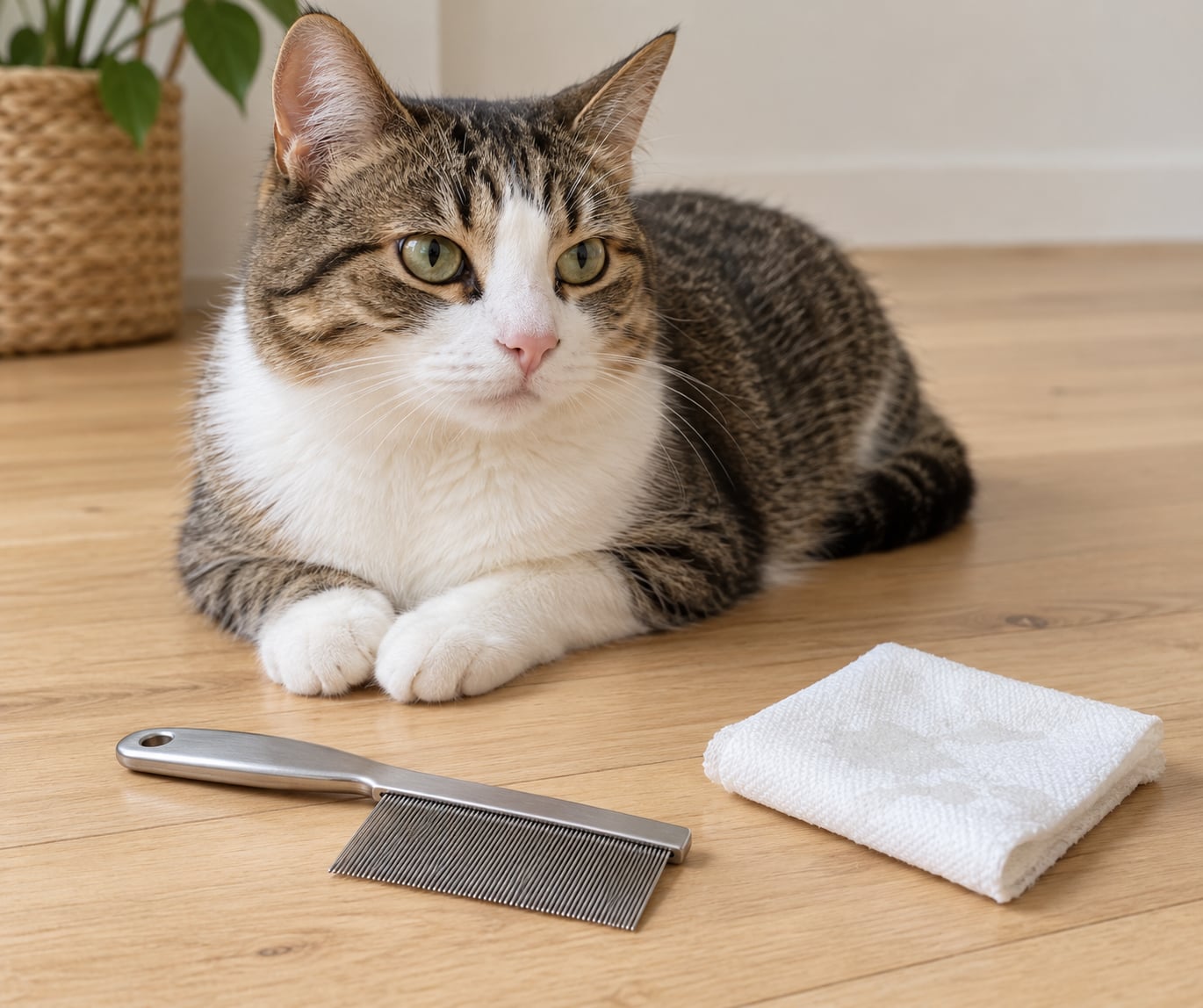
Look where fleas actually sit: along the neck and shoulders, the lower back and tail base, the belly, and around the hind legs where the skin is thinner. Run a fine-toothed flea comb through the coat in those areas, especially over the tail base and where the neck meets the head, and part the fur to see the skin.
Fast-moving dark specks that scatter when they see light are likely live fleas. Smaller black pepper-like grains that do not scatter are probably flea dirt, which is dried digested blood, and it can still turn up living flea eggs in the coat.
The paper towel test settles it. Dampen a white paper towel, press it firmly onto the parted coat at the lower back, then lift it and let it dry. Reddish-brown colour means blood, which means fleas. Do this over a sink or outside, because a full comb of live fleas is a very unpleasant surprise indoors.
Clean the comb after every pass. Water and detergent are enough for the comb itself, but dispose of vacuum bags and canister contents outdoors rather than in the house, and wash pet bedding at a high enough temperature that it is genuinely hot. A comb that finds nothing does not clear your cat either; fleas hide in dense coats, especially long-haired ones.
Do Indoor-Cat Fleas Bite People?
Yes, but people are not their normal host. Fleas bite to feed, and when a cat is not available a person will do for a short while, usually around the ankles, calves and waist where clothing presses against skin.
The bites tend to appear as small red spots in clusters or lines of three, and they itch badly for some people. That pattern, more than anything else, is what usually makes people search for signs of fleas on humans.
Do not scratch, because broken skin invites infection. And do not use a product made for animals on your own skin. If bites continue while your cat is being treated, that is a signal the environment still holds fleas, and it is worth mentioning to a veterinarian at the same visit.
What Should You Do After Finding a Flea?
Work through these steps in order rather than spraying everything at once.
- Keep pets contained. Separate your cat from other animals in the home for now so untreated animals cannot swap fleas back and forth.
- Check every animal in the household. That includes the cat that lives outside and any dog. Use the comb on each one and treat only what a veterinarian recommends for that species.
- Call your veterinarian. Ask which parasite treatment suits your cat’s age and weight, whether your area has tick-borne disease, and how often prevention should be given. Some products are not approved for kittens or for pregnant cats.
- Plan for the environment. Follow the label and your vet’s directions for vacuuming, washing bedding at high heat and treating carpets, rugs, upholstery and baseboards. Empty the vacuum outdoors immediately afterwards.
- Keep up prevention afterwards. Stay on the schedule your vet sets, because the routine is what stops the cycle from restarting.
One warning that matters more than the rest: never put a dog product on a cat. Some canine insecticides are dangerously toxic to cats. The same goes for essential oils, kerosene, homemade mixes and any pesticide not labelled for the species you are treating. Cats are small, they groom themselves, and they are quick to react badly to something that was never meant for them.
How Can You Prevent Fleas From Coming Back?
The single most useful step is year-round parasite prevention on schedule, set by your veterinarian. Indoor cats benefit from it as much as outdoor cats, and a long-running thread on r/cats about indoor cat fleas opens with an owner explaining that a previous vet said an indoor cat needed no treatment at all. That advice is the origin of most of the confusion around this question.
Prevention works best alongside simple habits. Brush or comb your cat regularly so you notice movement on the coat early. Wash pet bedding often enough that eggs do not accumulate in the seams. Vacuum carpets, rugs and upholstery on a steady rhythm rather than in a panic once fleas appear.
Consistency across the household matters more than any single product. If one cat is treated and the other is not, or if you skip doses, the environment keeps producing adults and the cat you treated becomes the landing place again.
Finally, check the obvious entry points. Look at window screens, door sweeps, and any gap where an outdoor animal could push through. When a new pet comes into the home, treat it as untrusted for fleas until a vet says otherwise.
Frequently Asked Questions
Can a cat that never goes outside get fleas?
Yes. Fleas are transported into a building rather than picked up outdoors. They arrive on clothing, shoes, bags, an outdoor dog, a visiting pet, a boarding or grooming visit, wildlife, or on secondhand furniture and bedding. Indoor living reduces how much contact your cat has with these sources; it does not remove them, because a single flea that gets in will find your cat.
Does a flea bite or a little black dot mean my indoor cat has fleas?
Probably, but neither one proves it on its own. Dark specks that scatter quickly when parted are likely live fleas. Black pepper-like grains that stay put are likely flea dirt, dried digested blood. Press a damp white paper towel onto the lower back, let it dry, and a reddish colour confirms fleas. Persistent itching with inflamed or thinning skin still needs a veterinarian.
Do I need treatment if I get bitten by a flea from my cat?
Usually you need no treatment for yourself. Fleas feeding on people are temporary because people are not their normal host, and the bites fade on their own. Avoid scratching to prevent infection, and never apply a product made for animals to your skin. Bites that keep appearing mean fleas are still in the home, so tell your veterinarian while you are treating the cat.
When should I contact a veterinarian about fleas on an indoor cat?
Contact a veterinarian as soon as you suspect fleas, because treatment depends on your cat’s age, weight and health and some products are not approved for kittens. Go sooner if the skin is raw, crusted, scaly or losing hair, if you see pale gums, if there is tapeworm-like material in the droppings, or if your cat is eating less or hiding more than usual.
Why do I still see fleas after treating my cat?
Because about 95% of the flea population lives off the animal, in carpet, bedding, upholstery and baseboards. Pupae are resistant to most sprays, so adults can emerge weeks later and land on your freshly treated cat. Treat every animal in the home, work through the environment as the label and your veterinarian direct, and follow the follow-up dose your vet recommends.
Conclusion
Start with three things. Keep your cat indoors and away from the other animals, comb and inspect the likely spots on the coat, and call your veterinarian to confirm the diagnosis and choose a treatment that suits your cat. Then deal with the home at the same time, because the eggs and larvae waiting in your carpet and bedding are what bring the fleas back.