The safest way to give a cat liquid medicine without being bitten is to wrap the cat in a towel with the head exposed, slip the needle-free syringe into the cheek pouch behind the canine tooth, and depress the plunger slowly while the head stays steady. Wrapped, still, and dosed in tiny amounts, most cats never get the chance to bite.
That answer covers the technique. The harder part of the question, honestly, is what happens when the cat fights: scratched forearms, a bitten thumb, and half the dose spat onto the carpet. Owner forums fill up with exactly those stories, and the recurring lesson is that the struggle usually comes from rushing, not from the medicine itself.
This guide covers what to set up before you start, the step-by-step method, the mistakes that cause bites and aspiration, and the point at which syringe dosing stops being worth it. Your own veterinarian’s dosing and product instructions always come first. Nothing here replaces their advice for your cat.
Table of Contents
- What You Need
- Step-by-Step: How to Give a Cat Liquid Medicine Without Getting Bitten
- How to prepare the medicine and syringe
- How to hold a cat safely without scruffing
- How to place the syringe without aiming at the throat
- How to give a cat liquid medicine slowly and safely
- How to reward your cat afterward
- When two people make sense
- Common Mistakes
- Frequently Asked Questions
- What should I do if my cat spits out liquid medicine?
- How can I stop my cat from coughing or gagging during liquid medicine?
- Is it safe to wrap a cat in a towel to give liquid medicine?
- Can I mix my cat’s liquid medicine with wet food?
- What if my cat will not allow a syringe near its mouth?
- Can I give my cat human liquid medicine instead?
- Conclusion
What You Need
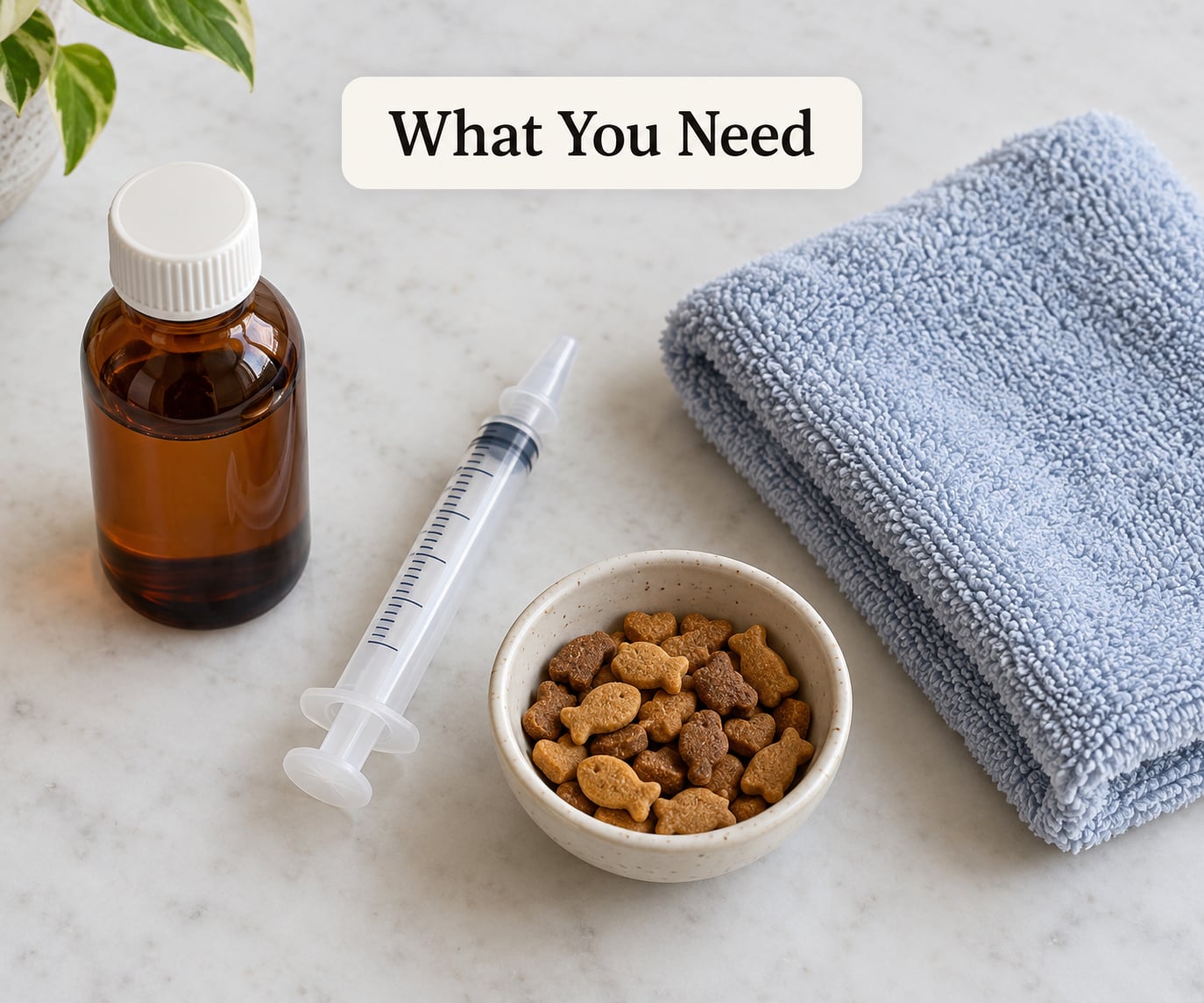
Five things, and most households already have four of them. Gather everything first, because a cat left alone for ninety seconds while you fetch the syringe will already be hiding.
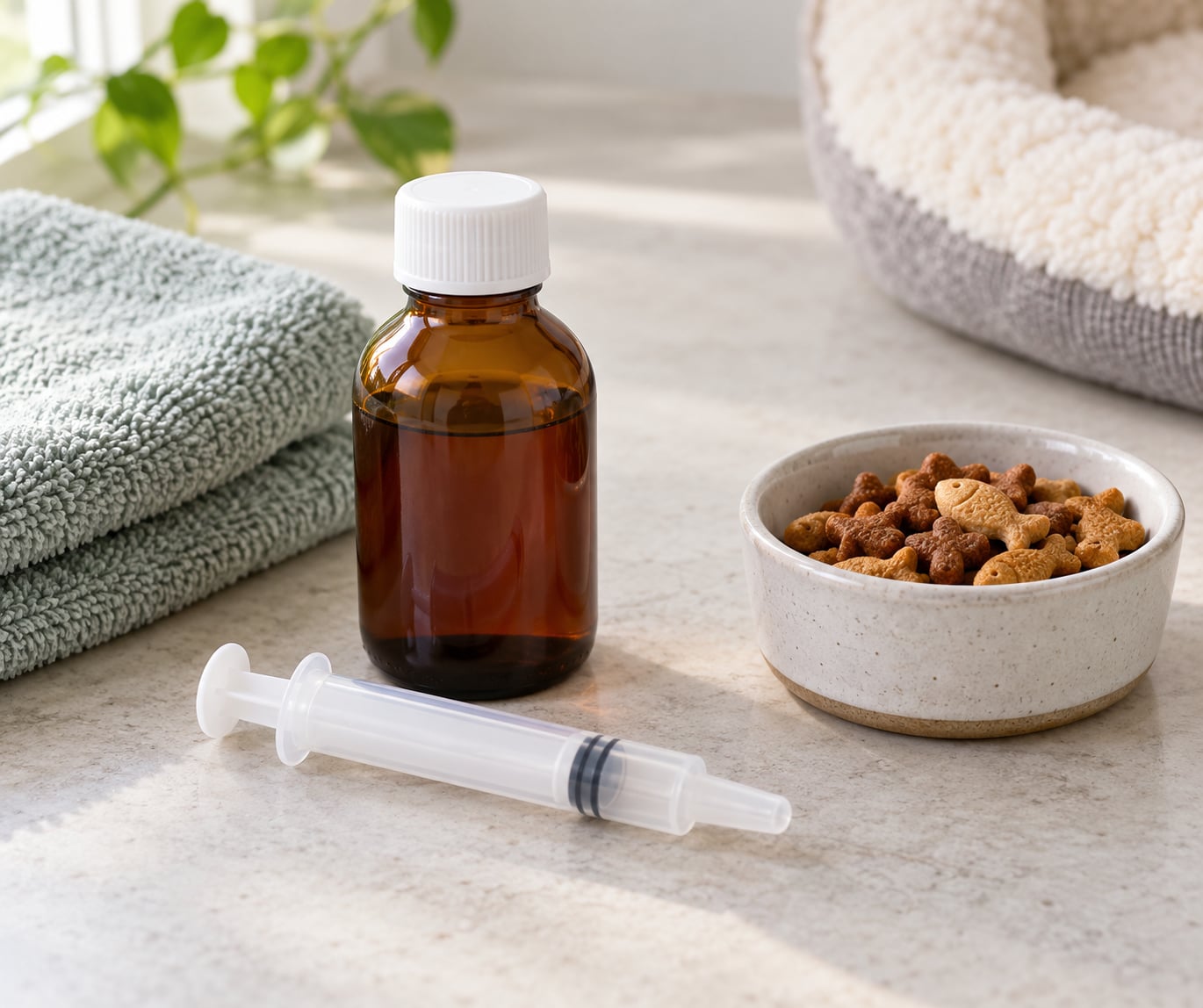
- The prescribed medicine, plus the label or the instruction sheet from your vet, so you can check the dose before you touch the cat.
- A needle-free oral syringe or the applicator that came with the medicine. Never a syringe with a needle attached for oral dosing.
- A soft towel or small blanket, big enough to roll the cat into a burrito with only the head showing.
- A small handful of treats and a squeeze treat or lickable tube if your cat is one for those.
- A second pair of hands, if you have one. Strong, large or frightened cats are genuinely a two-person job.
Two setup details people skip and later regret. First, read the dose markings on the syringe itself: a kitchen teaspoon and a medicine syringe do not measure the same thing, and household spoons are a common source of dosing errors. Second, if the suspension came out of the refrigerator, warm the bottle in your hands or stand it in warm water for a few minutes. Cold liquid gets resisted far more often than room-temperature liquid. Never microwave it.
Check the label before you start, too, and confirm the product is meant to be given orally and is prescribed for your cat. Some veterinary products look identical but are sold for injection or for a different species, and the route matters.
Step-by-Step: How to Give a Cat Liquid Medicine Without Getting Bitten
How to prepare the medicine and syringe
Have the bottle, the instructions and the required amount ready before you go near the cat. If the label says to shake the suspension, shake it. Draw the measured dose into the oral syringe, tap out any air bubble, and cover the tip with a small cap or your finger until you are ready to position it.
Load everything at the same spot each time. On day four of a twice-daily antibiotic course, muscle memory will do the work for you.
How to hold a cat safely without scruffing
Wrap the cat gently but snugly in the towel, legs included, so the claws have nothing to hook into. Leave the head and neck free. Sit with the cat between your thighs or on a table with its back to you, so it cannot spring backwards at you.
Hold the head with one hand, cupping the jaw and the top of the skull, and keep a light but steady hold. The towel does most of the work; your hand just stops the head turning. If the cat is thrashing, panting heavily or genuinely distressed, stop, let it breathe for a minute, and try again later. A stressed cat that panics is far more likely to bite than a calm one.
On scruffing: it is a genuine question, and the honest answer is that most vets advise against using it as a default. Grabbing the loose skin behind the neck triggers an automatic freeze response that many cats experience as fear, and freezing is not the same as cooperation. Plenty of owners get away with it on a calm cat, but it tends to make the next dose harder, not easier. The towel wrap holds the body without invoking that reflex.
How to place the syringe without aiming at the throat
This is the step most guides get wrong, and the mistake costs you twice: the cat spits the dose out and may inhale some of it.
Slide the tip into the side of the mouth, into the gap between the canine tooth and the pre-molars behind it. Angle the syringe slightly toward the cheek, so the liquid lands in the pouch beside the tongue rather than being sprayed straight down the throat. Aim for the back of the mouth and you are gambling on the airway.
Keep the mouth loosely closed around the tip and do not push the syringe forward once it is in position. A cat that can chew on the plastic tip will fight harder and may puncture the syringe.
How to give a cat liquid medicine slowly and safely
Give one or two drops at a time. Let the cat swallow before you add more, and pause if you hear swallowing. Cats take small swallows, and this pace is what keeps the medicine out of the lungs.
Do not push the plunger hard, do not squirt, and never hold the cat upside down or on its back. Speed is the single most common cause of problems here, and it is almost always because the cat is thrashing and you are panicking a little.
Stop immediately if the cat coughs, gags, struggles hard or seems uncomfortable. Wiping some foam or drool on the chin after a bitter-tasting medicine is a normal taste reaction, not an allergic emergency.
Watch for aspiration over the next hours. Signs that the liquid went into the airway rather than the stomach include a gurgling or wet-sounding breath that persists, rapid or open-mouth breathing, coughing that does not settle, blue, grey or very pale gums, unusual lethargy, and sometimes a fever and nasal discharge in the days that follow. If you see any of those, call your veterinarian straight away and describe what you gave and when. Aspiration pneumonia is treatable, and it is far easier to catch early.
How to reward your cat afterward
Release the towel gently rather than letting the cat bolt mid-unwrap, then say something calm and give a treat straight away. The treat lands within seconds of the unpleasant part, so the cat learns that the whole sequence sometimes ends well.
On treatment courses, follow the veterinarian’s instructions about a missed or spit-out dose. The practical rule is simple: do not automatically re-dose unless you are certain none was swallowed. Doubling up risks an overdose, and it is one of the more common calls a clinic receives at the end of a course. If you are unsure, ring the vet and describe what happened.
If your cat now hides every time the syringe appears, stop using the syringe for a few days and feed liquid treats from it instead, a few millilitres at a time, with a treat after each one. It takes several days of uneventful syringe meals before most cats stop reacting to the object itself. Then reintroduce the real medicine at the next scheduled dose.
Some people plan an entire course around food instead, and that is reasonable for a cat who takes food reliably. A small amount of wet food, a lickable squeeze treat with the dose in the hollow, or a few mouthfuls of the food your cat loves all work better than a full bowl, because a single bite means you know the dose went in. What you cannot use is dairy, and more on that below.
When two people make sense
One person holds the wrapped cat and the head. The other does the syringe. Trying to do both alone is how bites happen, and owners on cat forums say it plainly: a towel burrito alone is not enough for a strong or large cat. If you are alone and the cat is already struggling, call someone or ask your vet what to do rather than pushing through it.
Common Mistakes
Most bites trace back to one of these. Each has a safer substitute.
Using a syringe with a needle for oral dosing. Never. That is an injection, it is dosed differently, and the mistake is easy and serious. Ask your vet for a needle-free oral syringe if you do not have one.
Aiming for the back of the throat. This advice circulates widely and it contradicts what veterinary clinics recommend. The gap behind the canine tooth, angled to the side, is the safer placement.
Shooting the plunger to get it over with. Speed sends liquid into the airway. Small drops and a swallow between each one take longer and finish the job.
And here is how the delivery methods themselves compare, bite risk by bite risk, along with where each one tends to fall down.
- Oral syringe into the cheek pouch — low bite or scratch risk once the cat is wrapped, and it gives you full control of the dose with any medication. Watch out for aspiration if it goes in too fast.
- Medicine dropper — low risk, but you have less control over the volume. Best for small kitten doses and thick suspensions. Harder to measure precisely.
- Squeeze treat with the dose inside — low risk, and it suits cats that gulp food without chewing. Only works if the cat eats the whole treat.
- Stirred into a small portion of wet food — low risk for a hungry, food-motivated cat. Uneaten food means an unknown dose.
- Hidden in dry food or a full meal — low risk in the sense that nobody gets bitten, but rarely worth trying: cats eat around it and spit it out.
- Mixed into the water bowl — no bite risk, but not recommended for most drugs. Intake is unpredictable and some medicines lose potency in water.
- Fighting an unwrapped cat — high risk of bites and scratches and an incomplete dose. Never worth it.
Scruffing as your first move. It works as a panic reflex, not a restraint technique, and it teaches your cat to fear your hands. Use the towel.
Hiding the dose in water or milk. Medicine in the water bowl is a bad idea: you have no idea how much was drunk, and some drugs break down in water or lose potency. Dairy is worse. Most adult cats are lactose intolerant, and calcium binds certain antibiotics, tetracyclines including doxycycline among them, cutting how much the cat absorbs. Cheese and milk as a delivery vehicle can quietly waste a whole course of treatment.
Microwaving the medicine. It creates hot spots that burn the mouth. Warm it in your hands or in warm water instead.
Measuring with a household spoon. Kitchen spoons are inconsistent, and the difference matters for a kitten or a small dose. Use the markings on the oral syringe.
Re-dosing after a spit-out. If you saw some go down, do not give the full dose again. If you are not sure, ask the vet rather than guessing.
Using human medicine. Common human painkillers, particularly anything with paracetamol or ibuprofen in it, are dangerous for cats. Only give what your veterinarian prescribed.
If a bite does land, wash the area thoroughly with soap and running water for several minutes and get medical advice for deep punctures, or any wound that becomes red, swollen, warm, or starts producing pus. Cat bites carry bacteria that infect fast, and hand injuries from cats are worth a proper look. Tell your vet that the injury happened while dosing, because it changes how you handle the next dose.
For anything individual: dosing amount, timing, whether food is allowed, and what to do about a cat who refuses everything, go to your own veterinarian. Your cat’s history, weight and the specific drug decide those answers, not a general guide.
Frequently Asked Questions
What should I do if my cat spits out liquid medicine?
Do not automatically give the dose again. If you watched some go down, re-dosing risks an overdose. Call your vet and describe how much you think was swallowed, and they will tell you whether to repeat, wait for the next scheduled dose, or adjust the plan. If your cat reliably spits it out, ask about a compounded pill, a transdermal option or a different flavour.
How can I stop my cat from coughing or gagging during liquid medicine?
You usually cannot stop it entirely, but you can prevent most of it. Place the tip in the cheek pouch behind the canine tooth, angle it to the side rather than down the throat, and give one or two drops at a time with a pause for swallowing. Slow administration is the whole trick. Coughing, gagging and brief foaming are common; persistent wet breathing or open-mouth breathing afterwards is not.
Is it safe to wrap a cat in a towel to give liquid medicine?
Yes, a towel or blanket wrap is the recommended restraint for most cats. Roll the body snugly with the legs contained, leave the head and neck free, and hold the skull gently. It keeps claws away from your hands and forearms and calms many cats. Stop if the cat is severely distressed, and use a second person for large or strong cats. Avoid scruffing, which triggers a fear response in many cats.
Can I mix my cat’s liquid medicine with wet food?
It can work, but only with a small portion your cat definitely eats, such as one or two spoonfuls offered by hand. A full bowl means you cannot tell how much was eaten. Check with your vet first, because some drugs must be given on an empty stomach, and avoid dairy, which is both hard for most cats to digest and interferes with certain antibiotics.
What if my cat will not allow a syringe near its mouth?
Stop, do not force it, and let the cat calm down. Over the next few days, feed liquid treats from the same syringe several times a day with no medicine involved, so the object stops meaning pain. Then try again. If it is still impossible, tell your vet. A compounded pill, a flavoured suspension, a transdermal treatment or an injection given at the clinic may suit your cat better than a syringe.
Can I give my cat human liquid medicine instead?
No. Many medicines made for people are toxic to cats, and some that are not toxic are still dosed completely differently. Paracetamol and ibuprofen are especially dangerous. Cats also lack the liver enzymes many people rely on to break drugs down. Use only the product and dose your veterinarian prescribed for your cat, and ask the clinic before changing anything.
Conclusion
Start with the setup, not the syringe. Confirm the label is for oral use in cats, measure with the needle-free oral syringe, and warm refrigerated liquid in your hands so the cat is not objecting on temperature alone. Wrap the cat in a towel with the head clear, hold the skull steady, slide the tip into the cheek pouch behind the canine tooth angled to the side, and give one or two drops at a time with a pause to swallow.
Stop the moment the cat coughs, gags or thrashes, and never force liquid down the throat. Reward immediately afterwards, and expect a little drool. If the cat will not accept the syringe at all, say so to your veterinarian and ask about a pill, a transdermal treatment or a dose given at the clinic, because a course completed badly is worse than one delivered another way.
Use only the product and dosing instructions your veterinarian gave you for your cat. If anything here conflicts with what your vet told you, follow your vet, and ring the clinic with any question about a missed dose, a spit-out dose or breathing trouble afterwards.