Persian cat eye and coat care comes down to two short daily habits: wipe your cat’s flat face and eyes once or twice a day, and brush the long, dense coat every single day. Persians are brachycephalic, so their shortened muzzle sends tears spilling onto the face instead of down the tear duct, and their fine double coat tangles against the skin faster than almost any other breed. Ten minutes most days is what keeps staining, mats and skin sores away.
The routine is simple enough to learn in a week. What trips people up is knowing when a wipe is not enough, so this guide covers the technique, the tools, the frequency, and the symptoms that mean a veterinarian, not a cloth.
This is general care information, not a diagnosis. Anything involving pain, an eye that looks different from yesterday, or a broken skin area belongs with your vet, and no human medication should ever be used on a cat.
Table of Contents
- What You Need
- Step-by-Step: Persian Cat Eye and Coat Care
- How to Clean a Persian Cat’s Eyes Safely
- How to Brush and Detangle a Persian Coat
- How Often Should You Groom a Persian Cat?
- Common Mistakes
- When to Contact a Veterinarian
- Frequently Asked Questions
- How often should I clean my Persian cat’s eyes?
- Can I use human eye drops or saline on my Persian cat?
- What are the common causes of tear stains in Persian cats?
- How should I remove mats from a Persian cat’s coat?
- When should I take my Persian cat to the vet for eye discharge?
- Conclusion
What You Need
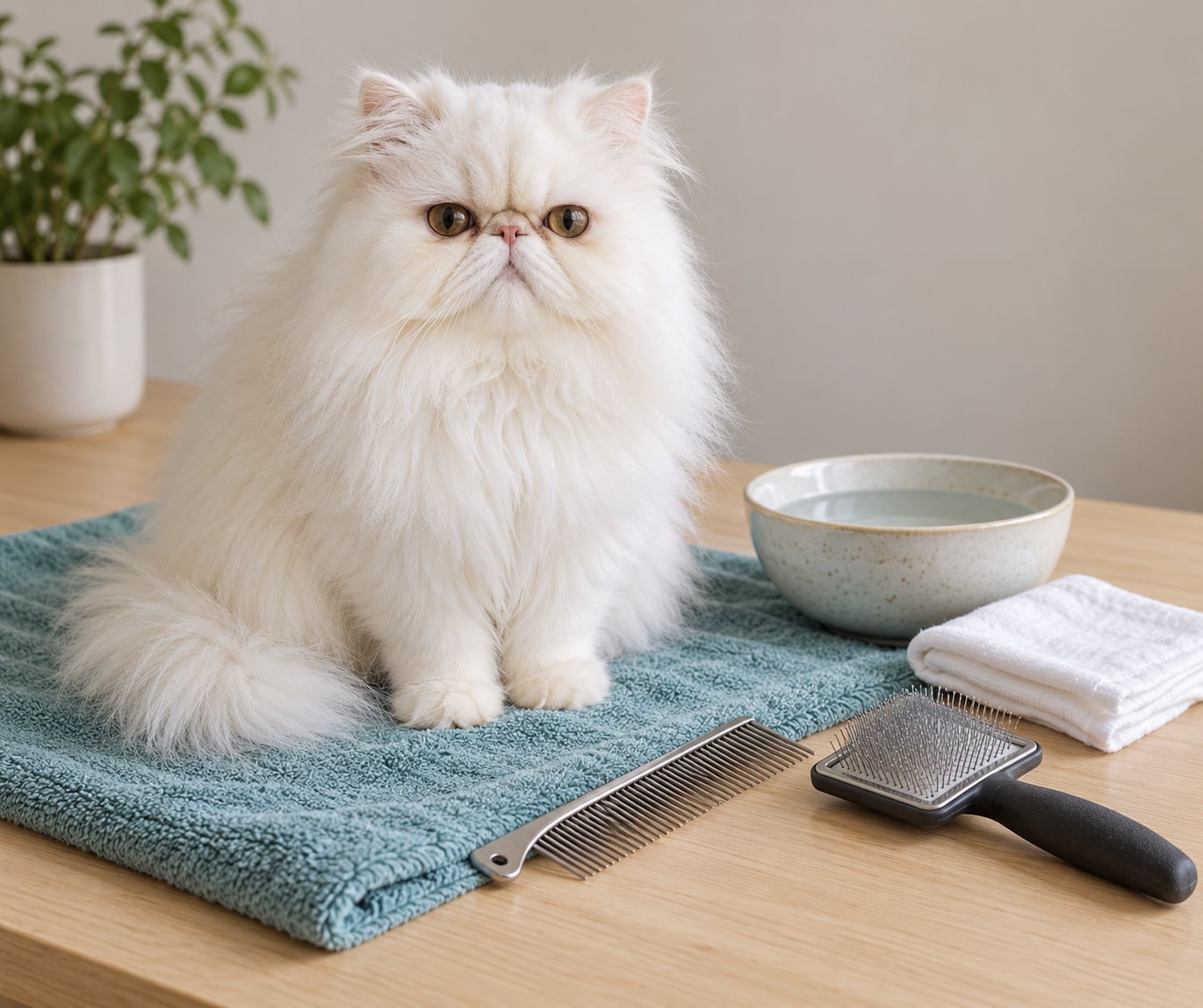
You need very little, and most of it is already in a kitchen drawer. Gather everything before you pick your cat up, because the worst part of face wiping is the cat bolting mid-wipe.
- Warm water and soft cloths or cotton pads. Lint-free cotton squares, one per eye, used once and tossed. A clean washcloth works too, as long as it has no fragrance and no rough loops.
- Sterile saline or a veterinary cat eye wash. Owners in Persian and long-haired cat groups repeatedly name veterinary-approved washes as what finally kept staining under control, and saline is the gentlest option if discharge is thin and watery.
- A wide-tooth metal comb and a slicker brush. The comb goes first, always, because it removes loose hair before the slicker gathers it into a pad.
- A towel and a non-slip surface. A bath mat or a towel on a table keeps a long-haired cat from sliding when they twist, which is also safer for you.
- Treats your cat actually likes. Delivered at the end of every wipe, every session, not just the first one. This is what makes the routine survive month six.
Deliberately not on the list: human eye drops, including saline meant for contact lenses, which is not the same thing; hydrogen peroxide or alcohol; cotton swabs pushed toward the eye; and scissors or de-matting shears near a tight mat. Each of those turns a routine task into a trip to the emergency clinic.
Step-by-Step: Persian Cat Eye and Coat Care
How to Clean a Persian Cat’s Eyes Safely
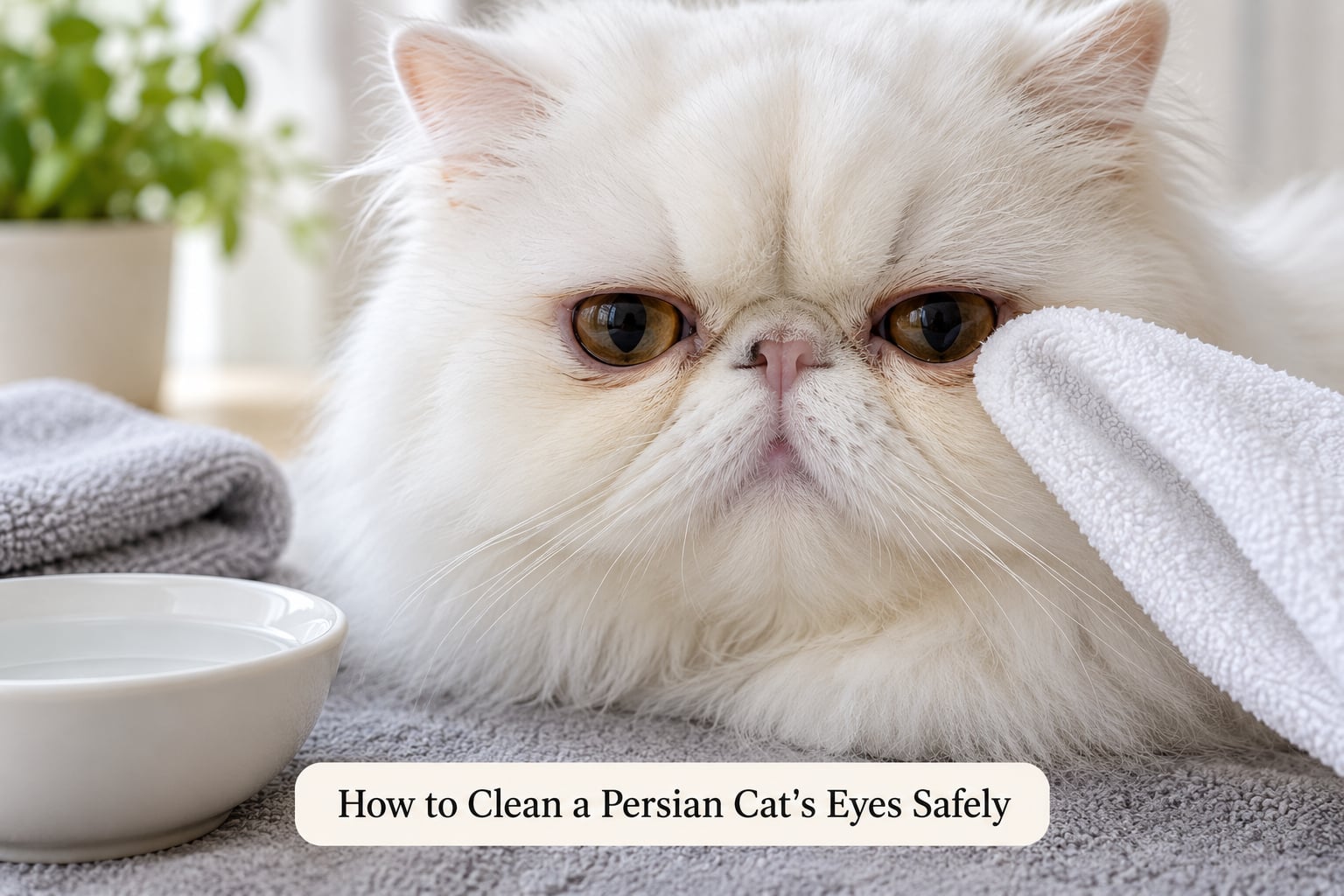
Warm the cloth in plain lukewarm water, wring it so it is damp rather than wet, and let your cat settle first. Sit with your cat between your knees or on your lap, one hand resting gently on the back of the head to steady it without pressing. Wipe from the inner corner of the eye outward, away from the nose, and use a fresh section of cloth for each stroke. Change pads between eyes so nothing is transferred across the face.
Repeat until the discharge is gone, usually three to five wipes per eye. Reward, release, and stop. If your cat squints hard, twists away, or the eye resists cleaning, that is your cue to stop that day rather than push through it.
You will know the routine is working when the staining takes a wipe instead of a soak, when the hair under the eye is dry rather than damp and crusty, and when your cat settles at the sight of the cloth rather than bolting. On r/persiancat, owners consistently describe twice-daily wiping as the real-world norm, because a single morning wipe is often crusty again by evening.
If discharge builds back up within a few hours of a proper clean, skip the home routine and call your vet. That pattern points to overflow, infection or a blocked duct rather than poor hygiene.
How to Brush and Detangle a Persian Coat
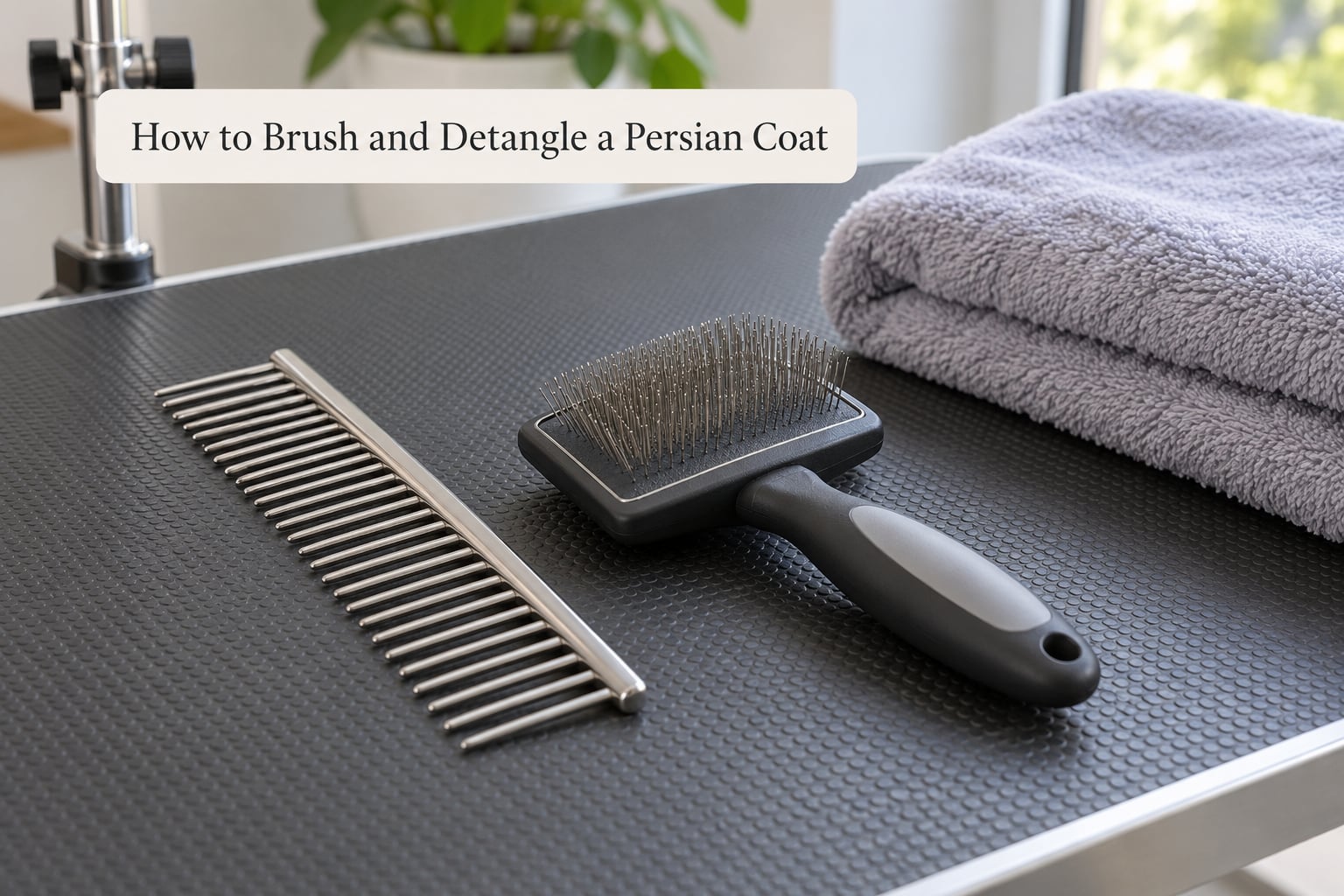
Start with the wide-tooth comb and work in small sections from the skin outward, holding the section above the comb so the skin never gets pulled. A few strokes, then move on. Follow with the slicker to lift and gather the loosened undercoat into a pad you lift off rather than rake off. Tool order matters: slicker first drags loose hair back into the coat, which is why so many owners swear by the slicker while wondering why their cat still mats.
Work the whole body, and pay attention where mats actually start: the ruff under the chin, the belly, behind the front legs, the britches, and the base of the tail. Daily brushing there prevents the tight mats that pull at skin and turn into sores. Long-haired owners on pet forums are blunt about it: a daily brush pass is the only thing that keeps a Persian coat manageable.
For loose hair you can already see, a deshedding rake or grooming glove works in the direction of hair growth on the back and sides. Skip it on the face and on any area with a mat, since both pull.
Tangles differ from mats. Tangles brush out with patience. Mats sit tight to the skin and must be fingered apart, combed from the underside, or snipped by someone who can see the skin line. You will know brushing is working when the coat parts easily under your fingers, loose hair comes away in your hand instead of staying in the coat, and your cat complains less week three than week one.
How Often Should You Groom a Persian Cat?
Daily brushing and one to twice-daily eye wiping is the baseline for an adult Persian, with more frequent grooming during heavy shedding. Here is the schedule most owners settle into, and the one to adjust with your own vet.
| Task | How often | Tool | Time |
|---|---|---|---|
| Eye check and wipe | Once or twice daily | Warm damp cloth, sterile saline | 2 minutes |
| Full coat brushing | Daily | Wide-tooth comb, then slicker | 5 to 10 minutes |
| Deeper de-shed | Twice weekly in shedding season | Deshedding rake | 10 minutes |
| Ear and nail check | Weekly | Nail clippers, damp cloth | 5 minutes |
| Bath | Every 3 to 4 weeks | Cat-specific shampoo, low-heat dryer | 60 to 90 minutes |
| Nail trim | Every 3 to 4 weeks | Sharp cat nail clippers | 5 minutes |
| Professional groom | Every 4 to 6 weeks | Groomer or vet tech | Drop off |
Bathing guidance online contradicts itself, with some breed pages calling for weekly baths and others monthly. Every three to four weeks is a workable benchmark, and more frequent bathing strips the coat and dries the skin. Two rules matter more than the date: de-mat before you bathe, because water tightens knots, and dry the coat completely, all the way to the skin, on a low or cool setting. Trapped moisture under a dense coat is what creates hot spots.
Kittens and seniors need the same routine with shorter sessions. A kitten gets five minutes of handling before real grooming, and a senior or arthritic cat may need two sessions a day instead of one.
Common Mistakes
Almost every problem I hear about comes down to one of these.
- Using human eye drops, including contact-lens saline. Formulation and preservatives differ, and some human drops are simply wrong for a cat. Use sterile saline or a veterinary cat eye wash, and ask your vet before using anything in the eye that is not sold for cats.
- Cleaning an eye that is dry, red or irritated. Wiping a sore eye spreads whatever is causing it and hurts the cornea. Stop and call your vet.
- Brushing a mat from the ends. You tighten the knot and pull hair out of the skin. Work from the underside, fingers first, then a wide-tooth comb, in short pieces.
- Reaching for scissors on a tight mat. Mat skin is thin and folds into the mat, so scissors find skin first. Cut parallel to the body with a blunt-ended pair, never scissor tips, and stop if your cat will not hold still.
- Bathing before de-matting. Water shrinks the coat and tightens every knot. Long-haired communities say it plainly, and they are right.
- Brushing a dry, matted coat. A little detangling spray or a light mist of water reduces static and breakage. Dry brushing a tangle just breaks hair.
- Waiting for staining to wash off. Tear staining is not dirt. Wiping manages it, and the underlying drainage problem needs a vet, not a stronger cleaner.
One more worth naming: forcing a full session on a cat who is fighting you. Cats that hate brushing will get worse at it, not better. Start with two minutes of touching the brush to the ruff while treating, add ten seconds a session, and stop while your cat is still tolerating it. Most cats are manageable in a fortnight, and a few minutes every few days beats a failed twenty-minute attempt.
When to Contact a Veterinarian
Routine Persian tearing is clear to watery, crusts along the inner corner and the hair beneath the eye, and comes and goes. That is breed anatomy, not disease. What follows is not normal.
- Squinting, blinking more than usual, or a partly closed eye. Pain, and on a flat face, a scratch or corneal ulcer can hide behind the folds.
- Thick, yellow, green or watery discharge that returns within hours. Common signs of conjunctivitis, which needs a vet, not repeated wiping.
- A cloudy or bluish-looking cornea, or a red patch on the white of the eye. Same-day call.
- A third eyelid showing, a dull coat, hiding, or not eating. Cats do not hide pain quietly; this is urgent.
- Skin sores, crusting or hair loss under the eyes or inside the folds. Constant damp fur causes facial dermatitis, and broken skin needs treatment.
- New mats that form within days, or mats fused to the skin. That points at a coat-care problem worth sorting at the vet visit.
- Staining that appears suddenly and worsens over days. A blocked or malformed tear duct can be the cause, and it is treatable.
Two hereditary conditions are worth discussing at your cat’s annual exam: polycystic kidney disease, which has a DNA test, and progressive retinal atrophy, which affects vision over time. Regular eye checks also matter more in flat-faced cats because their shortened facial structure makes the surface of the eye easier to injure. If you are not sure whether your cat’s tearing is normal anatomy or a developing problem, an exam settles it faster than any amount of wiping.
Frequently Asked Questions
How often should I clean my Persian cat’s eyes?
Once or twice a day, using a warm damp cloth or sterile saline, with a fresh pad for each eye. Persian owners on r/persiancat consistently report twice daily as the working norm, because staining that is wiped in the morning is often crusty again by evening. Wipe from the inner corner outward and stop if your cat squirms or the eye looks irritated.
Can I use human eye drops or saline on my Persian cat?
Not human eye drops, and not contact-lens saline, because the formulation and preservatives differ from what is made for cats. Sterile saline and veterinary cat eye washes are the options owners use most. If you want to try a product beyond plain saline, ask your vet first, since some eye conditions need the right treatment rather than a gentle rinse.
What are the common causes of tear stains in Persian cats?
Most staining is epiphora: the flat face and shallow tear ducts mean tears overflow onto the fur instead of draining away. Dark staining under the eyes is also normal pigment and often becomes less visible as the cat grows. Frequent staining can also come from a blocked or malformed duct, facial dermatitis from damp fur, or eye irritation, and those are worth a vet check.
How should I remove mats from a Persian cat’s coat?
Never pull or brush a mat from the ends, since that tightens it and pulls hair out of the skin. Finger the mat apart, then work a wide-tooth comb through it from the underside in short pieces. If it will not release, cut parallel to the body with blunt-ended scissors and see a professional groomer if your cat will not hold still. De-mat before bathing, because water tightens knots.
When should I take my Persian cat to the vet for eye discharge?
Book an appointment when discharge is thick, yellow or green, when it returns within hours of a proper clean, or when the eye looks cloudy, red or partly closed. Squinting, a raised third eyelid, hiding or not eating are urgent signs of pain, and a flat face can hide a corneal ulcer behind the folds. Routine clear tearing that just stains the fur is normal breed anatomy.
Conclusion
Start with two habits and build from there: look at your cat’s eyes and face once a day and wipe what is there, then brush the whole coat with a wide-tooth comb followed by a slicker. Keep cotton swabs, human eye products and scissors near mats out of reach, and remember to de-mat before any bath.
Call your vet for squinting, pain, thick or recurring discharge, a cloudy eye, a raised third eyelid, skin sores or sudden coat changes. Everything else is routine work, and routine work is what keeps a Persian comfortable.