Maine Coon care and size expectations are easier to handle once you have the numbers in front of you. Adult males usually weigh 13 to 22 pounds (6 to 10 kg) and females 8 to 15 pounds (4 to 7 kg), stand 10 to 16 inches (25 to 40 cm) at the withers, and measure 19 to 40 inches (48 to 100 cm) nose to tail tip. They are slow maturers, so the frame you see at one year is not the frame they keep.
That last point causes more worry than any other. Owners compare a six-month kitten to the full-grown cats on their feeds and assume something is wrong. Nothing is wrong. The breed just keeps building for three to five years, and a large healthy cat and a fat cat can look surprisingly similar on a kitchen scale.
This guide covers the size numbers, the growth timeline, the grooming routine that keeps a semi-longhaired double coat under control, how to feed a big cat without overfeeding it, and the changes that are worth a phone call to your veterinarian.
Table of Contents
- How Big Does a Maine Coon Get?
- Maine Coon Kitten Growth and Development
- What Makes Maine Coon Care Different?
- Maine Coon Care and Size Expectations by Life Stage
- How to Groom a Maine Coon Without Matting
- Food, Exercise, and Weight Management
- When a Maine Coon’s Size or Growth May Need Checking
- Frequently Asked Questions
- Is every Maine Coon exceptionally large?
- When does a Maine Coon kitten reach its full adult size?
- Are male Maine Coons always larger than females?
- How often should a Maine Coon be brushed to prevent mats?
- When should a Maine Coon’s weight or growth prompt a vet visit?
- Start With a Healthy Growth Plan
How Big Does a Maine Coon Get?
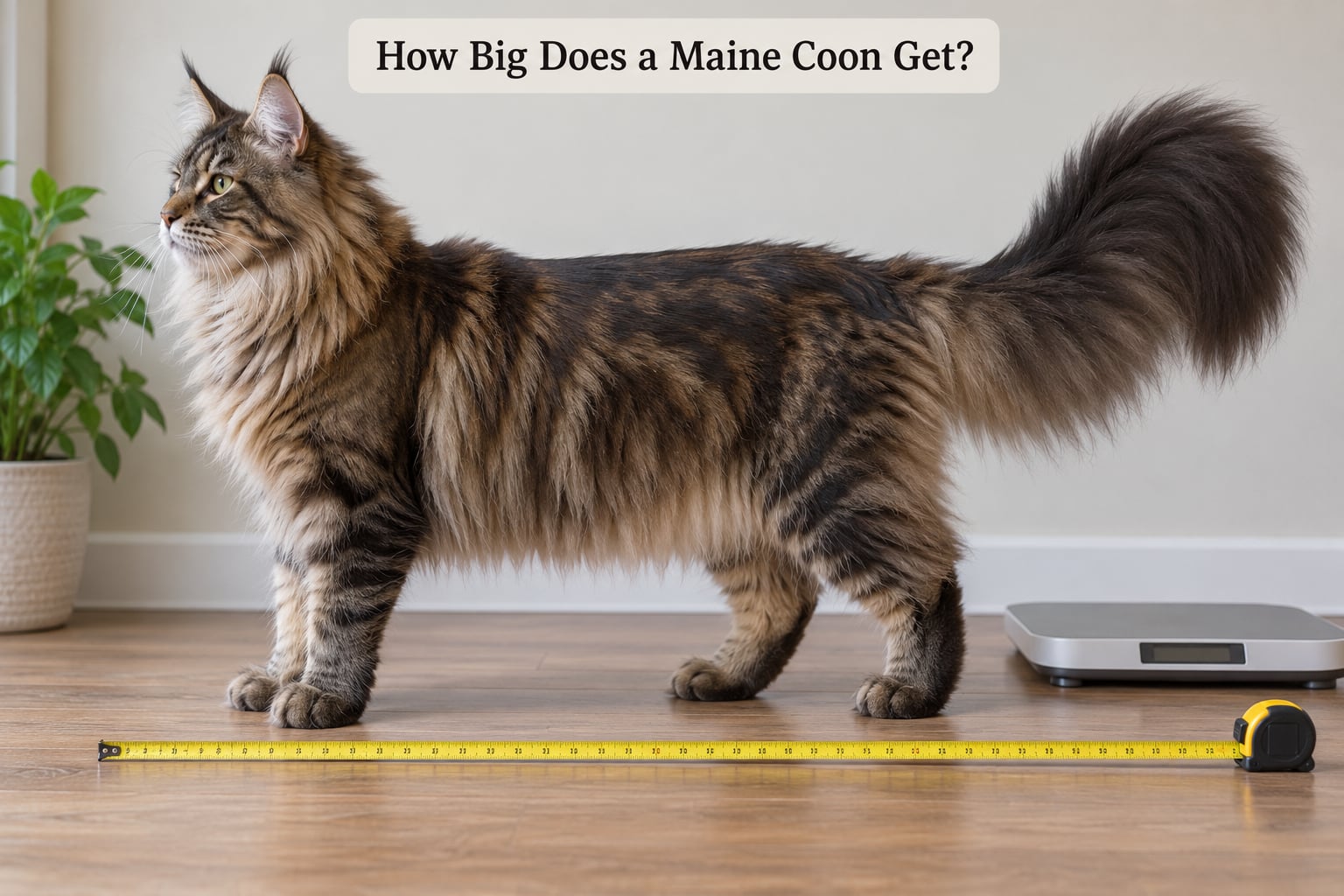
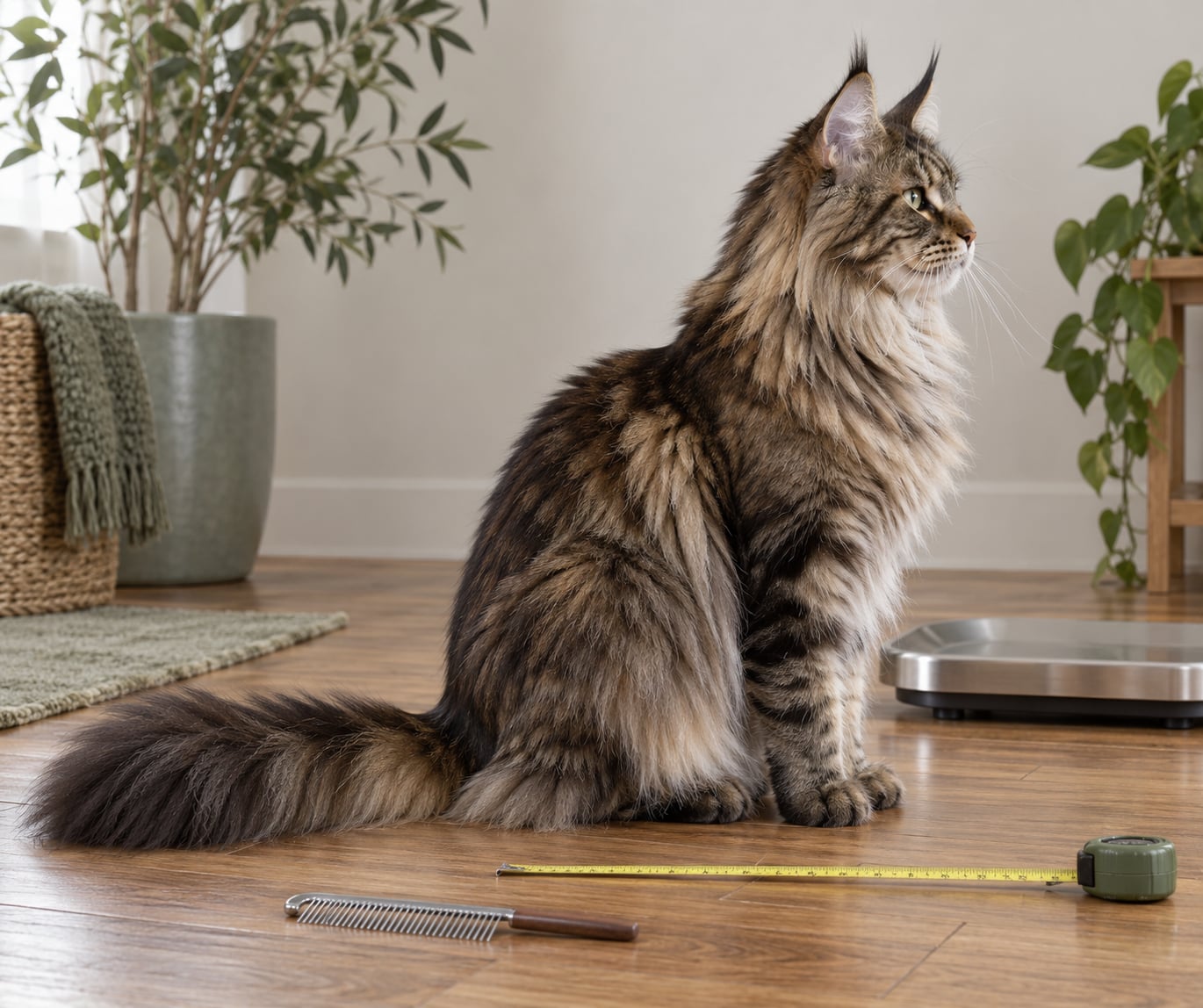
Adult males land between 13 and 22 pounds and adult females between 8 and 15 pounds, with some males pushing past 20 pounds without being overweight at all. The measurement people misread most often is height. Maine Coons are long cats, not tall cats, so they add up along the body and the tail rather than in leg length. A typical domestic shorthair stands around 9 inches at the shoulder and measures roughly 18 inches nose to tail. The Maine Coon is not a towering cat; it is a stretched one.
| Measurement | Adult male | Adult female | Typical domestic shorthair |
|---|---|---|---|
| Weight | 13-22 lb (6-10 kg) | 8-15 lb (4-7 kg) | 8-11 lb (3.5-5 kg) |
| Withers height | 10-16 in (25-40 cm) | 10-14 in (25-35 cm) | 9-10 in (23-25 cm) |
| Nose to tail | 30-40 in (76-100 cm) | 28-36 in (71-90 cm) | 18-20 in (46-51 cm) |
| Head | Broad, square muzzle, defined stop | Slightly narrower, softer lines | Small, wedge-shaped |
| Coat fullness | Heavy ruff, dense shaggy undercoat | Full ruff, slightly less heavy | Short, single coat |
| Tail | Long and plumed, base to tip | Long and plumed, a little finer | Short-haired, proportionate |
| Time to full frame | 3-5 years | 2.5-4 years | About 12 months |
Genetics accounts for roughly 70 to 80 percent of final size, so a kitten from two very large parents will usually stay large and a kitten from smaller parents will surprise you late in the process. Nutrition and health shape the rest, mostly by keeping growth steady rather than by adding height. Neutering a kitten before puberty shifts the timing slightly, with a slightly later and somewhat lighter adult result, which is why breeders compare like-for-like when they quote growth projections.
Here is the part worth being blunt about. A cat sold as a purebred Maine Coon with no verifiable pedigree, or one that arrived through a classified ad, is very often a Maine Coon mix. A mix can carry the long coat and the friendly personality without carrying the frame, and plenty end up closer to 11 pounds than 18. That is a perfectly good cat. It is just not the size the breed profile promised you, and setting that expectation early saves a lot of second-guessing.
To tell a large frame from excess weight, ignore the scale for a moment and look. Run your hands over the ribs and the spine from above: a cat at a healthy body condition score shows a visible waist behind the ribs, a slight dip before the hips, and ribs you can feel under a thin layer of fat. A big cat that looks heavy from above, has no waist, and has a flat, blocky belly is carrying weight it does not need, however impressive the number sounds. Your veterinarian can score this on the standard nine-point scale in about a minute, and that score is a far better target than any breed chart.
For reference, the largest cat ever recorded was a Maine Coon named Stewie at 48.5 inches nose to tail. That is a Guinness record holder, not a target, and chasing it with food is a fast route to joint strain.
Maine Coon Kitten Growth and Development
A Maine Coon kitten usually reaches close to adult size somewhere between three and five years of age, not at its first birthday. Between roughly six months and a year, kittens often look gangly and uneven, growing in bursts with paws, ears and tail outpacing the body. That awkward phase looks like a growth spurt and behaves like one, but the real finish line is years away.
| Age | Typical male weight | Typical female weight | Milestone |
|---|---|---|---|
| 3 months | 2-4 lb (1-1.8 kg) | 2-3 lb (1-1.4 kg) | Playful, clumsy, eating kitten food, litter training begins |
| 6 months | 6-9 lb (2.7-4 kg) | 5-7 lb (2.3-3.2 kg) | Teething, coat thickens, adolescent awkwardness starts |
| 12 months | 10-13 lb (4.5-6 kg) | 8-10 lb (3.6-4.5 kg) | Looks nearly grown, still has a year or two of growth left |
| 18 months | 13-15 lb (6-7 kg) | 10-12 lb (4.5-5.5 kg) | Muscles fill in, activity level settles, coat reaches full density |
| 3-4 years | 15-18 lb and up (7-8 kg+) | 11-13 lb (5-6 kg) | Full frame reached; most males add a little more until about age five |
These are ranges across a lot of cats, so a healthy kitten sitting at the bottom of a column is not a worry on its own. What matters is the shape of the curve: steady, gradual, roughly even growth, and roughly proportionate size across paws, ears, head and body. Not a small kitten that suddenly doubles in a month.
You cannot reliably predict adult size from an eight-week-old kitten, and anyone offering a precise figure that early is guessing. Breeders estimate from the parents, but a pedigree prediction is a tendency, not a measurement. The useful thing you can do is keep weekly notes or monthly photos from the side, on the same surface, and let your veterinarian plot the trend at each visit.
Appetite changes with the stage, and so does energy. Kittens eat often and play in bursts. Adolescents have huge appetites and uneven coordination, and they are also the age where a well-fed but under-exercised cat can start carrying extra weight. Adults settle into a steadier rhythm, usually with two or three substantial play sessions rather than constant motion.
One caution about growth food. Large-breed kitten formulas are formulated for slower, more controlled growth, and they exist because large-boned kittens put weight on growing joints that has to be carried for a decade. Do not push growth for size. If a kitten seems small at a year, more food will not accelerate the frame, and a surplus of calories simply stores as fat.
What Makes Maine Coon Care Different?
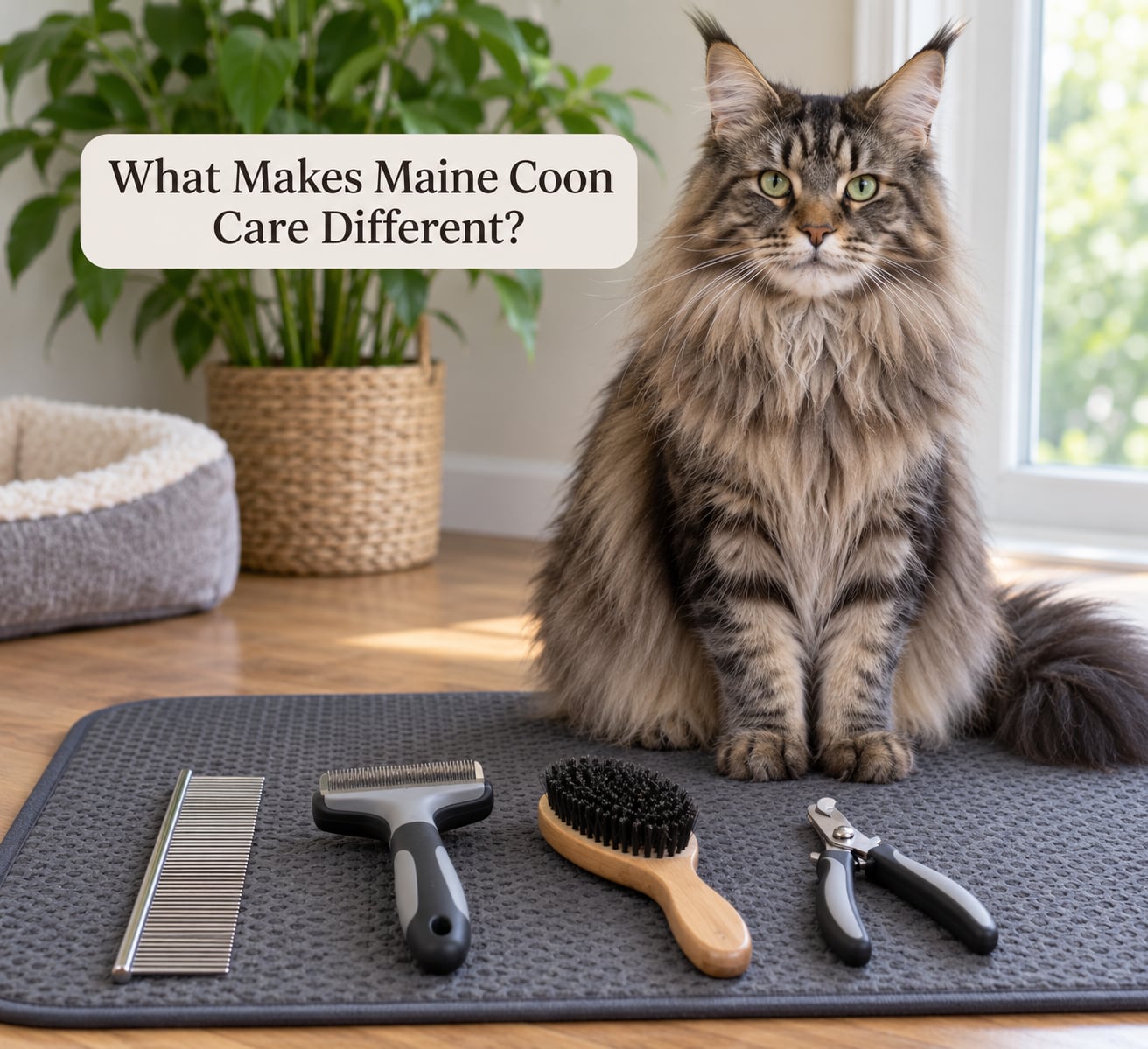
Maine Coon care differs from average-cat care in about four areas: coat, scale, temperament, and a strong preference for height. Each one has a practical response, and none of them means the breed is difficult.
The coat is the big one. A Maine Coon has a dense, water-resistant double coat with a soft undercoat under longer guard hairs, plus a heavy ruff around the neck. That undercoat is what sheds, and what tangles into mats. Coat care is the single most time-consuming part of living with one, and it is the part most worth getting into a habit early.
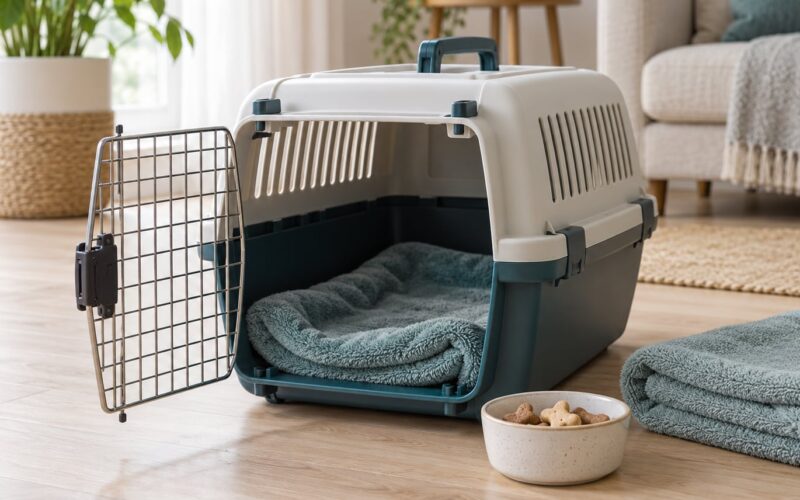
Scale changes your house, not just your cat. Litter boxes need to be oversized so a large cat can turn inside one. Bowls should be wide and stable, because a heavy cat can tip a narrow feeder and a wide one reduces the whisker contact some cats dislike. Carriers and harnesses have to be the large size from day one, since a cat only ever grows. Cat trees need a weight rating well above your cat’s adult weight, and the base needs to be solid, because a nineteen-pound cat landing hard from a height is a lot of force for a particle-board post.
Most Maine Coons are unusually social and vocal for a cat, and many learn to walk on a lead or come when called. That friendliness is a gift on a bad day and a nuisance at three in the morning when the hallway is a racetrack. It also means they often object to being handled against their will, and forcing a struggling cat into a brush or a carrier is a fast way to lose the trust you were relying on.
Climbing instinct is strong, and so is the pull toward water. A tall cat tree and a window perch are not extras, they are part of the furniture budget. Many Maine Coons will sit in a sink or supervise from the edge of a bath, and that tolerance makes bathing a far calmer job than the breed’s reputation suggests.
Maine Coon Care and Size Expectations by Life Stage
Care changes in three fairly distinct stages, and the transition between them deserves more attention than the stages themselves.
Kitten, birth to about six months. Feed a complete and balanced kitten food in measured portions, four small meals rather than two large ones. Vet visits are frequent, including vaccinations and a discussion about spay or neuter timing. Set up a scratch post, a covered litter box and a play area now, before the kitten is big enough to ignore new furniture. Litter: large pellets or a low-sided box, because small litter is hard for a growing kitten to balance in.
Adolescent, six months to roughly eighteen months. This is the window where portion control matters most. Move to an appropriate life-stage food, keep measuring rather than topping up the bowl, and build the exercise habit you want to keep. Climbing access now pays off later: a cat that learns to use a sturdy tree and a wall shelf as a teenager is far more likely to stay active than one that never did.
Adult, eighteen months onward. Full grooming every week at minimum, more during the twice-yearly shedding seasons. Food adjusted to keep the same body condition score, which usually means slightly less than you fed at eighteen months. Routine veterinary checks continue on the same schedule as any adult cat, plus any breed-specific screening your veterinarian recommends. Enrichment changes with age too: a big cat still needs daily play, but the sessions can be shorter and more puzzle-based.
Two practical things cut across all three stages. Feed from measured meals rather than a self-serve bowl, because a large cat with free access will quietly overshoot. And change food gradually over seven to ten days, mixing old and new, because a sudden switch in a cat with a sensitive stomach is the fastest route to a vet visit you did not plan.
How to Groom a Maine Coon Without Matting
Combing is the answer, and the tool is a metal comb with widely spaced teeth rather than a brush. Owners on r/mainecoons and r/MaineCoon report that switching to a metal comb largely solved their matting, and that the cats often seemed to enjoy it, which matters more than any product. A brush smooths the top layer and leaves the undercoat sitting underneath, where it then knots against the skin. A comb reaches the undercoat directly.
Run the comb in short strokes from the skin outward, always in the direction the hair grows. When you find resistance, stop and work the mat apart with your fingers rather than pulling. A tight mat pulls on the skin, and pulling on a tight mat is how you get a cat who now hates being groomed.
Four areas mat more than the rest, and owners consistently name the same ones. Check the belly, especially the lower abdomen and groin crease. Check the armpits. Check the back from the base of the tail forward, where friction from lying down works the coat into knots. And check behind the ears, where the fine hair tangles easily. Owners also say those are the mats that end up being cut out with clippers, so five minutes of attention in those four spots prevents a sedated appointment.
A workable routine looks like this. Comb through the whole cat daily while it is relaxed, in short sessions, and pay extra attention to the four hotspot zones. Check the armpits and belly every few days even if the full comb takes a day off. Vacuum or sweep the same spots every day or every second day, because fur that ends up on the floor is fur you removed before it tangled. Expect heavier shedding twice a year, in spring and again before winter, when the undercoat comes loose in handfuls.
Tools worth having: a metal comb for the undercoat, a deshedder for loose hair pulled off the coat, a soft bristle brush for the guard hairs and for finishing, and pet-safe nail clippers for the claws. Introduce each one over a few days with treats, and keep the first sessions short. Some cats will not sit still for a full groom, and two calm minutes every day beats one wrestling match a week.
Do not shave the coat. The undercoat is not decorative, it is insulation and skin protection, and shaving it can damage the follicles, change the coat texture permanently and expose the skin to sunburn. A clipper-trim of a small mat, or a careful cut with blunt-tip scissors by someone who knows what they are doing, is the right tool for a mat. A razor shave across the back is not.
Bathing is easier than most people expect with this breed. Monthly, or whenever the coat is dirty or oily, with a cat-safe shampoo, lukewarm water, and a towel dry plus a low or cool dryer on a distance. Many Maine Coons tolerate water well and will step into a sink unprompted. Nail trims every few weeks keep the claws blunt, and a quick look inside the ears every week or so is sensible, though anything beyond that belongs with your veterinarian.
Get a veterinarian involved rather than working on it yourself if you see persistent skin irritation or bald patches, swelling, an odor from the skin or ears, bleeding, sores, or a mat so tight and extensive that it cannot be separated. Cats groom for many reasons, and itching, over-grooming, sudden hair loss or a coat that has gone thin in patches is a medical question rather than a grooming technique question.
Food, Exercise, and Weight Management
Feed a complete and balanced food matched to the life stage, and measure it. Maine Coons have an active metabolism and a genuinely large appetite, which makes them easy to overfeed, and a fat large cat is a heavy large cat. A rough guide many owners use for a cat in the twenty-pound range is 350 to 400 calories a day, but energy needs vary with age, body condition, activity, indoor or outdoor access and whether the cat is neutered, so treat any number as a starting point to check with your veterinarian rather than a target to defend.
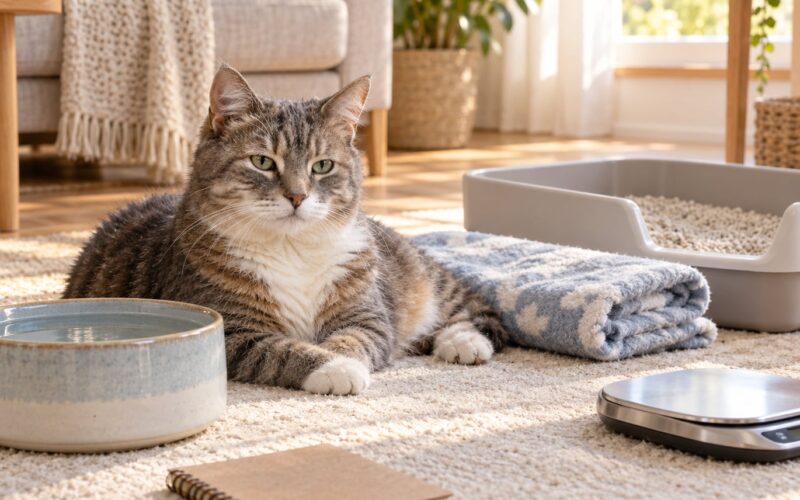
Weight is a function of balance, not breed. Maine Coons do not automatically get fat, but they can, and the breed has a reputation for it that is partly earned and partly inherited from sales copy. The practical approach is a body condition score rather than a maximum-weight goal. Feel for the ribs, look for a waist from above, run your hands over the hips, and have your vet score the cat on the nine-point scale at each visit. Adjust the portion to the score rather than to what a chart says the breed should weigh.
Exercise needs a structure, not a hope. A wand toy session of ten to fifteen minutes twice a day, a cat wheel rated well above your cat’s weight, sturdy scratching posts, and a tall tree with a base heavy enough not to tip, together cover most of it. Rotating a small set of toys keeps interest higher than leaving the same five out permanently. Puzzle feeders and treat hunts extend the same idea for cats who would rather not chase anything, and they slow down meal times, which helps with both boredom and gulping.
Watch for the two feeding extremes. Crash diets and weight-loss food imposed on a cat without veterinary guidance cause muscle loss along with fat loss, and a big cat losing muscle is a big cat with a worse problem than it started with. Forced exercise is the mirror image, and trying to exhaust a cat that does not want to be chased is neither effective nor kind. Steady, boring consistency beats both.
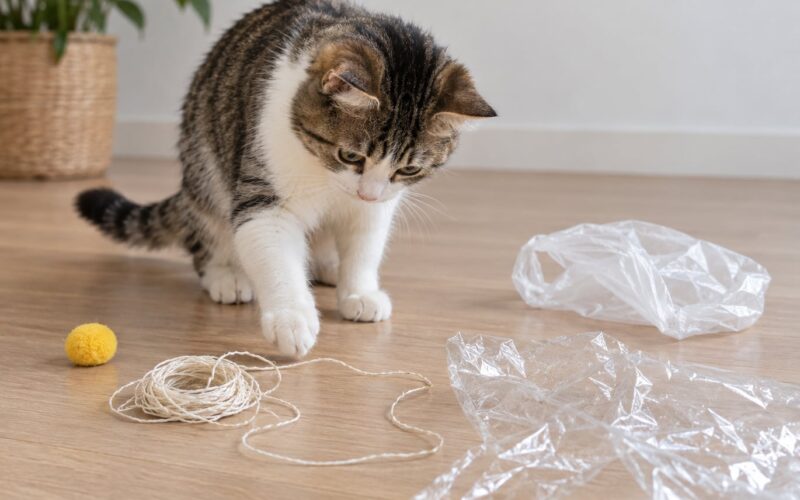
And the basics that are not negotiable: never human medication, no chocolate, no onion or garlic, no grapes or raisins, no alcohol or caffeine, and no string, ribbon or dental floss, because a long intestine is a surgical emergency. Keep lilies out of reach, since they are acutely dangerous to cats. If you are unsure about a food or a plant, ask your veterinarian first.
When a Maine Coon’s Size or Growth May Need Checking
Steady growth along a percentile curve is normal, and abrupt change is what deserves attention. Worth raising with a veterinarian: growth that is dramatically faster or slower than expected over a few months, a change in body shape such as a distended or suddenly narrow abdomen, a persistent increase or drop in appetite, weight loss despite a normal appetite, repeated vomiting or diarrhoea, a coat that thins or loses its shine without a seasonal explanation, reduced activity, reluctance to jump or any stiffness in the hips or knees, laboured or fast breathing at rest, or noticeably increased thirst and increased urination. In cats, sudden weight loss in an older cat is one of the changes most worth acting on quickly, and kidney and thyroid problems are common and treatable when caught early.
Two breed-associated conditions come up in almost every conversation about Maine Coons, and it is reasonable to ask about both. Hypertrophic cardiomyopathy is an inherited thickening of the heart muscle that shows up in a minority of cats; an echocardiogram is the screening test your veterinarian can arrange, and adult cats are generally rechecked. Hip dysplasia, where the hip joint does not fit snugly, produces stiffness, hesitation about jumping and early arthritis. Polycystic kidney disease is an inherited kidney condition, and DNA testing has made it straightforward to ask a breeder about. Ask what has been done, ask for the actual report or test result, and ask whether it was done on the parents or the kitten. Papers are a starting point, not a medical record. A kitten that arrives with a registration certificate and a hereditary diagnosis is unfortunately a real scenario reported by owners, so early testing is the cheapest protection.
On lifespan: many Maine Coons live into their early to mid teens, and the spread you see published, roughly twelve to fifteen years, reflects genetics, body condition, dental care and how early any heart or kidney issue was found. That is general information, not a prediction for your cat.
Two practical habits pay off here. Keep a short written record, monthly weight, coat condition, appetite and any change in behaviour, because you will not remember details at the appointment. And ask your veterinarian directly whether a baseline echocardiogram makes sense for your cat, and at what age. Neither this section nor any other part of this guide replaces an examination; diagnosis, treatment and any medication plan come from your veterinarian, never from an article.
Frequently Asked Questions
Is every Maine Coon exceptionally large?
No. Adult males usually weigh 13 to 22 pounds and females 8 to 15 pounds, which is well above a typical domestic shorthair, but plenty of Maine Coons sit at the lower end. Pedigree line matters, and a Maine Coon mix can carry the long coat and friendly personality without the large frame. A cat sold without verifiable ancestry is often a mix, so expect a moderate size rather than the breed maximum.
When does a Maine Coon kitten reach its full adult size?
Most Maine Coons reach their full frame between three and five years of age, rather than at twelve months like most cats. A one-year-old male might be ten to thirteen pounds and still have years of growth ahead. A common mistake is pushing food to speed things up, which adds fat, not frame. Photograph or weigh your kitten monthly and let your veterinarian plot the trend.
Are male Maine Coons always larger than females?
On average, yes. Males typically settle around 13 to 22 pounds and females around 8 to 15 pounds, and the size gap is more noticeable after the first year. There is plenty of overlap, so a large female and a smaller male are both normal. Neutering before puberty tends to produce a slightly later and somewhat lighter adult, which is a normal result and not a growth problem.
How often should a Maine Coon be brushed to prevent mats?
Comb rather than brush, and do it daily if you can. Short sessions with a metal comb catch loose undercoat before it knots, while a brush mostly smooths the outer hairs. Owners in Maine Coon forums report that switching to a comb largely solved their matting. Check the belly, armpits, back near the base of the tail, and behind the ears every few days, and vacuum daily or every second day during shedding seasons.
When should a Maine Coon’s weight or growth prompt a vet visit?
Book an appointment if growth is dramatically faster or slower than expected over a few months, if body shape changes noticeably, or if you see persistent appetite changes, weight loss, repeated vomiting or diarrhoea, coat thinning, reduced activity, stiffness in the hips, laboured breathing at rest, or a big increase in thirst and urination. Sudden weight loss in an older cat in particular is worth checking promptly, because causes such as kidney or thyroid problems are common and treatable when caught early.
Start With a Healthy Growth Plan
Set the size expectation somewhere realistic: a large, long cat that finishes growing at three to five years, not fully grown at one. Then aim at a body condition score rather than a maximum weight, because the healthy version of this breed is a ribby, long, slightly lean cat with a heavy ruff, not a round one.
Feed measured meals of complete and balanced food appropriate to the life stage, and adjust by condition rather than by the bowl. Give daily play, tall climbing furniture rated for the weight, and a large litter box. Comb the coat on a short daily routine, with extra attention to the belly, armpits and tail base, and never shave it.
Finally, keep a simple written record of weight and coat condition, arrange routine veterinary care, and raise the screening questions with your vet early. Any abrupt or disproportionate change in growth, weight, appetite or movement deserves a conversation with a veterinarian rather than a guess. Everything about Maine Coon care and size expectations gets easier once you stop chasing a number and start watching the cat in front of you.