How to stop a dog from chewing furniture comes down to three things at once: redirect the chew onto an approved toy, physically block access whenever you cannot supervise, and make the furniture itself taste unpleasant with a pet-safe bitter deterrent. No scolding, no punishment after the fact. Most dogs show clear improvement in four to eight weeks of consistent work, and puppies usually need the full run of teething behind them.
Chewing is not a defect in your dog. Dogs explore with their mouths, and a couch corner or a baseboard smells like you, which is exactly the scent a dog finds worth investigating. The problem is never the chewing itself. The problem is that your dog picked the sofa instead of the toy in the basket.
This guide covers both ends of the age range: puppies working through teething, and adult dogs who chew destructively, including dogs with separation anxiety and dogs who chew only when nobody is watching.
Table of Contents
- What You Need
- Step-by-Step: How to Stop a Dog from Chewing Furniture
- 1. Identify what makes your dog chew furniture
- 2. Block access to the furniture your dog targets
- 3. Redirect your dog to an appropriate chew
- 4. Reward your dog for leaving furniture alone
- 5. Use a dog-safe deterrent only as backup
- 6. Increase exercise, enrichment, and supervision
- 7. Gradually test and reinforce the training
- Common Mistakes
- Frequently Asked Questions
- What deterrent works best for a dog chewing furniture?
- How can I stop a puppy from chewing furniture?
- Why is my adult dog suddenly chewing furniture?
- What should I do if my dog chews furniture when I leave home?
- When should furniture chewing in a dog be a reason to see a vet?
- Conclusion
What You Need
You do not need all of this. Most owners need three things on day one: something to keep the dog away from the sofa, something good for the dog to chew instead, and a few treats you are not precious about.
- A short leash or drag line. Held indoors while you supervise, it lets you guide the dog away from a footstool without a chase. This is the single most useful training tool in the list, and trainers on r/OpenDogTraining recommend it for exactly this reason.
- High-value treats. Small, soft and smelly, cut into pea-sized pieces so training stays quick. Treats only work if they are better than the alternative, which for a dog is usually your attention.
- Two or three chew options. One for active supervised chewing, one for the times you need a long-lasting food toy, and one you can hand over instantly. Match the chew to the dog, not to a photo online.
- A pet-safe bitter deterrent. Buy a commercial spray that is labelled for use on furniture and safe for dogs, and follow the label on reapplication. This is a backup step, never the first one.
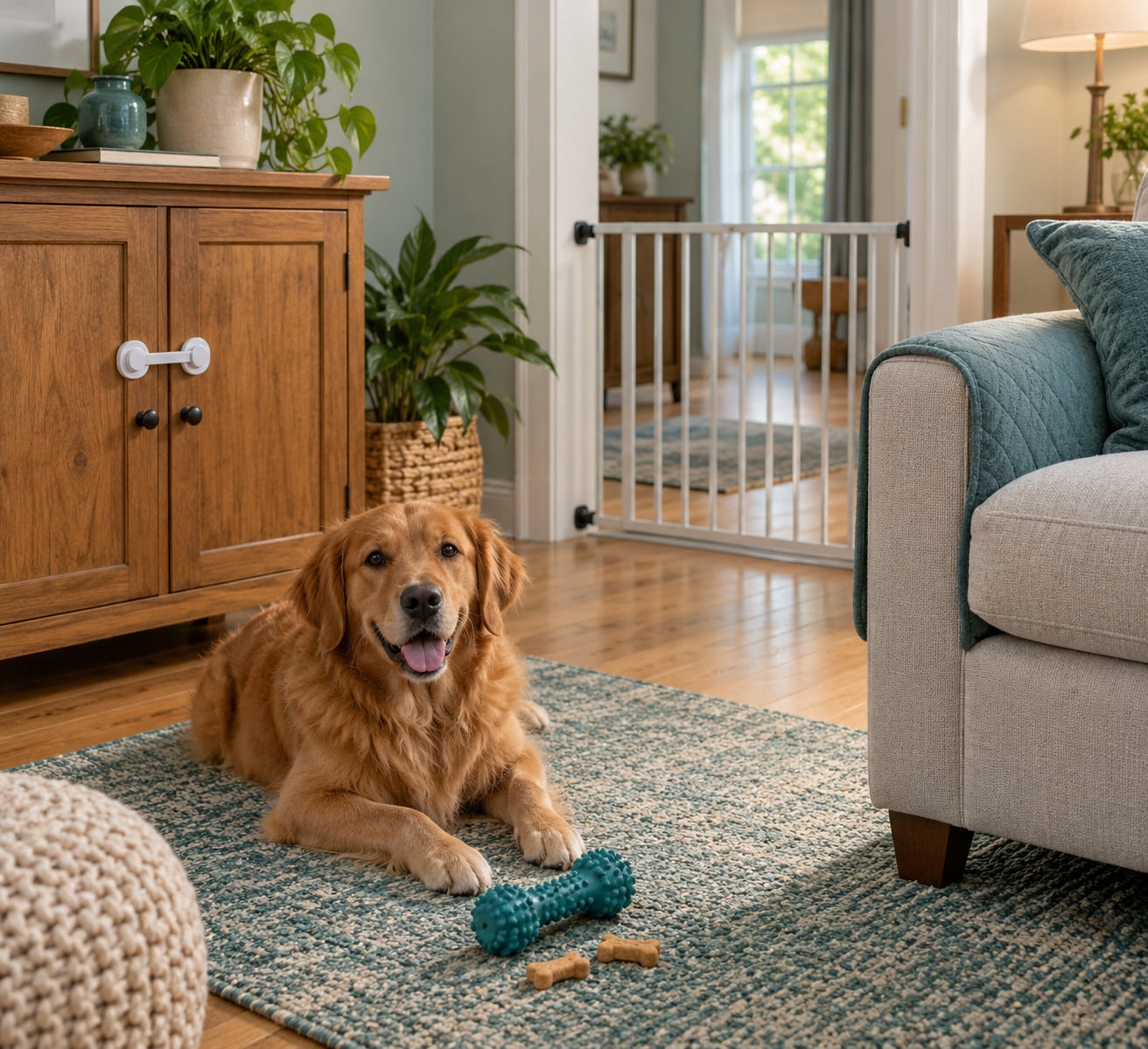
- Physical barriers. A baby gate or exercise pen, cabinet latches for a kitchen or TV unit, fitted furniture covers, corner guards on sofa arms, and pet-safe double-sided tape for edges you cannot cover.
- An enzyme pet-safe cleaner. For furniture that carries food, urine or saliva scent, which quietly invites more chewing.
One warning before you buy the deterrent: anything labelled for humans is off limits. Human medication, essential oils such as tea tree or eucalyptus, vinegar in quantity, and household cleaners can all harm a dog who licks the furniture afterwards. If a product is not sold and labelled for pets, leave it on the shelf.
Step-by-Step: How to Stop a Dog from Chewing Furniture
1. Identify what makes your dog chew furniture
Watch when it happens, not just where. Chewing that happens when you leave the room or leave the house is a different problem from chewing that happens the moment you sit down, and the two need opposite fixes.
Look at the damage, too. Sofa corners and baseboards are the usual casualties, because they sit at nose height and carry your scent. Scattered small items and chewed edges on things you never leave out suggest boredom or excess energy. Chewing that clusters around one room usually means the dog is anxious in that room.
Common triggers, roughly in order of how often they turn out to be the cause:
- Teething. Puppies between about three and eight months chew everything, furniture included. It fades, slowly.
- Boredom and excess energy. A dog with nothing to do and pent-up energy finds the nearest interesting object.
- Attention-seeking. Owners on puppy forums describe dogs who start chewing the moment they stop looking. Chewing gets you back, which is the whole problem.
- Separation-related stress. Chewing that starts in the first twenty minutes after you leave, often with barking or scratching, points here.
- Discomfort. Sudden, intense chewing in an older dog that also eats less, drops food or seems tender in the mouth needs a vet, not a training plan.
2. Block access to the furniture your dog targets
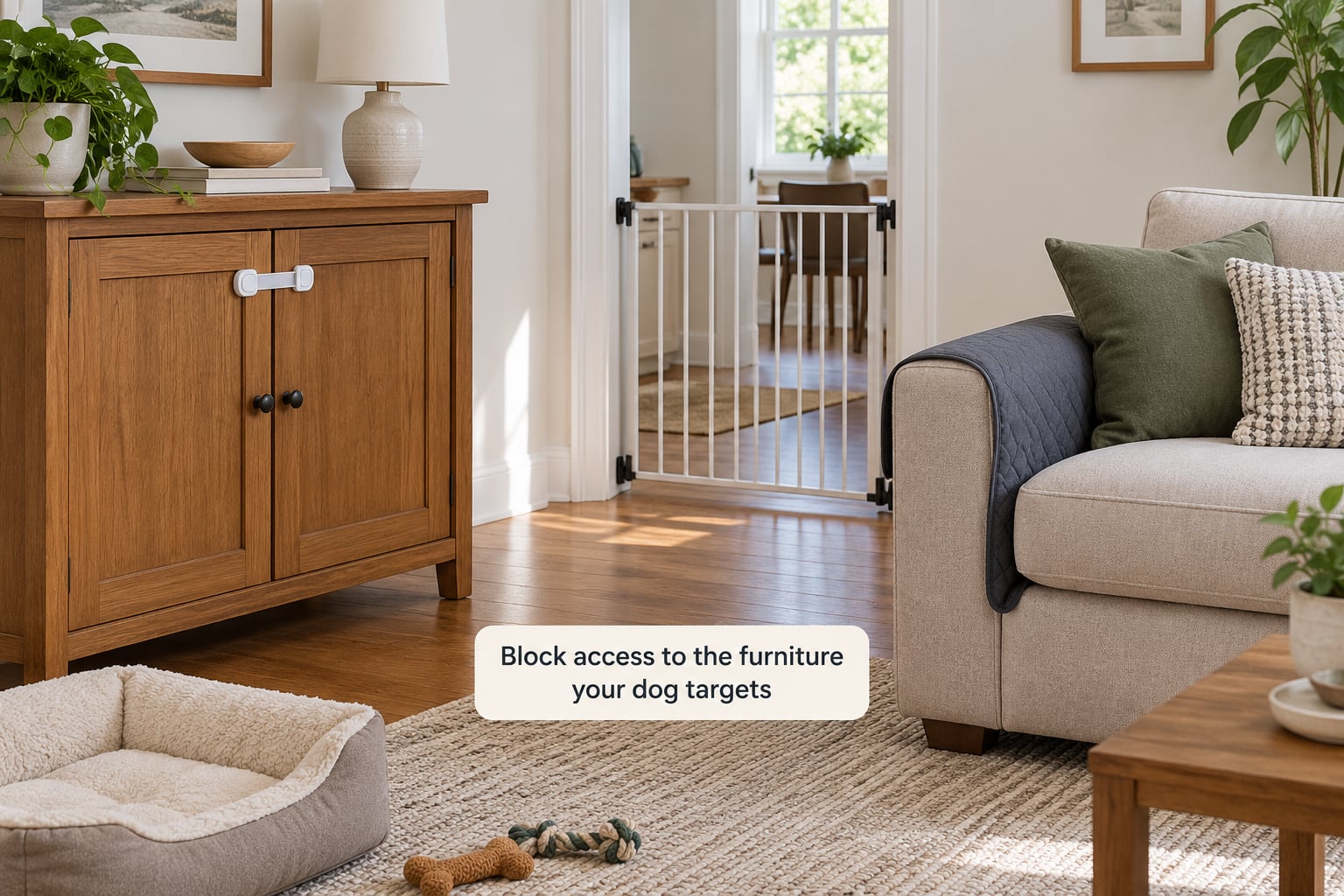
Management is not a failure of willpower. It buys you the weeks you need while the training catches up, and it protects the sofa while you are learning the dog’s patterns. Owners on r/goldenretrievers and r/puppy101 describe closing doors, using an exercise pen and kennelling as the tactics that actually held while the training took effect.
Match the barrier to the dog. A determined labrador respects a gate; a small terrier needs a barrier with no gap underneath. Cabinet latches solve the kitchen, fitted covers solve the sofa, corner guards protect the arm you care about, and pet-safe double-sided tape makes an exposed edge unpleasant to test.
Make the blocked zone boring rather than punishing. Move the interesting things out of reach, so a blocked room simply has nothing in it. A dog who keeps choosing a room you emptied has made a reasonable decision.
3. Redirect your dog to an appropriate chew
Give your dog something worth choosing. For a puppy in teething that means something cool and soft, like a chilled rubber chew. For an adult dog who shreds things, a food puzzle or a hollow rubber toy filled with peanut butter lasts far longer than a plush squeaker.
Watch how your dog chews and match the toy to it. Side-to-side shredders do well with long tough chews; dogs that gulp need something large enough that they cannot swallow the whole thing. Nothing unsupervised should be small enough to be swallowed or brittle enough to break into swallowed fragments, and that applies to chew toys at home just as much as it applies to anything in a pet shop.
The swap matters more than the toy. When the dog picks up a footstool, calmly guide them away, hand over the chew while they are still looking at you, and let them keep it. Do not snatch the footstool and hand over a treat in the same motion, because that teaches a trade rather than a rule.
4. Reward your dog for leaving furniture alone
Run this sequence three or four times a day for a couple of minutes at a time, not once a week for twenty minutes. Sit near the furniture your dog targets. If the dog looks at it, say your marker word or simply say yes, wait for four paws on the floor, and deliver the treat to the floor rather than to the hand.
Mark before you reward. The half-second between the behaviour and the treat matters, and the marker is what tells your dog which of the four things it just did was the right one.
Once the behaviour is reliable, name it. Add a cue such as leave it or off, say it as the dog looks at the furniture, and pay the moment the weight shifts back to you. Consistency beats volume: five short sessions daily will outperform one long one every other day, and small treats work fine if they arrive on time.
5. Use a dog-safe deterrent only as backup
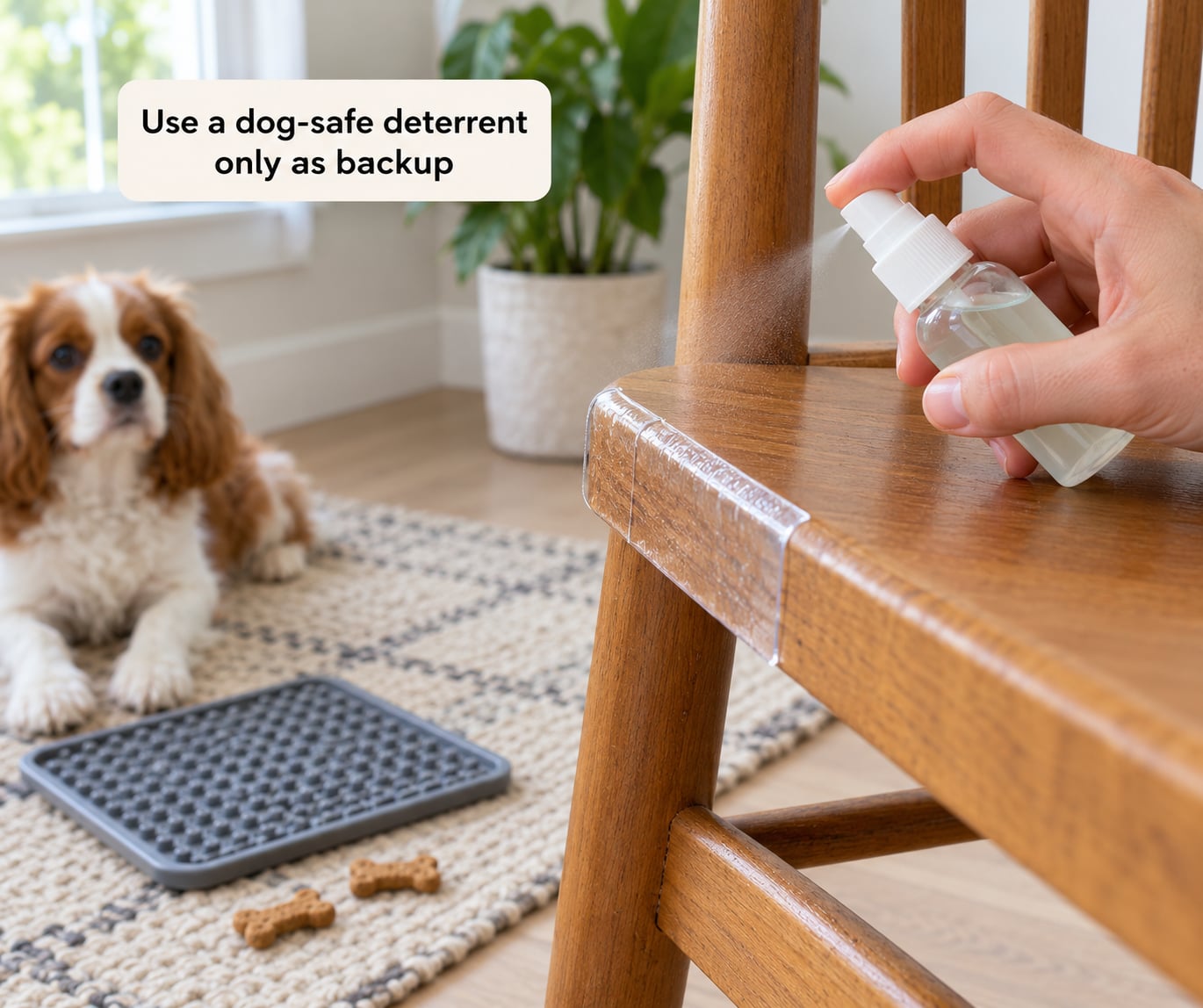
Spray a thin coat of the deterrent onto the furniture edge according to the product instructions, let it dry as directed, and keep your dog away from that spot while it sets. Bitter apple style sprays are the remedy owners name most often unprompted, including on Mumsnet’s dog house board, where it came up again and again as the spray that worked.
Then set your dog up to succeed. Put a treat down near the protected edge, wait for your dog to approach, guide them away before any contact, and pay generously for the choice. You are teaching an avoidance, not delivering a consequence.
Expect the coating to wear off, because owners report this constantly and publishers rarely mention it. Plan to reapply on the schedule the label gives you, and check the spot after a week of normal use. Vinegar sprayed on the chewing spot is the other widely repeated household workaround, and it is the one to treat most carefully: dilute it heavily, keep it off surfaces your dog licks often, and never leave a wet-soaked patch for a dog to walk through. A labelled deterrent is still the safer option.
6. Increase exercise, enrichment, and supervision
A tired dog chews less, and owners report the difference clearly: a long, interesting walk with sniffing in woods, field or beach cuts down on the same-day chewing more than any gadget in this article. Two walks a day, a training session, and a ten-minute sniff are a realistic baseline for a dog with energy to spare.
Feed part of the daily ration through a puzzle, scatter it on the floor, or use a lick mat so eating takes work. Chewing itself counts as enrichment, but only in the right spot and only while you are there to swap it out.
Supervise closely in the rooms your dog targets. Crate or pen training helps when it is done gradually and positively, as part of building a settle on a mat, and not as a punishment for chewing. Until the pattern is genuinely improving, leave that dog out of the high-risk room rather than gambling with it.
7. Gradually test and reinforce the training
Progress in small steps. After several days with no incidents, move the gate back a metre, then open the door one step further, then drop the lead and pick it up again. Watch the dog near the sofa in between rather than assuming the work is finished.
If chewing comes back, do not go to the beginning. Step back to the last level that worked, keep the barriers in place for another week, and go forward again. You are looking at a habit that took months to build, so expect weeks rather than days, and keep paying for calm behaviour long after the furniture is safe.
Common Mistakes
- Scolding after the fact. By the time you find the shredded cushion, the behaviour is over and your dog cannot connect the two. Animal welfare guidance is blunt about this: punishing after the fact teaches nothing and can damage trust.
- Yelling or grabbing the item mid-chew. Sometimes you catch them, and the result is a dog who hides and guards chews instead of one who stops.
- Human medicine and DIY essential-oil sprays. Never put human medication on furniture a dog might lick. Essential oils such as tea tree and eucalyptus can be toxic to dogs, and household cleaners can damage both the furniture and your dog.
- Leaving chew toys unsupervised. A chew left alone can still be swallowed whole, choked on or buried in the sofa. Supervise the chews that are new, and take away anything your dog gulps.
- Rewarding the wrong behaviour. Telling off the chewing and then comforting the dog teaches that chewing earns contact. Redirect and pay instead.
- Expecting one spray to fix a habit. Deterrents work while they are on the surface. Without management and training underneath, owners report the habit returning within days of the coating wearing off.
- Giving freedom too fast. One good morning is not proof. Step the barriers back gradually and only after several clean days.
To speed things up: reward at the exact moment of the choice, keep sessions short, deal with one piece of furniture at a time rather than the whole living room, and cut the number of chews you own down to two or three that you actively rotate. More toys is not the fix, and owners who doubled their toy collection often watched the problem get worse.
Frequently Asked Questions
What deterrent works best for a dog chewing furniture?
A commercially made, pet-labelled bitter spray, such as a bitter apple style deterrent, applied to the furniture edge as directed, is the most commonly recommended option. It works best as a backup behind gates and covers, because the coating wears off and needs reapplying. Never use human medication, essential oils or household cleaners on furniture your dog can lick.
How can I stop a puppy from chewing furniture?
Block the furniture first, then give the puppy something cooler and softer to chew, since teething drives most of it. Reward four paws on the floor and a glance away from the sofa, and keep sessions to two or three minutes. Puppies usually grow out of the habit as teething finishes, often somewhere between eight and twelve months.
Why is my adult dog suddenly chewing furniture?
Adult dogs chew for different reasons than puppies: boredom, excess energy, attention-seeking, or stress around being left alone. Sudden intense chewing with reduced appetite, dropped food or mouth tenderness can point to dental pain or illness. Book a vet visit if the change came on quickly or comes with any other change in behaviour.
What should I do if my dog chews furniture when I leave home?
You cannot train what you cannot see, so manage the hours you are out. Close doors, use a gate or exercise pen, or crate train gradually and positively. Give a long-lasting food toy just before you leave, keep walks interesting, and add low-cost camera monitoring to catch what happens in the first twenty minutes after you leave.
When should furniture chewing in a dog be a reason to see a vet?
See a vet when the chewing starts suddenly, is unusually intense, damages non-food objects, or comes with appetite changes, weight loss, vomiting, limping or mouth tenderness. Chewing that destroys door frames or baseboards within minutes can point to pain or a compulsive behaviour, and a certified behaviourist is the right next step if the cause turns out to be anxiety.
Conclusion
Start with three things this week: work out what triggers the chewing and when it happens, physically block the furniture your dog goes after, and give your dog a better chew to redirect onto while rewarding the calm choice every single time.
Keep the barriers up longer than feels necessary and step them back only after several clean days. Deterrent sprays and management buy you time; the reward schedule is what actually changes the habit. And if the chewing arrives suddenly, hits non-food objects, or comes with any change in appetite or comfort, talk to your vet before you change anything else.