If you want a proper method rather than a guess, learning how to tell if your dog is overweight at home takes about a minute and four checks: look at the ribs and waist from above, feel the ribs with open hands, check the side profile for an abdominal tuck, then turn what you found into a body condition score.
A home check screens for risk. It does not replace a veterinary examination, and it cannot tell you why a dog gained weight.
One thing worth saying up front: owners are not good at this by eye. A Purina survey found roughly one in three dog owners does not recognise when their pet is overweight. A UK study of owner perception went further, with about half of owners misjudging their dog’s condition and nearly 80% of those rating it too low.
Table of Contents
- What You Need
- Step-by-Step: How to Tell if Your Dog Is Overweight at Home
- 1. Look at the Ribs and Waist From Above
- 2. Feel for the Ribs With Your Hands
- 3. Check the Side Profile and Abdominal Tuck
- 4. Feel the Ribs and Waist From the Side
- 5. Use a Simple Body Condition Score
- Common Mistakes That Skew a Home Weight Check
- Tips for a More Accurate Home Check
- Frequently Asked Questions
- Can my dog be overweight if I can still see a waist?
- How can I check whether a long-haired dog is overweight at home?
- Is a body condition score accurate enough for a home check?
- When should I take my dog to the vet about weight?
- How quickly should an overweight dog lose weight?
- What to Do First After Your Home Check
What You Need
Very little. A healthy adult dog, a quiet moment when they are standing comfortably, and clean hands are enough.
What you do not need is a scale. Body condition is scored by shape and touch, not by kilograms, and no ruler or measuring tape will tell you whether a rib cage is buried under fat.
A few things distort the picture, so keep them in mind before you start. Breed, age, coat length, muscle condition, whether the dog was recently spayed or neutered, and pregnancy all change how a dog looks from the outside. That is why the check works best as a comparison of your dog with itself, month after month, rather than against a generic breed photograph.
Step-by-Step: How to Tell if Your Dog Is Overweight at Home
Run the checks in this order and stop at each one to note what you found. The combined result tells you far more than any single feature, because fat shows up in a predictable sequence: it leaves the ribs first, then flattens the waist, then rounds the belly.
1. Look at the Ribs and Waist From Above
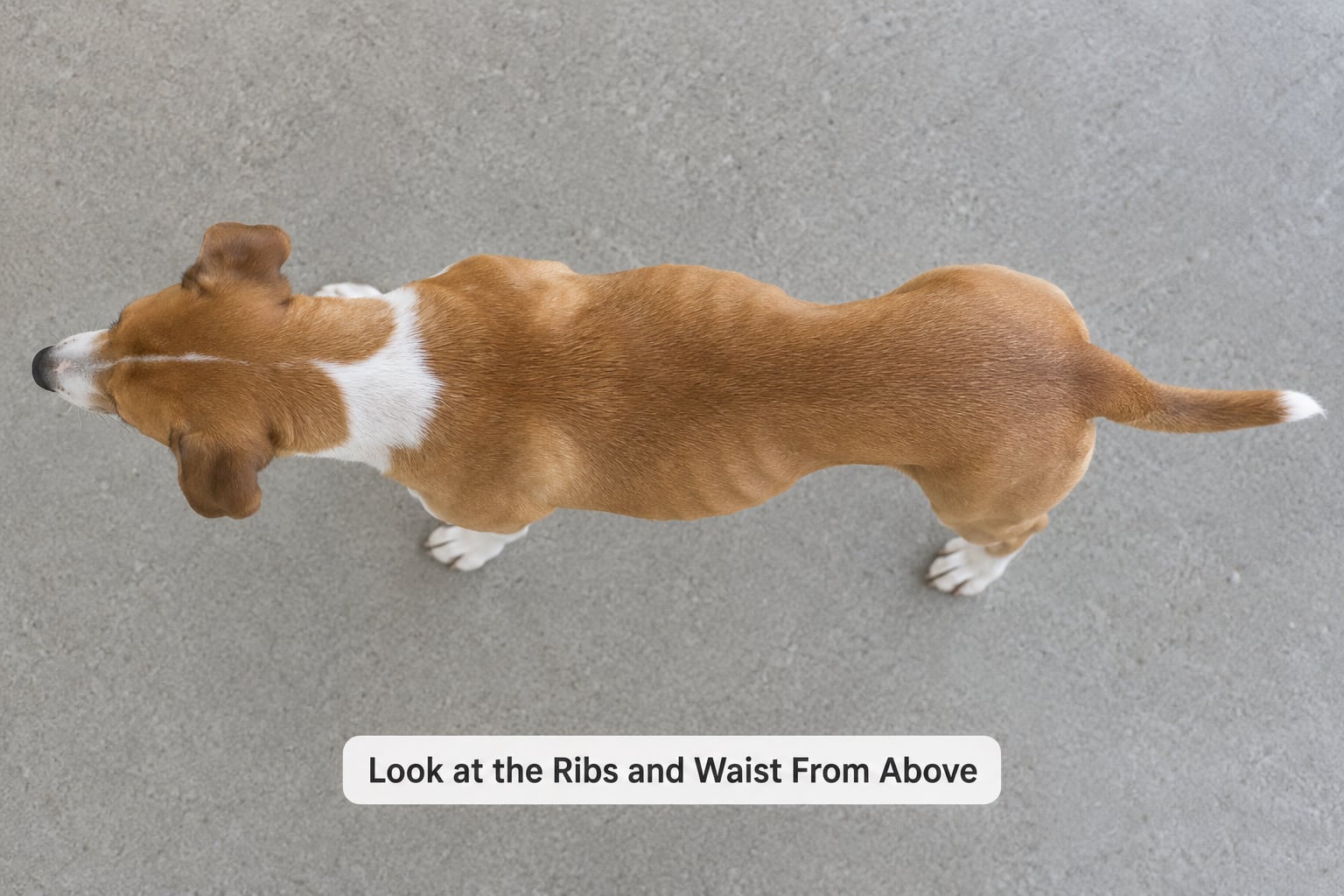
Stand over your dog while they stand square, and look straight down. If you are working out how to tell if your dog is overweight at home, this top-down view is where most owners start, and it shows two things: the rib cage and the waist behind it.
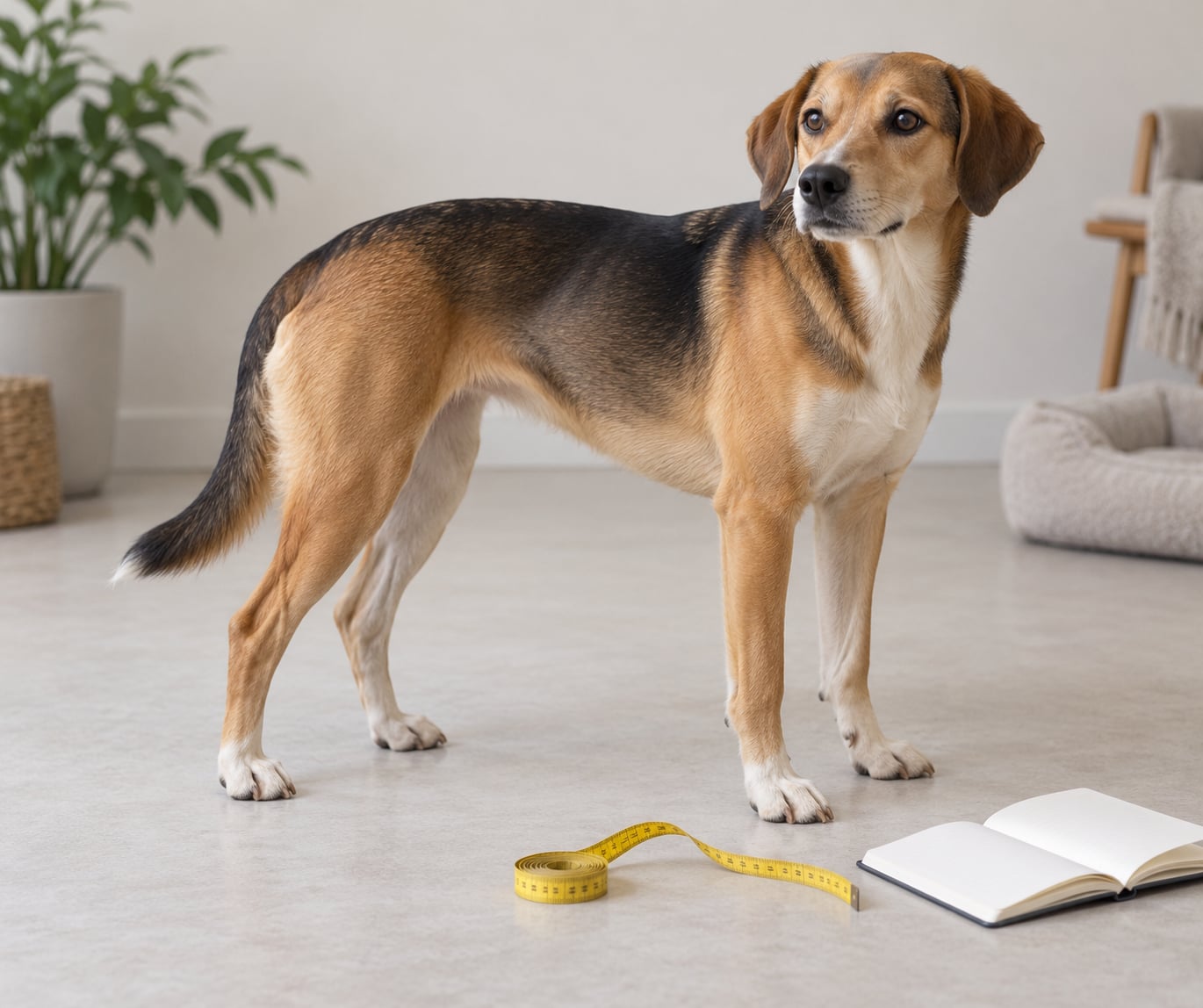
At a healthy weight, the ribs are easy to see under a thin layer of fat and the waist narrows clearly behind the last rib, giving an hourglass shape from above. If you cannot make out the ribs at all, or the line from ribs to hips runs straight down the sides with no inward curve, your dog is carrying excess fat.
Coat and build muddy this view. A long-haired dog hides everything, a muscular dog like a working breed shows a waist even with some fat on top, and a short-haired dog shows fat within weeks. Judge what you can see, then move to the parts you cannot see.
2. Feel for the Ribs With Your Hands
Run both open hands lightly over the ribs, thumbs toward the spine, without pressing. At ideal body weight the ribs are palpable under a slight fat covering, and the surface contour is easy to make out. You should not have to hunt for them.
If you have to push firmly or push for a long time before locating ribs, the dog is overweight. If the ribs feel sharp, prominent and bony with no covering at all, that is the opposite problem, and cutting food would make it worse.
This is the single most useful signal in the whole check, and it is the one owners most often skip. Visibility of ribs is genetic and breed-dependent. Palpability is the actual test.
3. Check the Side Profile and Abdominal Tuck
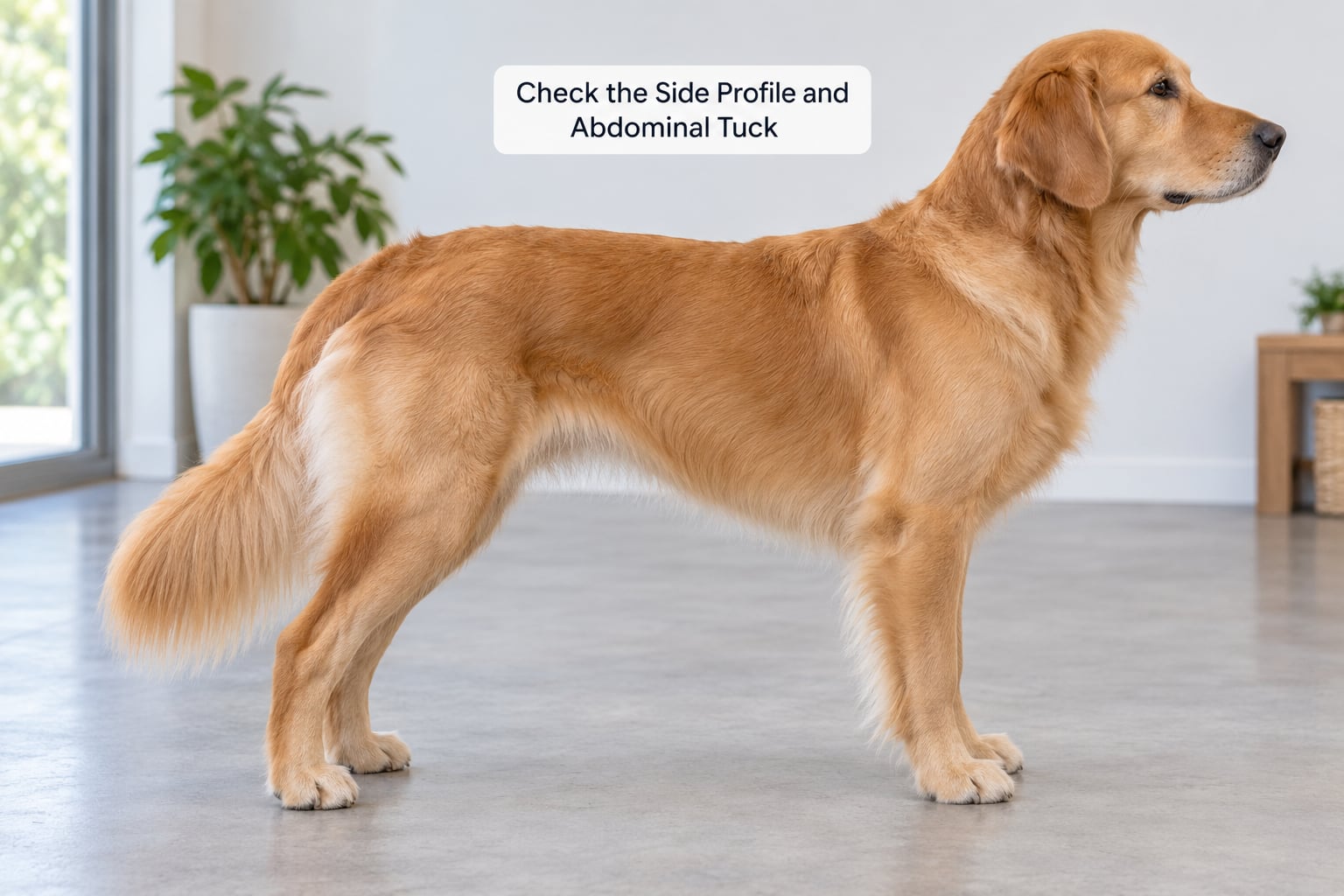
Ask someone to hold the dog, or take a photo from the side at rib height and study it afterwards. You are looking for the line running from the last rib forward to the abdomen.
At a healthy weight that line angles upward into a visible tuck-up. When the tuck disappears and the belly hangs level or drops below the chest, most of that is fat. A dog with a clear belly droop but a slim waist from above is a different story, and that pattern usually points to something other than calories.
Posture skews the result. A dog leaning forward, panting, or standing with legs stretched will read as heavier than they are. Deep-chested breeds such as setters and shepherds will always look fuller here than a greyhound, and that difference is normal.
4. Feel the Ribs and Waist From the Side
Repeat the tactile pass with the dog standing beside you rather than in front. Slide a hand along the side, feel the last rib and the curve of the loin just behind it, and note whether a light fat layer sits over the top of the ribs and spine.
At ideal condition the waist is a slight inward curve behind the ribs and the spine is palpable with a thin fat layer over it. A thick coat, loose skin, age and hard muscle all change what your hands detect, so use a slow pass and part the fur with your fingers as you go if you cannot feel anything at first.
5. Use a Simple Body Condition Score
The World Small Animal Veterinary Association uses a nine-point scale, where 5 is ideal and 3 to 8 covers the range from underweight to obese. Score what you found rather than what you hoped to find.
| Score | Ribs | Waist from above | Abdominal tuck | Other fat |
|---|---|---|---|---|
| 1 to 2 | Very prominent, thin and sharp | Clearly visible | Strong tuck-up | None apparent, bony landmarks stand out |
| 3 | Easy to feel, no fat covering | Visible | Clear | Hip bones and spine stand out |
| 4 | Easy to feel, slight fat covering | Easily visible | Clear | Hip bones easily felt, spine visible |
| 5 | Palpable with a slight fat covering | Visible | Clear | Ideal condition |
| 6 to 7 | Difficult to feel, heavy fat covering | Little to none | Minimal to none | Hip bones hard to find |
| 8 to 9 | Very hard to feel | Absent, sides bulge | None, belly hangs | Fat deposits over shoulders, spine and tail base |
A score of 6 to 7 corresponds roughly to 10% to 20% above ideal body weight, which is where most dogs qualify as overweight. Scores of 8 to 9 usually mean 30% or more over.
One more sign gives it away: you should be able to feel a waist easily and see a slight indent above the shoulder blades without pressing. If those landmarks have disappeared, the score is not 5.
Treat any score you give at home as a screening estimate. It tells you whether to book an appointment, not what is causing the change or what your dog should eat.
Common Mistakes That Skew a Home Weight Check
Judging by breed standard. Breed charts give ranges wide enough to be unhelpful, sometimes 20 to 30 pounds across males and females of the same breed. They are a starting point for a conversation, never a verdict on your individual dog.
Treating a narrow waist as proof of a healthy weight. A young dog can have a trim waist and still carry too much fat over the ribs. That is exactly why the waist check alone is not enough.
Pressing hard enough to hurt. The check is a light pass with open hands. Digging for ribs with your fingertips teaches you nothing about fat cover and may make your dog avoid the next check.
Reading the food label instead of the dog. Calorie counts tell you about the food, not about how much your dog actually eats. Treats, table scraps, chews and training rewards routinely add a fifth of a dog’s daily intake without appearing anywhere on the bag.
Calling a thick coat fat. A dense double coat hides the entire rib cage. Part the fur with your fingers to reach the skin before deciding anything.
Changing the diet abruptly after a positive check. Sudden cuts cause stomach upset and, in some dogs, a serious condition called refeeding syndrome. If the home check points to extra weight, the safe response is a veterinary conversation, not an immediate change.
Tips for a More Accurate Home Check
Take two photos each month from the same angle, in the same room, with your dog standing square. Side by side, they show change that daily contact hides.
Write down the score you gave and the date. A number on a calendar turns a vague worry into a trend line, it gives your vet a starting point, and it turns the next round of checking how to tell if your dog is overweight at home into a comparison rather than another guess.
Ask for a weigh-in at your next appointment. A home check narrows the question; a scale on the veterinary scale settles it, and the clinic will also record a body condition score of its own.
If you do want a number before then, weigh yourself on a bathroom scale, step on holding your dog, then step on alone and subtract. Useful as a rough trend for a large dog, unreliable for anything small.
Frequently Asked Questions
Can my dog be overweight if I can still see a waist?
Yes. A visible waist only tells you something about the shape from above. Fat accumulates across the rib cage and along the spine first, so a dog can show an hourglass silhouette from above while carrying several pounds too much. Always pair the top view with a light hand pass over the ribs. If you cannot feel them without pressing, treat the waist as unreliable.
How can I check whether a long-haired dog is overweight at home?
Skip the visual check and go straight to your hands. Part the coat with your fingers down to the skin, then run open hands lightly along the ribs and behind the last rib. You are looking for a slight fat covering over the ribs and a shallow inward curve at the waist. Photographs of fluffy dogs are close to useless for this, which is why hands win every time.
Is a body condition score accurate enough for a home check?
A nine-point score from an experienced owner is a reasonable screen, but it is not a diagnosis. Muscle condition, coat, age and breed all shift what you feel, and owners tend to score their own dog lower than a stranger would. Use the score to decide whether to book a veterinary appointment. Let your vet assign the official score and the ideal body weight.
When should I take my dog to the vet about weight?
Go in promptly if the change came on fast, if your dog has a swollen belly while the waist and ribs still look normal, or if there is sudden thirst, increased urination, panting, weakness or reluctance to rise. Those patterns point to conditions such as Cushing’s disease or hypothyroidism rather than extra calories. Booking a routine weigh-in is also worthwhile when a home check returns a score above 5.
How quickly should an overweight dog lose weight?
Slowly, over months rather than weeks. Veterinary weight loss plans usually run on a timescale of many months, and rapid loss can cause muscle loss, loose skin and, in severe cases, refeeding syndrome. Any change to food quantity or activity should be agreed with your vet first, and a recheck every few weeks lets the plan be adjusted to how your dog is actually responding.
What to Do First After Your Home Check
Run the four checks above in order, assign a score, and write it down with today’s date. If the result is above 5, or if the weight change was sudden, book a veterinary appointment and take the photos with you.
Let your vet weigh the dog and set the target before you change anything. Extra weight shortens lives and drives arthritis, diabetes, heart and respiratory problems, so the conversation is worth having early. In one study of Labrador retrievers, dogs 10% to 20% over ideal body weight lived a median of 1.8 years shorter than dogs at a healthy weight.