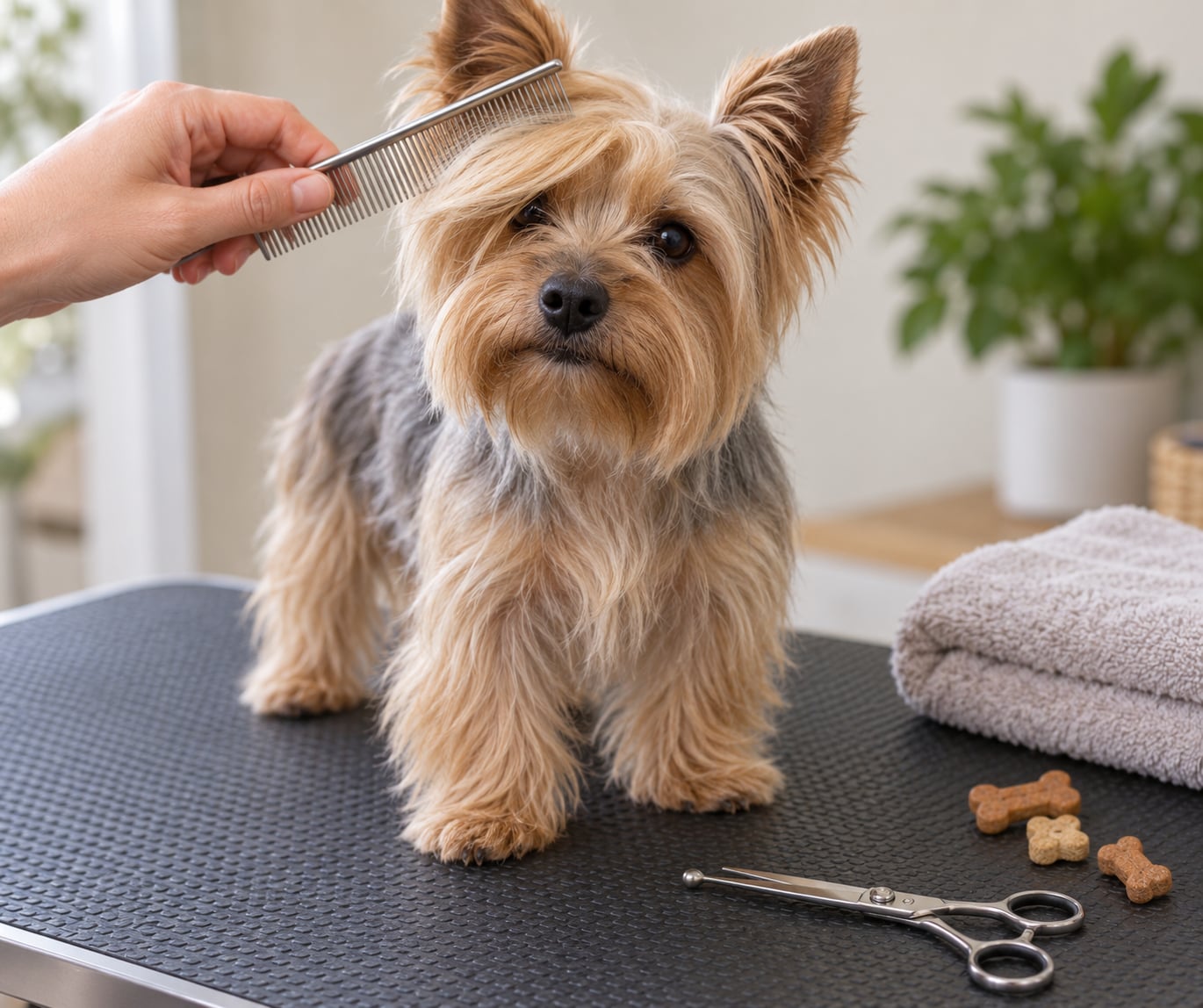
To trim hair around a dog’s eyes safely, you only need rounded-tip grooming scissors, a metal comb and a calm, still dog. Comb the fur up and away from the eye, hold the blades flat against the face with the points aimed toward the stop between the eyes, and take short snips moving outward until the hair stops blocking vision.
That whole job takes about ten minutes once your dog is comfortable, and for most breeds you only need to do it every four to six weeks. Owners of Poodles, Shih Tzus, Maltese, Yorkshire Terriers, Havanese, Bichon Frises, Cockapoos, Cavapoos and Schnauzers hit this job constantly because their facial hair keeps growing back over the eyes.
The honest part: your dog has to be willing to sit still. If they squirm, panic or freeze the second the scissors come out, stop and come back to it another day, or book a groomer. A trim that takes three attempts is better than a nick near the cornea.
Table of Contents
- What You Need
- Step-by-Step
- How to prepare your dog and pick the right hair
- How to position your dog without frightening them
- How to check the tools and comb hair away from the eyes
- How to trim hair around a dog’s eyes: take small amounts at a time
- How to check the result and reward your dog
- Common mistakes and how to fix them
- When to stop and call a veterinarian
- Frequently Asked Questions
- Should you shave the hair around a dog’s eyes?
- Can you use small clippers safely around a dog’s eyes?
- How do you trim a dog’s eye hair when the dog is scared?
- How short should facial hair be trimmed around the eyes?
- What if a dog’s eye hair grows back quickly?
- When should a groomer or veterinarian trim facial hair?
- Conclusion
What You Need
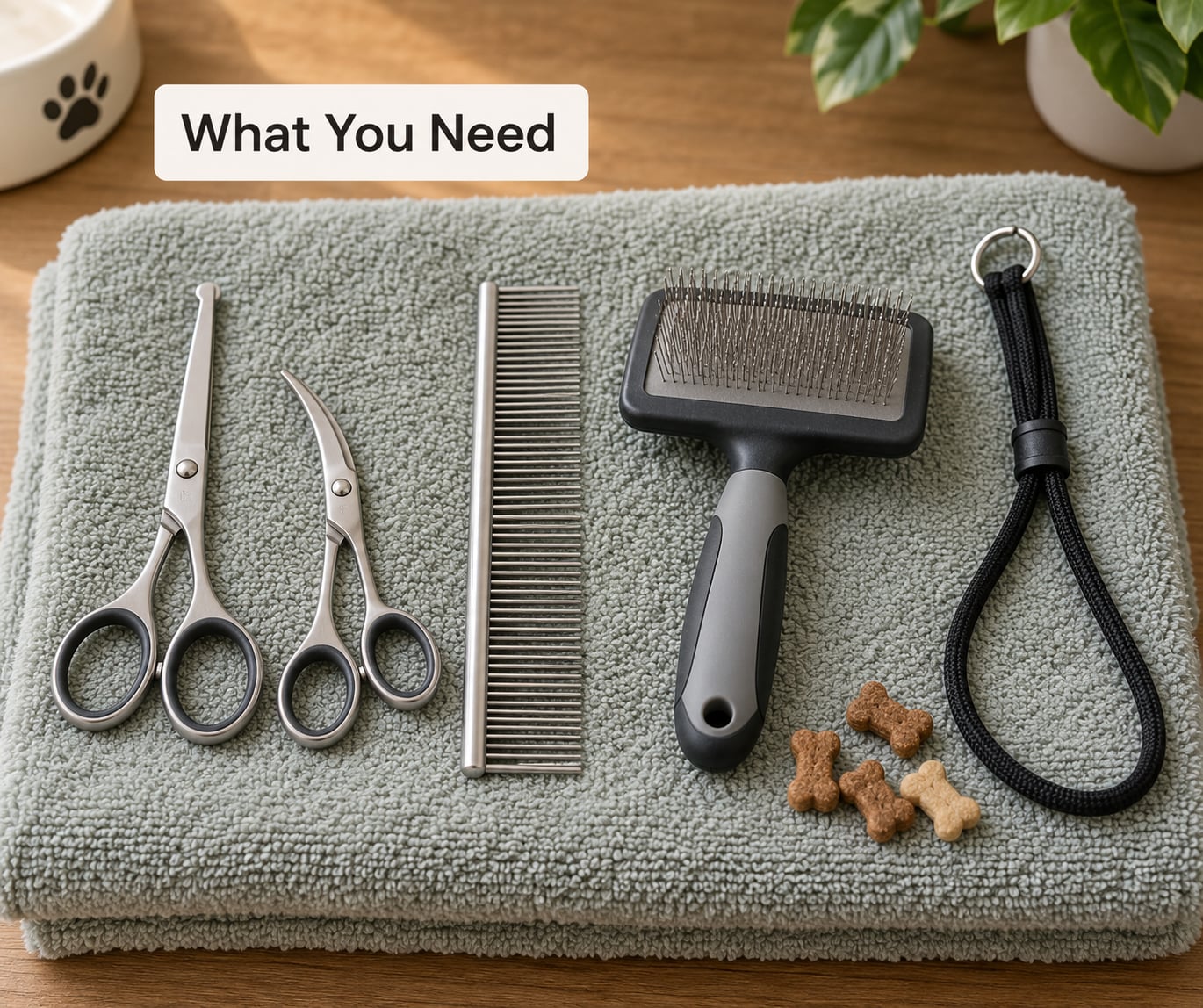
Rounded-tip or blunt-tip scissors are the one non-negotiable item. The rounded ball at the tip is there so a slip pushes skin aside instead of puncturing it, and owners on r/poodles treat it as the deciding factor between a tool they trust and one they don’t.
- Rounded-tip straight scissors for the top of the head, the stop between the eyes and the under-eye crescent.
- Small curved scissors for the fringe or visor, where a circular motion follows the face better.
- Metal grooming comb to lift hair clear and act as a barrier between the blades and the skin.
- Slicker brush or metal comb to get mats out first, since scissors over a mat pull the skin up into the blades.
- Sterile saline and soft gauze or a damp cloth to wipe away dried discharge before you cut.
- Dog treats and a helper if your dog needs one.
- A nonslip mat or folded towel so nobody slides mid-snip.
Clippers are the optional item, and only if you already know how to use them on a body coat. Owners in dog grooming groups say it plainly: clippers are for a dog who will stay completely still, and even then the under-eye crescent comes out uneven. Professional groomers usually scissor across the eyes rather than clip them.
Here is how the four main tools compare before you commit to one:
- Rounded-tip straight scissors — the stop between the eyes, the under-eye crescent and the top of the head. Low risk, because a slip pushes skin aside. Start here if you own only one pair.
- Small curved scissors — the fringe or visor around the face. Low to medium risk, and easy to overcut a curve. Learn on this after you are comfortable with the straight pair.
- Thinning shears — softening a heavy fringe without shortening it much. Medium risk, because the teeth can catch near the lid. Use them off the eye, never on it.
- A clipper with a guard — larger flat areas such as the sides of the muzzle. High risk, because a moving blade meets moving skin. Skip it unless clipping is already familiar.
Step-by-Step
How to prepare your dog and pick the right hair
Start on a dry, well-lit, nonslip surface after your dog has had a walk or a play session. A tired dog holds still longer, and light is what lets you see exactly where the hair ends and the eye begins.
Brush the face out fully before you touch the scissors. Work the metal comb through the fringe and the inner eye corner, and if you find a tight mat, comb it out in small pieces rather than cutting it, because a mat pulls skin up into the blades.
Then decide what actually needs cutting. Most owners wait until the hair is about to poke the eye or obscure it, which is exactly how the r/Maltese owners describe their routine. Leave hair that sits well clear of the eye alone, because every extra snip is another chance for a slip.
How to position your dog without frightening them
Have your dog stand or lie down, and keep one hand steady on the top of the head or under the chin. The chin-hair grip that owners on r/doggrooming recommend is simply a firm hold on the fur under the jaw so the head cannot jerk sideways while you work.
Never pull the skin taut, never clamp the neck, and never hold a squirming dog down. A helper holding treats in front of the dog’s nose is far more useful than an extra pair of hands gripping the head.
Take breaks while you are still ahead. A short trim over three calm sessions beats one long fight, and if your dog is already breathing hard, panting hard or trying to leave, the session is over.
How to check the tools and comb hair away from the eyes
Open and close the scissors a few times in the air before they go anywhere near the dog, so you know how much pressure the blades need. Rounded tips still cut skin, so treat the handles gently.
Use the comb to lift the hair up and away from the eye until you can see the eyeball clearly. Those comb teeth between the hair and the eye are the physical barrier that makes a mistake survivable, and they let you cut evenly instead of guessing.
Work in small sections rather than the whole face at once. Trim the stop between the eyes first, moving the hair toward the middle so the points always travel away from the eyeball.
How to trim hair around a dog’s eyes: take small amounts at a time
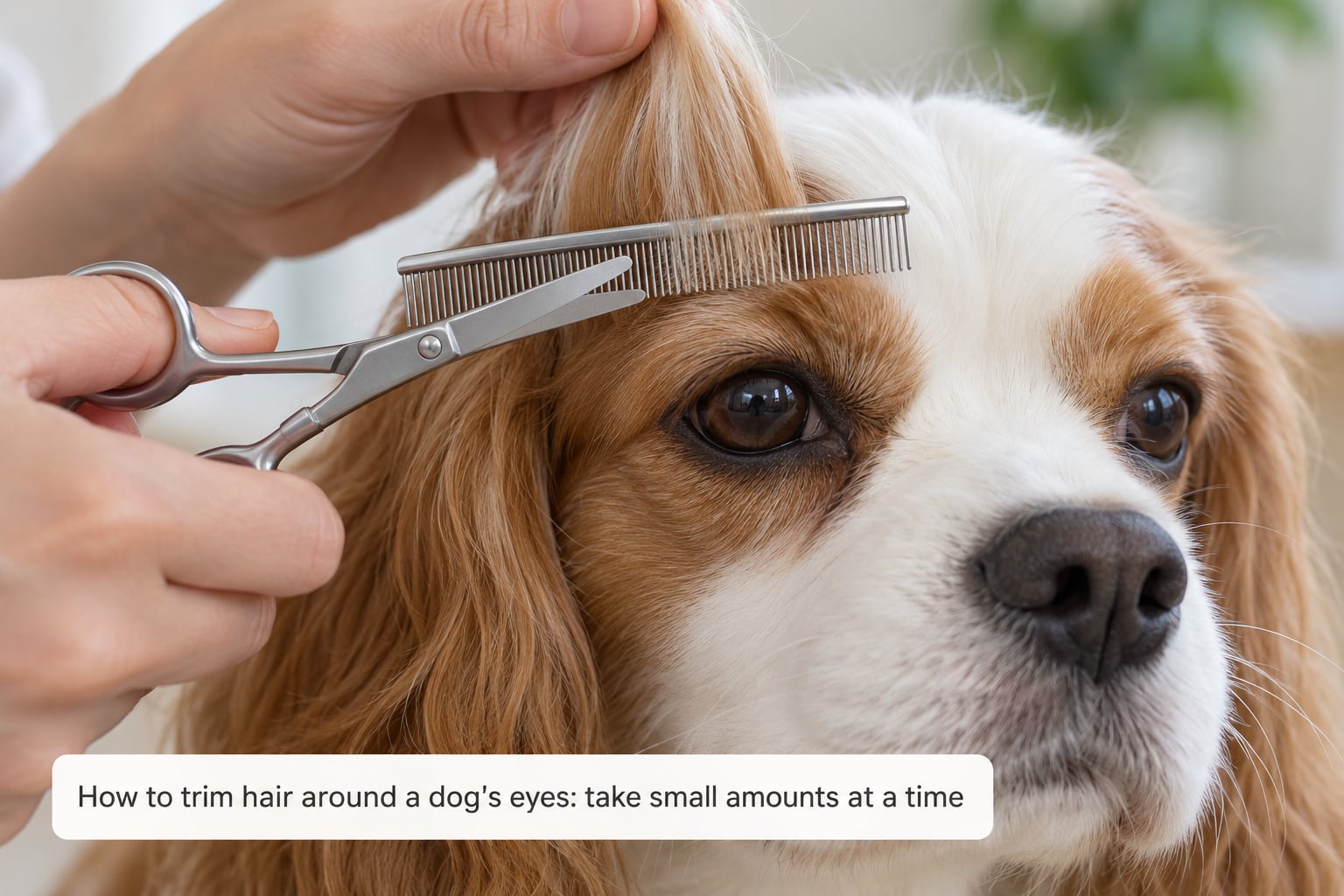
Hold the scissors flat against the face, blades resting on the skin, points aimed at the stop between the eyes rather than at the eyeball. That single habit matters more than anything else: if your dog moves or your hand slips, the tip travels sideways and away instead of into the eye.
Cut the longest hair first, well away from the eyelid, then come back and shorten the edge gradually. Snip, comb, check, snip again. Each cut should be small enough that you can see what fell before you make the next one.
Stop the moment the scissors, the comb or your hand strays near the cornea. The same applies if the dog turns their head, blinks hard or goes rigid. You can always come back in a minute, and you cannot undo a scratch.
How to check the result and reward your dog
Step back and look at both eyes together rather than at one side up close. The fringe should look even and symmetrical, the eye should be fully visible, and no hair should be curling inward toward the eyeball.
While you have the face in front of you, check for eyelashes or lid skin turning inward, which is called entropion and rubs the eye with every blink. If you see it, stop trimming and let your vet assess it rather than cutting it away yourself.
Brush off the clippings, wipe the corner of the eye with a saline-damp cloth to remove loose hair, then praise the dog and give a treat while the memory is fresh. In the following days, watch for squinting, redness or discharge rather than assuming it all went fine.
Common mistakes and how to fix them
A slip usually comes from holding the blades tip-forward or angled at the eye. Reset the scissors flat on the face, points toward the stop, and try a fresh section rather than the one that just went wrong.
Cutting too close is usually about being unable to see the eye while you snip. Comb the hair away again and only take hair you can still see clearly.
Working over mats is the most avoidable error of all. Scissor blades ride the skin a mat is pulling upward, so comb it out first or move the whole job to the groomer.
Running human clippers over the eye, leaving one side shorter than the other, and trimming a dog who is already distressed round out the list. Match both sides by eye rather than by symmetry alone, and give up for the day when the dog is fighting it.
When to stop and call a veterinarian
Stop immediately and get veterinary advice if you notice redness, swelling, squinting, excessive blinking, thick or coloured discharge, cloudiness or a white film on the eye, bleeding, or a change in how the dog behaves around that eye. Scratching at the eye makes it worse, so keep the area clean and prevent rubbing.
A corneal scratch from a scissor or a clipper blade is urgent. The same applies to any eye problem that shows up after a trim, whether or not you think you caused it. Never use human eye drops, human painkillers or human shampoo near the eye, and never try to treat it at home while you wait.
Brachycephalic breeds such as Pekingese, English Bulldogs, Pugs and flat-faced Shih Tzus have prominent, shallow-set eyes that are easily injured. For those dogs, a groomer or vet clinic with experience is the better call than a home trim.
Frequently Asked Questions
Should you shave the hair around a dog’s eyes?
No, shaving to the skin is the riskier option. Hair acts as a filter against dust and glare and gives the eye some protection from a nick. Most owners do better with scissors, taking just enough length away that the hair no longer blocks vision or rubs the eye. If a groomer clips the area, ask them to leave some length rather than cutting flush to the skin.
Can you use small clippers safely around a dog’s eyes?
Only if you already clip dogs’ bodies confidently and your dog holds completely still. A moving blade against moving skin is the highest-risk option around the eye, and the under-eye crescent rarely comes out smooth. If you clip at all, use a guarded blade and keep the guard in contact with the skin at all times, moving away from the eye.
How do you trim a dog’s eye hair when the dog is scared?
Stop cutting and desensitize instead. Over several weeks, touch around the eyes and reward the calm reaction, then introduce the scissors, make a snip in the air and treat, then a snip in the hair away from the eye, then closer. Keep sessions to a few seconds at first. One owner on r/Dogtraining needed about a year, and that is a normal timeline.
How short should facial hair be trimmed around the eyes?
Short enough that the eye is fully visible and no hair curls toward the eyeball, but not so short that the skin is exposed. Most owners trim every four to six weeks and only when the hair is starting to poke or obscure the eye. Test it by looking straight at your dog: if you cannot see the eye clearly from the front, there is still too much hair.
What if a dog’s eye hair grows back quickly?
That is normal for continuously growing breeds such as Poodles, Bichon Frises, Schnauzers, Cockapoos and Cavapoos. Short trims every three to four weeks are easier to manage than long gaps, because you take less off each time. Wiping the inner eye corner with saline or a damp cloth on a regular schedule also stops tear-stain crust building up in the hair.
When should a groomer or veterinarian trim facial hair?
Book a groomer when your dog struggles, moves suddenly or needs a full haircut, or when mats reach the eye. Choose a vet instead for flat-faced breeds with prominent eyes, for a dog with existing discharge, squinting or redness, or if eyelashes or lid skin are turning inward. A professional trim is not a failure, it is the safe call.
Conclusion
The safest first move is to remove only enough hair to clear the vision, nothing more. Comb the hair up and away from the eye, keep the scissors flat against the face with the points toward the stop between the eyes, work outward in small snips, and treat every pause as a signal to stop rather than push through.
If your dog struggles, stop for the day and desensitize slowly. If the eye ends up red, swollen, cloudy or squinting, skip any trimming and get veterinary advice straight away.