Why is my house trained dog peeing inside again? In most cases the answer falls into one of four buckets: a medical problem such as a urinary tract infection, diabetes or kidney disease, a change in the household that made the dog anxious, memory loss in an older dog, or simply a bathroom routine that drifted apart from reality. Medical causes come first, and everything after that is management. The good news is that most regressions are fixable once you find the actual trigger instead of guessing at it.
This guide walks through the same order I would use: rule out illness, hunt for what changed, rebuild the outdoor habit, and clean properly so the smell stops calling your dog back to the same carpet spot.
Table of Contents
- What You Need
- Why Is My House Trained Dog Peeing Inside Again? Step-by-Step
- 1. Check for a medical problem first: the most common reason a house trained dog pees inside again
- 2. Identify what changed at home
- 3. Restore a predictable outdoor bathroom routine
- 4. Supervise access indoors
- 5. Clean accidents with an enzymatic cleaner
- 6. Retrain without punishment
- 7. Track progress and adjust the plan
- Common Mistakes
- Frequently Asked Questions
- Can a house-trained dog suddenly start peeing inside?
- How long should I take my dog outside to pee?
- Should I punish my dog for peeing inside?
- What if my dog pees inside even when I am home?
- How do I stop my dog peeing in the same spot again?
- Can I give my dog human medicine for the peeing?
- Conclusion
What You Need
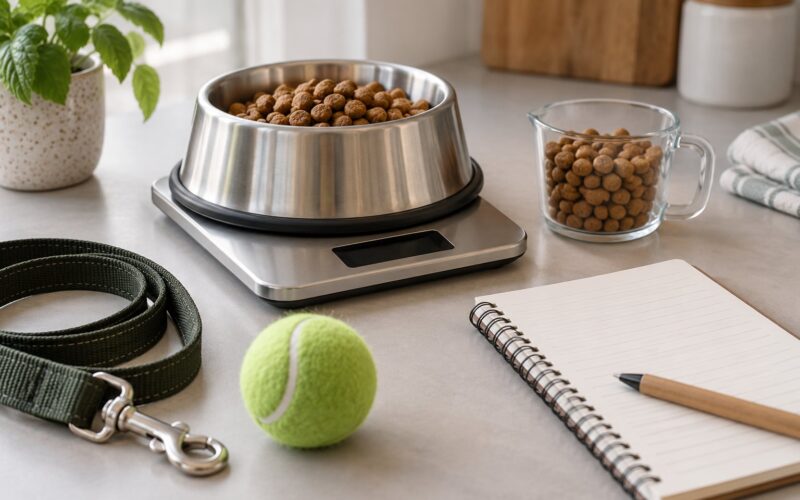
Gather these seven things before you start investigating. Having them ready turns a stressful week of guesswork into a simple routine you can actually keep.
- A written bathroom schedule. Fixed times on a paper list or your phone, not whatever the day allows.
- A leash and a harness. You want to get the dog outside fast, without a wrestling match at the door.
- Absorbent pads or pee pads. A temporary bridge for nights and for times you genuinely cannot supervise.
- An enzyme-based pet cleaner. Not a standard household spray, and one labelled safe for carpets, hardwood or upholstery where relevant.
- Fresh water within easy reach. Dogs that drink more than usual need access so you can track how much, and so restriction never becomes part of the plan.
- Treats or a favourite toy. You will use them outdoors every single time, so pick something your dog actually values.
- An accident log. A notebook works. Write down the date, time, room, amount and what was happening ten minutes before.
Skip the log and you will spend weeks saying it only happens in the afternoon without ever knowing why. The log is the cheapest diagnostic tool in this whole article.
Why Is My House Trained Dog Peeing Inside Again? Step-by-Step
Match what you see against the most likely cause before you change a single thing in your routine. Medical signs cluster differently from behavioural ones, and the split tells you who to call first.
| What you notice | Most likely category | What to do |
|---|---|---|
| Frequent small amounts, straining, licking at the genitals, accidents during sleep | Medical, urgent | Call your vet the same day |
| Drinking noticeably more water, puddles much larger than before | Medical, urgent | Ask about urinalysis and blood work |
| Dripbling or leaking while lying down or asleep, female dog | Medical | Book an appointment, mention spay status |
| Stiffness, slower on stairs, reluctance to go out in cold or wet weather | Mobility or pain | Vet check, then shorten and warm up outings |
| Accidents only when you are gone, or right after you leave | Separation anxiety | Vet first, then behaviour plan |
| Urine in corners, on furniture, in a consistent spot, small volumes | Territorial marking | Clean with enzymes, manage access, address the trigger |
| Accidents at night only, dog seems confused during the day | Cognitive decline in a senior dog | Vet check, night routine with pads |
| Accidents in a room tied to a new pet, new person or recent move | Environmental stress | Restore routine, add distance, supervise |
1. Check for a medical problem first: the most common reason a house trained dog pees inside again
A dog that was reliable for months or years does not forget house training overnight without a reason. Sudden indoor urination in a previously house trained dog is a medical question before it is a training question, and treating it as a discipline problem is the most common mistake owners make.
Ask your vet for a urinalysis with a urine culture, and blood work covering kidney values, liver values and blood sugar. That single request covers urinary tract infection and cystitis, bladder stones or crystals, kidney disease, diabetes mellitus and Cushing’s disease, which in dogs often shows up first as excessive drinking and excessive urination rather than as thirst alone.
Other possibilities your vet should consider: urinary incontinence, which in spayed females is often hormonal and treatable; arthritis or back pain that makes a trip outside or a squat genuinely hurt; diabetes; and canine cognitive dysfunction in an older dog, which erases the memory of the routine itself.
Go the same day, without waiting to see if it improves, if you notice straining, blood in the urine, frequent small accidents, a sudden increase in drinking, pain when you pick your dog up, weakness, diarrhoea alongside the accidents, or urine accidents during sleep. One forum owner described a dog urinating on her while lying on the sofa, and a bladder stone turned out to be the cause. That is the kind of story that ends badly when it waits a week.
Never give a dog any human medicine for this. Painkillers, decongestants and allergy tablets are not interchangeable with veterinary drugs, and several are dangerous to dogs. If your dog needs medication, your vet prescribes it and tells you the dose.
2. Identify what changed at home
Dogs read their schedule closely, so any change can knock a habit loose. Walk through the last four weeks and write down anything that is out of the ordinary, even small things you barely noticed at the time.
- Furniture moved or a room closed off. A dog that used to have a clear path to the door may now be blocked by a sofa.
- A new pet, a new baby, or a visitor staying in the house. Reddit owners describe fully housetrained dogs that started soiling the moment a cat arrived, one of them under the kitchen table while the cat was hiding underneath.
- Renovation or construction noise. Dogs cope badly with sustained, unpredictable noise.
- Your own schedule shifted. Longer days, remote work, a new baby, or a commute that now keeps you out past the usual outing.
- Fewer outdoor breaks than before. The most common cause of all, and the easiest to miss because it feels normal to you.
- A food change, a new supplement, or medication. Some drugs increase thirst and urination, and a diet change can irritate the bladder.
- Weather. Owners describe dogs refusing to go out in heavy rain, snow or extreme heat, then having accidents indoors the same afternoon.
Put the log and this list side by side. Patterns usually show up within a week, and one dated observation beats a month of guessing.
3. Restore a predictable outdoor bathroom routine
Put the dog outside at fixed points every day, not just when you think it needs to go: first thing after waking, about twenty minutes after meals, after active play, before any nap, before bed, and at regular intervals through the day. Puppies and small breeds need more of these breaks, and dogs with mobility trouble may need them shorter and more frequent.
Use one cue word, say it the same way every time, and let the dog finish. Reward the elimination itself, outdoors, within seconds, not the walk home and not the return indoors. Carry a treat in your pocket so you are not fumbling for it.
Then stretch the gaps, slowly. If your dog is clean for a week, extend one break by fifteen minutes and watch. If accidents come back, you moved too fast, and you go back to the tighter schedule rather than blaming the dog. Owners on r/Dogtraining describing full retraining for a dog that peed and pooped indoors regardless of schedule rebuilt clean habits this way, one interval at a time.
4. Supervise access indoors
You cannot reward an accident you never saw coming, and you cannot supervise a dog who is alone for eight hours. While the routine rebuilds, keep the dog where you can see it, or use a leash, a baby gate across the hallway, or a crate if your dog already settles comfortably in one.
The limit matters: never leave the dog alone longer than its current reliable routine. If it is reliably clean for four hours, four hours is the maximum. A dog that is left alone eight hours and cannot hold it is being set up to fail, not being tested.
Confinement also has to stay neutral. A crate as a safe place to rest is a tool. A crate as a punishment after an accident teaches the dog to associate one with the other, and makes the whole recovery slower.
5. Clean accidents with an enzymatic cleaner
Standard household cleaners, including most ammonia products, fail here because urine is not what the residue is made of. What is left behind after wiping is the mineral byproduct of the urine, and it keeps drawing the dog back to the same spot even when the carpet looks and smells clean to you.
Use an enzyme-based cleaner labelled for pets and safe for your floor type. Follow the label on contact time, keep the area wet for the stated period, then blot. Many owners apply it far too thinly and give up early, which is the most common reason people say enzymatic cleaners do not work. On a soaked carpet pad, a second application the next day often finishes the job.
Keep the dog out of the room until the area is fully dry. Before you assume the smell is gone, stand at floor level and sniff along the baseboards, under furniture and around doorways, because that is where the urine wick runs. A blacklight makes hidden patches obvious, and a professional carpet cleaner handles deep-seated contamination that DIY work cannot reach.
On hardwood or tile, test a small hidden area first, since some enzymatic products leave a visible mark. Grout lines and seams in vinyl and laminate are the usual repeat offenders.
6. Retrain without punishment
Scolding after the fact changes nothing for the dog, because the connection to the accident is already lost. Owners on thriftyfun.com describe the same dead end: rubbing a dog’s nose in the spot, or yelling, and getting an anxious dog that hides to eliminate instead of asking to go out.
The version that works is simple. If you catch the dog in the act, stay calm, do not grab roughly, and get outside fast, carrying the dog if you must. Once elimination happens outside, praise quietly and reward. Your goal is to prevent indoor urination, not to deliver consequences afterwards.
While you rebuild, teach a signal. A doorbell hung low or a bell on a rope gets rung with a paw within a few days in most cases, and a paw at the door works too. The cue-to-outside link is what you are installing: dog signals, door opens, dog goes out, dog gets rewarded. r/Dogtraining owners who trained a signal report that it also fixed the problem of a dog standing at a door it could not get through, which looks exactly like a training failure and is really a communication failure.
If the accidents happen only when you are gone, that is separation anxiety territory, not house training. Vet first, then a trainer who works with anxiety, and only then medication such as an SSRI, which is a prescription conversation, not a supplement you add on your own.
7. Track progress and adjust the plan
Keep the log going for a minimum of two weeks. Record the date, the time, the location, roughly how much, whether the dog made it outside first, and what was happening in the hour before: a visitor, a walk, a meal change, you working late, a storm, a fight with another pet.
Three or four clean days in a row, not one, is what justifies lengthening the intervals between breaks. If accidents resume, the pattern in the log usually explains it within a day or two of the first entry, and you can return to the tighter schedule without drama.
Go back to a stricter schedule if accidents cluster at a specific time of day, and go back to the vet if accidents return even on the tight schedule, or if you see any of the warning signs from step one. Owners who logged for a few weeks often find the trigger was something that never occurred to them, like a contractor who arrived early every morning for three weeks.
Common Mistakes
- Scolding the dog after the accident. Fix: interrupt the behaviour calmly, guide the dog out, reward outside. Punishment after the fact teaches avoidance, not control.
- Rubbing a dog’s nose in the spot. Fix: never do this. It damages your dog’s trust in you and makes indoor elimination something to hide.
- Stretching breaks too fast. Fix: change one interval at a time and hold each new interval for several clean days.
- Relying on scented household cleaners. Fix: use an enzyme-based pet cleaner, respect the label contact time, and reapply if the smell is still there at floor level.
- Leaving the dog alone for a full workday. Fix: match alone time to the dog’s current reliable hold, and use a gate, leash or safe crate with regular breaks.
- Assuming it is purely behavioural. Fix: request urinalysis, urine culture and blood work before you change the routine. A urinary tract infection, diabetes or kidney disease can look like stubbornness.
- Using an indoor potty right away. Fix: pads are fine as a short bridge, but going back to them too early delays the outdoor habit you are rebuilding.
Frequently Asked Questions
Can a house-trained dog suddenly start peeing inside?
Yes. Sudden indoor urination in a dog that was reliably trained usually comes from a medical problem, a change in routine, stress, reduced access outside, age-related memory loss, or training that was never fully finished. If the change is sudden, book a vet appointment and ask for urinalysis, urine culture and blood work before adjusting anything in the routine.
How long should I take my dog outside to pee?
Go out on a fixed schedule: after waking, about twenty minutes after meals, after play, before naps, before bed, and at regular intervals through the day. Use the same outdoor spot and the same cue word, reward within seconds of elimination, and only lengthen the gaps by a few minutes once your dog is clean for several days in a row.
Should I punish my dog for peeing inside?
No. Punishing a dog after the accident cannot undo it, and it teaches the dog to hide elimination or become anxious. If you catch the dog in the act, stay calm and get outside quickly, then reward the elimination outdoors. Never rub a dog’s nose in the spot. Prevention while you supervise is what changes the behaviour.
What if my dog pees inside even when I am home?
Keep the dog leashed or beside you, take it out on a tight schedule, and use a baby gate or other safe barrier when you cannot supervise. Do not leave the dog alone longer than its current reliable hold. A dog that is left eight hours and cannot hold it is being set up to fail, and separate accidents in your presence may still point to a medical cause.
How do I stop my dog peeing in the same spot again?
Remove the scent, because the residue left after wiping is what draws the dog back. Use an enzyme-based pet cleaner on the full area, keep it wet for the contact time on the label, and blot. Check under furniture, along baseboards and in seams at floor level, or use a blacklight to find hidden patches, and keep the dog out until the area is dry.
Can I give my dog human medicine for the peeing?
No. Human painkillers, decongestants and allergy tablets can be dangerous for dogs, and more importantly they do not treat the cause. If your dog needs medication, your veterinarian prescribes it and sets the dose. Bring your dog in for an examination rather than treating a possible urinary tract infection, diabetes or incontinence on your own.
Conclusion
If your house trained dog is peeing inside again, start with a vet visit if the change came on suddenly or comes with straining, blood, extra drinking, pain or accidents during sleep. Then look at what changed at home, clean the affected areas with an enzyme-based product, and rebuild the outdoor bathroom habit through a fixed schedule, active supervision and reward.
Most dogs are back to normal in a few weeks. The ones that are not usually have a cause nobody listed in the log yet, which is a good reason to keep writing it down.