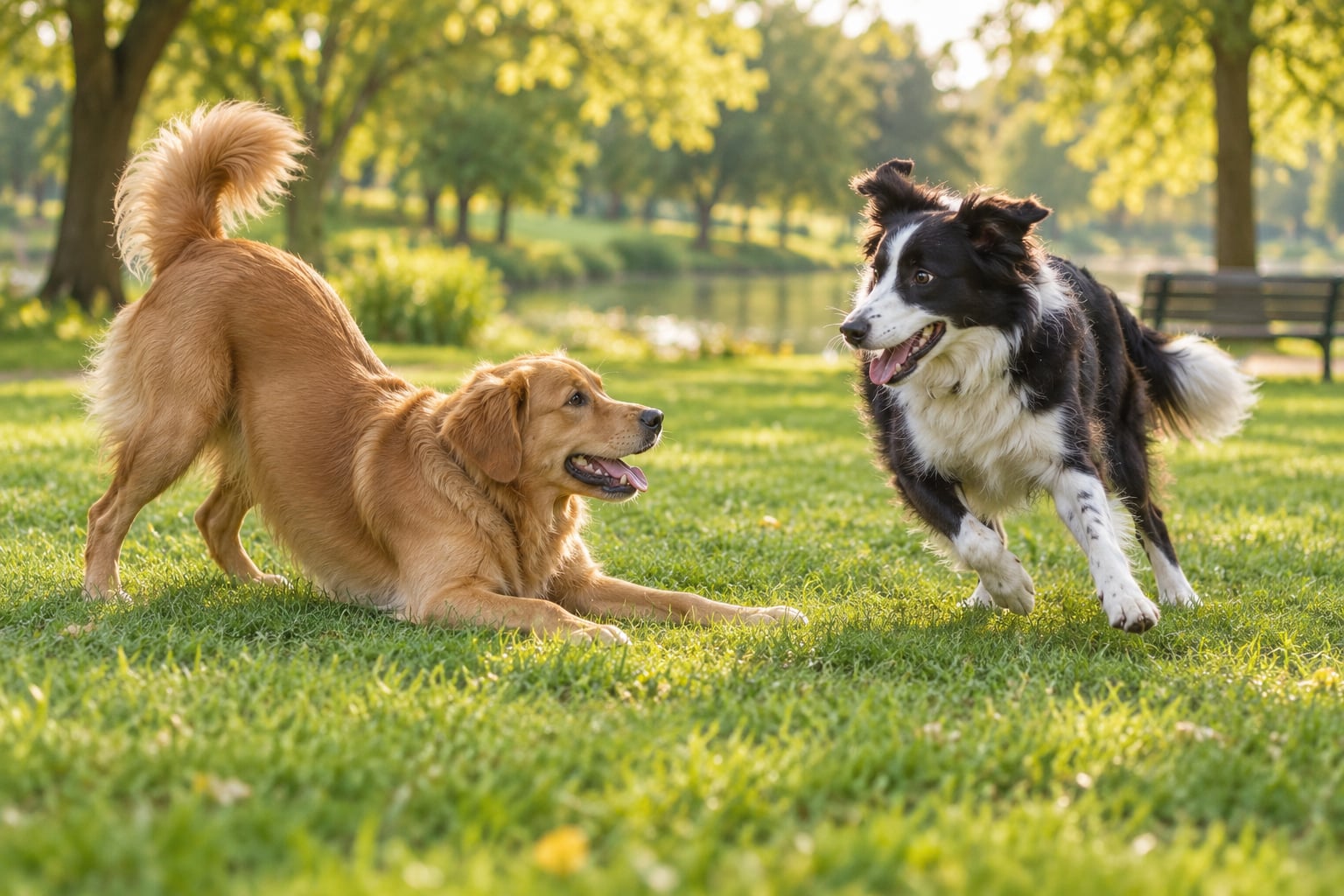
To tell whether two dogs are playing or fighting, watch the whole interaction rather than a single moment. Play stays loose and bouncy, with play bows, exaggerated movements, role changes and frequent pauses. Fighting goes stiff and efficient: raised hackles, a hard stare, a closed mouth, growls that build instead of stopping, and no pauses at all. The clearest tell is whether each dog can voluntarily stop and walk away.
Most of the panic at the dog park comes from misreading one of those two. Owners see a snarling husky and grab the dogs apart, cutting off exactly the social learning that keeps play polite. Other owners watch a genuine fight build for thirty seconds because growling “means it is fine.” Both mistakes are expensive. Learning to read the sequence takes about ten minutes of practice on your own dogs, and it is the difference between interrupting at the right moment and never.
- Posture. Playing: loose, wiggly, weight shifting constantly. Fighting: rigid, weight forward, braced on the legs.
- Movement. Playing: exaggerated, theatrical, sometimes clumsy on purpose. Fighting: quick, efficient, no wasted motion.
- Mouth. Playing: open and relaxed, tongue often visible. Fighting: shut tight a moment before contact, lips pulled back.
- Sounds. Playing: short, sputtery play growls that stop and start. Fighting: one sustained growl, then snarls and sharp barks.
- Who is on top. Playing: changes every few seconds. Fighting: stays the same.
- Entry and exit. Playing: play bow at the start, a pause in the middle, easy finish. Fighting: no signal, no pause, no signal to end it.
- Afterwards. Playing: relaxed, back to normal within a minute. Fighting: panting, trembling, avoidance, guarding, hiding.
Table of Contents
- What You Need
- Step-by-Step: How to Tell If Two Dogs Are Playing or Fighting
- 1. Check the dogs’ body language
- 2. Listen to the sounds and timing
- 3. Look for pauses and role changes
- 4. Notice whether both dogs can disengage
- 5. Watch what happens after the interaction
- Common Mistakes
- How to Interrupt a Dog Fight Safely
- Frequently Asked Questions
- How can I tell whether a dog growl is playful?
- Is it normal for dogs to play bite or pin each other?
- What should I do if two dogs start fighting?
- Why does one dog keep trying to escape during play?
- When should I ask a veterinarian about dog play behavior?
- What is the 3-3-3 rule for dogs?
- What to Do First
What You Need
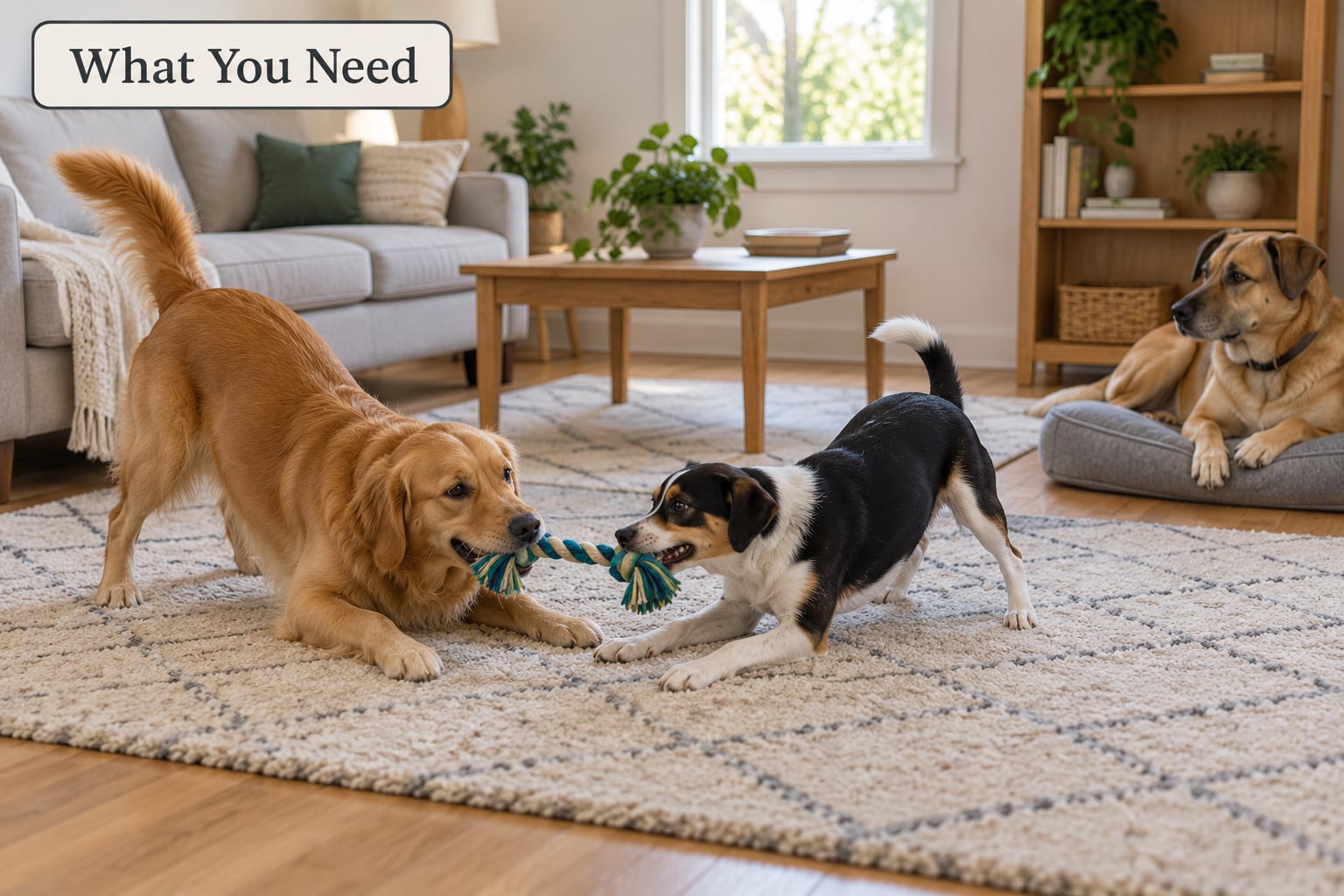
No equipment, no apps, no special gear. This is a watching exercise, and what you bring to it is baseline knowledge: how each of your dogs looks when nothing is wrong.
Before you judge an interaction, sit on the floor with each dog alone for two minutes and take a mental snapshot. Note the height and carriage of the tail at rest, how loose the mouth is, how quickly the dog drops into a down or a stretch, and whether it sniffs food when you offer it. That relaxed version is your reference point. Comparing a mid-play dog to its own normal is far more accurate than comparing it to a picture of some other breed.
You also need a safe vantage point and a separator. For indoor dogs, a doorway, a baby gate across a hall, or simply a large piece of furniture between you and the dogs works. Outdoors at a park, benches, gates and car doors are the usual tools. Have your phone in your pocket with the camera ready, because the ten seconds you miss while panicking are usually the ten seconds that explain everything, and a recording lets you review it slowly afterwards.
One last thing helps more than the rest: a recall cue that actually works in the presence of another dog. If your dog will not come when called around a distracted playmate, you have no remote option, and that changes how carefully you need to choose your moment. Work on recall separately, away from play, until it is boring and reliable.
Step-by-Step: How to Tell If Two Dogs Are Playing or Fighting
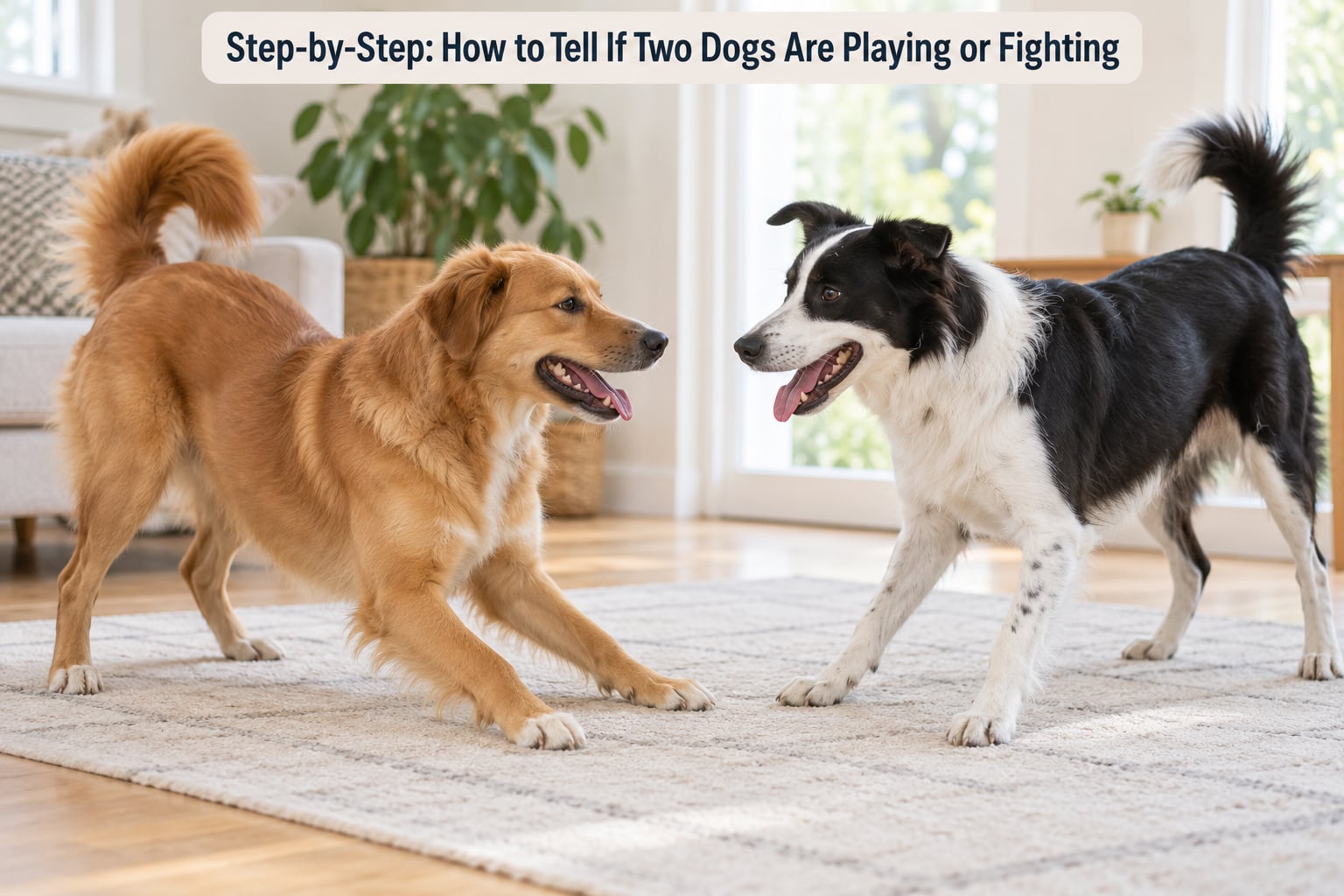
Work through these five checks in order. Any single signal can mislead you, because a confident dog play-fights roughly, and a nervous dog can hold a play bow while grumbling. The pattern across all five is what tells you the truth.
1. Check the dogs’ body language
Look for a loose, bouncy body in play: muscles that move freely, a tail that swings or wiggles rather than sticking out straight, and exaggerated moves like running past and coming back, pouncing with flattened ears, or deliberately tripping over the other dog. A play bow is the clearest single signal. The front end drops, the hind end stays up, and the dog usually adds a bounce or a little hop before launching in.
Watch the transitions between movements. Play dogs are clumsy in a way that looks sloppy but is often controlled. A heavy dog sliding carefully past a small one, or a dog pulling up a half-second before collision, is showing self-handicapping, which means it is managing its strength for the other dog. In a fight, movement becomes economical. Every muscle works toward one outcome, the stance is braced, and the weight sits forward over the front legs.
Fighting posture is stiff from the neck forward, the head is level rather than lowered, the hackles rise along the shoulders, and the eyes go hard. A dog showing the whites of its eyes, the so-called whale eye, is usually in a conflict situation rather than a play one. A tucked tail, crouching low, or a dog repeatedly trying to slip away and get cornered tells you one animal has already left the play frame entirely.
2. Listen to the sounds and timing
Play growls are short and rhythmic. They come in bursts, stop when the dogs pause, and start again when play restarts. They are often higher in pitch, mixed with a few excited yaps, and a play growl usually ends with a shake-off, a sneeze, or a moment of open-mouthed panting. Vocal breeds are the biggest source of confusion here: huskies, shelties, and some terriers make a racket during play that sounds alarming and means nothing.
Conflict sounds change the texture. The growl drops lower and becomes continuous rather than intermittent, right at the moment the bodies go stiff. A dog that has stopped growling entirely and gone quiet during a clash is often worse news than a noisy one, because silence during a tense interaction frequently means a dog is holding itself back or has already escalated past the point of warning.
Sharp, repeated barks and high-pitched yelps are worth noticing too. A single yelp during rough play is common and often self-correcting. Sustained yelping, or yelping that does not stop when the other dog eases off, means the play has gone past what one dog can absorb.
3. Look for pauses and role changes
This is the check most people skip, and it is the most reliable one. Healthy play keeps resetting. Dogs disengage, shake off, wander a few steps, and come back. Someone else takes over the chase, the pinning flips, the one on their back ends up on top two seconds later. If you paused the footage and had to guess who was winning, you were probably watching play.
Then there is the pause that gets missed: a genuine break in the middle of a play session, where a dog gets water, comes back, and the whole thing starts again. A structured intermission is a strong sign of play. A tight, repetitive exchange with no breathing room and no resets points the other way, and it is the pattern most associated with an argument that is escalating.
Self-handicapping is the related tell. A larger dog that matches the smaller dog’s speed, bites softly, or lets himself be pinned for a moment is managing the interaction. A larger dog that pins the smaller one hard and repeatedly, with no relief, is not playing.
4. Notice whether both dogs can disengage
This is the question to keep returning to: can each dog voluntarily stop? Watch whether a dog that walks away gets followed and pressured, or allowed to leave. In play, the one who leaves is chased for a moment and then the game changes shape. In a fight, the dog trying to exit is blocked, cornered against a fence or a wall, or held in place, and the other dog keeps escalating even as the first dog signals.
Also check response to outside input. A dog deep in play will usually glance at you, eat a treat dropped nearby, or respond to a neutral cue like a sit with some delay and exaggeration. A dog in conflict often will not respond at all, and a dog that responds sharply and immediately to nothing in particular is wound tight, whether or not a fight has started.
Be honest about one-sidedness. If one dog always initiates, always ends up on top, and the other spends most of the session escaping or hiding behind furniture, the pair are not really playing together. That is a welfare problem for the escapee even when the body language still looks bouncy at a glance.
5. Watch what happens after the interaction
The after tells you the most and gets the least attention. Play usually ends with a shake-off, a drink, some sniffing, and a return to ordinary activity within a minute or two. Both dogs look loose, breathing normal, interested in food.
After conflict, you see panting that does not settle, trembling, a dog that avoids the other and hides, one that stares and guards the space where it happened, or one that startles at ordinary movement. Owners on forums describe this pattern constantly: the dogs were quiet for a minute, everyone assumed it was fine, and then one of them spent the next two hours glued to the owner’s legs. A vet check after any real fight is worth it, since puncture wounds under the fur are common and easy to miss.
A note on breed and age: puppies mouth hard, hump, and climb because they are still learning bite inhibition, and adult dogs self-handicap more with a puppy than they do with each other. A rough-looking litter of older dogs wrestling over a stolen sock can also stay inside play for a long time, because the object, not the dogs, is the actual focus. Video is your fastest way to resolve all three, because the sounds alone will never settle it.
Common Mistakes
Judging on one sign. A raised tail does not mean aggression, and a growl does not mean play. Read the pattern: posture plus sound plus reversals plus recovery. Any single signal will send you to the wrong conclusion at least once a year.
Treating every growl as dangerous and punishing it. Punishing a dog for a play growl teaches it that communicating with you is not safe, so the next time it feels conflicted it may stay silent instead. Quiet conflict is harder to catch and worse to manage. This is a well-known piece of dog training advice for a reason.
Interrupting too early. Many owners break up a healthy session at the first dramatic pounce and teach their dogs that another dog nearby means the fun stops. Owners also repeatedly report that pulling dogs apart is what made a wobble into a real fight, because the interruption leaves both animals wound up with no outlet.
Stepping between two fighting dogs. Hands in the middle of a fight is how people get bitten, and the dogs often redirect onto you. This is the mistake with the worst possible outcome, and it is entirely avoidable with a plan.
Ignoring the quiet one. A dog that spends a session pinned, cornered, or repeatedly leaving is not having a good time, even if nobody drew blood. If the same dog is always the one that ends up hiding, the arrangement is not working.
Assuming size mismatch is fine as long as the dogs are friendly. A large dog that treats a small dog gently one day is not guaranteed to be gentle the next, especially when aroused, startled, or protecting food. Size difference is a permanent variable in every risk calculation for that pair.
Overlooking the trigger. A great many fights that look spontaneous were actually about a bowl, a toy, a couch corner, a door, or a pregnant or nursing dog. Notice where the fight happens. The same spot, over and over, is a clue worth acting on.
How to Interrupt a Dog Fight Safely
This section is general safety guidance, not a substitute for a trainer or veterinarian who knows your dogs. Reach for a professional whenever fights recur, whenever anyone has been bitten, or whenever a fight is over a resource such as food, toys, or a litter of puppies.
The first rule is simple: keep your hands out. Do not reach between two dogs, do not grab collars, and do not try to pull a dog off with your bare hands. A grabbed dog often turns and bites the hand that grabbed it, even a dog that is normally gentle, because the grab reads as an attack rather than a rescue.
Use a barrier instead. A gate, a screen door, a fence panel, a car, a large table, anything solid that can move between the dogs. Many fights end within seconds when one of them realises the other is gone, and closing an interior door is often enough to break the cycle. A chair over a small dog, a wooden board held as a shield, or a blanket held up in front of you while you step back are all reasonable tools.
Use your recall cue, once, calmly, and expect it to fail. Recall is worth trying because a dog that turns toward you and disengages ends the interaction cleanly. It is not worth reaching for after repeated failures. If a recall does not work, stop trying and use the barrier.
Distraction sometimes buys a few seconds: a tossed treat in a separate area, a loud noise from a safe distance, a call to a different room for one dog. Treats work best thrown away from both dogs rather than at their faces. Treats thrown into the middle of a fight are the fastest way to add a third target to the conflict.
Separate completely, not just at a few feet. Different rooms with doors closed, one dog outside, crates, a car, whatever holds. Dogs that can still see, hear, or smell each other stay wound up and often start again. Once they are apart, do not immediately stage a reunion to see if they have made up.
Check both dogs over. Look for puncture wounds, especially around the neck, shoulders, and legs, and check inside the mouth and ears if there was any biting. Call your veterinarian if there is bleeding that has not stopped, a wound you can see, limping, heavy panting that does not settle, or any doubt at all. Puncture wounds can get infected quietly beneath the coat days later, and a limp that appears the next morning is a common and treatable aftermath.
When a pair of dogs has fought, do not just put them back together and hope. Separate them, write down the location, the trigger, and who started it, and look for a behaviour professional or a veterinary behaviourist. If a fight involved a bite to a person, that needs a professional plan rather than another attempt at managing it yourself.
Frequently Asked Questions
How can I tell whether a dog growl is playful?
Play growls come in short bursts, change pitch, and stop when the dogs pause. They come with a loose body, an open mouth, play bows and role changes, and they often end in a shake-off or a play sneeze. A conflict growl drops lower, becomes continuous, and lines up with the moment the bodies go stiff and the mouths close. Judge the sound together with the posture and whether the dogs can take breaks, never on its own.
Is it normal for dogs to play bite or pin each other?
Yes, for most dogs. Mouthing, nipping without puncture, climbing, and brief pinning are normal parts of canine play, and good play partners have bite inhibition, meaning they control how hard they press. What is not normal is hard biting that draws blood, one dog pinned repeatedly with no relief, or a size mismatch where the larger dog does not soften. Watch whether the pair take turns and whether the dog underneath gets to move.
What should I do if two dogs start fighting?
Keep your hands out of the middle and do not grab collars. Use a barrier such as a gate, a closed door, or a solid object between the dogs, and try your recall cue once, calmly. If it does not work, go straight to physical separation. Move them into different rooms and keep them apart long enough to settle. Then examine both dogs for puncture wounds, limping, or heavy panting and contact your veterinarian if you find anything or are unsure.
Why does one dog keep trying to escape during play?
It usually means the other dog is not listening to the signals, or the pair simply are not good play partners. A dog that leaves gets cornered, followed, or pinned repeatedly is telling you the play has become uncomfortable, even if the body language still looks bouncy. Puppies, small dogs, seniors, and dogs with pain or fear responses all escape more often. If the same dog is always the one hiding afterwards, that pair needs a new arrangement.
When should I ask a veterinarian about dog play behavior?
Ask a vet whenever play results in a bite to a person, bleeding, limping, or wounds you cannot see, because puncture wounds under the coat are easy to miss and can get infected quietly. Also ask if one dog consistently avoids the other, seems afraid around it, has a sudden change in play style, or shows signs of pain that make normal rough play unbearable. A vet can also refer you to a behaviourist for repeated fights over toys, food, or space.
What is the 3-3-3 rule for dogs?
It is a loose adoption guideline: three days to settle, three weeks to show the real personality, and three months to feel fully at home. People use it during introductions to set expectations, so you know a tense first week is not a verdict on whether two dogs will work out. It is not a test with a pass or fail, and every pair moves at its own pace. It is also not a substitute for supervising play while they work out the ground rules.
What to Do First
Pick one normal interaction and record it on your phone. Watch it back with the five checks in mind: loose or stiff body, the sound pattern, whether the roles change, whether either dog can walk away, and how they behave afterwards. Ten minutes of that beats a year of guessing, and it is how you learn your own dogs rather than everyone else’s.
Once you can read it, trust the pattern. Loose, reversible, breakable play needs room to run. Anything stiff, silent, one-sided, or impossible to exit gets a barrier between the dogs and a call to a qualified behaviour professional if it happens again.