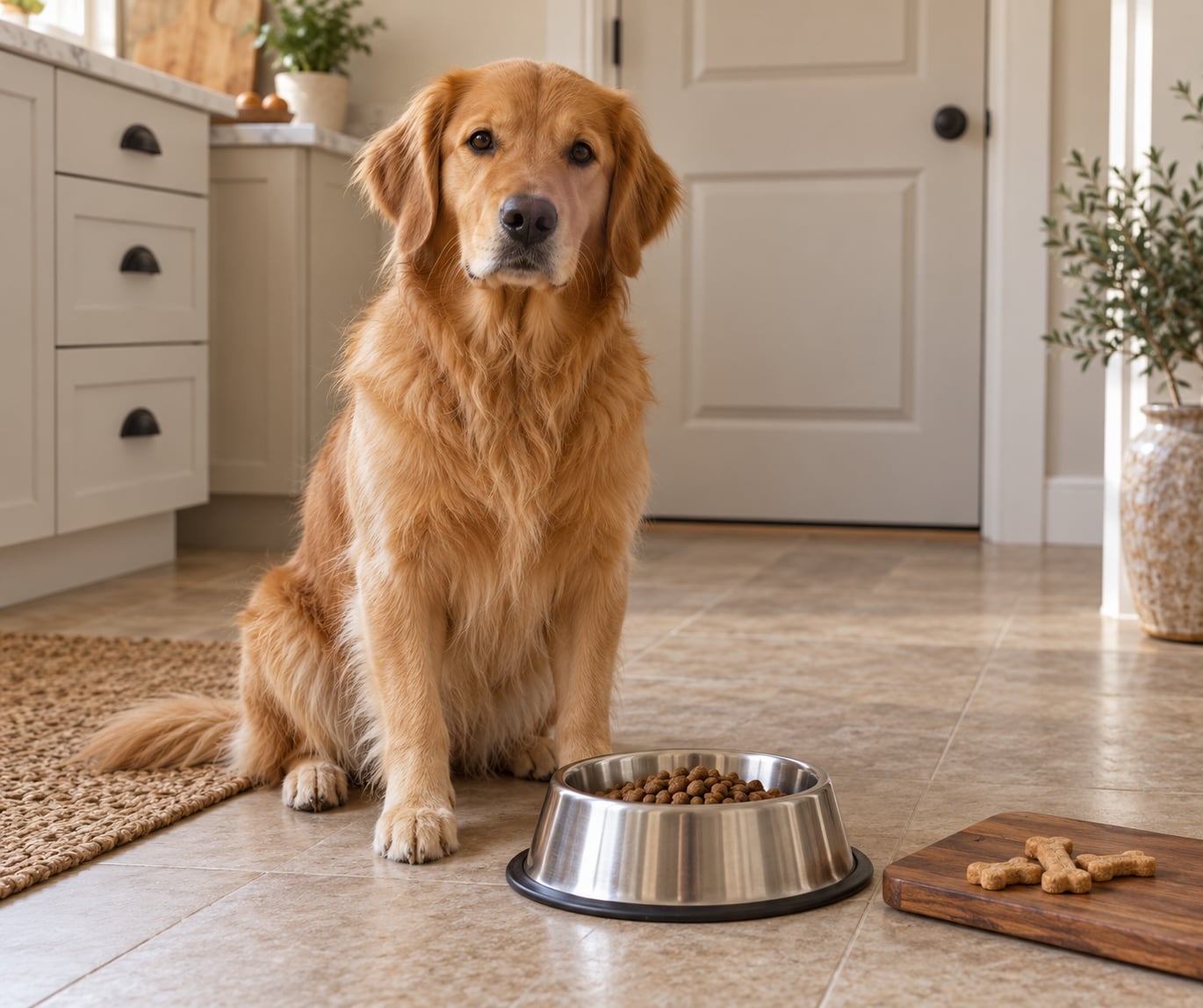
If your dog growls when you touch his food bowl, he is telling you the bowl is his and the reach is a threat, not that he is being defiant. This is resource guarding, and it is one of the most ordinary behaviors in dogs. The right first move is to stop reaching, back off calmly, and never punish the growl.
Most of what you read about this is either alarmist or vague. What helps is a plain explanation of what is happening in his head, a way to tell guarding apart from pain, and a protocol you can run tonight without putting anyone’s fingers near his teeth. That is what follows, updated for 2026.
This is general behavior information, not veterinary advice. Any sudden change in a dog’s eating, mood or movement belongs with your veterinarian.
Table of Contents
- Why Does My Dog Growl When I Touch His Food Bowl?
- Why does my dog growl when I touch his food bowl but not when I feed him by hand?
- What Behaviors Usually Surround the Food-Bowl Growl?
- What Are the Most Common Reasons Dogs Growl at Food Bowls?
- 1. The instinct itself
- 2. Fear of losing the food, not anger at you
- 3. A new or worsening medical problem
- 4. Hunger that got worse
- 5. Inconsistent household rules
- 6. Stress in the room
- 7. Something taught him to do it
- How Can You Tell Resource Guarding From Pain or Illness?
- What Should You Do When Your Dog Growls at the Bowl?
- How to Prevent Your Dog From Guarding the Food Bowl
- Can You Train a Dog Not to Growl When You Touch Its Food?
- When Is Food-Bowl Growling an Emergency?
- Frequently Asked Questions
- Is it normal for a dog to growl when someone touches its food bowl?
- Should I take the food bowl away when my dog growls?
- How do I stop my dog from growling over food?
- Can a dog growl because it is in pain?
- Should I punish my dog for growling at its bowl?
- When should I call a veterinarian about food-bowl growling?
- What to Do First
Why Does My Dog Growl When I Touch His Food Bowl?
A dog growls over his bowl because food is one of the highest-value items he owns, and a hand moving toward it reads as a threat to his supply. Dogs evolved to defend calories they might not get again, so the growl is a warning meant to make you stop. It is communication, not dominance, and it usually means he expects to lose something valuable.
That expectation is the whole mechanism. The growl itself works only if the person withdrawing makes the person stop, so punishing it teaches him to swallow the warning and keep the behavior. Owners who were told years ago to put their hands in the bowl to prevent this often discover their dog learned something different from the lesson: hands near food mean a fight is coming.
Worth noting that most dogs do not guard their people, their beds or their laps over anything. Food is special because it is perishable, valuable and genuinely lost the moment it leaves the bowl.
Why does my dog growl when I touch his food bowl but not when I feed him by hand?
Hand feeding works because the food travels from your hand to his mouth with nothing between you and the food. Touching the bowl is a different picture entirely: your hand is next to the item he is eating, at the moment he is most aroused, and the bowl is the thing he is protecting. Owners describe this split often, including in a well-known r/DogAdvice thread about a four-month-old Lab who ate happily from a hand and growled the moment a hand touched her head while she ate from a bowl.
That same Lab inhaled her food. Gulping and growling tend to travel together, because both come from a dog running hot in a high-value moment.
If hand feeding is going fine and the bowl is not, you are not dealing with a dog who dislikes you. You are dealing with a dog guarding one specific object in one specific moment.
What Behaviors Usually Surround the Food-Bowl Growl?
Guarding almost never starts with a bite. It starts with a small body-language change most owners miss, then climbs. The signals below run in roughly the order they typically appear, and the useful thing to notice is that the first three are quiet enough to talk yourself out of seeing.
| Sign | What it usually means | Intensity | What to do |
|---|---|---|---|
| Eats very fast, gulps, or swallows without chewing | Arousal is high and the meal feels scarce | 1 | Let him finish. Note it for your vet if it is new. |
| Stops eating when you enter the room | He is watching you instead of the food | 2 | Turn around and walk out. Reduce your approach. |
| Freezes, body goes stiff, tail goes still or low | The warning starts, held very quietly | 3 | Freeze, then retreat slowly. Do not reach. |
| Hard stare, hackles up, lip licking, crouches over the bowl | Full attention on you, body blocking the bowl | 4 | Leave the room. Close the door if you can. |
| Low growl that starts when a hand crosses the bowl | The warning is being delivered on purpose | 4 | Remove yourself. Do not scold. |
| Air snap in the air without contact | Aimed to drive you back, not to bite | 5 | Give space immediately, then call a professional. |
| Muzzle grab, or any contact with skin | The warning has already failed somewhere along the way | 6 | Separate him, assess the household, get help now. |
Two details trainers point out often. A wagging tail while you approach, with a loose body and a normal appetite, is a good sign at any stage. And growling that only appears in one spot on your body, such as over a chew but not the bowl, is guarding of that object, not of you.
What Are the Most Common Reasons Dogs Growl at Food Bowls?
Resource guarding is the umbrella explanation, and it usually has a specific trigger underneath it. Here are the ones owners run into most.
1. The instinct itself
Dogs are built to protect high-value food. Some individuals are wired for it, which is why a perfectly social dog can still growl at an empty fridge door.
2. Fear of losing the food, not anger at you
This is the most common one. He is not annoyed that you exist, he is worried that the food is about to be taken away. Commenters in r/reactivedogs put it bluntly: punishing a growl removes the warning without touching the feeling, and the dog loses his only way to tell you to stop.
3. A new or worsening medical problem
Dental pain, a sore neck, arthritis that makes lowering the head hurt, nausea, an ear infection and stomach trouble can all make a meal hurt. A dog in pain protects the thing that hurts. This is the cause most often missed.
4. Hunger that got worse
Free-fed dogs with a bowl that is always out sometimes start guarding as their appetite rises. A dog who suddenly eats like it is a competition may be unwell rather than hungry.
5. Inconsistent household rules
This shows up in r/Dogtraining threads constantly. One adult can reach into the bowl, another cannot, so the dog learns that hands near food mean unpredictable outcomes. A Basset Hounds Forum thread describes the same pattern in reverse: a four-year-old tolerated the whole family and began growling when one specific child came near the bowl.
6. Stress in the room
Noise, a new baby, visitors, another dog nearby, a vacuum, a busy kitchen. A dog that eats fine alone may guard a bowl placed in a crowded corner, and that is environment, not character.
7. Something taught him to do it
Scolding a growl, taking the bowl away, or repeatedly reaching in to prove nothing happens teaches a dog that food and people predict bad things. Several owners say the behavior started after they were advised to put their hands in the bowl.
How Can You Tell Resource Guarding From Pain or Illness?
The distinction matters more than most guides admit, because the fixes are opposites. Guarding is a training problem. Pain is a medical one, and no amount of treats reaches it.
| Clue | Points toward guarding | Points toward pain or illness |
|---|---|---|
| When it started | Gradual, often around adolescence or after a change in routine | Sudden, overnight, with no training history |
| Appetite | Normal, he wants the food | Reduced, or he approaches the bowl and leaves it |
| Eating itself | Fast but no hesitation | Coughing, gagging, head shaking, chewing on one side |
| Movement | Normal | Stiff, slower to rise, reluctant to jump or lower the head |
| Other touch | Tolerates pets and handling elsewhere | Flinches at ears, mouth, neck or back touch |
| Pattern | Only near food, or near one person | Irritable in general, or guarding spreads to other resources |
If more than one row points toward illness, book an appointment and describe the behavior as a symptom, not a habit. A full physical exam plus whatever bloodwork or dental check your vet considers appropriate is the sensible starting point.
Sudden onset with no obvious trigger is the scenario owners describe as most frightening, and it is the one where the general advice to just train harder is wrong. The same applies when growling appears alongside growling at children, at other dogs, or in situations that have nothing to do with food.
What Should You Do When Your Dog Growls at the Bowl?
There is a right response in the first thirty seconds, and it is much shorter than most people expect. Nothing in this sequence requires you to reach toward your dog.
- Stop moving toward the bowl. Your hand in midair is the problem, not your character.
- Turn your body away and take two or three steps back without turning around again.
- Let him finish the meal. Do not take the bowl, do not block him, do not stand over him.
- Leave the room if the growl continues or the body stays stiff.
- Write down what happened: who approached, how fast, where the bowl was, who else was in the room.
- Later, change the setup so the situation is easier: a quieter spot, a door between the bowl and the rest of the household.
That last step is not avoidance, it is buying room to work. You cannot train a dog through an emotional emergency, and every approach that ends in a growl teaches him that the growl is the only thing that works.
Do not growl back. Doing it teaches escalating conflict and hands you a losing game. Owners also ask whether they should take the bowl away, and the answer is no: removing the food teaches loss, not manners.
How to Prevent Your Dog From Guarding the Food Bowl
Prevention is mostly boring consistency, and it is easier to do with a puppy. A few habits carry a long way.
- Feed the same way every time. Set meals down, walk away, pick up leftovers when the bowl is done. Unfinished food left out teaches a dog that food is available whenever he decides to enforce it.
- Give the family one rule. Nobody reaches into a bowl. If one person can and another cannot, the dog has to guess, and he will guess the loudest option.
- Build a trade. Teach an exchange cue outside meals: he drops or steps back, he gets something better. Practice it with toys and chews before you ever try it near food.
- Feed in a calm, predictable spot. A busy kitchen corner with a vacuum going is a harder test than a quiet room. A closed door beats a gate if you have one.
- Separate feeding for multi-dog homes. Rotate crates, pens and rooms so two dogs never meet at a bowl. Fighters around food escalate fast, and people who break those fights end up bitten.
- Give children a rule they can follow. Children stay away from dogs while they eat, and children never take food away. They cannot read the early signals, they move fast, and they are the ones most often bitten.
- Split meals for puppies. Several small meals a day, a chew now and then, and a chew handed over rather than taken away. Management in the first months is what prevents the adolescent version of this problem.
Guarders do not always guard the bowl. The same dog can be fine with dinner and intense about a bone, a stuffed toy or a stolen sock. Those items deserve the same separate-room treatment.
Can You Train a Dog Not to Growl When You Touch Its Food?
Yes, but aim at the wrong target and you will make things worse. The goal is not to suppress a meaningful warning. It is to teach him an alternative and reduce how often he needs the warning at all.
That work is counterconditioning: pairing your presence near the food with something good, at a distance low enough that he stays relaxed. The exercise ladder, adapted from the staged protocol published by the ASPCA, goes like this.
- Stand far across the room. Say nothing. Toss a treat into the bowl as he finishes it.
- Move one step closer. Toss a treat. Walk away.
- Sit nearby. Drop a treat into the bowl. Leave on purpose.
- Say a neutral cue such as “what have you got there” and toss a treat while he eats.
- Touch the edge of the bowl once, then toss a treat and walk away.
- Only after the previous step is boring: touch the bowl while he eats, and reward the calm.
The advancement rule is what keeps this safe. Do not move up a step until the current one has gone well for ten meals in a row. Owners describe that rule as the part they wish someone had given them at the start, because it tells you what “normal” looks like in week two.
Progress is quiet. A soft wag when you approach, a loose body, eating while you are in the room, glancing at you and then back to the bowl. If he stops eating, freezes or resumes the growl, you moved too fast, and you drop back a step rather than pushing through.
Keep the following in mind. Repeatedly reaching into a bowl to prove he will not react is not desensitization, it is a rehearsal, and veterinary behaviorist Dr. Julie Albright has warned that it can create the very guarding you were trying to remove. Never run these exercises with a child in the room. And a basket muzzle, properly conditioned as a basket muzzle, changes the arithmetic for the worst stages, which is why trainers bring them in rather than owners reaching for them in a panic.
When Is Food-Bowl Growling an Emergency?
Call a veterinarian or a qualified behavior professional, not a general trainer, when any of these are true.
- Anyone has been bitten, even through clothing, even a small nip that drew no blood.
- The growl is escalating across weeks, or has moved from low growl to air snapping to contact.
- He now guards from children, other dogs, or people he used to tolerate.
- The guarding started suddenly with no change in training, routine or environment.
- He stops eating, eats and stops, chews on one side, or seems uncomfortable after meals.
- He is stiff, slow to rise, reluctant to jump, or flinches when touched around the face, ears or neck.
- He is growling in situations unrelated to food, such as being handled or woken up.
- He has bitten before, at any time, in any context.
Credentials matter here, because the field is not regulated. A board-certified veterinary behaviorist, a Certified Professional Dog Trainer with documented aggression experience, or a CAAB or ACAAB credential are the marks owners trust. Experienced owners also warn that a certification on its own does not mean the person has handled bite cases, so ask directly how many they have seen and what their protocol is.
Some cases are diagnosed as idiopathic aggression, sometimes called rage syndrome, where the reaction appears with no obvious trigger and is not clearly tied to a resource. It is rare, it often appears in adult dogs rather than puppies, and it is a veterinary diagnosis, not a label for a dog who growls about dinner. If your dog is reacting to people he has no reason to fear or cannot identify, that conversation belongs with a veterinary behaviorist.
Frequently Asked Questions
Is it normal for a dog to growl when someone touches its food bowl?
A growl over food is common and usually not a sign of a bad dog. It is resource guarding, an instinctive response to a resource your dog values. Normal is not the same as fine to live with, and growling is the last easy stage, so treat it early with distance and a consistent household rule rather than punishment.
Should I take the food bowl away when my dog growls?
No. Taking the bowl teaches your dog that people near food means the food disappears, which raises anxiety rather than lowering it. Walk away, let him finish, and change the setup so meals happen somewhere calmer. You can pick up an unfinished bowl once he has left the room, not while he is standing over it.
How do I stop my dog from growling over food?
Start with ten relaxed meals where you stand at a distance and toss a treat into the bowl. Move one step closer only after the current step has gone well for ten meals in a row, and use a neutral cue like what have you got there before you ever touch the bowl. If he stops eating or the growl returns, you moved too fast.
Can a dog growl because it is in pain?
Yes, and this is the cause most often missed. Dental problems, a sore neck, arthritis that makes lowering the head hurt, nausea or an ear infection can all make eating painful, and a dog in pain protects the thing that hurts. Guarding that appears suddenly, with reduced appetite or stiffness, needs a veterinary exam before any training work.
Should I punish my dog for growling at its bowl?
No. Punishment teaches your dog to hide the warning without changing what he feels, and a dog with no warning left has no way to tell you to stop. Scolding also creates a link between you and the food. Back away quietly, give him space to finish, and address the underlying fear of loss with distance and rewards.
When should I call a veterinarian about food-bowl growling?
Call when the guarding starts suddenly with no change in routine, when his appetite drops or eating looks painful, when he is stiff or reluctant to move, or when the growl has spread to children, other dogs, or situations with no food involved. Sudden onset in an adult dog is a medical question first and a training question second.
What to Do First
Stop testing him. Do not reach for the bowl, do not pick it up, do not scold, and do not keep walking past to prove nothing happens. Every one of those turns a warning into a fight he expects to have.
Give him room today: a quieter spot, a closed door, a separate feeding area, and one rule for everyone in the house that hands stay away from food. Then note down when it started, whether he still eats normally, and whether anything else has changed recently.
If the growl is sudden, severe, spreading, or has ever come with a bite, that note is the thing to hand to your veterinarian or a qualified behavior professional. Start there and the rest of the plan becomes much easier to follow.