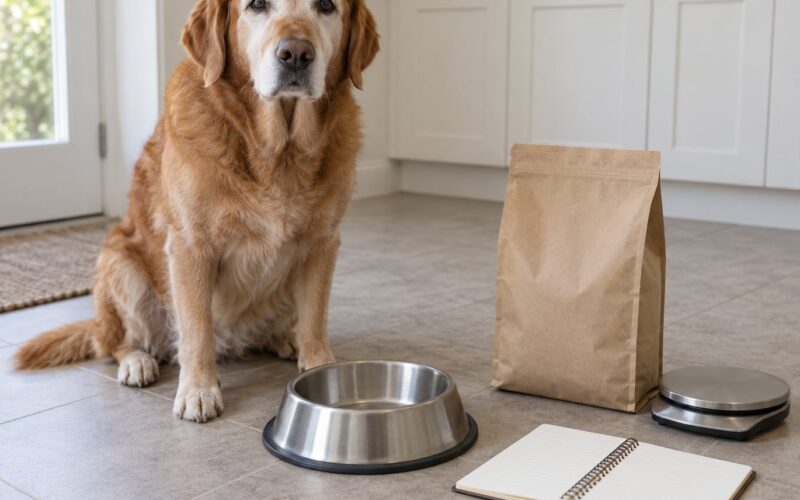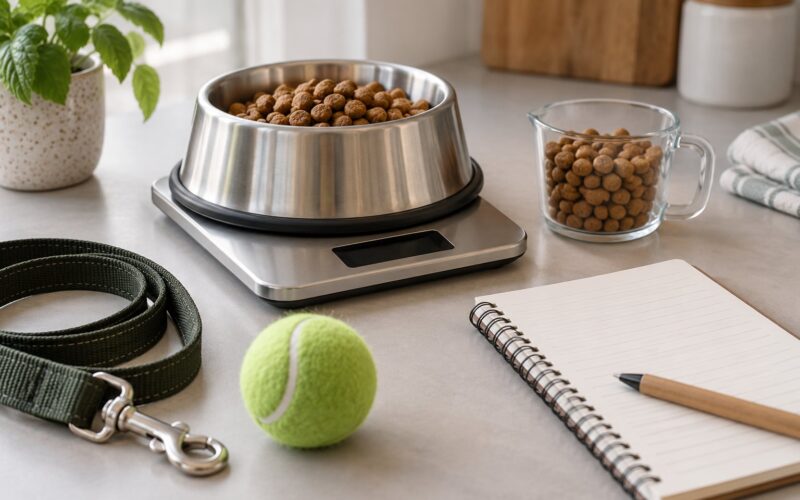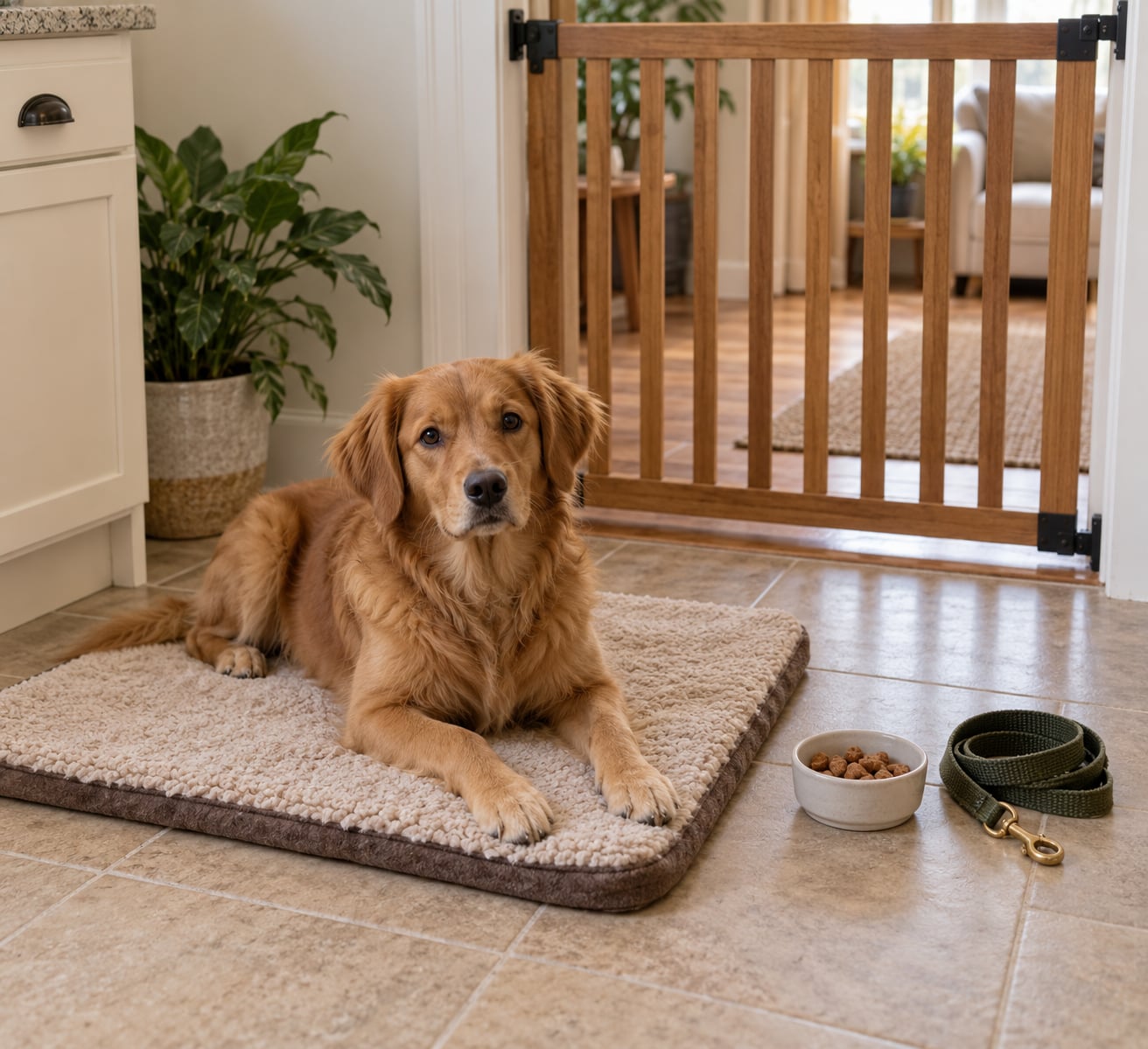
How to stop a dog from counter surfing comes down to two changes at once: take away the access, then give your dog a better option to earn. Clear the counters, shut the kitchen door or block the doorway, and train a rewarded alternative like staying on a mat. Most dogs need three to six weeks of consistent work, longer if the habit is years old.
Before the long version, here is the short version we come back to with every dog we work with:
- Keep counters completely clear at all times, including crumbs and wiped surfaces.
- Block kitchen access with a baby gate, exercise pen or closed door whenever you cannot supervise.
- Teach one alternative behavior, usually go to mat, and reward it heavily at first.
- Pay for calm near the counter, not just for leaving it.
- Practice at low distraction first, then add cooking smells and people.
- Redirect quietly: no chasing, no yelling, no tug-of-war over the counter.
- Keep the rule every single day, including when guests visit.
The rest of this guide walks through each of those seven steps, what to have on hand first, and how long the whole thing realistically takes.
Table of Contents
- What You Need
- Step-by-Step: How to Stop a Dog from Counter Surfing
- 1. Identify why your dog counter surfs
- 2. Block access before training begins
- 3. Teach an alternative behavior
- 4. Reward distance from the counters
- 5. Practice with realistic distractions
- 6. Redirect without engaging in a tug-of-war
- 7. Maintain the rule every day
- Common Mistakes
- Frequently Asked Questions
- Why is my dog counter surfing all of a sudden?
- How long does it take to stop a dog from counter surfing?
- What device can I use to keep my dog off counters?
- My dog counter surfs when I am not home. How can I stop it?
- Does counter surfing mean my dog is bad, and what do I do if he is already on the counter?
- Do chew toys, snuffle mats and puzzle feeders help reduce counter surfing?
- Conclusion
What You Need
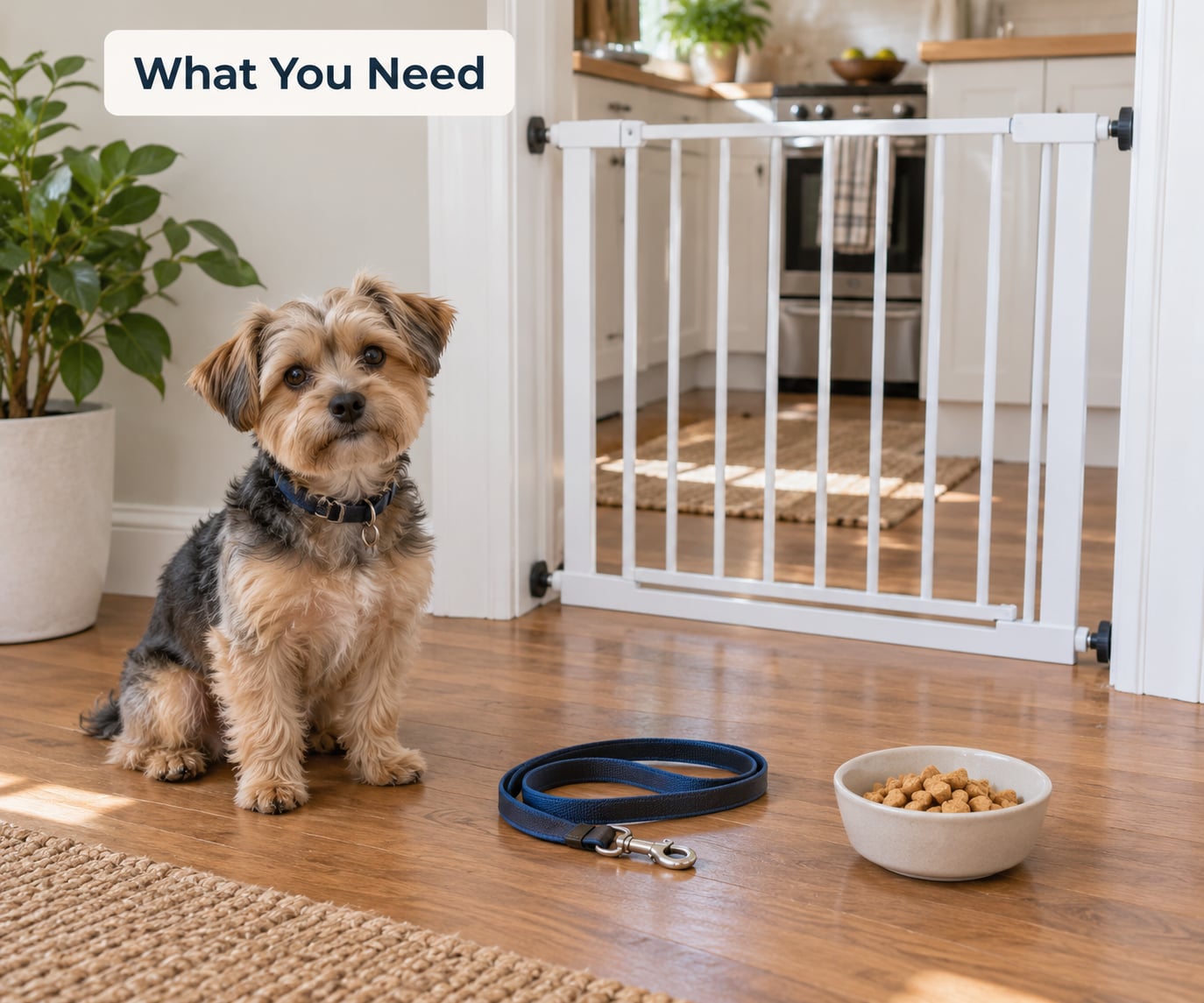
You do not need much, but you do need the right things. Cheap kibble thrown from across the kitchen will not compete with a chicken dinner, so treat value matters more than treat quantity.
- High-value treats. Smelly, soft and different from the everyday meal. Cooked chicken, small bits of cheese, hot dog slices, dried liver or a training pouch filled with wet food. Keep a portion in a sealed bag so you are not fishing through the cupboard mid-session.
- A leash or harness. Not for restraint, for focus. Holding the leash in the kitchen lets you guide the dog off the floor and away from the counter without a chase.
- One cue word. Pick a single word for the alternative behavior and use nothing else. Most people land on mat, place or bed. Decide tonight, because switching words halfway through is the most common self-inflicted delay.
- A barrier. A baby gate across the kitchen doorway, an exercise pen, or simply a closed door. Push it to the edge of the counters if the dog can reach them from the floor.
- A plan for the hours you are out. Decide in advance where the dog goes when nobody is home. Kitchen shut behind a closed door during your workday is a complete plan. Wandering around hoping is not.
A clicker helps if you already use one, but a marker word like yes said once, sharply, does the same job at no cost.
Step-by-Step: How to Stop a Dog from Counter Surfing
Knowing how to stop a dog from counter surfing comes down to a sequence, and the order matters more than the effort. Start with access, finish with maintenance.
1. Identify why your dog counter surfs
Watch the dog for three or four days without correcting anything, and write down what happens right before they get up. Is it the smell of food, the sound of a can opener, someone turning their back, or simply being bored with nobody around?
Food-motivated dogs want the food, and the fix is management plus a trade. Curiosity-driven dogs want to look at what is happening in the kitchen, so giving them a mat with a view or a chew at floor level covers the need. Dogs who counter surf for attention are asking to be included, and excluding them without replacing that will make the jumping worse.
Dogs who surf only when nobody is watching have learned something specific: that a behavior performed out of sight gets no correction. That is a sign you have been training their avoidance of you rather than their behavior.
2. Block access before training begins
This is the least fun part and the part that does the most work. Until the new behavior is trained, the counters need to be physically impossible to reach. Move the trash can out of nose range, put it in a cabinet if the dog is tall, and stop leaving food or dishes out.
Wipe surfaces, especially grease and crumbs, because a clean-looking counter still smells like dinner to a dog with a nose a hundred times better than yours. Use a vinegar solution or an enzyme cleaner on the ones the dog returns to repeatedly.
A good rule: anything you would not leave a toddler alone with goes in a closed cabinet. That single habit removes most counter-surfing opportunities before training starts.
3. Teach an alternative behavior
Put the mat down where you want the dog to end up, somewhere with a clear view of you and away from the foot of the counters. Then capture: whenever all four paws hit the mat, mark with your word and deliver a treat to the mat, not to your hand.
After a few repetitions, add the cue word. Say it once as the dog settles, mark, treat. Sessions should be short, two or three minutes, and finish while the dog is still succeeding.
Keep the reward rate high at first. You are not being generous, you are buying the behavior before it exists. Once the dog lies down on the mat without being asked, drop to paying every few seconds, then every ten, then at random. Random payoffs are what make it hold up when you are making dinner.
4. Reward distance from the counters
Most people wait for the perfect moment when the dog is calm, which means they never train at all. Instead, pay earlier: the instant the dog looks away from the counter and back to you or the mat, mark and treat.
Work on duration in small jumps. Reward a stay of one second, then three, then ten, then thirty. Then add distance: calm sitting two feet from the counter gets paid, then four feet, then in the next room with the door open.
If the dog stops taking treats, whines, or stares hard at the counter, you have gone past what the dog can hold right now. Back up one level and rebuild. Training ends when the dog is still eating happily, not when it finally breaks.
5. Practice with realistic distractions
Three levels, worked in order, and only move up when the previous one is boring to the dog.
- Low. You sitting in the kitchen doing nothing, door closed, dog on the mat.
- Medium. You chopping vegetables, opening the fridge, turning your back. Real smells, short sessions.
- High. A second person walking through, the dog counter-surfing for real, guests in the kitchen.
Most household dogs fail at level three, not level one, because levels one and two only get practiced. Set a pan on the counter and step away deliberately, rather than hoping the moment arrives on its own.
For puppies and adolescent dogs, expect level three to take weeks. Puppies have no impulse control at all, and most dogs go through a shark-teeth phase between roughly six and twelve months where every previously trained behavior falls apart for a while.
6. Redirect without engaging in a tug-of-war
When the dog is mid-jump, do not grab, shout, clap, or shove them off. Anything that happens in the moment teaches the dog that jumping produces a reaction, and reaction is the thing you are trying to remove.
What works is boring and mechanical. Wait silently, or walk out of the room without a word. The moment all four paws are down, mark and treat, even if the treat lands a second late. Then send to mat and reward there.
For a dog that grabs something, use a trading game rather than a confrontation. Hold a treat at nose level, wait for the mouth to open, take the item, reward, and put the treat back down so the dog knows nothing was lost. Never grab a held item out of a dog mouth, and never punish a dog for grabbing, since that teaches the dog to guard harder.
7. Maintain the rule every day
Two weeks of perfect work followed by one evening of guests with pizza on the coffee table resets you to almost where you started. Maintenance is the whole job: a crate or closed room during parties, counters cleared before food comes out, and the mat rewarded every single day, not just when the dog is misbehaving.
Pay the dog for staying off the counter even when nothing is happening. Ten seconds of calm chewing gets a treat. That is what makes the rule durable once the novelty is gone.
Then watch for relapse triggers: moving to a new house, a new baby, a dog walk change, or an illness. A dog who has held this behavior for six months will slip for a week after a disruption and that is normal, not failure.
Common Mistakes
Being inconsistent. You block the kitchen some days and leave the door open others. From the dog’s point of view that is two different rules, and the one that works for him is the open one. Every person in the household has to follow the same plan, and that conversation happens before the next dinner party, not during it.
Punishing after the fact. You find a plate licked clean and get upset an hour later. Your dog cannot connect the two, and all you have taught is that you are unpredictable. Dogs have no useful concept of delayed consequences, so scolding a counter surf is not training.
Using startle devices. Spray bottles, foil on the counter, e-collars, citronella. Owners sometimes report a dog who stopped after the noise, but trainers and veterinary behaviorists warn against it: it suppresses the behavior in that spot and does not generalize, while risking fear of the kitchen and a dog who learns to counter surf when you are out of the room. Management plus rewards is slower and works in more households.
Using commands you never trained. Telling an adolescent dog off has nothing to do with discipline. That word only means something if you spent sessions teaching it, with the dog on the floor first, then near a counter, and rewarded for putting paws back down.
Progressing too fast. If the dog fails three times in a row, the distraction level is wrong, not the dog. Drop back to something easy and boring enough to succeed.
Rewarding the jumping indirectly. Owners who shout off, then scoop the dog up to cuddle, then put the dog down have taught three useful things: jumping works, hands grab me, and I get attention when I misbehave. Redirect first, then engage.
Two prevention tips close the loop. Keep a written list of every food that appears on a counter and treat it as a safety item, and take the dog to a vet before training if the behavior started suddenly in an older dog. Pain, loss of vision or hearing, and cognitive change all show up as new restlessness, and a sudden change in a dog’s routine deserves an exam rather than a training plan.
Frequently Asked Questions
Why is my dog counter surfing all of a sudden?
A sudden change usually means something in the environment changed. New snacks at a higher counter level, a guest who feeds the dog, a moved trash can, or a dog who can suddenly see out a new window all change the calculation. In an older dog, rule out pain, vision or hearing loss, and cognitive change with a vet visit before you train anything. A change that appears with panting, pacing or staring at nothing deserves a call to your vet the same week.
How long does it take to stop a dog from counter surfing?
For a puppy or a young dog, expect three to six weeks of daily short sessions with counters blocked the entire time. A dog who has surfed for years needs longer, often two to three months, because the habit is well rehearsed and the payoff has been consistent for years. The variable that changes the timeline is access: a dog who can still reach the counters when nobody is looking is still practicing every day.
What device can I use to keep my dog off counters?
A pressure-mounted baby gate across the kitchen doorway handles most dogs under fifteen pounds. A taller dog needs a hardware-mounted gate or a full gate with a latch tall enough that it cannot jump the gap. Exercise pens are cheap and useful for giving the dog its own space during cooking. For large, athletic dogs, a closed door is more reliable than anything you can latch. Whichever you use, the dog cannot practice while you are out.
My dog counter surfs when I am not home. How can I stop it?
You cannot train absence with treats, so remove the opportunity instead. Keep the dog out of the kitchen or in a crate during the times you are gone, and store food and trash in closed cabinets. A pet camera is useful for diagnosis, not training: it tells you whether the dog is truly unsupervised or that someone is feeding them. Once the room is blocked, start training the alternative behavior when you are home so it carries over.
Does counter surfing mean my dog is bad, and what do I do if he is already on the counter?
It does not mean bad. Counter surfing is opportunistic scavenging, and dogs that do it are usually the ones who have been rewarded for it, often accidentally. If you catch the dog in the act, stay quiet, wait for all four paws on the floor, then mark and treat, and send to the mat. Never grab, shout or yank the dog off, and never punish after the fact, because neither teaches anything except that you are unpredictable.
Do chew toys, snuffle mats and puzzle feeders help reduce counter surfing?
They help indirectly. A dog with a long chew, snuffle mat or puzzle feeder at floor level has an outlet for the scavenging drive that normally sends it to the counter, and owners report a calmer dog in the kitchen when that outlet exists. They do not replace barriers or training on their own, and a dog left with a rawhide or similar chew unattended is a choking risk, so choose something sized for the dog and supervise the first few sessions.
Conclusion
Do one thing tomorrow morning: clear every counter, put the trash away, and block the kitchen before you leave. Then spend three minutes rewarding a mat behavior with the treats your dog actually cares about. Repeat that daily, add distractions slowly, and keep the rule the same for everyone in the house.
When the jumping stops, you can widen access gradually rather than all at once. Most dogs who learn how to stop a dog from counter surfing turn out to be dogs who were never given a workable alternative, and once they have one they take it happily. If the behavior appears alongside guarding, anxiety or a sudden change in an older dog, talk to your vet or a force-free trainer before you add anything else to the plan.