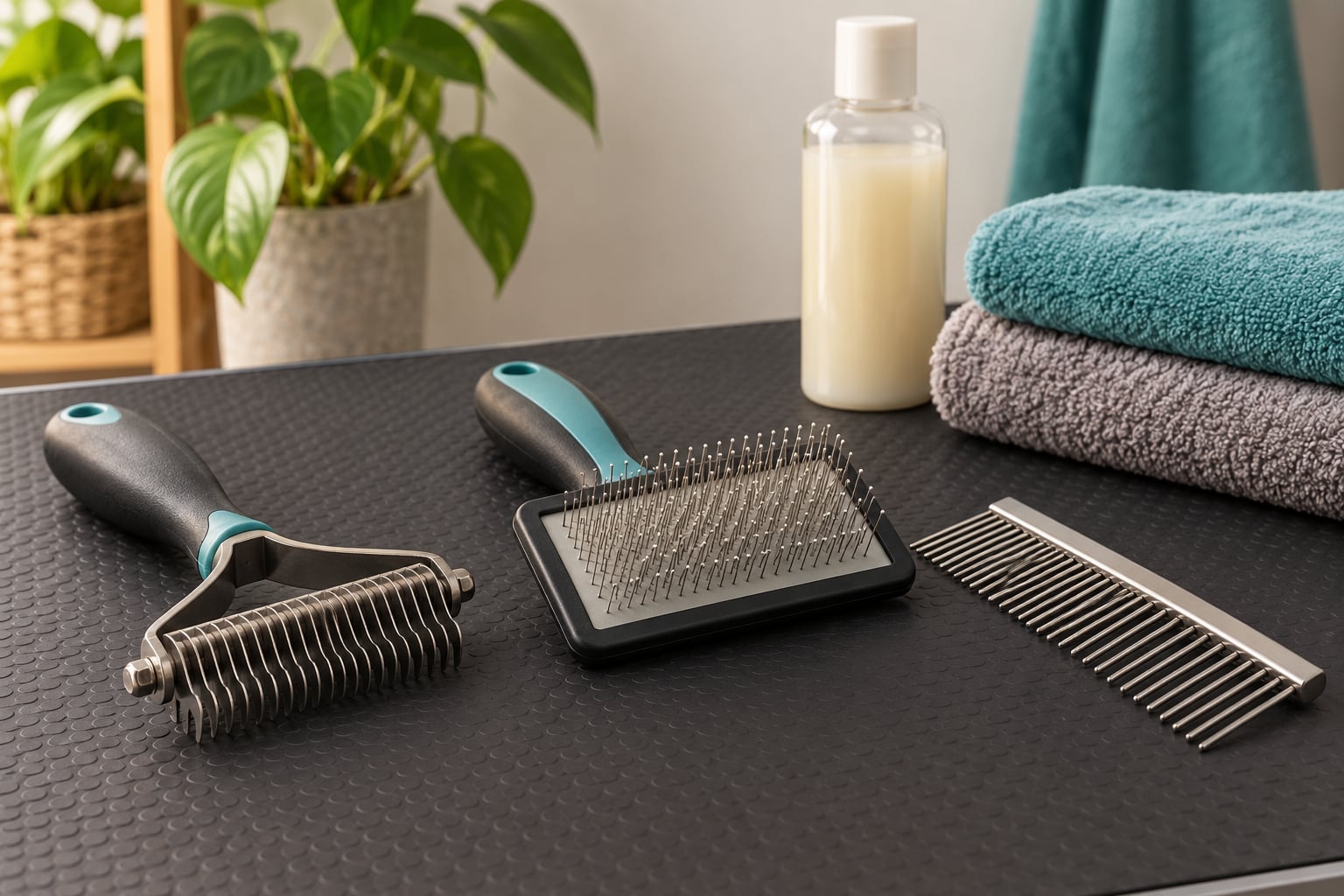
To groom a double coated dog at home you need three tools in this order: an undercoat rake to lift the dense undercoat, a slicker brush to work the outer layer, and a metal comb to confirm both layers are clear. Brush two to four times a week, daily during a moult, and never shave a healthy double coat.
The hard part is not the bath. It is the ten minutes of line brushing twice a week that keeps the undercoat from felting against the skin. A weekly session on a Labrador or a Border Collie takes 10 to 15 minutes; a full de-shed on a Husky, Malamute or Bernese in peak coat blow runs 45 to 90 minutes.
Table of Contents
- What You Need
- Step-by-Step: How to Groom a Double Coated Dog at Home
- How to Groom a Double Coated Dog at Home Step 1: Prep and First Line Brushing
- Step 2: Comb Check
- Step 3: Bathing Without Setting Mats
- Step 4: Drying the Undercoat
- Step 5: Trimming Only What Needs Trimming
- Step 6: Finishing Checks
- How Often to Brush a Double Coated Dog
- Common Mistakes
- Shaving a healthy double coat
- Brushing only the surface coat
- Bathing a matted coat
- Drying thick undercoat with heat or by air alone
- Using human shampoo
- Trimming too close, or using clippers without a guard
- Ignoring signs of discomfort
- Maintenance and the shedding calendar
- Frequently Asked Questions
- Should I shave my double coated dog in summer?
- How often should I brush a double coated dog?
- How do I remove loose undercoat from a double coated dog?
- Can I bathe a double coated dog before brushing out mats?
- When should home grooming be stopped and a vet or groomer consulted?
What You Need
A double coat is two layers with two jobs. The undercoat sits against the skin, soft and dense, trapping air so the dog stays warm in winter and cool in summer. The topcoat is the longer, coarser layer of guard hairs that sheds water, dirt and sun. Most mat problems in these breeds start when owners brush only the top layer and leave the undercoat to felt into a mat against the skin.
Before buying anything, run three quick checks. Part the coat down the spine and look at the skin underneath; if you see a soft, fuzzy, differently textured layer, it is a double coat. Pull a few hairs from the coat and check whether they come out in clusters. And check behind the ears, at the collar line, in the armpits and on the inner thighs, where friction builds mats first.
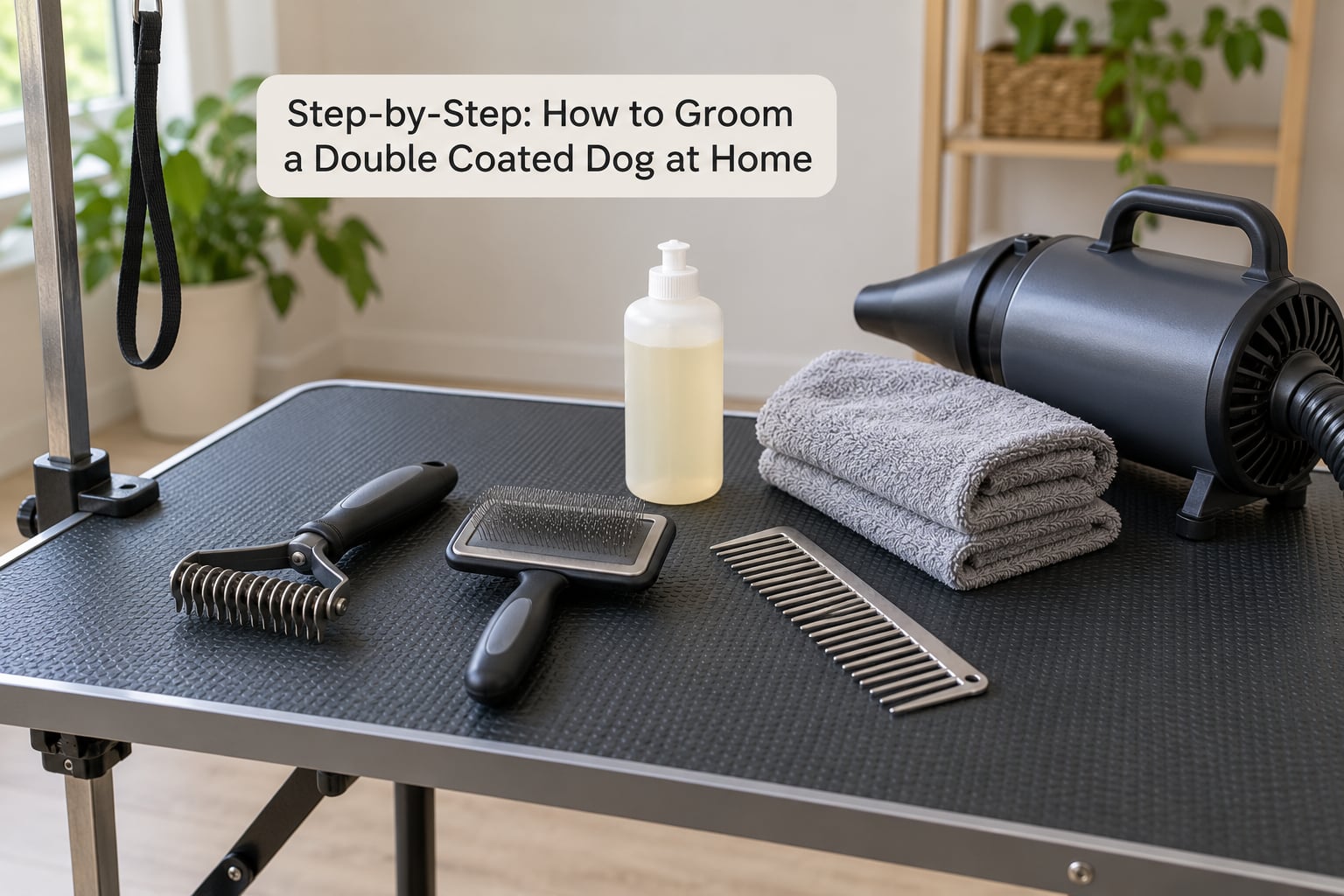
| Tool | What it does | Coat layer | When in the routine |
|---|---|---|---|
| Undercoat rake | Lifts and drags out loose undercoat | Undercoat | First pass, before and after the bath |
| Slicker brush | Opens and smooths the outer coat, lifts loose hair | Topcoat | Second pass, weekly and after drying |
| Metal comb, wide tooth | Confirms both layers reach the skin; finds tangles | Both | The done test, every session |
| Detangling spray | Lets you work a tight knot without pulling | Both | Only on small tangles, before brushing |
| Dog shampoo and conditioner | Washes dirt and resets a matted undercoat | Both | Bath day, never on a matted coat |
| High-velocity dryer or cool airflow | Lifts the undercoat while it dries | Undercoat | Bath day, until the skin is dry |
| Hair catcher | Catches the volume of loose hair during the bath | n/a | Bath day |
On rakes, the question comes up constantly: bladed or bladeless? A bladeless rake has rounded teeth that scoop dead hair out and stop at the coat, while a bladed rake has a cutting edge that can pull guard hairs along with the undercoat if you work it hard or press hard. Breed-specific communities, including r/siberianhusky and r/dogs, keep recommending bladeless for exactly that reason. Use a bladed rake only as a de-shedding tool during a heavy moult, and only with light pressure.
On the other side of the shed, de-shedding tools with a blade strip a set amount of coat each pass. Used year-round they thin the dog and leave patchy bald areas, which owners in r/grooming complain about constantly. Reserve them for the spring and autumn blow, twice a season at most.
Also useful: a pin brush for the finishing pass, a dog-specific dryer or a cool-air nozzle, rubber grooming gloves for quick tidy-ups, non-slip matting for the bathroom, and treats. Clippers and scissors are optional and only for sanitary trims; more on that below.
Before you start, do a safety pass. Look for mats, lumps, redness, damp patches, flakes or bald spots. Check the skin where the coat is thin, around the ears and between the toes. If you find anything sore, stop and talk to your vet first, and never use human shampoo or human medication on a dog.
Step-by-Step: How to Groom a Double Coated Dog at Home
How to Groom a Double Coated Dog at Home Step 1: Prep and First Line Brushing
Pin or clip the coat into horizontal rows about 5 cm wide and work from the bottom of that row upward, with the tool angled toward the skin. A dampened hand or a little detangling spray on dry fur keeps static down.
Pass the undercoat rake from skin outward along each row, never digging into the coat. Do not scrub or rake one patch repeatedly; that is how guard hairs get broken. Pick the hair up off the coat with your hand rather than pulling it out.
Do two things every session: rake first to release, then slicker second to smooth and catch the rest. Check that the tool reaches skin rather than sliding over a fluffy surface. The community rule of thumb is simple: if the coat looks brushed but you can still feel a dense pad under it, you have only done the topcoat.
How to tell you are finished with this stage: the comb runs from skin to tip with no resistance, and the coat parts easily into rows instead of springing back into one mass.
Step 2: Comb Check
Run a metal comb from the skin to the tip of the coat, section by section. If it catches, there is still a knot down near the skin, and that is where mats start.
Work small tangles out by hand first, then with the comb held close to the skin so the teeth carry the hair instead of the handle pulling on it. Skip the scissors. Cutting a mat out with scissors or clippers breaks guard hairs and can leave permanent bald patches that never grow back properly.
If a mat is tight, close to the skin, and will not release, stop. That is a groomer job, and it is a cheap one compared with what a cut mat does.
Step 3: Bathing Without Setting Mats
Never bathe a matted double coated coat. Water compresses the mat, drives it tighter against the skin, and turns a solvable tangle into a felted lump. This is the mistake that costs people the most, and it is the one to avoid above all others.
Check for mats and get them out before the dog sees the tub. Plug the drain with a hair catcher, since one bath can pull out a surprising amount of loose undercoat.
Wet the coat from the skin out, not from the back down. That means soaking the undercoat first and letting it take the water, then the topcoat. Work dog shampoo down to the skin with your fingers. Use a conditioner made for double coats on the second wash, leave it a few minutes, and rinse until the water runs clear.
Washing loosens dead undercoat. Rinse, then rake straight through the wet coat before it dries, because once it dries tangled it stays tangled.
Step 4: Drying the Undercoat
Do not air-dry a dense double coat. Trapped moisture in the undercoat is how you get hot spots, and skin that stays damp in a thick coat will smell within a day.
Start at the skin and move outward with a high-velocity dryer on cool, while brushing with the slicker so the hair separates as it dries. Work from the neck down the spine, then down each side, then the chest, belly and legs. Keep lifting and separating as you dry; a coat that looks dry on top can still be soaked underneath.
Check by pressing your hand flat into the coat, right down to the skin. If it feels cool or damp rather than warm and dry, keep going.
Step 5: Trimming Only What Needs Trimming
Most double coated dogs do not need a trim at all. Sanitary spots are enough: paw pads, the hair between the toes, the belly area that gets urine, and the sanitary area. These stay tidy without touching the coat length.
Clip the coat on the body down to the length it already grows, and only with a coat rake or guard comb between passes. Never take it shorter than the existing topcoat. If you cannot see the skin through the coat while clipping, you are going too short.
And never shave. More on that in the mistakes section below.
Step 6: Finishing Checks
Run the metal comb once more from skin to tip. Then check the hot spots: behind the ears, the collar line, the armpits and the inner thighs. If the comb passes cleanly in all four, the coat is done.
Finish with a light pin brush or rubber grooming glove pass to lay the topcoat flat. Expect some loose hair for a day or two after a heavy de-shed; that is normal.
How Often to Brush a Double Coated Dog
| Breed | Off-season | Moult season | Full bath |
|---|---|---|---|
| Samoyed, Chow Chow, Pomeranian | 2-3 brushings a week, longer sessions | Daily | Every 6-8 weeks |
| Husky, Malamute, Bernese Mountain Dog | 2 brushings a week, 15-20 min | Daily, 30-45 min | Every 6-8 weeks |
| German Shepherd, Belgian Shepherd | 2 brushings a week, 10-15 min | Daily | Every 8 weeks |
| Golden Retriever, Labrador Retriever | 1-2 brushings a week, 10 min | 3-4 brushings a week | Every 6-8 weeks |
| Border Collie, Australian Shepherd, Corgi | 2 brushings a week | 3-4 brushings a week | Every 8 weeks |
| Beagle, Shiba Inu, short-haired double coats | 1 brushing a week | 2-3 brushings a week | Every 8 weeks |
| Long-haired double coats: Collie, Sheltie, Cocker Spaniel | 3 brushings a week | Daily | Every 6-8 weeks |
Those figures are brushings, not hours. Short-haired double coats such as the Beagle and the Labrador need far less time per session than a long-haired Collie, where the coat has enough length for the undercoat to hide in.
Common Mistakes
Shaving a healthy double coat
Shaving does not cool a double coated dog. It removes the guard hairs and the insulating undercoat both, and the coat often comes back in a different, coarser texture. The follicles can also take months to settle, and some dogs develop post-clipping alopecia, where patches of coat simply fail to regrow. In the meantime the dog has less protection from heat, cold, sunburn and insect bites. A dog that is genuinely overheated needs water, shade, a cool floor and air movement, not a shaved back. Trim the belly, sanitary area and paw pads instead if that is all you want.
Brushing only the surface coat
This is the most common mistake, and the cause of most mats. Owners brush, the dog looks neat on top, and the undercoat keeps felting against the skin. Then a mat appears behind an ear or in the armpit with no warning. Work to the skin every time, section by section, and use the metal comb as your check.
Bathing a matted coat
Water tightens mats. A mat that was finger-width before the bath is a felted lump after it, and the only way out is clipping, which breaks guard hairs. Remove mats before water touches the coat. No exceptions on this one.
Drying thick undercoat with heat or by air alone
A hot dryer on high can scorch and dry out skin, and air-drying leaves the undercoat damp. Use cool or warm airflow while brushing, working from the skin outward, until your hand pressed into the coat feels warm and dry all the way down.
Using human shampoo
Human shampoo is the wrong pH for dog skin and dries it out. Use a dog shampoo, and a conditioner formulated for double coats when you can. Never apply human medication, creams or topical treatments to a dog without asking your vet.
Trimming too close, or using clippers without a guard
Clippers with no guard take the coat down to the skin and cut the guard hairs. Set the clipper to the length the coat already grows and check constantly with a coat rake. The same goes for scissors around mats: cut out with scissors and you will find broken hairs and a bald patch later.
Ignoring signs of discomfort
Flaking, redness, dark greasy patches at the skin, damp or smelly areas, lumps, bald spots, or a dog who moves away when you touch a spot are all reasons to stop and see your vet. A coat that has been over-brushed or worked with a stiff tool on knots can get irritated, and hot spots can start in a damp undercoat within days.
Maintenance and the shedding calendar
Spring: the biggest shed. Expect daily line brushing for two to three weeks and expect to vacuum more than usual. Run the undercoat rake a section at a time, keep passes light, and use a hair catcher in the bath.
Summer: brush as normal, check for mat hot spots twice a week, and keep the coat. Do not shave. Clean water and shade do more for a hot dog than a shorter coat.
Autumn: the second heavy shed, often with tangles forming as the coat lengthens. Add detangling spray and a second comb pass.
Winter: the undercoat is at its densest. Check the belly, armpits and inner thighs weekly, since trapped coat and moisture there turn into mats in a fortnight.
Between seasons: two brushings a week for most dogs. A short daily pass with a grooming glove catches what the undercoat sheds in the house, which is the fastest way to keep hair off the sofa.
Frequently Asked Questions
Should I shave my double coated dog in summer?
No. A double coat insulates against heat as well as cold, so shaving removes the layer that keeps your dog cool. The guard hairs are also damaged by clippers and can grow back a different texture, and some dogs develop post-clipping alopecia with bald patches that take months to fill in. Keep the coat, trim the belly and sanitary area if needed, and cool a hot dog with shade, water and cool floors.
How often should I brush a double coated dog?
Two to four times a week outside the shedding season, and daily during the spring and autumn moult. Short-haired double coats such as Beagles and Labradors need the least; long-haired Collies and Shelties need the most. Sessions are short on regular days, 10 to 15 minutes, and longer during a blow. The comb check matters more than the clock: if it passes skin to tip, the coat is done.
How do I remove loose undercoat from a double coated dog?
Use a bladeless undercoat rake in horizontal sections, working from the skin outward in one pass per row, then finish with a slicker brush to lift the rest. Pick the hair off the coat with your hand rather than pulling. A bladed de-shedding tool belongs in a heavy moult only, twice a season, because repeated use thins the guard hairs and leaves patchy bald areas.
Can I bathe a double coated dog before brushing out mats?
No. Water compresses a mat and drives it tighter against the skin, so a tangle that was easy to finger apart becomes a felted lump after a bath. Work the mats out with your fingers, a wide-tooth comb and detangling spray before the tub. Cutting a mat out with scissors or clippers breaks guard hairs and can leave a bald patch that never grows back properly.
When should home grooming be stopped and a vet or groomer consulted?
Stop and see a vet if you find redness, flaking, dark greasy patches at the skin, damp or smelly areas, lumps, bald spots, bleeding or a dog who flinches when touched. Those need a diagnosis, not a brush. Book a professional groomer for mats tight against the skin, coat that is matted in several places, a heavily felted undercoat, or any trim near sanitary areas and paw pads. A vet visit comes first whenever skin is involved.
Start tomorrow with fifteen minutes and three tools. Part the coat, rake one row from the skin outward, slick it, then run the comb and see what it catches. Do that two or three times a week and the undercoat never gets the chance to felt into mats, which is how you groom a double coated dog at home without ever needing the razor.