
Learning how to introduce a dog to a cat in the same home comes down to one rule: control the contact, then reward the calm. You separate them completely for the first few days, swap scents through a door or gate, allow brief visual contact, and only then run short leashed sessions where the dog is marked and treated for noticing the cat without lunging. Most households need two to four weeks for a relaxed introduction and considerably longer before the two animals genuinely tolerate sharing a room.
Rushing this is the single reason people end up with a household where the cat lives permanently under a bed. One bad encounter can undo weeks of careful work, and a frightened cat often carries that fear for the rest of its life.
This guide walks through the whole process in five stages, including what to prepare, how to read both species’ body language, what to do when the dog has high prey drive, and how to recover if a first meeting goes wrong.
Table of Contents
- What You Need Before the Animals Meet
- Step-by-Step: How to Introduce a Dog to a Cat in the Same Home
- Step 1: Set Up Separate Safe Spaces
- Step 2: Exchange Scents Without Direct Contact
- Step 3: Allow Controlled Visual Contact
- Step 4: Hold Short, Positive Meetings
- Step 5: Increase Contact Gradually
- How Long Does It Take? The 3-3-3 Rule and Realistic Timelines
- Common Mistakes That Set Introductions Back
- Introducing Immediately and Letting Them Sort It Out
- Using the Dog as a Decoy
- Feeding Both Animals in an Open Room
- Leaving Them Together Too Long
- Punishing Fear or Growling
- Forgetting That the Dog Still Needs Training in the Middle of It All
- Dogs With High Prey Drive Need a Slower Plan
- When to Slow Down or Separate the Animals
- Safety Tips for Everyday Management
- Frequently Asked Questions
- What is the 3-3-3 rule for introducing a dog and a cat?
- How long does it take for a dog to get used to a new cat?
- How long should I wait before letting a dog and a cat meet?
- How do I introduce a cat to a dog with high prey drive?
- Can cats and dogs live together peacefully in one home?
- Conclusion
What You Need Before the Animals Meet
A gradual introduction depends on having the right setup in place before anyone opens a door. Most of the gear is cheap or already in the house, and all of it can be removed once the animals are comfortable.
- Two separate base areas. One room or zone for the dog with a bed, water and somewhere to hide, and one closed room for the cat with a litter tray, food, water and at least two hiding spots. A spare bathroom or bedroom works fine for the cat.
- A secure barrier. A baby gate tall enough that the dog cannot jump it, an exercise pen, or a screen door. Gates beat crates for this job because the cat can see and hear the dog without being cornered, and that visual contact speeds the whole process up.
- A harness and a long line. A well-fitted harness plus a 10 to 15 foot lead gives you control without putting your hands anywhere near the dog’s mouth. Never attach a lead to a collar for this work.
- Two sets of bedding with familiar scents. Soft towels or blankets that have been sat on or slept in. These become your scent-swap tools in stage two.
- High-value treats for both animals. Use something better than the everyday kibble: small soft training treats for the dog, and the cat’s favourite treats or a few pieces of wet food for the cat. Keep a supply in a jar within reach during every session.
- A carrier or covered hiding spot for the cat. A carrier with the door open, a cardboard box with two exits, or a covered bed lets the cat withdraw without being cornered.
- A marker word or clicker. A single consistent sound that tells both animals a reward is coming. Many people just use the word “yes” in a bright, flat tone.
- A written plan. Jot down what each session looked like, how long it lasted, and what each animal did. That note is what tells you when to move forward, and it stops you judging progress by memory alone.
- An optional pheromone diffuser. Plug-in diffusers marketed for cats or for dogs can take the edge off a nervous first fortnight. They help some animals a great deal and do nothing for others, so treat them as a bonus rather than the main tool.
A quick note on the litter tray: whatever you do during the introduction, keep it. Litter trays are the single most important thing a cat owns, and burying that fact in a closet or a busy laundry room is a common cause of litter box avoidance later on.
Step-by-Step: How to Introduce a Dog to a Cat in the Same Home
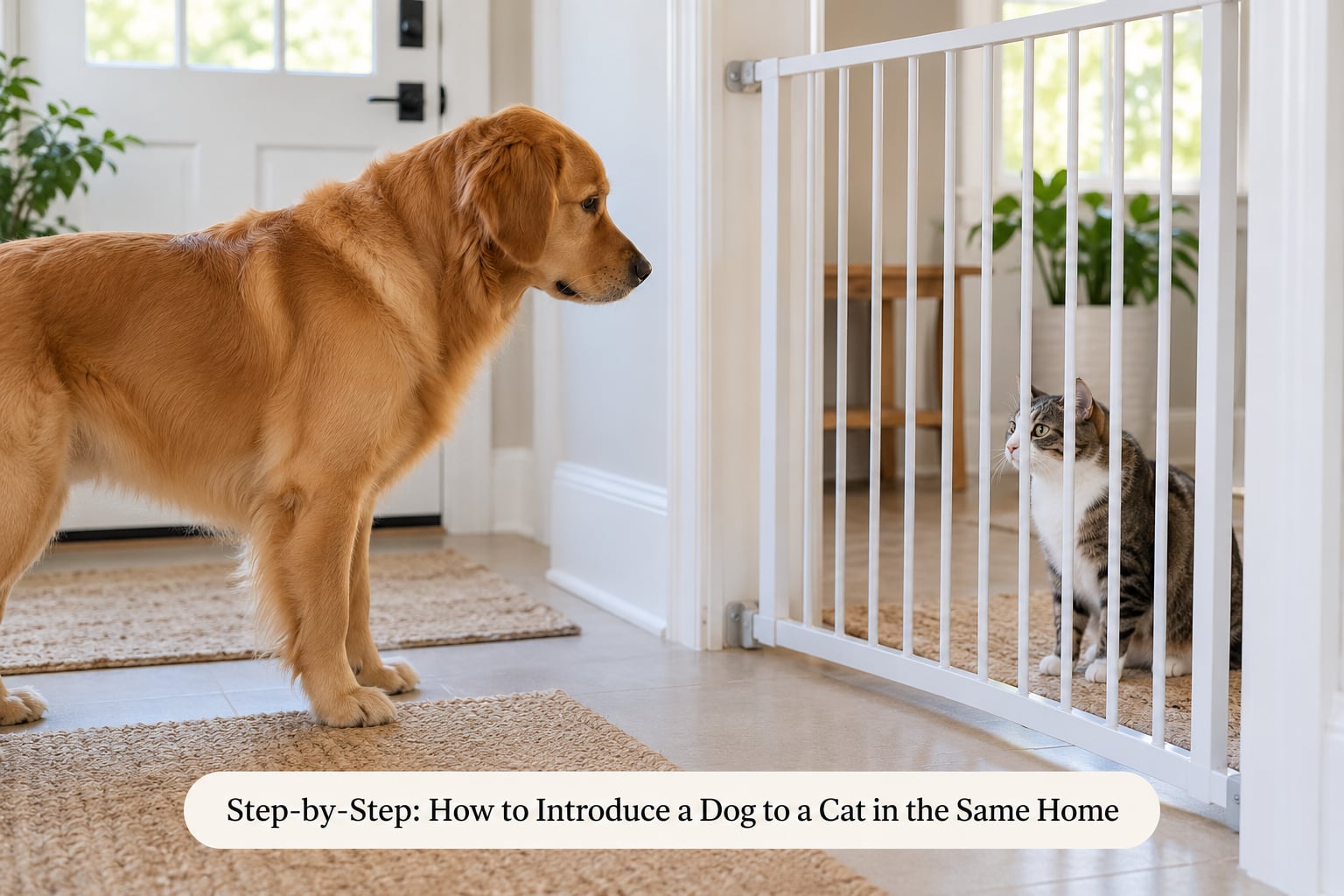
The process runs in five stages and each one depends on the previous stage being genuinely relaxed, not merely survived. Move forward when the animals are eating, resting and curious in each other’s presence. Wait an extra day or two whenever you are unsure.
Step 1: Set Up Separate Safe Spaces
Complete separation is the foundation. Before any contact at all, the cat needs a room where the dog cannot reach it, and the dog needs an area it cannot break out of.
Start with the doors closed and pick a base area for the dog, ideally a crate or a bedroom with a gate across the door. A calm dog settles within a day or two. Crate training matters here for that reason; if your dog has never seen a crate, start crate training before you bring the other animal home, not during.
Then set up the cat’s room properly. Put the litter tray on one side of the room and everything else, food, water, bedding, on the other, so nothing has to be crossed to reach the tray. Add hiding spots with two exits so the cat never has to squeeze past anything to get away from a noise.
Give the cat vertical options too. A cat tree or a sturdy shelf near the door lets the cat sit above the dog and watch from a safe height. You will be glad of that perch during every later session.
Keep them apart overnight for the first few nights. Feed the dog in the dog’s area and the cat in the cat’s room, always at the same time, so the cat does not feel chased out of its own bowl. Doors closed between them is the arrangement for now.
One warning about barking: a dog barking at a closed door is a problem worth solving early, not something to ignore. That barking means the dog is highly aroused, and an aroused dog that keeps barking builds stress in the cat on the other side. Answer the barking by moving the dog to a further room, or work on a settle-on-a-mat behaviour with treats while the door stays shut.
How to tell this stage worked: both animals are eating normally, using their trays, and settling rather than pacing or vocalising constantly.
Step 2: Exchange Scents Without Direct Contact
Scent is how dogs and cats gather most of their information. Swapping scents lets each animal learn the other exists without any of the drama that comes with a face-to-face meeting.
Take a separate cloth or towel for each animal. Rub one over the cat’s cheek, neck and flanks and place it near the dog’s water bowl, then wash your hands before you handle the dog. Do the same in reverse, putting a dog-scented towel near the cat’s bed or bowl.
Repeat this daily for several days, moving the items closer each time. Watch what happens without intervening too much: does the dog go quiet and sniff the cloth, or does he pace and whine? A still, sniffing dog is a good sign. Whining, scratching at the door or frantic barking means you have moved too fast, so step the item back.
Many owners find it helps to feed through the closed door at this stage. Put the cat’s bowl on one side of the door and the dog’s on the other. Both animals get a good meal near the sound and smell of the other, and the dog learns that the door means something pleasant is happening.
How to tell this stage worked: the dog investigates the cat-scented item with a loose body and then returns to normal, and the cat settles near the dog-scented item rather than fleeing from it.
Step 3: Allow Controlled Visual Contact
Once the scent is boring, sight is the next step. Put a baby gate or exercise pen across the doorway between the cat’s room and the rest of the house, and let the cat choose whether to come to the gate.
Keep these first looks short. Thirty seconds to a couple of minutes is plenty. Sit down near the gate and have both treats ready. The moment the dog looks at the cat, mark with your marker word and feed him. Mark and feed the cat too when it looks your way or when it chooses to stay close instead of running off.
The behaviour you are building is called counterconditioning: pairing the sight of the cat with something good until the sight alone stops being exciting. Over a few days, extend the sessions slightly and move the gate farther from wherever the dog tends to lie, so he learns to be calm about the cat across the room rather than only at arm’s length.
Keep the dog on his lead even at the gate, attached to your belt or held loosely. A dog that can see a cat but not reach one is rehearsing exactly the impulse you will need him to have later. Sessions ending on a calm note are worth more than long sessions that end in a spike of barking.
How to tell this stage worked: the dog can see the cat, take a treat, and go back to lying down, rather than freezing, barking or lunging at the barrier.
Step 4: Hold Short, Positive Meetings
This is the stage most people rush, and it is where introductions usually go wrong. The first in-person meeting should be very short, very boring, and on a lead.
Put the cat in its carrier, on a chair, or on a stable high surface such as a cat tree or washing machine. Keep the door of the carrier open so the cat can leave if it wants to. Keep the dog on a harness and a long lead with plenty of slack, sitting down rather than standing, because a standing human creates tension in the dog.
Start with one to three minutes and end the session early on purpose while everything is still fine. Feed the dog for any calm behaviour, including looking at the cat and then looking away. That looking-away moment is the one you are really rewarding, because it is the beginning of the dog choosing not to chase.
Reading the cat takes more attention than most people expect. A content cat has slow blinking, ears forward or neutral, and a tail that hangs or curls gently. A stressed cat has flattened or sideways ears, a twitching or lashing tail, pupils blown wide in a lit room, crouching or freezing, frantic grooming, or a very fast tail. A cat that bolts for cover and stays hidden for the rest of the session has told you the meeting was too long.
The dog’s signals are just as informative. Stiff, frozen posture with the weight forward means the dog is working hard to hold back. Hard staring without blinking, creeping steps, a closed mouth that goes tight, or a sudden quiet stop all point the same way. Repeated stalking and lunging is a clear signal to end the session, even if nobody has drawn blood.
Two to three short sessions a day beats one long one. Several owners report that three one-minute sessions produced faster progress than a single twenty-minute attempt, because the dog stays under its arousal threshold and keeps earning rewards instead of getting overwhelmed.
How to tell this stage worked: both animals took treats, nobody chased or cornered anyone, and the cat chose to leave the carrier rather than being trapped in it.
Step 5: Increase Contact Gradually
Once you have three or four calm sessions behind you, you can start removing supports one at a time. Drop the long line first while the dog stays with you, then drop the carrier while the gate stays, then drop the gate while the dog stays on the lead.
Lengthen sessions by a minute or two each time rather than by jumping ahead. Keep rewarding the dog for anything close to calm: a look, a sniff in the cat’s direction, a step towards the cat followed by a step back.
Then proof the behaviour in other contexts, because dogs often learn that one room is fine and everything else is a different story. Move to another room together, then to the garden or yard, then to a room with different lighting and different floor surfaces. Add a third person walking through. Practise the recall away from the cat so that coming back to you is always more rewarding than watching the cat.
As things settle, rotate access. Owners of multi-dog households often find it works best to let one dog be with the cat while the others are in their own space, then swap. The cat gets alone time with a dog rather than a constant free-for-all.
Progress rarely runs in a straight line. Expect a wobble whenever furniture moves, the mail arrives noisily, or someone brings a visitor in. That is normal and it does not mean you have gone back to square one, as long as both animals still eat and rest normally.
How to tell this stage worked: the dog walks past the cat, takes a treat, and carries on with his business. Noticing the cat is not automatically a problem. Noticing the cat and never being able to look away is.
How Long Does It Take? The 3-3-3 Rule and Realistic Timelines
Most introductions take two to four weeks to reach a place where both animals are relaxed around each other, and three to six months before you can honestly call them comfortable companions. Kittens to adult dogs generally go faster than adult cats to adult dogs. Cats almost always need longer than dogs, because cats are small, territorial and built to hide rather than to negotiate.
The 3-3-3 rule comes from the cat rescue world and gives a rough shape to the timeline: three days to de-stress in the new environment, three weeks to settle into a routine and begin feeling safe, and three months to reach a normal social baseline. Dogs follow a similar arc, though their first three days are usually easier than a cat’s.
| Stage | Typical timing | What is happening | Move on when |
|---|---|---|---|
| Full separation | Days 1 to 3 | Each animal learns the new base area and settles without direct sight of the other | Both are eating, using their trays and resting normally |
| Scent swapping | Days 2 to 7 | Scent items move closer each day, sometimes with feeding through a closed door | Each animal investigates the other’s scent without distress |
| Visual contact at a gate | Week 1 to 2 | Short looks at a baby gate or screen, both animals treated for calm | The dog can see the cat and go back to lying down |
| Leashed meetings | Week 2 to 3 | One to five minute sessions, cat elevated, dog on a long line | Three sessions in a row with no chasing, cornering or hiding |
| Barrier down, lead on | Week 3 to 5 | Full room access with the dog still managed on a lead | Ignoring the cat while playing and eating normally |
| Proofing in new contexts | Week 5 onward | Other rooms, outdoors, visitors, different surfaces | The dog checks in with you instead of chasing |
Use this as a map, not a deadline. Slower is almost always better than faster, and backing up a stage for a few days costs far less than pushing ahead into a fight.
Common Mistakes That Set Introductions Back
Most failed introductions share a handful of causes, and every one of them is avoidable.
Introducing Immediately and Letting Them Sort It Out
Putting both animals in a room together on day one and hoping for the best is the most common error by a distance. Cats do not resolve tension through negotiation, they resolve it by hiding or by swatting, and the dog reads that fleeing creature as something to chase. Separate, go back a stage, and restart.
Using the Dog as a Decoy
Tossing treats for the cat while the dog watches, hoping he will ignore it, does not work. A fixated dog does not notice treats, and the cat pays for the mistake with a chase. Feed on opposite sides of a closed door or a solid barrier so neither animal has to perform for the other.
Feeding Both Animals in an Open Room
Food is the most common trigger for resource guarding, and a dog who learns he can take a cat’s dinner will not unlearn it quickly. Feed them in their own areas until the dog reliably walks away from a cat who is eating. Check the tray and bowls for holes and chews; that is the fastest way to catch a developing habit.
Leaving Them Together Too Long
The instinct is to extend a good session until something breaks. End every session while both animals are still relaxed instead, and pick it up again later in the day. Two short successful sessions teach more than one long messy one, and a cat that ends the day hiding is being taught that the dog is unpleasant.
Punishing Fear or Growling
Never punish a growl, a hiss or a swat, and never punish the dog for barking at the cat. Growling and hissing are warnings, and punishing a warning removes the only signal you had. The behaviour that follows a warning is what you need to address. Redirect with treats, increase distance, and go back to the previous stage.
Forgetting That the Dog Still Needs Training in the Middle of It All
A reliable recall and a solid leave-it command do more for a successful introduction than any piece of equipment. Teach a leave-it by offering a treat the dog is about to grab, saying the cue once, and rewarding him for looking at you instead. Practise it away from the cat until it is automatic, then practise it with the cat in view.
Dogs With High Prey Drive Need a Slower Plan

Prey drive describes a dog’s built-in chasing instinct. It varies enormously between individuals of the same breed, so breed is a hint rather than a verdict, but it tells you which dogs to set up with extra management from day one.
| Breed group | Typical prey drive | Management that helps |
|---|---|---|
| Sighthounds such as greyhounds, whippets and salukis | High | Long line or fenced outdoor space, muzzle conditioning, no off-lead freedom with the cat until the recall is proven |
| Terriers including many Jack Russell and bull breeds | High | Muzzle conditioning, closed doors between the cat’s high resting spots, rewards for disengaging |
| Herding breeds such as collies and shepherds | Medium to high | Reward calm, avoid repeating herding-style chasing, work on an emergency recall |
| Spitz and northern breeds | Medium | Watch for stalking behaviour, reward disengagement early |
| Retrievers and spaniels | Medium | Manage around the cat’s toys, which can trigger carrying and shaking |
| Many mixed breeds and individual dogs | Unpredictable | Watch the individual dog rather than the breed label, and be ready to manage more than you expected |
Muzzle training is the most useful tool here, and it is worth the two weeks it takes to get right. A basket muzzle lets a dog open, pant and drink, so it is not a punishment, and many dogs relax noticeably once they learn it does not hurt. Condition it in stages over several days: show the muzzle and treat, touch it to the nose, slip it on for a second and treat, then build to five minutes of play and treats indoors, all without the cat anywhere near.
For a dog whose chasing is out of habit rather than instinct, a long line attached to a harness works better than any verbal cue for the first few months. The physical limit on the distance he can create does the training for you.
When to Slow Down or Separate the Animals
End the session and step back a stage the moment you see any of these. On the dog side: stiff frozen posture, creeping or stalking steps, repeated lunging, hard unbroken staring, a sudden quiet intensity, resource guarding around food or toys, or refusing food. On the cat side: ears flattened or turned sideways, tail lashing or tucked, pupils blown wide, crouching, frantic grooming, hissing, swatting, or hiding and staying hidden.
Separate them fully, do not just put the dog back in the room and leave them to sort it out, and give everyone a day or two of calm. Then restart from the stage before the one that failed. A cat that has been chased does not need a longer session, it needs a step backwards.
If the dog fixates on the cat and will not take food, or if the cat stops eating and hides for more than a day, that is your signal to call a vet and ask for a referral to a qualified behaviourist. Cats that hide for extended periods can develop stress-related urinary problems, and a cat that will not eat is a cat in real distress.
Safety Tips for Everyday Management
Once the two animals share space, the habits that keep them safe are boring but permanent. Keep one extra litter tray compared with the number of cats, spaced apart rather than clustered together, and never place one beside the dog’s bed or in a dead-end spot. Feed separately, at least until the dog reliably walks away from food that is not his.
Keep escape routes. The cat should have at least one high place in every room it uses, and the dog should never be able to corner it in a hallway or a corner with no exit. Widen doorways a cat can squeeze through with a baby gate across the gaps, which closes off the under-bed and behind-the-sofa spaces dogs prefer.
Supervise closely at the predictable high-risk times: mornings, when someone opens the front door, around visitors, and when the dog is excited after exercise or a walk. Many dogs are perfectly reasonable for six hours and impossible for ten minutes after a run.
Give everyone in the household the same rules and the same wording, since a mixed message undoes the training. Keep the notes you made during the introduction and read them back if progress stalls, because you will usually find that a session failed for one identifiable reason rather than because the plan was wrong.
Some animals need help from a professional. Ask your vet for a referral to a certified behaviourist or a qualified force-free trainer if the dog cannot be taken off the lead, if the cat stays hidden for more than a day or two after an incident, or if you feel unsafe handling the situation yourself. Never give human medication to either animal for stress.
Frequently Asked Questions
What is the 3-3-3 rule for introducing a dog and a cat?
The 3-3-3 rule describes the pace of adjustment: three days for the new animal to de-stress in the home, three weeks to settle into a routine and begin eating and resting normally, and three months to reach a stable social baseline. It originated in cat rescue and works reasonably well for dogs too, though most dog and cat introductions need two to four weeks to reach the relaxed stage.
How long does it take for a dog to get used to a new cat?
Most dogs adjust to a new cat faster than the cat adjusts to the dog. Two to four weeks of structured work usually gets you to a place where both animals are relaxed around each other, and three to six months before the relationship is genuinely settled. Kittens to adult dogs go faster than adult cats to adult dogs. Progress that stalls for a week is normal, and stepping back a stage usually works better than pushing ahead.
How long should I wait before letting a dog and a cat meet?
Wait until the cat is eating, using its tray and resting normally in its separate room, usually three to seven days. Then start with scent swapping and a few days of visual contact at a baby gate before any face-to-face meeting. The signal to move on is not a day on the calendar but relaxed behaviour from both animals at the stage you are currently at.
How do I introduce a cat to a dog with high prey drive?
Treat it as a longer project, not a shorter one. Start with muzzle conditioning and long line work before the two animals are ever in a room together, keep the cat’s high resting places and litter trays physically out of reach, reward any disengagement from the cat, and never leave them together unsupervised. Sighthounds, terriers and herding breeds usually need months rather than weeks, and a behaviourist referral is worth considering early.
Can cats and dogs live together peacefully in one home?
Yes, most cats and dogs that are introduced gradually end up sharing a home without drama. They rarely become best friends, and that is fine, because coexisting quietly is the realistic goal. What matters is that the cat has escape routes and high ground, both animals eat separately, and the dog can be managed whenever arousal rises. Households that rush the first month are the ones that end up rehoming one of the animals.
Conclusion
Start tonight, not with a meeting. Pick the cat’s room, close the door, set up the dog’s area with a gate or crate, and put a hiding spot and an elevated perch in the cat’s space. Everything else in this guide follows from that separation.
Keep the stages in order, reward calm rather than excitement, and move forward only when the animals are relaxed rather than merely coping. If either one shows stress, separate them and go back one step, and talk to your vet or a behaviourist if that keeps happening. Slow and boring is what gets two animals living comfortably in the same home.