
A kitten explores at floor level, chews anything string-like, climbs anything vertical and fits through any gap wider than its head. Kitten-proofing means removing, locking or blocking whatever it could chew, swallow, fall from, or get trapped in — and most of that work is a single walk through your home on your hands and knees, done before the kitten even arrives.
Complete proofing is impossible. You are buying time, not building a museum. This guide covers how to kitten proof your home room by room, what to buy or borrow first, and how to recheck the place as your kitten gets taller, stronger and more curious.
Table of Contents
- What You Need
- Step-by-Step: How to Kitten Proof Your Home
- 1. Identify the rooms and high-risk zones your kitten can reach
- 2. Secure windows, doors, balconies, and other escape routes
- 3. Remove toxic foods, medicines, and small objects
- 4. Protect cords, outlets, furniture, and unstable objects
- 5. Make each room safe for play, rest, and litter use
- 6. Check floors, surfaces, and hiding places
- 7. Introduce the kitten gradually and supervise exploration
- 8. Recheck the home as your kitten grows
- Common Mistakes
- Safety Tips for a Kitten-Safe Home
- Frequently Asked Questions
- When should I kitten-proof my home before bringing a kitten home?
- What are the most dangerous rooms for a new kitten?
- Are window screens enough to keep a kitten safe?
- How should I supervise a kitten while exploring the home?
- What should I do if my kitten eats a toxic food or small object?
- Do I need to recheck the home as my kitten gets older?
- Conclusion
What You Need
Gather these before you start, so the walk-through runs without trips back to the hardware store.
- Storage boxes or lidded bins for small objects, medications, cords and cleaning supplies.
- Cabinet latches — the push-to-open or screw-in kind used in homes with toddlers.
- Pet or baby gates, one per doorway you plan to block, plus a gate for the safe room.
- Cord covers: rigid tube for exposed runs, or a baseboard raceway and a cord box where you want the room to still look tidy.
- Outlet protectors for unused sockets.
- Furniture anchors or anti-tip straps for tall shelving, wardrobes and wall units.
- Window locks or pet-resistant mesh if you live above ground floor.
- Pet-safe cleaning products and sealed bins for anything you would normally leave within reach.
- A notebook or floor plan to tick off hazards room by room, so nothing gets forgotten.
If you rent and cannot drill, tension rods, peel-and-stick hooks and self-adhesive mesh all work for the first pass. You can upgrade later.
Step-by-Step: How to Kitten Proof Your Home
Work through these eight steps in order, and do them gradually rather than all in the final hour before collection. A three-month-old kitten reaches different shelves than a seven-month-old one, so reassessment matters as much as the first sweep.
1. Identify the rooms and high-risk zones your kitten can reach
Start by watching, not guessing. Sit still in one room for ten minutes with the kitten loose and note everything it investigates.
Then get down to kitten height yourself and map what is reachable: the top of the washing machine, the inside of low cupboards, the gap behind the radiator. Kitchens, bathrooms, bedrooms, laundry rooms, balconies and storage spaces come first because they carry the most hazards.
This is the step most guides skip, and it is the one that actually tells you what to kitten proof your home for. A two-minute notebook list beats a day of buying things you do not need.
2. Secure windows, doors, balconies, and other escape routes
Falls from windows and balconies are among the most common injuries in apartment cats — vets call it high-rise syndrome, and no cat has ever judged the drop honestly.
Check every window on your list, starting from the top floor down. Standard insect screens are not pet-proof: they flex outward under a jumping cat, so they keep bugs out and cats in, occasionally. Fit window locks above ground-floor level or tension-mounted pet-resistant mesh, and check the fixings on a monthly basis.
Close or block balcony doors, seal gaps under external doors wide enough for a kitten to squeeze through, and check the space under the bath, behind the dryer and along pipe runs for a quiet place to nap.
Avoid improvised barriers: stacked boxes, a chair against a door, a towel over a handle. They look fine until the one time the kitten jumps.
3. Remove toxic foods, medicines, and small objects
Latch every low kitchen cupboard that holds glass, sharp objects or food, and move the cleaning products out of the room entirely rather than onto a higher shelf.
Human medication is the most common cause of poisoning in pet cats, so keep pills, blister packs and supplements in a closed drawer or a high cupboard, never on a counter or bedside table.
Use a trash can with a secure, foot-pedal or latching lid, and take the bin out before the lid wobbles.
Clear anything swallowable: batteries (button cells are an emergency), rubber bands, string, dental floss, sewing needles, twist ties, small LEGO pieces and toy parts with loose eyes or squeakers.
Know the toxic list before you shop: chocolate, onions and garlic, grapes and raisins, alcohol, caffeine, xylitol found in some sugar-free gum and toothpaste, and lilies, which are lethal to cats in every part of the plant including pollen and vase water.
If ingestion is suspected, call a veterinarian straight away rather than watching for symptoms.
4. Protect cords, outlets, furniture, and unstable objects
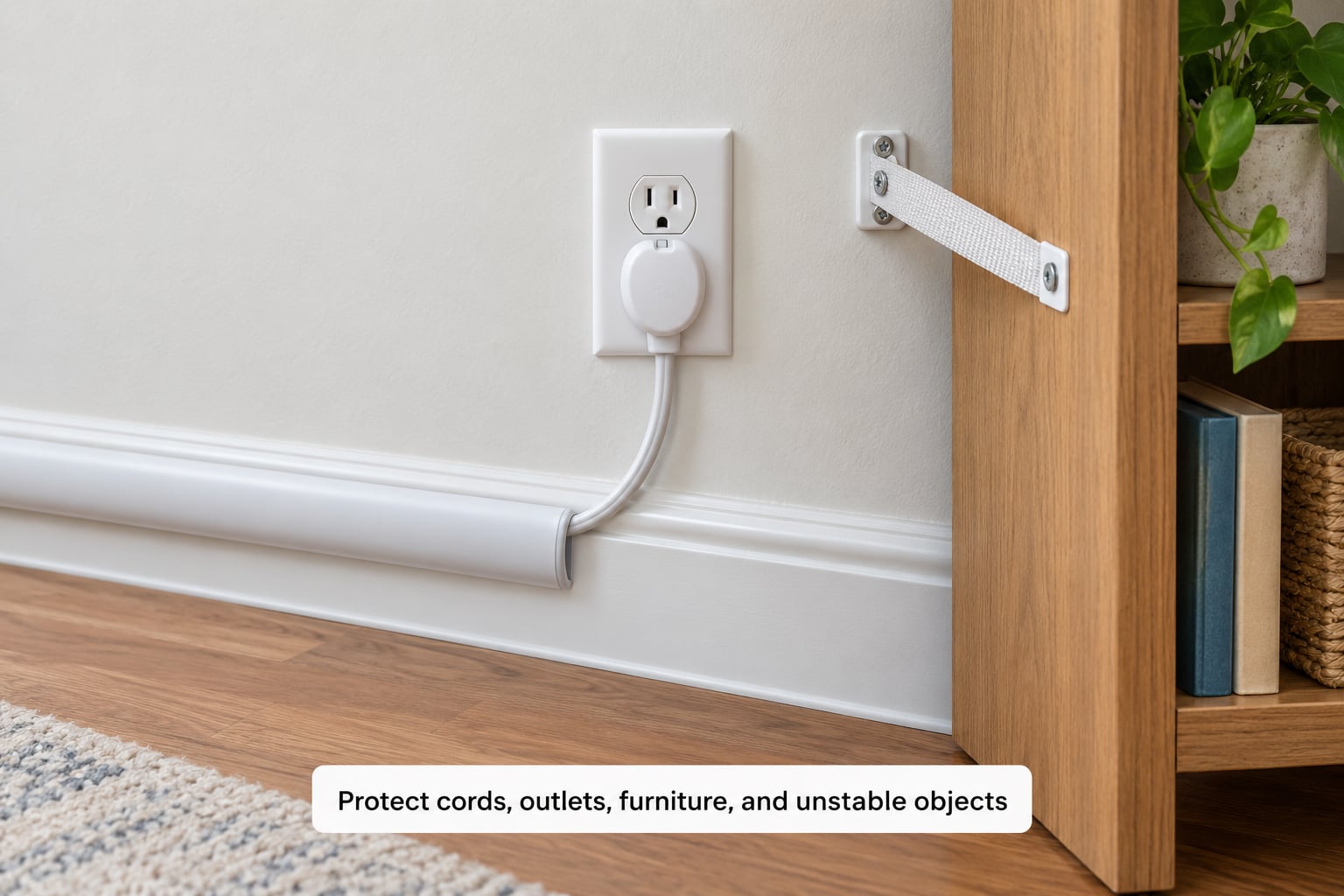
Electrical cord protection is the single highest-priority job in most homes. Unplug what you can, route the rest behind furniture or along the baseboard, then sleeve any run the kitten can reach.
Cover every unused outlet. A kitten chewing a live cord risks burns, electrocution and chewed-through insulation behind the wall, which is a repair far more expensive than the protector.
Window blind cords are a strangulation risk, so tie or clip looped pulls well out of reach or replace the blind with a cordless version.
Anchor tall shelving, wardrobes and entertainment units to the wall. A climbing kitten can pull a light bookcase over with very little effort, and the same applies to a flat-screen TV on a narrow stand.
Remove anything resting precariously — a lamp on a shelf edge, a plant on a high sill, a stack of books on the back of a sofa.
5. Make each room safe for play, rest, and litter use
A safe room needs more than empty floor space. Give it a stable scratching post, somewhere to climb, water and food away from the litter tray, and a quiet bed in a corner the kitten can retreat to.
Vertical space for cats does more for behaviour than almost anything else you can add: a cat tree or wall shelves gives a climbing kitten an outlet that is not your curtain rail or kitchen counter.
Keep only non-toxic plants. If lilies are toxic to cats in your household, remove them entirely rather than relying on your memory to notice a bouquet later.
Check toys for loose threads, small detachable parts and elastic, and skip anything with stringy feathers a kitten could partially swallow.
6. Check floors, surfaces, and hiding places
Kittens love small dark gaps, so work through the places you would forget: under the bed, behind the washing machine, inside the wardrobe, along baseboards and beneath the sofa.
Move appliances out when you can to look behind them. It is a common way to find a blocked heating pipe, a chewing rodent trap, or a nest someone else built in there.
Look for dust and grime in corners, sharp screw heads on cheap furniture, holes in rugs or curtains, and any wire or chemical store you missed from standing height.
Finally, check doors and closets every night. A kitten locked in an airing cupboard or a shed overnight is far more common than any of the hazards above.
7. Introduce the kitten gradually and supervise exploration
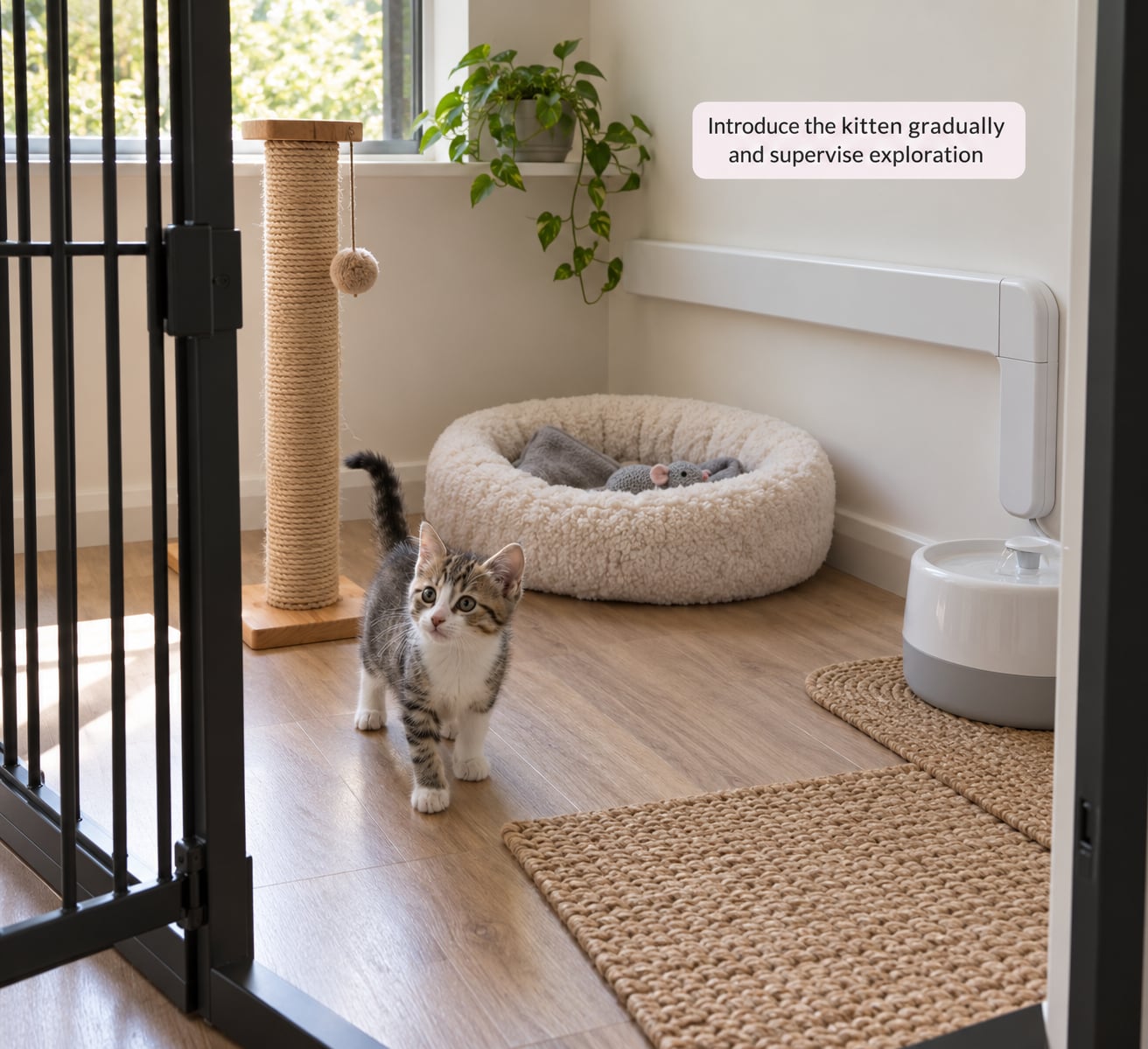
Start with one prepared safe room, closed and gated. Keep litter, water, food, a bed, a scratching post and a couple of toys in it, and spend the first few days sitting quietly in the room rather than letting the kitten out.
Hiding for a day or two is normal and healthy. Opening the whole house on day one does not speed that up, it just adds hazards.
When you do expand access, open one new area at a time and stay close. Supervise the whole session rather than glancing from another room.
Redirect rather than punish: move the kitten to a permitted perch or toy, or add an alternative, such as a second scratching post near the sofa you are trying to protect. If a kitten turns an electric stove knob, fit stove knob covers, push the knobs to off and never rely on telling them no.
8. Recheck the home as your kitten grows
The six-month-old kitten who ignored the bookshelf will treat it differently at ten months. A repeat sweep every month or two catches the new hazards that appear with height, weight and climbing confidence.
Use the same checklist, plus a shorter recurring list: barriers still tight, mesh intact, gates closed, cords still covered, no new gaps behind moved furniture, plants still out of reach.
Repeat the whole process whenever the layout changes — a new sofa, a move, a Christmas tree, string lights or a stack of gift wrap all create fresh hazards.
Common Mistakes
- Leaving a window cracked or a screen unlatched. Fix it before the kitten arrives, and check every month; screens sag.
- Relying on DIY barriers. A tower of boxes fails under a jumping cat. Use a rated gate or a tension-mounted mesh instead.
- Storing medicines in a drawer. Many cats open drawers. Use a high latched cupboard.
- Overlooking balconies, service yards and laundry areas. Block the door rather than assuming your kitten will not be curious there.
- Assuming an adult cat will not explore. Proofing for an adult is harder and happens later; the window problem returns at every age.
- Using correction instead of redirection. Punishment teaches hiding, not safety. Change the environment or offer an alternative.
- Skipping appliances. Check the washer, dryer, oven and dishwasher before every cycle. Owners on forums describe kittens climbing in for a nap during a tumble.
- Forgetting blind cords. These are a strangulation risk and they hang exactly at kitten height.
Safety Tips for a Kitten-Safe Home
Use pet-safe products only, and keep every cleaner, pest control product and scented item in a sealed bin the kitten cannot open. That includes essential oil diffusers, which can harm cats, and open toilet bowls or standing water in plant saucers.
Never give a kitten human medication to treat an ailment. It is one of the most common preventable poisonings.
Give enrichment so the kitten has somewhere legal to spend energy: climbing options, scratching posts, hiding places, daily play and a supply of safe toys rotated so they stay interesting.
Re-verify any plant you bring in before it enters the room, and keep cut flowers out of reach too.
Keep your nearest emergency veterinary clinic and an animal poison control number on the fridge. Call immediately for suspected poisoning, chewing a live cord, breathing difficulty, collapse, a fall, or swallowing a foreign object — do not wait for vomiting or lethargy.
Frequently Asked Questions
When should I kitten-proof my home before bringing a kitten home?
Finish the main work at least a day or two before collection, while you can still move furniture and buy latches without a kitten underfoot. Prioritise escape routes, medications, chemicals, cords and toxic plants first; the rest can be finished in the first week. Leave the safe room set up with food, water, litter and a bed before the kitten arrives.
What are the most dangerous rooms for a new kitten?
The kitchen, bathroom, laundry room and any balcony or high window come first. Kitchens hold food, sharp objects and hot surfaces, bathrooms hold medicines and standing water, laundry rooms hide washer and dryer interiors, and open windows are where falls happen. Bedrooms matter mainly for blind cords, small objects and gaps under furniture.
Are window screens enough to keep a kitten safe?
No. Standard insect screens are built to hold weather and insects, not a jumping cat, and they flex or pop free at the corners. Above ground floor, use window locks above the lower sash or tension-mounted pet-resistant mesh, and inspect the fixings every month. Screens alone are still better than an open window, but treat them as one layer.
How should I supervise a kitten while exploring the home?
Stay in the same room and close enough to intercept, rather than watching from a distance. Give the kitten one new space at a time so you know where it has been. Keep the safe room open as a retreat, and redirect unwanted behaviour by moving the kitten to a perch or toy instead of scolding it.
What should I do if my kitten eats a toxic food or small object?
Call a veterinarian or animal poison control line immediately and do not wait for symptoms. Try to note the substance, the amount and the time. Do not induce vomiting unless a veterinary professional instructs you to, because it can cause more harm in some cases. Button batteries, lilies and human medication need emergency care.
Do I need to recheck the home as my kitten gets older?
Yes. A growing kitten reaches higher shelves, squeezes into smaller gaps and pushes harder on doors, so hazards appear with age. Walk the same checklist every month or two and repeat it whenever you move furniture or change the layout, such as adding a tree, string lights or new decorations.
Conclusion
Kittens explore at floor level with no sense of danger, so proofing means working at their height and removing whatever they can chew, swallow, fall from or get trapped in.
Start with the two things that cannot wait: secure every window, balcony and door, and lock away medicines, chemicals and toxic plants including lilies. Then cover cords, anchor the tall furniture, and set up one safe room before the kitten walks in.
Then walk the house again every couple of months. Growing kittens reach places they could not reach last month, and that second sweep is what keeps the first one working.