If you are researching bengal cat energy needs for first time owners, the honest answer is this: most Bengals need two structured interactive play sessions a day, roughly 15 to 20 minutes each, plus foraging, climbing space and some form of training. That is about 30 to 60 minutes of focused activity, not an all-day mess of chasing mice. The rest of the day they should be sleeping, because that is what a healthy adult Bengal does.
The trouble is that every breeder page and half the forum advice describes Bengals as “very active” and stops there. Very active does not tell you what to do on a Wednesday when you have just got home from work and the cat has been alone for eight hours. This guide fills that gap with numbers, an age table, and a first-week plan you can actually follow.
One thing up front: I am not a vet, and nothing here replaces a veterinary exam. If your cat’s behaviour changes suddenly, that is a health question, not a training question.
Table of Contents
- Bengal Cat Energy Needs for First Time Owners
- How Much Energy Does a Bengal Cat Need?
- How energy needs change from kitten to senior
- What Factors Change a Bengal Cat’s Energy Requirements?
- Age and neuter status
- Temperament
- Health and body condition
- Heat and environment
- Access to play and company
- How to Build a Daily Play and Enrichment Routine
- What Kind of Play Helps a Bengal Burn Energy Safely?
- Should You Feed a Bengal Cat to Match Its Energy Level?
- How Much Rest Does a High-Energy Bengal Cat Need?
- How Can You Tell If Your Bengal Has Enough Energy and Stimulation?
- What Should You Do During the First Week With a Bengal Cat?
- A simple seven-day plan
- Frequently Asked Questions
- Are Bengals good for first time owners?
- At what age do Bengals calm down?
- Are boy or girl Bengal cats better?
- Do Bengals bond to one person?
- How many play sessions a day does a Bengal need?
- Do Bengals need a second cat to stay happy?
- Start With a Simple Play and Rest Routine
Bengal Cat Energy Needs for First Time Owners
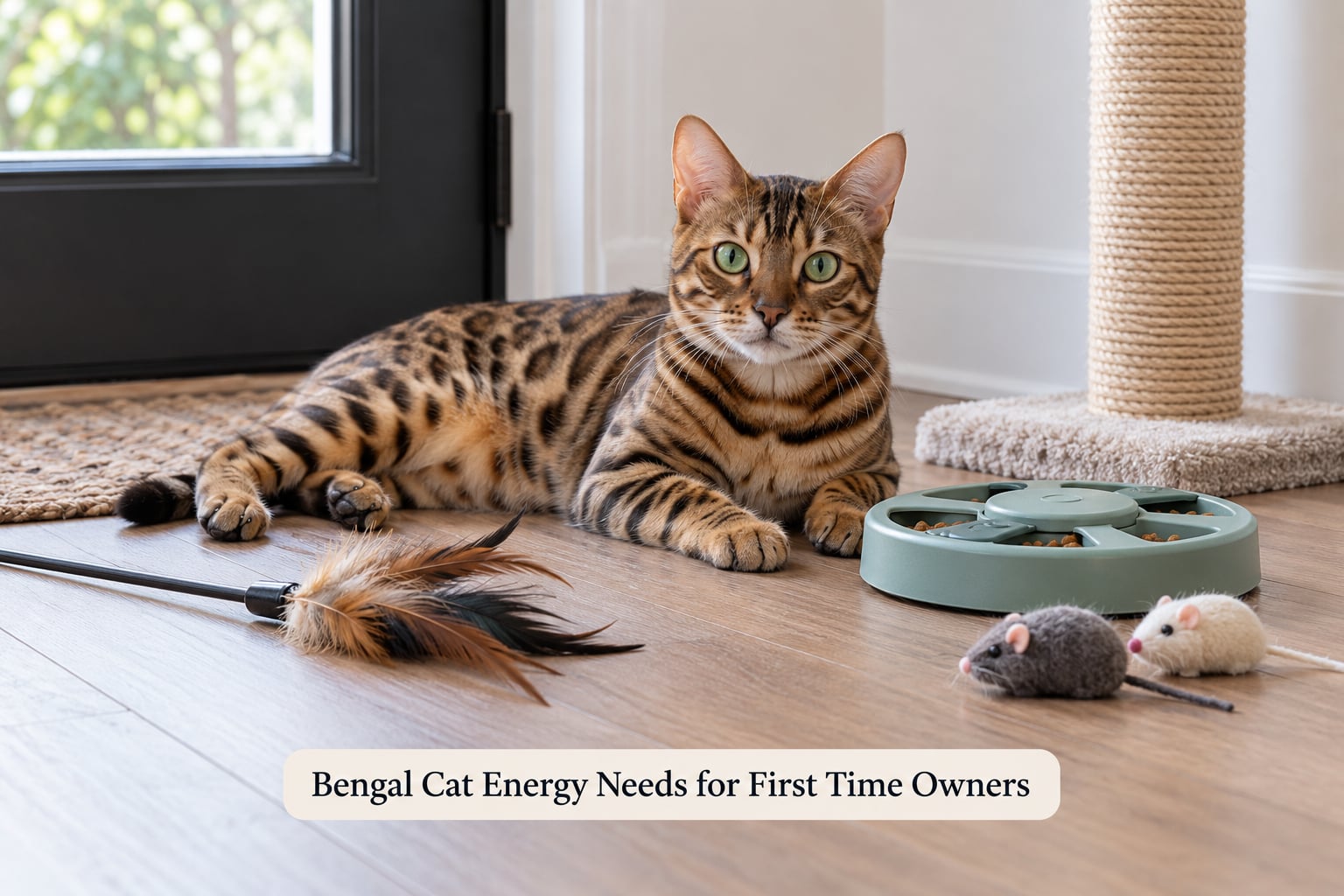
Bengals burn energy through a hunt, catch, eat cycle that their Asian Leopard Cat ancestry left in place. Physical play alone is not always enough, because a cat that never catches anything never completes the cycle and keeps searching for it. Here is the short version of what a day looks like for a healthy adult in a normal home.
| Part of the day | What it looks like | Time |
|---|---|---|
| Morning | Interactive wand play, then breakfast | 15 to 20 minutes |
| Work hours | Foraging, puzzle feeder, cat wheel, window perch | Solved throughout the day |
| Evening | Second play session, then a small meal | 15 to 20 minutes |
| Night | Wind-down, quiet perch, sleep | 14 to 16 hours of sleep |
| New home, first days | Short quiet observation before handling | Let the cat set the pace |
That table is a template, not a rule. A seven-month-old adolescent needs double the play of a ten-year-old, and a Bengal in a busy shelter needs less than one with a person home all day.
How Much Energy Does a Bengal Cat Need?
A Bengal’s energy needs are best described as daily physical and mental stimulation, not a fixed calorie count. Most owners and behaviourists describe the baseline as two interactive sessions of 15 to 20 minutes, and owners in r/bengalcats consistently repeat that figure when they ask how long they should play with their cat each day.
The other half of the requirement is mental. Puzzle feeders, foraging toys, clicker training and a cat wheel fill the hours when nobody is home, and they fill them in the specific way a hunting cat needs: slowly, with problem solving, over a period of time.
How energy needs change from kitten to senior
| Life stage | Age | Daily play | Sessions | Top priority |
|---|---|---|---|---|
| Kitten | Under 6 months | Five 10-minute bursts | 5 or more | Socialisation and bite control |
| Adolescent | 6 to 18 months | 45 to 90 minutes | 3 to 4 | Redirection and climbing |
| Adult | 18 months to 7 years | 30 to 60 minutes | 2 structured | Hunting cycle and foraging |
| Senior | 7 years and over | 10 to 25 minutes | 2, gentler | Mobility and easy access |
This is where the question “at what age do Bengals calm down” gets answered by owners rather than by anyone selling kittens. Most say the noticeable drop arrives somewhere between two and four years, and they consistently describe the worst stretch as eight to fourteen months, when a manageable kitten turns into what one owner called an incredibly energetic teenager.
What Factors Change a Bengal Cat’s Energy Requirements?
Seven things move the number up or down, and the individual cat usually counts for more than the breed average.
Age and neuter status
Neutering usually settles a cat down somewhat, but it does not turn a Bengal into a lap cat. A neutered adolescent still needs three or four sessions a day.
Temperament
Two Bengals in the same litter can differ completely. The shy one may want ten quiet minutes of wand play; the bold one may climb the curtain rod for entertainment.
Health and body condition
Pain, thyroid problems, anaemia and joint issues all change how much a cat moves. A drop in activity that has nothing to do with your enrichment setup belongs with your veterinarian.
Heat and environment
Cats sleep more in hot weather, and Bengal cats have a short coat with little insulation, so a cool room matters more for this breed than for a fluffy one.
Access to play and company
An indoor-only cat with two people home needs less solo entertainment than one alone in an apartment for eight hours. A second cat helps with the load, and owners say so often, but it does not replace human play.
High energy is not the same as hyperactivity either. Hyperactivity is restlessness that does not settle, and it usually points to unmet needs rather than a calm cat being disturbed.
How to Build a Daily Play and Enrichment Routine
The routine that works is built from several short play periods spread across the day, not one long evening session. Here is a version shaped around a full-time workday, which is the situation most first-time owners are actually in.
- Before you leave (about 20 minutes). Two wand sessions back to back, then breakfast in a puzzle feeder. The cat has eaten, exercised and solved something before the door closes.
- Late morning. A scatter of a few pieces of kibble across the floor or a rug. It takes a minute of your time and gives the cat something to hunt for an hour later.
- Midday. The cat wheel, if you bought one, plus a window perch. Owners who work full time rate the wheel as the single best indoor energy burner, and the perch keeps the watch going.
- Late afternoon. A lick mat or a foraging toy left out. This is the slot that absorbs counter surfing and cabinet opening.
- Evening (about 20 minutes). The main hunt of the day, with a wand toy, then a small meal. This is the session that decides whether your night is peaceful.
- Wind-down. Food, then dim lights, then no games. Many owners solve early-morning vocalisation by moving play and feeding earlier and ending the day more predictably.
What to set up before day one matters as much as the schedule. Owners repeatedly say the setup was never budgeted and the toys were never bought before the cat arrived. A perch, a wand, a scratching post and one foraging toy is a workable starting set; the rest can arrive later.
What Kind of Play Helps a Bengal Burn Energy Safely?
Interactive play that copies stalking, chasing, pouncing and catching works best. Wand toys are the standard answer because you control the movement, and erratic, unpredictable motion mimics prey far better than a mouse that slides in a straight line.
A few things make the difference between a good session and a frustrating one.
- Let the cat catch it. Owners report that ending every session with a catch, followed by a treat, closes the hunt-catch-eat cycle and leaves the cat settled. A cat that never catches anything keeps hunting, sometimes at your ankles at 3am.
- Rotate toys rather than piling them out. Six toys in a basket is a pile of boredom. Put four away and swap them weekly.
- Start harder than you think you should. Treat puzzles beat beginner puzzles here, because Bengals solve easy ones in under a minute.
- Store string and wand attachments in a drawer. Swallowed string is an emergency, and feathers detach easily.
- Skip the collar. Never attach a wand toy to a collar. Use a harness if you want to hold the toy near your hands.
For kittens, use shorter, faster bursts and treat any nipping as feedback rather than discipline. For older cats, keep sessions gentle and low; jumping down from a height is where arthritic Bengals hurt themselves.
Water play is worth trying too. Plenty of Bengals will chase a dripping tap or sit in a sink, which surprises people who chose this breed expecting a low-maintenance cat.
Should You Feed a Bengal Cat to Match Its Energy Level?
Food supports activity, but it cannot replace enrichment, and feeding more to a bored cat usually produces a fatter, still-bored cat. What matters is that the diet is complete and balanced, portions are measured rather than free-fed, and the meal itself becomes part of the hunt.
Using a puzzle feeder or scattering part of the meal turns eating into five or ten minutes of problem solving instead of thirty seconds of eating. Several smaller measured meals suit a high-energy cat better than one large bowl, provided the total daily amount stays the same.
Hydration matters too. Bengals have short coats and do not groom to stay warm, so they are not built the way a long-haired cat is. Wide bowls, a couple of bowls around the house, and a fountain if your cat likes water all help.
Assess body condition by feel, not by eye: run your hands over the ribs and the waist from above. Your veterinarian can score it properly and adjust portions for your cat’s age and activity. Do not start a diet on your own, and never use human food as a treat; several everyday items, including onion, garlic, grapes and chocolate, are toxic to cats.
How Much Rest Does a High-Energy Bengal Cat Need?
A healthy adult cat sleeps 14 to 16 hours a day, and a Bengal sleeping through the afternoon is normal, not a warning sign. Rest is when the brain consolidates the day’s learning, and a well-exercised Bengal crashes properly after play.
Give that sleep somewhere worth having: a quiet room away from the traffic of the household, a perch at cat height, and a spot where the cat can watch without being watched. Sudden noise or a new person in the room can end a good sleep cycle and start a restless evening.
Extreme fatigue, restlessness, vocalising that will not stop, or a sudden change in sleep pattern are different from ordinary tiredness. Chronic stress grooming, where a cat chews at its coat until patches thin out, is worth a veterinary call rather than a new toy.
How Can You Tell If Your Bengal Has Enough Energy and Stimulation?
A balanced routine shows up in the boring details: regular appetite, an easy to feel body, interest in the room, normal play and deep sleep. Here is how that differs from the version that needs attention.
| What you notice | Often just boredom | See a vet if |
|---|---|---|
| Energy | Restless at dawn, then settles | Lethargy, or constant pacing that never stops |
| Damage | Chewing, cabinets, plants, curtains | Gums or mouth look painful, grooming is excessive |
| Voice | Talks at 5am, settles after play | Vocalising changes suddenly or with pain signs |
| Coat | Sheds heavily in season | Balding patches, licking that will not stop |
| Appetite | Finishes food, begs occasionally | Refusing food, or thirst that has changed |
Two of those deserve emphasis. Weight loss that appears without you changing anything is a veterinary question, not a feeding-plan question. And boredom can look like lethargy, which is why owners get it wrong: a cat that sleeps all day and ignores its wand toy may be under-stimulated, or it may be unwell.
What Should You Do During the First Week With a Bengal Cat?
The first week sets the tone, and the goal is a cat that eats, sleeps and uses the litter tray normally in the room you have set up for it. Keep it to one quiet space at first, with food, water, a bed and two or three enrichment items. More than that is a lot to process.
A simple seven-day plan
Days 1 to 2. Sit in the room and read. Let the cat come to you. Open play only if the cat initiates. Do not introduce a cat tree, a litter tray change and visitors in the same week.
Days 3 to 4. Start with two 10-minute wand sessions. Use consistent meal times so the cat has a rhythm to follow. Add one new toy or one foraging element, not both.
Days 5 to 7. Extend to 15 or 20 minutes per session and let the cat catch the toy at the end. If it is working well, begin training with a treat and a clicker, five minutes at a time.
Record three things daily: appetite, sleep, and elimination. Those three catch most problems early, and the notes are genuinely useful at the first vet visit.
Call a veterinarian if the cat has not eaten in 24 hours, has not used the litter tray in 24 hours, hides continuously, or seems painful when touched or jumped. Those are not adjustment issues, and adjustment does not take more than a few days for a healthy young cat.
Frequently Asked Questions
Are Bengals good for first time owners?
They can be, but they are the least forgiving breed for a nervous first-timer. A Bengal needs two structured play sessions daily from week one, plus foraging and vertical space, and many owners report spending far more time on this than they planned. If you want a cat that is content with two five-minute sessions a day, choose a different breed. If you enjoy interactive play and can commit to a daily rhythm, a Bengal rewards the effort.
At what age do Bengals calm down?
Most owners report the noticeable drop between two and four years of age, with the hardest stretch falling between eight and fourteen months, when a kitten turns into an extremely energetic teenager. After that, adult Bengals still need around 30 to 60 minutes of focused play a day. Calm, low-energy individuals exist, but they are the exception rather than the rule.
Are boy or girl Bengal cats better?
Energy level is broadly similar across both, and individual temperament varies far more within a sex than between sexes. Neutering usually calms any cat somewhat, but it does not change a Bengal’s fundamental need to hunt, climb and forage. Pick on health, coat pattern and personality from the litter rather than on sex, and ask the breeder or shelter about each kitten’s observed behaviour.
Do Bengals bond to one person?
Often, yes, and in a very active way. The relationship is usually built on play rather than lap time, which suits people who want a companion they interact with rather than one who sits on them. That bond brings separation issues with it. Owners whose cats are alone for long stretches report vocalising, destructive behaviour and over-grooming, so a stable daily play habit matters more than affection alone.
How many play sessions a day does a Bengal need?
Two structured sessions of 15 to 20 minutes each is the widely repeated baseline, and that should be spread across morning and evening rather than crammed into one block. Kittens and adolescents need more, usually three to four sessions spread through the day. Sessions work best when you end the chase, let the cat catch the toy, and follow with a small meal.
Do Bengals need a second cat to stay happy?
A second cat can help carry the energy load, and many owners add one for that reason. It is not a replacement for human play, and two cats can end up competing instead of playing. Introduce them slowly through scent and a cracked door before any face-to-face meeting, and budget for a second set of bowls, beds and toys. One well-engaged Bengal can also live happily alone.
Start With a Simple Play and Rest Routine
Here is what to do this week, in order. Watch your cat for three days and note when it is most active. Then book two 15-minute interactive sessions into that window and protect them. Set up one foraging element, give the cat a perch it actually likes, and leave the rest of the room alone.
Adjust from there using what you see: appetite, sleep, play, and any advice your vet gives you at the first check. That last point is the one people skip. Understanding bengal cat energy needs for first time owners comes down to knowing the baseline numbers and then letting the individual cat tell you where it sits — every Bengal is different, and the one in your home is the only expert on itself.