To tell if a dog is dominant or just excited, watch what happens over several seconds, not in a single moment. An excited dog bounces, pants, drops into play bows and settles again once the trigger is gone. A dog using dominance holds a tall, stiff, forward-leaning posture with a closed mouth and sustained eye contact, and that posture tends to stay put while the other dog moves away.
Neither label tells you much on its own, which is why so many owners get this wrong. Context does the work: what triggered it, who else was there, and whether the dog can recover on its own afterwards. This guide walks through the signals, the three questions to ask in the moment, and what to do when the behaviour is more than either state.
It takes about ten minutes of observation across a few normal days to get a workable read on your own dog. Nothing here requires special equipment, and nothing requires you to test your dog on purpose.
Table of Contents
- Dominant or Excited: What to Look For
- The Difference Between Dominance and Excitement
- How to Tell If a Dog Is Dominant or Just Excited
- Check the Trigger and the Situation
- Look at Body Language and Recovery
- Use a Calm, Low-Risk Test
- When the Behavior May Be More Than Excitement
- How to Respond Safely
- Frequently Asked Questions
- What are the signs that a dog is dominant?
- At what age do dogs try to assert dominance?
- Should I pin my dog down to show dominance?
- Is my dog dominant or just excited when he pulls on the leash?
- What does a stiff tail wag mean?
- Should I take my dog to a vet or a behaviourist?
- Conclusion
Dominant or Excited: What to Look For
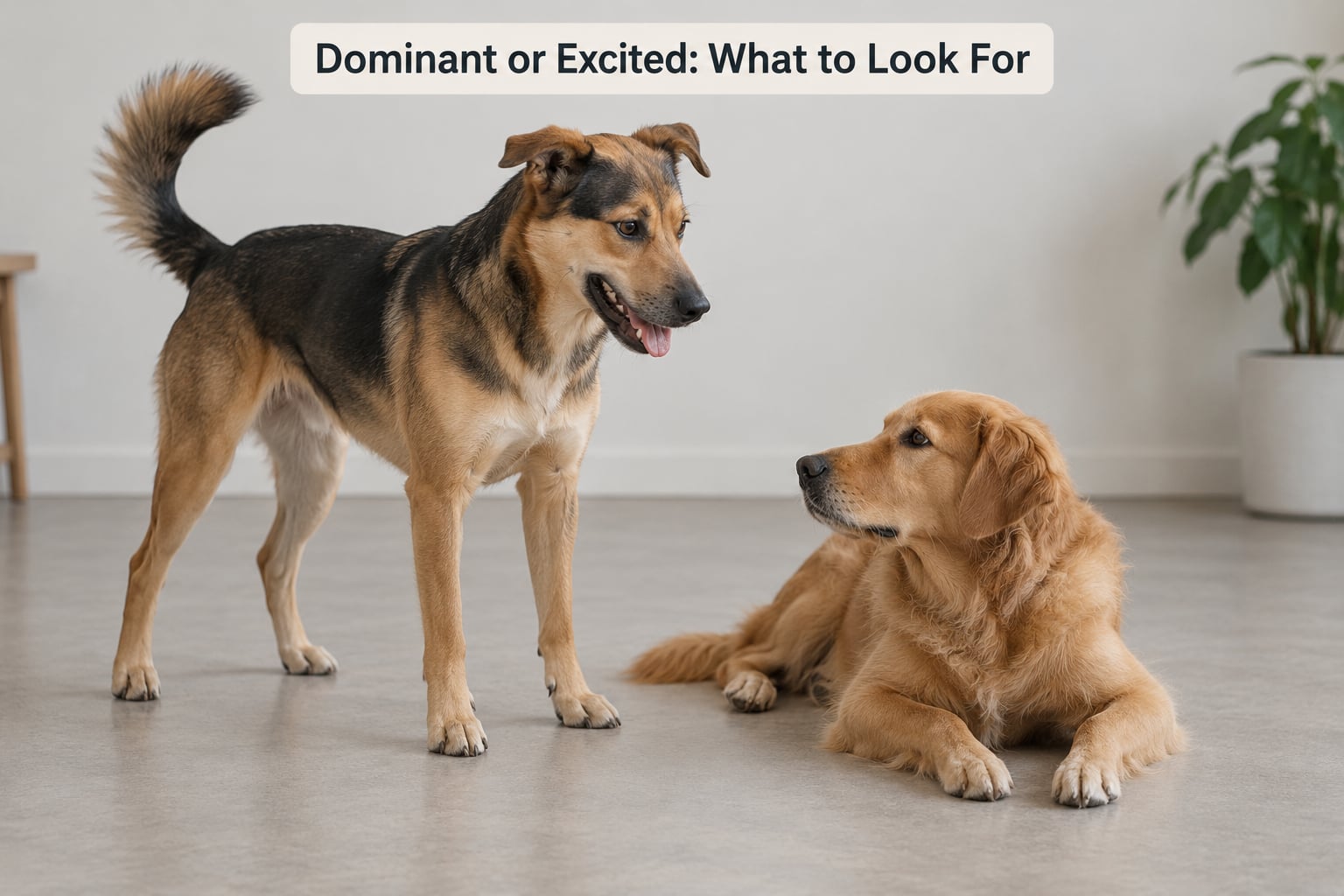
The single biggest mistake is treating dominance as a personality. Dogs do not walk around permanently on or off a dominance dial. Dominance describes a relationship around one specific thing at one specific moment: control of a resource, a space, or the movement of another dog.
The Difference Between Dominance and Excitement
Dominance-related behaviour is goal-directed. The dog has something in mind, holds its position, and applies pressure until the other dog yields. Excited behaviour is arousal. The dog is wound up by something happening nearby and has no strategy beyond getting to it.
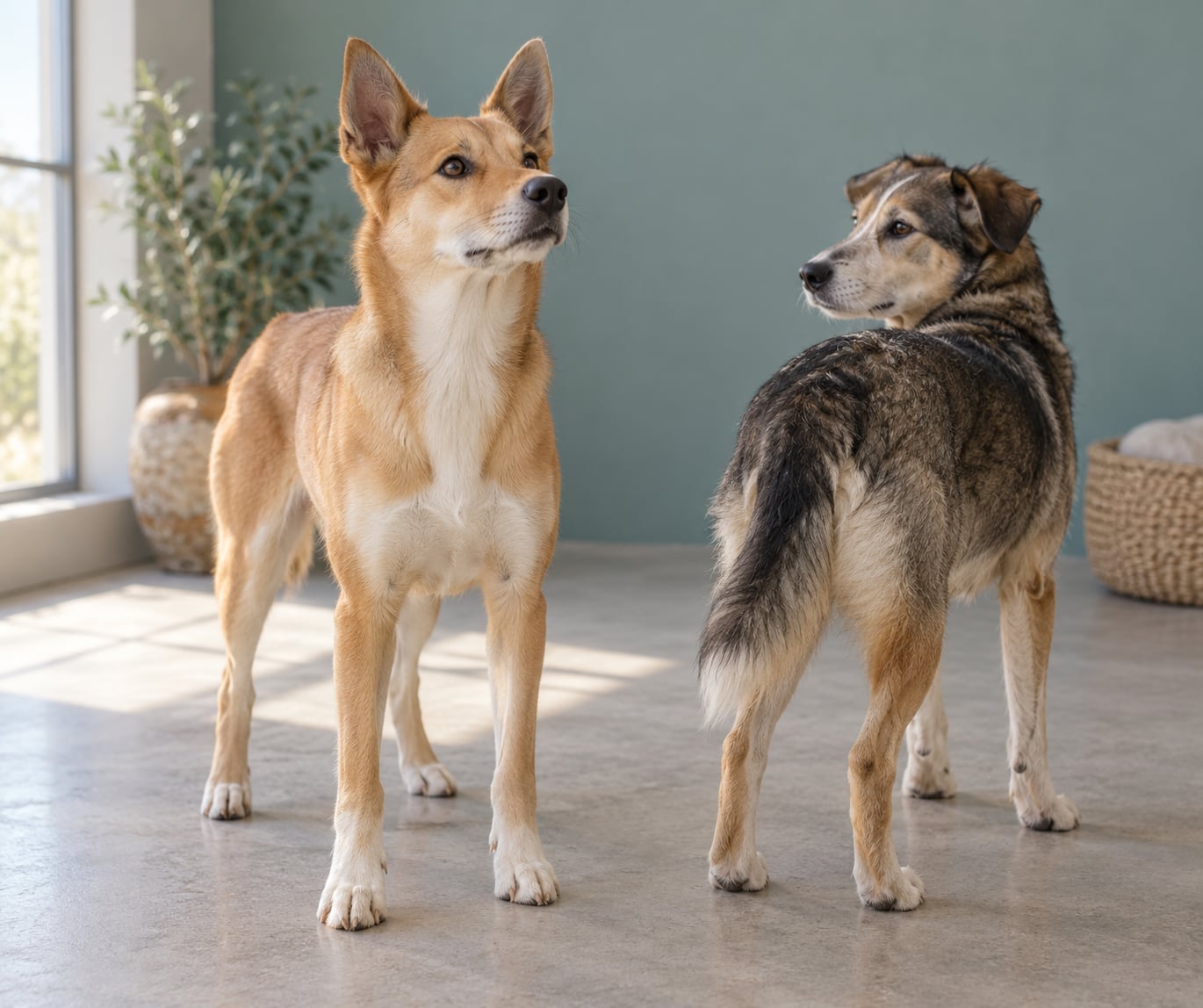
Trainers who work with reactive dogs tend to say it plainly: dogs swap roles throughout the day depending on who feels confident, so the dog that controls a cushion at 9am may be the one backing off at 3pm. A single event tells you about a relationship in that moment, not about the dog in general.
Here is the difference that matters most in practice.
| Body part | More likely dominance or defensiveness | More likely excitement |
|---|---|---|
| Posture | Tall, square, weight even or shifted forward, front legs locked | Bouncing, leaning into movement, weight shifting constantly |
| Tail | High and stiff, or a slow deliberate wag | Fast loose wag, wagging whole body, high wag that stays high |
| Ears | Pinned flat back or pinned forward, fixed | Forward and mobile, swivelling with whatever moved |
| Eyes | Hard stare, whale eye, whites visible | Soft, darting, frequent glances away |
| Mouth | Closed and tight, teeth shown without a play bow | Open and panting, tongue out |
| Movement | Slow, deliberate, straight line, no side steps | Quick, circling, stop-start, sudden direction changes |
| Sound | Low, infrequent growl or a single hard bark | Fast repeated barking, excited whining |
| Afterwards | Holds position or advances after the other dog leaves | Settles within a minute or two once the trigger passes |
Raised hackles, or piloerection, sit outside that split. Hackles come from fear and high arousal as often as from confidence, so a puffed-up coat tells you about intensity rather than intent.
How to Tell If a Dog Is Dominant or Just Excited
Run the same three-step check every time. It takes seconds once you get used to it, and it stops you from arguing about labels in the moment.
Check the Trigger and the Situation
Before you read the body, name the trigger. Is it food, a toy, a chew, a person reaching over the dog’s bed, another dog coming near, a leash being unclipped, or a stranger on the street? Write down where it happens and who is present.
Then change one variable and watch what changes. If you can calmly increase distance and the dog settles within a minute or two, you were looking at excitement. If backing away does nothing and the dog keeps advancing, or keeps holding the space no matter how far you go, you are looking at something goal-directed and worth treating as a safety issue.
Ask three questions in order: what just happened, who is here, and what is about to happen next. That last one is the most predictive, because a lot of dog behaviour happens in the gap before an event rather than during it.
Look at Body Language and Recovery
Watch the whole body over at least five seconds, because a stiff tail wag reads very differently from a loose one. Excited dogs pant, bounce, offer play bows, wag fast and loose, and their weight keeps shifting. Their attention switches easily when the trigger moves.
Sustained stiffness, repeated forward pressure, freezing in place, a closed tight mouth, bared teeth without any play bow, or a dog who cannot settle afterwards all point away from ordinary excitement. Freeze and stare is the one to act on quickly, because a dog holding that posture has run out of options for handling the situation.
Recovery time is the most honest measure you have. Most excited dogs are back to normal within a few minutes of the trigger disappearing. A dog still wound up half an hour later, or who escalates on a second encounter, is telling you something different.
Use a Calm, Low-Risk Test
Set the dog up in a neutral spot with a short lead or a harness line, somewhere quiet, and watch without provoking anything. Lower the distance gradually rather than pushing to the edge to see what happens.
Change one thing at a time: distance, then presence of another dog, then the trigger object. Feed a treat away from the trigger and watch whether the dog takes it. A dog who can eat is usually still in a workable emotional state. Keep a note of what you saw and when, because behaviour patterns over a week tell you far more than one afternoon.
When the Behavior May Be More Than Excitement
Fear looks a lot like dominance from a distance, and the difference matters. A fearful dog often leans forward while stiff, holds the tail low or tucked, shows the whale eye, and may urinate or drool when approached. That is not control. It is a dog trying to increase the distance and failing.
Frustration, pain and resource guarding sit alongside both. A dog that guards a specific object consistently, escalates on the second reach, and has a history of quick recoveries is guarding, not seeking status. Sudden behaviour change in an adult dog is a vet question first, since pain changes how a dog behaves around everything that used to be fine.
Frustration is the sneakiest one, and it explains most leash pulling and jumping. A dog who drags toward a squirrel or another dog is not asserting anything; it is frustrated that a barrier is in the way of something it wants. Common mislabels follow the same pattern: humping and mounting are often arousal or over-tolerance rather than status play, and standing over a leg is usually a dog asking for space under your body.
What to avoid: rolling a dog over, pinning it, holding it down by the neck, or scolding a growl. Owners often try this because they are told it works, and trainers who work with reactive dogs consistently report the same outcome, more fear and faster escalation. A dog forced into stillness is not learning submission. It is learning that being near you is unsafe, and the next time it warns you, it may skip the warning.
Age matters too. Puppies between roughly 8 and 16 weeks bounce, bite and mouth constantly, and that is normal development. Between about 4 and 8 months many dogs go through a period of increased sensitivity that looks like stubbornness. Somewhere around 8 to 12 months is when social behaviour matures and any genuinely goal-directed patterns tend to become clearer and more consistent.
How to Respond Safely
Start with distance. If the trigger is another dog at 15 metres and the dog settles, you have found the working distance, and you can build from there.
- Increase distance or add a visual barrier before the dog reaches its threshold.
- Reward calm at the first sign you want, such as a soft body, a loose tail or taking a treat.
- Feed and play in neutral spaces so the walk and the training session stop being part of the problem.
- Keep the dog away from triggers it cannot recover from yet, including its own rehearsed reactions.
- Log the pattern for a week, then decide whether it needs training support or professional help.
In the first three seconds after a dog freezes or stares, do this: stop moving forward, loosen the lead rather than tightening it, drop your own energy, and turn your body slightly away. That removes the pressure the dog is reacting to. Do not reach over the head, and do not use a high-pitched voice.
Get professional help when the dog may bite, when a warning escalates straight to contact, when it cannot recover after an encounter, or when another dog in the home is being bullied. A board-certified veterinary behaviourist or a qualified reward-based trainer can read the pattern properly. For any medical question or sudden change, start with your vet, and never give a dog human medication.
Frequently Asked Questions
What are the signs that a dog is dominant?
Signs usually include a tall, square, forward-leaning stance with the front legs locked, a high and stiff tail or a slow deliberate wag, ears pinned forward or flat, a closed tight mouth, sustained eye contact, and slow straight-line movement. The behaviour is usually tied to a specific context such as food, a toy, a doorway or another dog, and it repeats in similar situations rather than happening anywhere. Compare those signals with recovery: a dog that settles quickly once the trigger leaves is most likely excited, not dominant.
At what age do dogs try to assert dominance?
Puppies from about 8 to 16 weeks mouth, bite and bounce as part of normal development. Between 4 and 8 months many dogs go through a stretch of increased sensitivity that reads as stubbornness. Social behaviour matures somewhere around 8 to 12 months, and goal-directed patterns become clearer and more consistent after that. What looks like a dominant puppy at six months is often just an over-aroused one that has not learned to settle.
Should I pin my dog down to show dominance?
No. Rolling a dog over, pinning it, holding it down or scolding a growl teaches that being near you is unsafe. It does not produce genuine submission, and owners regularly report the dog escalating at the next opportunity. Trainers who work with reactive dogs see the same pattern, where fear rises and warning behaviour gets faster and more abrupt. Manage with distance, reward calm behaviour and get professional help if the dog may bite.
Is my dog dominant or just excited when he pulls on the leash?
He is almost certainly excited or frustrated. Leash pulling usually happens because a barrier stands between the dog and something it wants to reach, such as another dog, a squirrel or a person. A dominance-related pattern would be more deliberate and would not depend on what is ahead. Reduce distance, reward loose-leash calm and reward looking at you rather than the trigger. If the pulling comes with lunging or a hard stare, treat it as a training priority rather than a manners nuisance.
What does a stiff tail wag mean?
A wag on its own means arousal, not friendliness. A fast, loose wag usually points to excitement, while a slow or stiff wag with a high, rigid tail points to tension or an attempt to control the situation. Judge it alongside the body: ears, mouth, eyes and movement. A dog with a soft face and a loose wagging bottom is having fun. A dog with a closed mouth, forward weight and a stiff tail is not.
Should I take my dog to a vet or a behaviourist?
Start with your vet for anything medical, especially a sudden behaviour change in an adult dog, since pain changes behaviour and can look like aggression. For pure behaviour, look for a board-certified veterinary behaviourist or a qualified reward-based trainer. Seek help promptly if your dog may bite, if a growl escalates straight to contact, or if it cannot settle after an encounter. Never give a dog human medication.
Conclusion
Start with three things on the next walk: name the trigger, watch the whole body for five seconds, and time how long the dog takes to settle afterwards. That simple log will tell you far more than any label.
If the pattern is excitement, you are dealing with arousal and the fix is distance, recovery and reward. If the posture is stiff, sustained and goal-directed, treat it as a safety problem and get qualified help. Knowing how to tell if a dog is dominant or just excited is less about picking the right word than about noticing which one your dog is, this afternoon, on that street.