To teach a dog not to pull toward other dogs, you work below your dog’s reaction threshold and reward a different behaviour the moment another dog comes into view — a check-in, a U-turn, a hand target. Pulling toward dogs is a learned habit that usually started as excitement or frustration, and it can be unlearned. Most dogs need several weeks of short daily sessions, and some need a few months before greetings feel normal again.
The single biggest mistake is training at full distance from a dog park. Until your dog can walk past another dog on a loose lead without lunging, the walk itself is the exercise, not the reward for good behaviour.
Table of Contents
- What You Need Before You Start
- Step-by-Step: How to Teach a Dog Not to Pull Toward Other Dogs
- 1. Build loose-leash control in a quiet area
- 2. Reward the dog for noticing other dogs without rushing
- 3. Add a recall cue that works around dogs
- 4. Practise controlled greetings with a helper
- 5. Gradually reduce distance and distractions
- 6. Carry the behaviour into everyday walks
- What About a Dog That Is Fine Off-Leash but Reactive On-Leash?
- Equipment That Helps (and What to Avoid)
- Common Mistakes That Make Pulling Worse
- Frequently Asked Questions
- How do I stop my dog from pulling toward other dogs?
- Is a no-pull harness or head halter effective with other dogs?
- How far away should my dog be from another dog during training?
- What if my dog only listens when there are no other dogs nearby?
- Should I let my dog greet other dogs while training?
- When should I get help for dog reactivity?
- Conclusion: Where to Start This Week
What You Need Before You Start
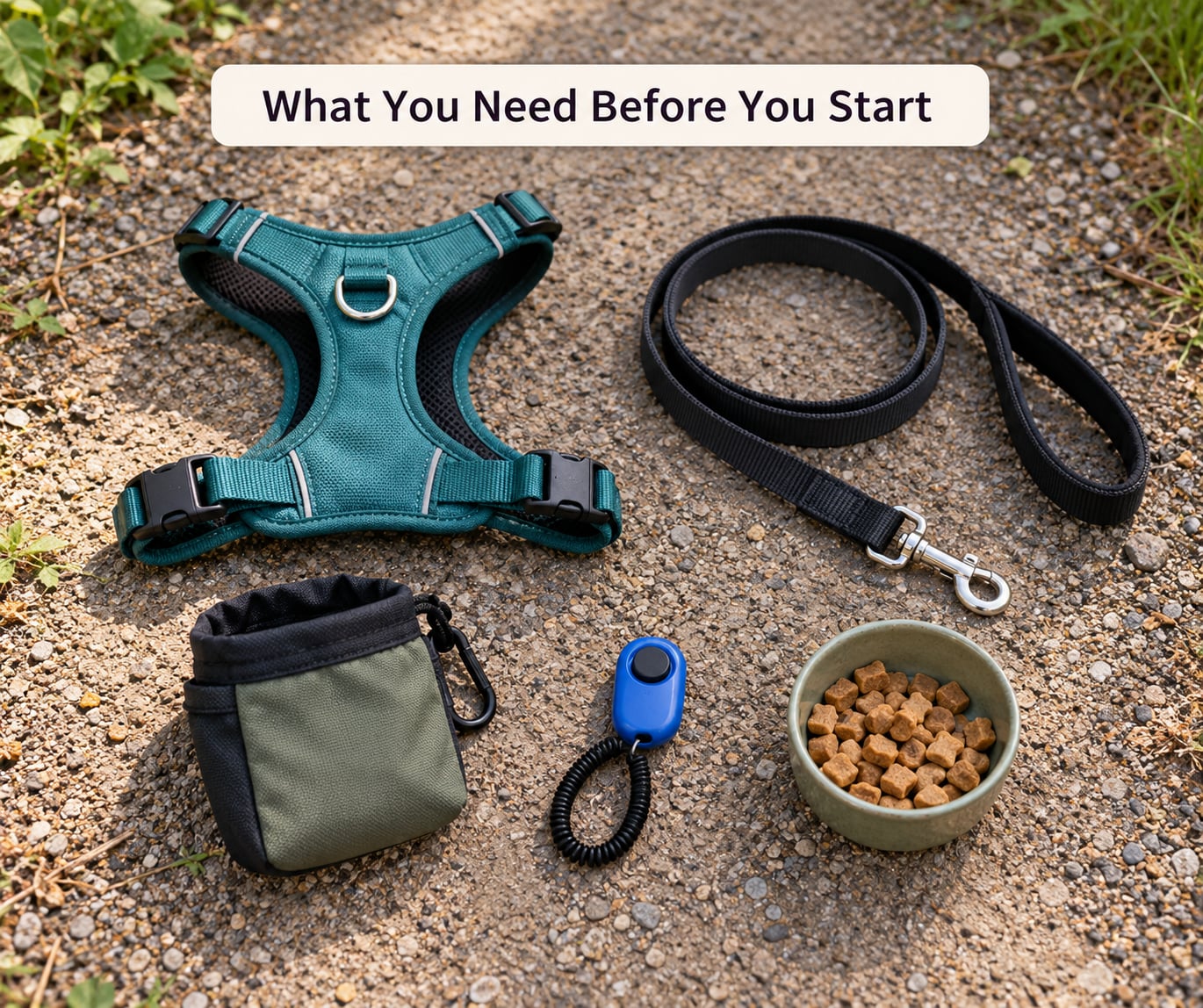
Gear matters less than the sequence you follow, but the wrong equipment can undo good work. Here is the honest short list.
- A secure collar or a properly fitted harness. You should be able to slip two fingers under either one, no tighter. A front-clip harness gives you more steering control on a reactive dog than a collar alone.
- A standard fixed-length leash. Skip retractable leashes entirely for this work. They teach your dog that pulling creates tension, and they give you no control when a dog lunges.
- A treat pouch and high-value treats. Ordinary kibble is not enough during early sessions. Use cooked chicken, cheese, hot dog slices or a soft training treat your dog has never had before.
- A quiet, familiar place to train. An empty field, a quiet street at dawn, or a hallway works. Somewhere with no dogs, no traffic noise and no people is ideal for the first two weeks.
- A helper. One person holds your dog on a loose lead; the other walks a calm, friendly dog at a distance. Both people stay still and quiet.
- Optional extras. A long line for use in wide open spaces, a clicker if your dog responds to a mark, and a mat or towel that means “settle here”.
Two skills have to exist before greeting practice makes sense: walking on a loose lead and turning to you when you say your dog’s name. Owners describe the same frustration constantly — the dog is brilliant at home with other dogs, then loses every cue the moment a lead comes out. That is a training gap, not a character flaw.
Step-by-Step: How to Teach a Dog Not to Pull Toward Other Dogs
Work in order, from easy to hard. Each step has a clear success marker — move on only when you hit it, and if your dog cannot do the step, you were simply too close or too distracting.
1. Build loose-leash control in a quiet area
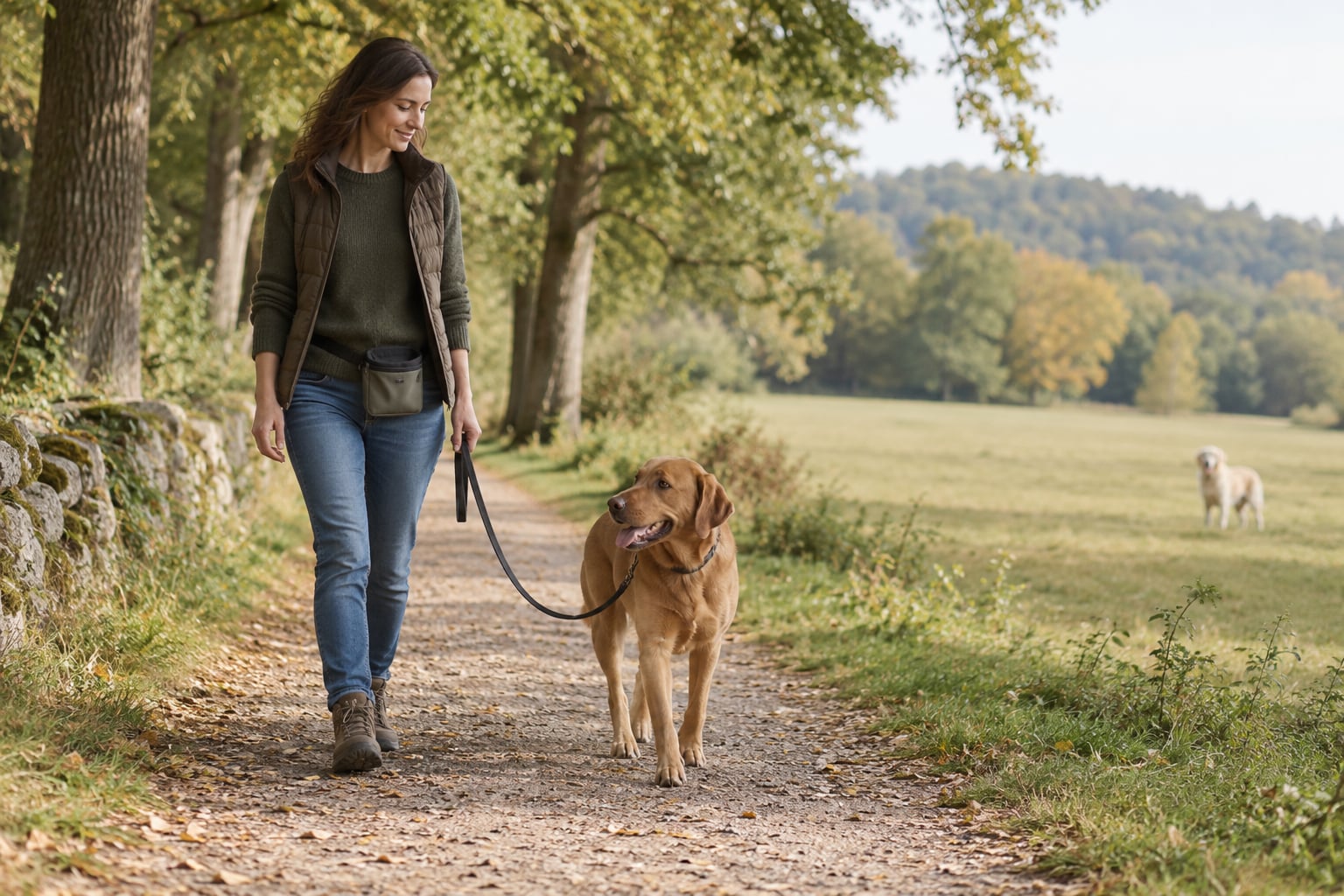
Start away from dogs entirely. Reward your dog for walking beside you, for stopping when you ask, and for looking back at you on its own accord. Deliver treats at the side of your leg so the leash stays slack.
When the leash feels loose and your dog is offering check-ins without being asked, start reducing the treats. Feed on a variable schedule rather than constantly, because constant feeding turns the walk into a payment for mere existing. Success looks like a dog who will happily take a treat, then return to your side when released.
2. Reward the dog for noticing other dogs without rushing
With a helper holding a calm dog at a distance, let your dog see the other dog and mark the calm moment with a treat. A look that is accompanied by a loose body and a closed mouth is a look you reinforce. Lunging, freezing or hard staring is not the moment to feed.
Keep the distance generous at first — far enough that your dog can still eat and still respond. Do not let your dog walk directly up to the other dog; approach on a wide arc so nothing narrows into a nose-to-nose line. If you cannot tell whether your dog is calm or about to pop, assume the second and move back.
3. Add a recall cue that works around dogs
Practise your recall before your dog gets excited, not after. Say the cue once, wait a fraction of a second, then reward heavily the moment your dog turns toward you — even if it takes half a walk to arrive. Repeating the cue over and over teaches your dog that the word has no meaning.
Build duration by feeding for a few seconds at your feet before releasing back to the walk. Keep a release word so coming back never means the fun ends forever. A dog that is already barking, spinning or has locked eyes onto another dog is too overwhelmed to learn; that is your cue to leave, not to repeat the exercise.
4. Practise controlled greetings with a helper
Walk toward the calm dog on a loose lead and pause before any tension appears. Ask for a sit or a hand touch, reward it, then allow a brief neutral greeting — three seconds of nothing dramatic, then separate. The goal is a dog who can be near another dog without a performance.
Watch both dogs, not just yours. Look for a loose, wagging body, a soft mouth and a curved approach. Stiff posture, a closed mouth with a still tail, hard staring or an arched back means the greeting is over, so separate calmly by turning your dog away and walking off rather than pulling them apart mid-shout.
5. Gradually reduce distance and distractions
This is where most owners rush. Use a distance ladder and drop down a rung any time your dog cannot eat, cannot respond, or cannot walk past.
- Far (about 50 m): check-ins, name response, walking past. Move on when your dog eats and responds while the other dog is visible.
- Medium (about 30 m): U-turns and recall in the presence of dogs. Move on when your dog comes back first time, every time.
- Close (about 20 m): walking past on a loose lead without turning the head. Move on when the leash stays slack for a full minute.
- Near (about 10 m): brief neutral greetings with a helper. Move on when both dogs stay relaxed for three seconds.
- Pass and play: short greetings in real life with known dogs. Move on when your dog walks away calmly when you cue it.
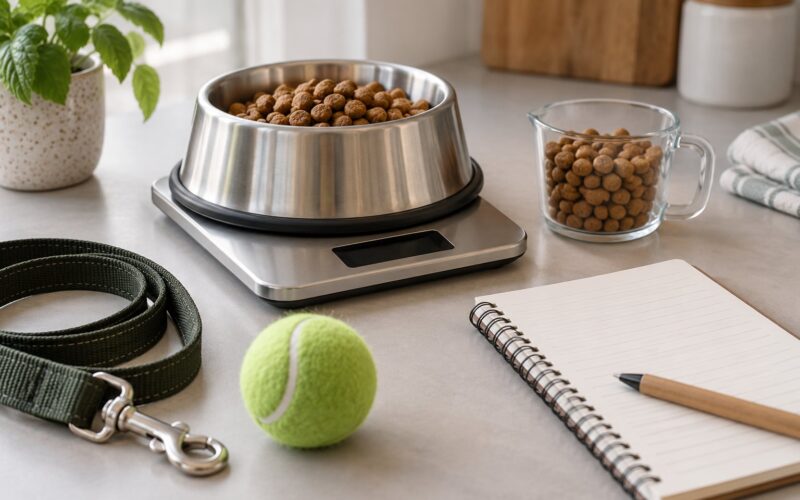
Many owners track this in a notebook — one line per walk with the distance, what your dog did, and how long it lasted. After a few weeks that log usually shows progress you could not feel in the moment, which matters more than any single good walk.
6. Carry the behaviour into everyday walks
Use the same cue word and the same reward everywhere, because dogs generalise badly. That means doorways, the car, the vet’s waiting room, a friend’s arriving dog and a neighbour’s garden gate.
Keep one rule for the hard days: move farther away, cut the distraction, get an easy success, then leave. Repeating a difficult exercise until something goes wrong teaches your dog that the situation is worth escalating.
What About a Dog That Is Fine Off-Leash but Reactive On-Leash?
This is the most common version of the problem and it has a clear explanation. Off-leash, a dog can move away whenever it wants, so another dog is only mildly interesting. On a lead that restriction disappears and the frustration shows up as pulling, barking or lunging.
The fix is not more socialising. It is teaching your dog that other dogs are not going anywhere — and that the tension in the lead buys nothing. Reward the walk past rather than the greeting, and let your dog build distance work into ordinary walks. Reactive-dog forums describe exactly this pattern with dogs who play happily at daycare yet drag toward a single dog across a park.
A long line in a quiet field gives you the breathing room to practise recalls before you are back on streets with no options to change route.
Equipment That Helps (and What to Avoid)
No collar trains a dog for you, but the right gear removes a lot of avoidable struggle. Keep everything below in a force-free frame, and talk to a qualified reward-based trainer before adding any device that applies pressure.
- Front-clip harness: redirects pulling into turning toward you and makes a loose lead easier to hold. The most common recommendation on dog training forums for this exact problem.
- Head harness: gives a very light, direct cue with no pressure on the throat. Fitting takes practice, and it must sit correctly, front clip on the chest, not on the skull.
- Martingale or slip-limited collar: gives you a safety backup against a dog that reverses direction fast, without tightening in the face.
- Long line: only for recall practice in quiet, open areas where a surprise dog is unlikely.
- Fixed-length leash: the safest default and the one to use for all distance work.
- Avoid: prong, shock and pain-based devices, and any method built on dominance or physical intimidation. They may suppress the behaviour briefly while raising arousal and fear, and they teach your dog to distrust you.
Another common question: does neutering fix leash reactivity? No. Spaying or neutering can reduce some hormone-driven behaviours, but leash reactivity is a learned, fear- or excitement-based pattern, and it needs training.
Common Mistakes That Make Pulling Worse
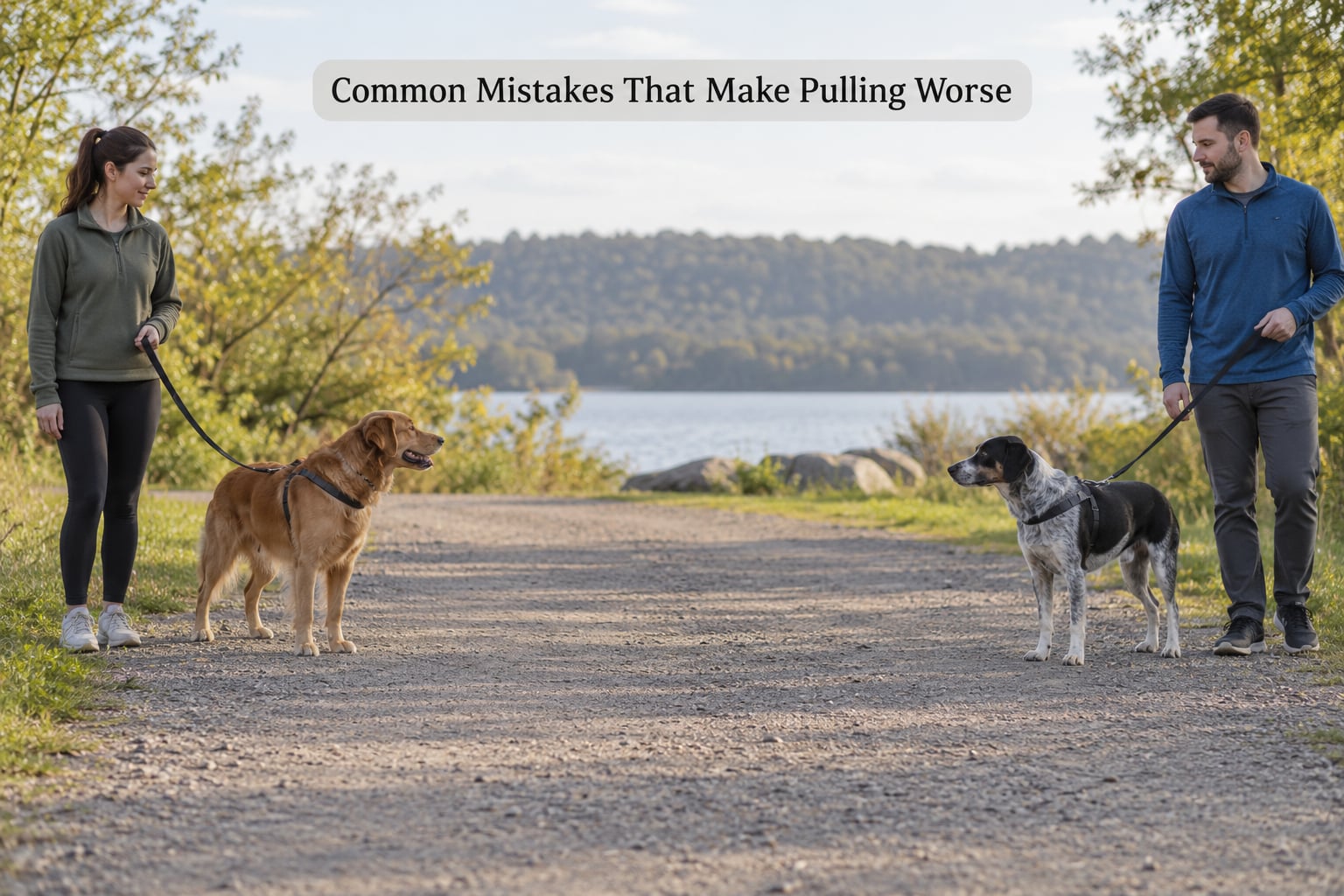
Almost every stalled plan traces back to one of six habits, and knowing how to teach a dog not to pull toward other dogs means knowing which one you are making.
- Using a retractable leash. The lead extends as the dog pulls, so the behaviour is reinforced the whole way toward the other dog.
- Allowing greetings before control exists. Every relaxed close meeting rewards the pulling that got you there.
- Repeating one cue ten times. If your dog is not responding, the problem is distance or arousal, not volume. Repeating the cue teaches you that it is optional.
- Rewarding excitement. Treating a dog mid-lunge for going quiet means a quick burst of arousal followed by a stop. Reward the calm that comes before it, or you teach start-and-stop pulling.
- Correcting with a sharp leash or a scolding. Tighter leash pressure and raised voices often create an opposition reflex, where the dog pulls harder or backs up. Once the other dog is out of sight, the association persists.
- Raising difficulty too fast. A single stressful encounter can undo several good sessions. A rule that works well: if your dog cannot eat, retreat to a shorter distance and finish on something easy.
Three habits fix more than any of the rest. Keep sessions to one to three minutes and end while things are still going well. Use a reward your dog has to work for, and let family members follow the same cue words and the same rules, because inconsistency between people is one of the most common reasons progress stalls. And read the early signs, not the end signs — a head turn, a stiff neck, a sudden sniffer interest or a brief freeze all mean you are already at the dog’s limit.
Frequently Asked Questions
How do I stop my dog from pulling toward other dogs?
Start by walking your dog on a loose lead in a quiet area until check-ins and name responses are reliable. Then use a helper with a calm dog at a distance your dog can tolerate, and reward the moment your dog notices the other dog while staying loose. Gradually shorten that distance, one small step at a time. The behaviour is learned, so steady reward-based sessions over weeks work better than any single dramatic walk.
Is a no-pull harness or head halter effective with other dogs?
Both can help, because they give you a direct cue and make turning toward you easier when your dog braces or lunges. A front-clip harness suits most dogs and takes seconds to fit; a head harness gives a lighter cue but has to be fitted correctly. Neither trains anything by itself — treat any device as a tool for the training above, and stop any session the moment your dog seems uncomfortable.
How far away should my dog be from another dog during training?
Far enough that your dog can still eat, still respond to its name and still walk on a slack lead. For most dogs that means a busy path, a field edge or a car park rather than the dog park gate, often tens of metres away. Move closer only when the dog is calm at the current distance, and step back the moment you see a head turn, stiff body or sudden freeze. Distance is the tool that keeps training possible.
What if my dog only listens when there are no other dogs nearby?
That is normal and very common: other dogs raise arousal, and an aroused brain cannot think. Work first on a very distant dog where your dog can still respond, reward the check-in heavily, and build up in small steps. Practise the recall on a long line in a quiet field so you can repeat it safely. If your dog cannot take food in the presence of another dog, the distance is wrong, not the training.
Should I let my dog greet other dogs while training?
Not at the start. Greetings pay off the pulling that brought you there, so early sessions should reward walking past instead. Ask the other owner first, keep your dog on a loose lead, pause before any tension appears, and allow a brief neutral greeting of a few seconds with relaxed bodies. Separate calmly and walk off if either dog stiffens, freezes, stares or closes its mouth. Save longer greetings for once your dog is reliable.
When should I get help for dog reactivity?
Get a qualified reward-based trainer involved if pulling escalates despite consistent distance work, if your dog cannot eat or respond when a dog appears, if you fear being knocked down, or if the behaviour appeared suddenly in a dog that was always social. Book a vet visit first if it started suddenly, involves growling, snapping or a change in appetite, sleep or touch tolerance, because pain can look exactly like reactivity. A veterinary behaviourist is the right referral for genuine aggression risk.
Conclusion: Where to Start This Week
The first thing to do is unglamorous. Spend a few quiet walks earning a reliable loose lead and a name response with no dogs anywhere near you. Once that is solid, add other dogs at a distance your dog can still handle, and reward the calm walk-past rather than the greeting. That sequencing is the whole answer to how to teach a dog not to pull toward other dogs.
Keep sessions short, keep the household on the same cues, and take a note of the distance that worked each time. Progress is a sequence of easy successes, not a single breakthrough walk — but the walks stop being miserable fairly quickly, and that is the first sign the plan is working.
If the pulling comes with fear, pain, growling or a sudden change in a dog who was always social, talk to your vet and then a qualified reward-based trainer. Something is bothering your dog, and that is worth finding out before anything else.