To teach a dog to stay alone in a room, you prepare one safe room, send your dog to a bed or mat, walk out for two seconds, and walk back in before your dog reacts to you leaving. Then you repeat, adding a few more seconds each time the last few reps were calm. That is the whole method: tiny steps, calm exits, quiet returns.
It matters because a dog that is comfortable in a room with you down the hall is a dog that can cope with a full workday later on. Research cited by the RSPCA suggests eight out of ten dogs find being alone difficult, and roughly half of those show no obvious signs while you are gone. Quiet dogs can still be pacing, trembling and scraping a door for four hours.
Most guides jump straight to leaving the dog alone in the whole house. That skips the part that actually teaches the skill. The room is the training unit: a small, controlled space where you can return in seconds, reward quickly and stop early. Get the room right and the rest of the training gets easier. Get it wrong and you get chewed skirting boards and a dog who hides when you reach for his lead.
This guide is for responsible owners working with positive reinforcement only. No punishment, no bark collars, no shutting a dog in a room to teach him a lesson. Expect weeks, not days.
Table of Contents
- What You Need
- Step-by-Step: How to Teach a Dog to Stay Alone in a Room
- Choose a Safe, Familiar Room
- Set a Clear Training Cue
- How to Start Room Alone Training With Very Short Absences
- Build Duration and Distance Gradually
- End With a Calm Return
- Common Mistakes
- When to Use a Professional or Your Vet
- Frequently Asked Questions
- How long does it take to teach a dog to stay alone in a room?
- Is it safe to leave my dog alone in a room while I am at work?
- How do I stop my dog barking or whining when I leave the room?
- What if my dog will not settle down on their own?
- Is 10 hours too long for a dog to be home alone?
- What is the 3-3-3 rule for dogs?
- Conclusion
What You Need
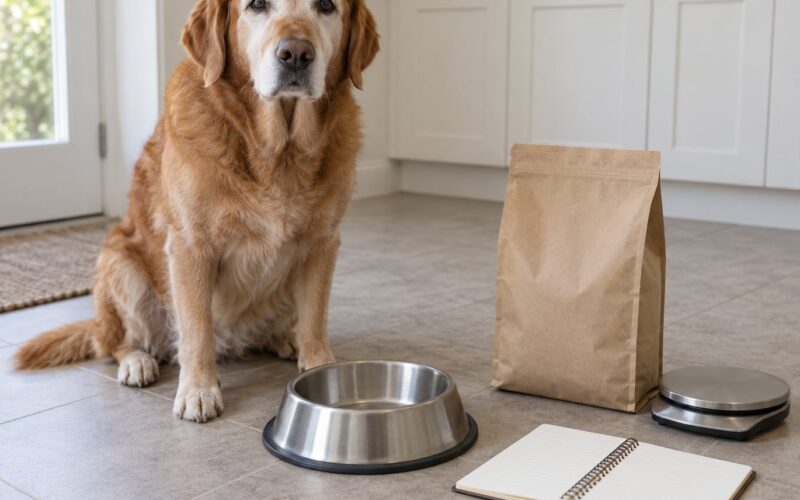
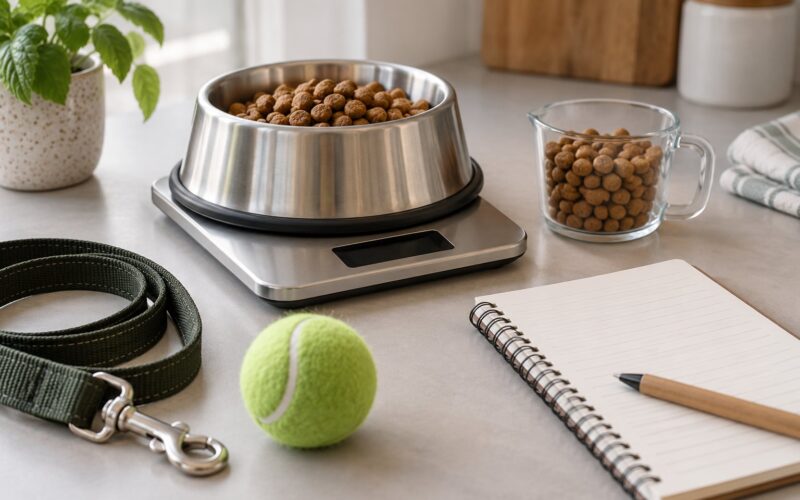
You need very little, and most of it is already in the house. What matters more than equipment is that the room is boring, safe and predictable.
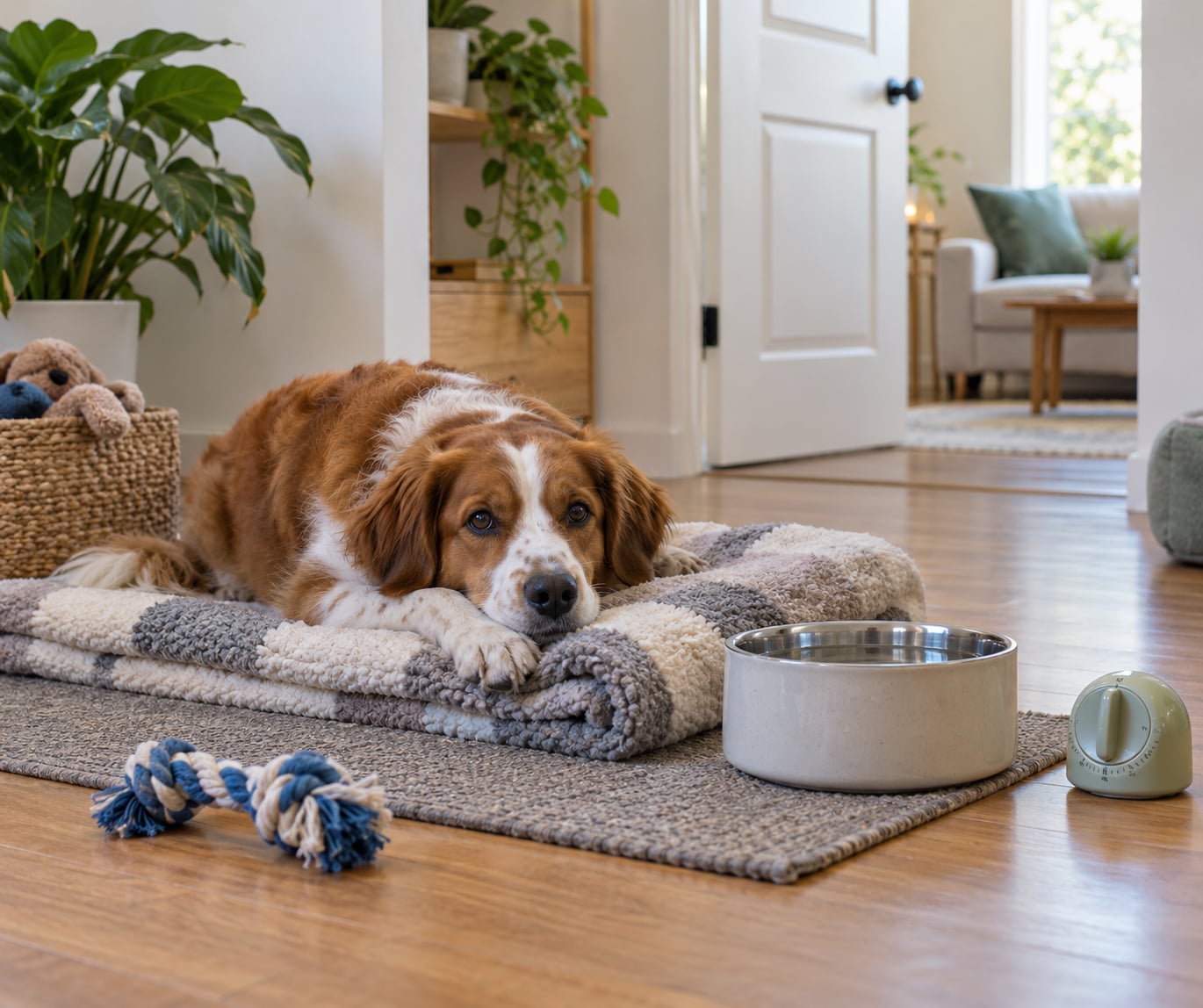
- A dog-proofed room. One room, checked for hazards. Move shoes, cables, chemicals, bin bags, children’s toys and anything else that can be chewed or swallowed. Check the floor for small items first, since they are the ones dogs find instantly.
- Familiar bedding. The same mat, bed or blanket every session. A new blanket in a new room becomes a thing to investigate and then chew, which is not the lesson you want.
- Fresh water. A bowl that cannot tip over. Long absences mean long time without a drink, and thirst makes house soiling much more likely. There is no training scenario where leaving water out is a bad idea.
- Treats or a food toy. Small and high value, because the reward has to travel. A stuffed chew or a puzzle feeder gives your dog something to do rather than something to listen to.
- One consistent cue. A single word or gesture, such as “wait here” or “settle”, used the same way in every session. Two cues split the learning in half.
- A visible timer. A phone or kitchen timer. Guessing is how people end up away for four minutes when they meant one.
- A way to observe. A baby gate, a door left ajar, or a camera. Watching from outside without stepping in is how you learn what calm actually looks like.
Optional extras include a pheromone diffuser, background radio or music, and a calming wrap. Owners on the training forums report these helping some dogs and doing nothing for others. They are a comfort layer on top of training, not a replacement for it.
Step-by-Step: How to Teach a Dog to Stay Alone in a Room
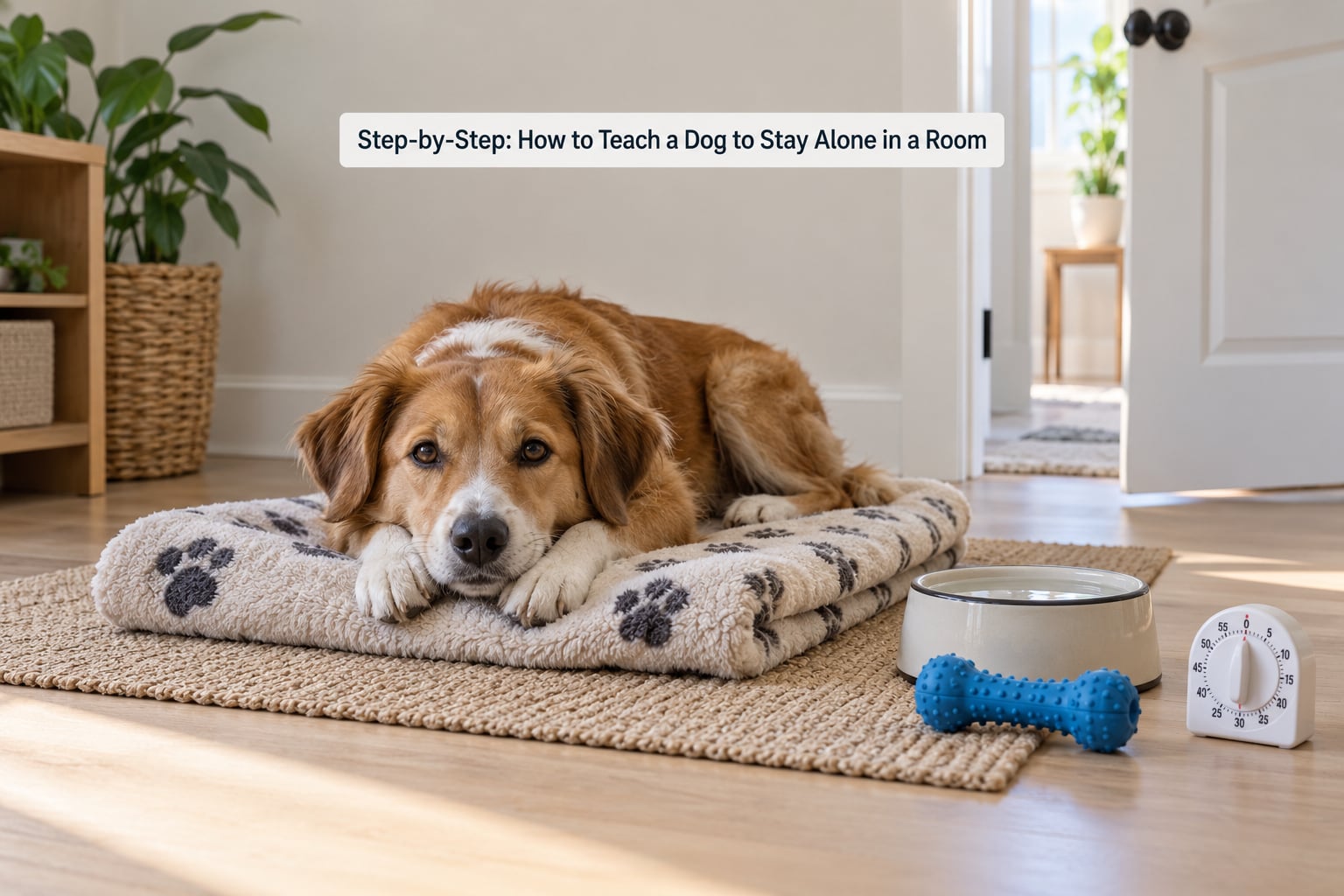
Work through these in order and only move on when the current step is easy. If step three is hard, step three is where you live for a few days.
Choose a Safe, Familiar Room
Pick one room and make it boring. A kitchen with smells and traffic is usually harder than a quiet bedroom or a hallway corner, and a room your dog already naps in is much easier than a room he has never been allowed to explore.
Walk the space and remove anything you would not want a two-minute-old puppy chewing. That means electrical cables, cleaning products, human medicines, laundry detergent, chocolate and anything sugar-free that contains xylitol, and houseplants such as lilies, dieffenbachia and philodendron. Keep bins out of reach, and check under furniture for wires and bits of plastic.
Put the water bowl down, then the mat or bed in a corner away from the door and away from draughts. Leave the door open for now. A dog who has never been alone in a space does not need the added problem of a closed door on day one.
Set a Clear Training Cue
Teach one cue that means “this is where you wait”. Say it once, in a flat friendly voice, place a treat on the mat, and let your dog eat it. That is the whole cue for the first few sessions. No repetitions in a row, no eye contact games, no asking whether he is sure.
Reward any calm behaviour immediately: lying down, resting his chin, sighing and settling. The timing is the training. A treat that arrives four seconds after he lies down teaches him that lying down is optional.
Deliver the reward without walking to him. Toss it from the doorway, slide it under the door, or hand it through a gate. If you walk in every time to give the treat, you have trained your dog to follow you out, which is the problem you started with.
How to Start Room Alone Training With Very Short Absences
Now add the absence. Say your cue, wait for your dog to lie down, walk to the door, step out, and start the timer. Two seconds. Walk back in and reward him before he moves.
Repeat that several times in a row. Success means the whole sequence stays quiet: no barking, no whining, no jumping at the door, no scratching. If your dog stands up and watches you leave the first time, that is not a failure, it just means two seconds is currently too long. Go back to half a second and build from there.
Trainers call the point where your dog is still comfortable the threshold, and the whole method depends on returning before your dog crosses it. Owners who report the fastest progress all describe the same thing: they made sure they were back before the barking started, every single time. Once barking begins, the session is over and you have learned nothing useful, because the dog is now rehearsing barking and you are reinforcing attention-seeking by rushing back.
The other thing forums agree on is that dogs handle two hard departures better than one long one. Three reps of five seconds beats a single rep of fifteen.
Build Duration and Distance Gradually
Once two or three reps in a row are quiet, add time. Move in small jumps, seconds at a time, not minutes. Five seconds becomes ten becomes fifteen, and each increase has to earn its place with calm repetitions before you move on.
Rough expectations by age, for a room with food, water and company next door:
- Puppies under four months. Seconds to a few minutes. Young dogs have tiny bladders and no tolerance for frustration, so expect to start again several times a day and to clean up accidents without comment.
- Adolescents, roughly four to twelve months. Ten to thirty minutes once the basics are reliable, but expect regression. A dog that held a room for an hour at eight months can fall apart at nine, and that is normal development rather than a broken dog.
- Adults. One to four hours of comfortable room time is realistic. Most welfare charities advise against longer than about four hours on a regular basis, and that limit applies well before you reach the point of wanting eight.
- Seniors. Shorter sessions are plenty, and watch for restlessness caused by discomfort rather than distress. A dog that paces and pants when left may be uncomfortable, not anxious.
Add difficulty in this order, one variable at a time: close the door, then move further down the hall, then practise at a different time of day, then swap rooms. Changing everything at once makes it impossible to know what caused a bad rep.
Generalising to a new room is the part most people underestimate. A dog who settles in the bedroom may barge into the kitchen the first time you shut him out of the living room. Go back to the stage that is comfortable and practise there twice before trying again. Dogs learn a specific room faster than they learn a general skill, so do not read one failure as “the training does not work”.
For velcro dogs that follow you room to room, including into the bathroom, the only fix is a visible barrier for the first weeks. Close a door between you for one minute while your dog is settled, reward through the door, and build from there. Owners of velcro dogs report that ignoring the following and rewarding any moment of staying behind works better than picking the dog up, which teaches the dog that struggling produces hands.
End With a Calm Return
Finish the way you plan to be seen when you come home from work: quietly. Open the door, walk in, ignore any spinning or jumping for the first few seconds, then reward him on his mat once he settles. No “good boy!” shouted at the door, no clapping, no picking him up mid-excitement.
If you make a big fuss, you teach him that your absence is an event worth celebrating, which makes the next departure harder. Calm returns are one of the strongest trust signals in this whole process. Stop each session while your dog is still relaxed and still bored. Two successful reps end the day better than six, because reps five and six usually include the first sign of frustration.
Common Mistakes
Going too fast. The most common error, and the easiest to fix. If your dog was calm at ten seconds, go to twelve. If he was restless at three minutes, drop back to one. Pushing past the threshold teaches your dog that being alone is something to survive rather than something fine, and that lesson is much harder to unlearn than to teach.
Using the room as punishment. A dog who is sent to a room for barking will learn to associate that room with you being angry. Then the room stops being a safe space and the training stops working. Room alone training has to be something the dog wants back into.
No water and no toilet plan. Long absences plus no access to water leads to house soiling, which then leads to punishment, which then destroys the trust you spent weeks building. Take the dog out right before you leave.
Punishing barking or destruction. Owners on r/Dogtraining are unanimous on this one. Bark collars, shouting and rubbing a dog’s nose in a mess do not teach him that being alone is safe; they teach him that you are unpredictable, and they escalate the behaviour. Removal of a barking dog from the room is worse, because barking is often what buys him company in the first place.
Treating distress as normal settling. A quiet dog is not automatically a relaxed dog. Put a camera on the room and watch: relaxed means lying down, resting the head, slow movement and drinking. Stressed means pacing, trembling, scratching the door, panting, house soiling, or wedging itself into a corner. Reviewers consistently note that cameras reveal pacing and trembling that never showed on their return, so buy one before you decide your dog is fine.
Sneaking out and making a fuss. Leaving while your dog is mid-excitement teaches him that departures are unpredictable, which raises anxiety rather than lowering it. Use the same calm exit every time.
Two more that catch people out. In a multi-dog household, train the pair separately at first, since a confident dog drags a nervous one back into the door. And if your schedule changes, expect a regression for a week or two; dogs read routine changes as threat, and going back one stage is usually all it takes.
When to Use a Professional or Your Vet
Talk to your vet first about anything medical. Urinary problems, pain, hearing or vision changes, and the discomfort of arthritis can all make a dog restless when left alone, and none of that is fixed by training. Never give a dog human medication, and if someone suggests a supplement such as a calming oil or chew, ask your vet to check the ingredients and dosing for your dog’s weight rather than copying advice from a forum post.
Book a qualified behaviour professional or veterinary behaviourist when you see these:
- Destructive behaviour that continues well past the early training stages, or damage to doors and windows
- Escape attempts, or scratching and biting at the exit
- Excessive barking and howling that does not improve as the steps get smaller
- House soiling in a previously house-trained dog, with no medical cause found
- A dog that refuses to eat, pant heavily, or injure itself when left
- A dog with a history of trauma, rehoming or a recent loss of an owner or companion
Severe separation anxiety is a medical welfare issue, not a training failure, and it responds best to a plan built with someone qualified. Ask your vet for a referral to a veterinary behaviourist or a certified separation anxiety trainer, and bring your camera recordings. Video evidence of what the dog actually does when you are gone is the single most useful thing you can hand a professional.
One reassurance worth repeating from the RSPCA: rescue dogs are not more likely than any other dog to develop separation-related behaviour, and a dog that was rehomed is not damaged by it. Slow, patient, reward-based work is what changes the behaviour, and it takes weeks to months.
Frequently Asked Questions
How long does it take to teach a dog to stay alone in a room?
Most dogs need two to six weeks of short daily sessions, and puppies take longer because of bladder control and short attention spans. Progress is not a straight line: a dog who held a room for an hour can regress after a schedule change or a busy week. If you have trained every day for three weeks with calm reps at each level and the dog still cannot manage thirty seconds, that is a signal to get advice from a qualified behaviour professional rather than to push harder.
Is it safe to leave my dog alone in a room while I am at work?
It is safe once your dog settles there on their own, without barking, pacing or scratching, and the room is dog-proofed with fresh water available. Start with the door ajar and a gate, then move to a closed door as the calm reps build. A young puppy or a dog with separation anxiety should never be left in a room alone while you are out. Keep the room boring and use a camera so you can see what you cannot hear from another room.
How do I stop my dog barking or whining when I leave the room?
Drop back a stage and practise a shorter absence. Barking is a symptom, not the behaviour you are training, so add something absorbing such as a stuffed food toy, increase exercise before you leave, and add steady background sound. Return before the barking starts, every time, and stop that session there. Never shout, use a bark collar, or remove the dog from the room, since all three raise anxiety instead of lowering it.
What if my dog will not settle down on their own?
Check for physical discomfort or an unmet need first, such as no toilet break before you left, a full bladder, or pain. Then give your dog a defined job that lasts longer than your absence: a stuffed food toy frozen solid, a snuffle mat, or a puzzle feeder. If your dog is following you from room to room, use a baby gate or a closed door and reward any moment of staying behind. A rest-trained dog who still cannot settle needs professional guidance.
Is 10 hours too long for a dog to be home alone?
Yes, ten hours is too long for most dogs on a regular basis, and the RSPCA advises against leaving a dog alone for more than about four hours. Long days also raise the chance of house soiling and boredom-related damage. A midday walker, a sitter, dog daycare or a second pet usually solves this better than training for longer. If you genuinely cannot arrange company or breaks, talk to your vet about what is realistic for your dog’s age and health.
What is the 3-3-3 rule for dogs?
The 3-3-3 rule describes how a new dog adjusts to a new home: three days to decompress, three weeks to learn the routine, and three months to feel fully settled. Use it as a yardstick, not a deadline. It applies to room alone training too: do not start expecting time away from your dog in the first three days, expect visible routine-following around the three-week mark, and treat anything faster as a bonus rather than a target.
Conclusion
Start with one dog-proofed room, one bedding spot, water and a single cue. Walk out for two seconds, walk back in, reward, and only add time when the last few reps were quiet. That is how to teach a dog to stay alone in a room without rushing the one thing your dog has to learn slowly.
If your dog barks, destroys things or hurts himself at any point past the early stages, speak to your vet and ask for a referral to a behaviourist. Years of calm days are built out of two-second reps, and they work.