
If your dog is vomiting repeatedly, treat more than two or three episodes in a few hours, or any vomiting that carries on past 12 to 24 hours, as the point where you call a veterinarian rather than keep watching. A single episode in a dog that bounces straight back to normal is usually not serious, but repeated vomiting dehydrates quickly and can be the visible sign of problems that do not wait, such as a swallowed object, a twisted stomach, pancreatitis or toxin exposure. This guide gives you the order of operations for the next few hours. It is general guidance, not a diagnosis, and only a veterinarian can tell you which category your dog falls into.
One useful note before you start: acting completely normal does not rule anything out. Plenty of dogs vomit twice, eat a biscuit and carry on as if nothing happened, and plenty of those turn out to have eaten something out of the bin. The behaviour is reassuring but not decisive, which is why the answer below is about counts and timelines rather than about how worried your dog looks.
Table of Contents
- What You Need
- Step-by-Step: What to Do If Your Dog Is Vomiting Repeatedly
- 1. Confirm the Episodes and Note What Happened
- 2. Look for Emergency Warning Signs
- 3. Prevent Further Exposure
- 4. Contact a Veterinarian or Emergency Clinic
- 5. Follow the Veterinary Plan and Monitor Recovery
- Common Mistakes
- Frequently Asked Questions
- How many times should a dog vomit before I call a veterinarian?
- Can my dog drink water after vomiting repeatedly?
- What should I do if my dog may have swallowed a toxic food or plant?
- Is it safe to give my dog human medicine for vomiting?
- What should I do if my dog keeps retching but nothing comes up?
- When is repeated vomiting in a dog an emergency?
- Conclusion
What You Need

Vet calls go faster when the answers are already written down. Before you dial, gather what you can.
- Your dog’s age, weight and breed. Puppies, seniors and deep-chested large breeds are triaged differently.
- A count of the episodes and roughly when each one happened, in order.
- What came up each time and roughly how much. A photo helps more than you would think.
- The last normal meal and what it was, plus any diet change in the past week.
- Every medication and supplement currently in use, including anything human.
- Possible exposure history what your dog had access to in the last 24 hours: bin, garden, chemicals, plants, another animal, a toy or a chew.
- Whether your dog has urinated recently. This gets asked constantly and owners rarely have the answer ready.
- A pen and paper, or the notes app, for writing answers down mid-call.
Also have ready a leash and harness or a carrier, a towel, and a second person to drive if you can. If you may be heading to an emergency clinic, tell them you are coming before you leave the house.
Do not give human medicine. Paracetamol, ibuprofen, antihistamines and anti-diarrhoeal products meant for people are not safe for dogs in the doses printed on the packet, and some are dangerous outright. No household remedies either, no herbal preparations, and nothing left over from another pet’s treatment unless your vet has told you to use it.
And do not force food or force water down a dog who is actively nauseous. Pushing past nausea usually triggers another episode and adds dehydration to the problem.
Step-by-Step: What to Do If Your Dog Is Vomiting Repeatedly
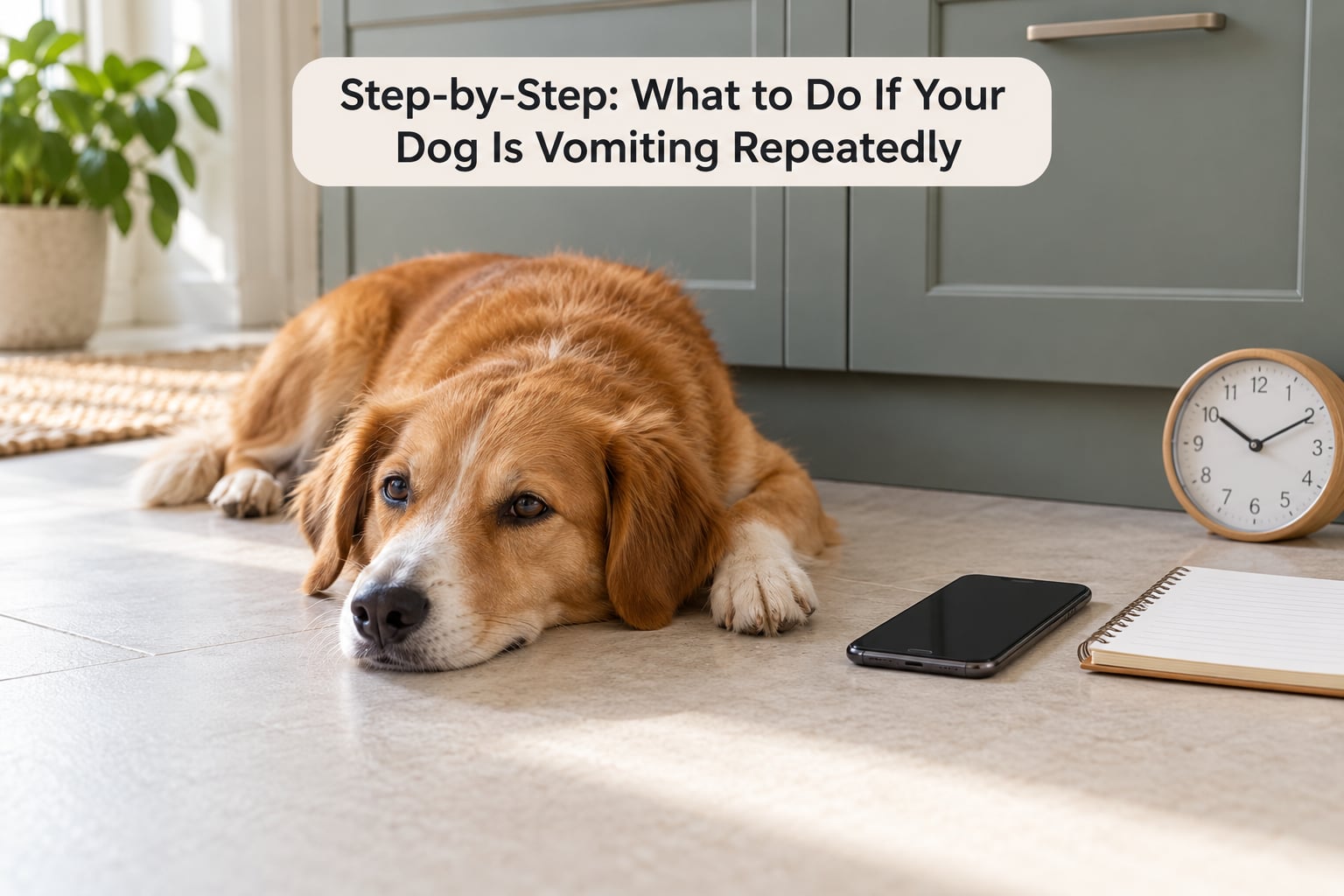
1. Confirm the Episodes and Note What Happened
Not everything that comes back up is vomiting. Regurgitation is passive: food tubes up with no warning, no abdominal heaving, often soon after eating, and the dog looks almost disappointed rather than ill. Vomiting is active, and it is usually preceded by nausea signals such as repeated lip licking, heavy drooling, a hunched posture or pacing.
Retching is the third thing. Your dog braces, heaves hard and produces little or nothing. That distinction matters, and step 2 explains why.
Write the time, the count and the contents of every episode. Note the last food and water your dog managed to keep down, and whether water is staying down now. Small frequent sips work far better than a full bowl at once, so offering a little at a time tells you much more than leaving the bowl down.
Repeated vomiting is a symptom with a long list of possible causes, not a diagnosis you can make from the kitchen floor. That list runs from eating something spoiled to an intestinal blockage, and telling them apart is clinical work.
2. Look for Emergency Warning Signs
Some combinations need an emergency animal hospital now, not a phone call in the morning.
- Retching that brings nothing up while the abdomen looks swollen, hard or painful. Retching without output plus a bloated abdomen can mean a twisted stomach, and that is one of the few true time-critical emergencies in dogs.
- Blood in the vomit, whether bright red or dark and coffee-ground, or blood in the stool.
- Suspected poisoning or toxin ingestion, including chocolate, xylitol, human medicines, cleaning products, fertiliser, bait, or a toxic plant. Call a veterinarian or animal poison control service immediately, and do not wait for symptoms.
- Inability to keep water down, repeated attempts to vomit, collapse, extreme weakness or a dog who cannot stand.
- Difficulty breathing, pale gums, or gums that feel dry or sticky when you press them.
- A swollen or painful abdomen, or a dog who whines or flinches when you touch it.
- Suspected foreign-object swallowing after a sock, toy piece, bone or small object went missing.
A large, deep-chested dog retching with a swollen belly is an emergency at any age. So is any sign of a foreign object, because a blockage does not clear on its own.
Any one of these, and your vet decides whether you need emergency care. That decision is theirs, not yours, which is exactly why the call is worth making early.
3. Prevent Further Exposure
Stop the trigger before it adds to the problem. Move the dog away from the bin, take food out of reach, and check the kitchen for anything that should not have been accessible in the first place: cleaning products, medication, chocolate, grapes and raisins, xylitol products such as some sugar-free gum and peanut butter, and anything fertiliser or pest-control related.
If there are toxic plants in the house or garden, note which ones and tell the vet exactly what you think your dog may have eaten. Keep other animals away from the sick dog’s food, since a dog with a settled stomach will often eat quickly and then vomit again.
Never induce vomiting at home unless a veterinary professional specifically instructs you. Salt, oil and hydrogen peroxide all circulate on forums as remedies and all of them can cause serious harm. For many toxins, making a dog vomit actually increases the damage. If your dog has swallowed something, the phone call is the first step, always.
4. Contact a Veterinarian or Emergency Clinic
Call rather than wait for home care to prove itself. If your dog has passed the threshold above, contact a veterinarian or emergency animal hospital promptly instead of continuing to withhold food and hope.
Have your notes in front of you and be ready to say:
- How many times your dog has vomited, and over what period.
- What came up and what colour it was.
- Your dog’s age, weight and breed.
- Current diet and any change in the last week.
- Medications and supplements, including human ones.
- Possible toxin or foreign-object exposure, and when.
- Whether your dog can urinate, and whether there is diarrhoea.
- Whether your dog seems bright or unusually flat.
If the clinic asks for a video of the episode, have your phone ready. If the answer is an emergency visit, follow their instructions exactly about leaving food and water alone in transit.
5. Follow the Veterinary Plan and Monitor Recovery
Treatment depends entirely on the cause, and that is why it cannot be replaced by a home protocol. Depending on what they find, a vet may recommend a physical examination, bloodwork, a faecal test, X-rays or ultrasound, anti-nausea medication, gut-protective medication, fluids, or in an obstruction or twisted stomach, surgery.
Follow their instructions on food and water rather than switching back to the usual diet early. That often means small, frequent meals of something bland for a few days, then a gradual return to normal food over two to three days.
Watch what happens over the next 24 to 48 hours: appetite returning, water staying down, energy lifting, and no new episodes. Seek urgent help again if vomiting comes back, if your dog refuses water, or if lethargy deepens instead of improving. Relapse after seeming better is worth reporting straight away.
Common Mistakes
Most of what circulates in dog-owner groups is well-meant and often wrong in the same handful of ways.
- Giving human medicine. A human anti-nausea or anti-diarrhoeal tablet is not a scaled-down version of a veterinary one. Several are toxic to dogs, and none should be given without veterinary direction.
- Trying household remedies. Anything from herbal drops to kitchen ingredients is unproven at best and can delay the call that actually matters.
- Withholding water for too long. Withholding food is a common recommendation; withholding water for long stretches is not, because repeated vomiting dehydrates fast. Small frequent sips, or ice cubes in a shallow dish, are the safer route.
- Forcing food. A dog who refuses food after vomiting is usually nauseous, not stubborn. Forcing a meal usually brings it straight back up.
- Inducing vomiting yourself. Salt, oil and peroxide are dangerous. Only a veterinary professional should decide whether vomiting should be induced, and how.
- Ignoring unproductive retching. Heaving with nothing coming up is not the same as vomiting up food. Paired with a swollen abdomen, it is an emergency.
- Writing off blood or severe lethargy as ordinary upset. Neither is normal. Both mean veterinary assessment, and blood in the vomit often means going now.
Two practical habits help more than anything else. Keep a running symptom log, even a rough one on your phone, so the next call does not start from zero. And travel with the dog on a leash or in a carrier rather than loose, because a sick dog can bolt, and a dog that vomits in a moving car is much harder to manage.
Frequently Asked Questions
How many times should a dog vomit before I call a veterinarian?
More than two or three episodes within a few hours is the point to call, and any vomiting that continues past 12 to 24 hours is a reason to call even if it seems mild. Frequency matters as much as how sick your dog looks, because a dog can act entirely normal between episodes. If you are unsure, call and describe what you have seen; a veterinarian would rather hear from you early than late.
Can my dog drink water after vomiting repeatedly?
Usually yes, in small frequent amounts rather than a full bowl at once. Ice cubes in a shallow dish or a spoonful at a time lets you test whether water stays down without triggering another episode. Do not withhold water for long stretches during repeated vomiting, because dehydration develops quickly. If your dog cannot keep water down at all, contact a veterinarian or emergency clinic straight away.
What should I do if my dog may have swallowed a toxic food or plant?
Contact a veterinarian or animal poison control service immediately, and take the packaging or a photo of the plant with you if you can. Do not wait for vomiting to start and do not induce vomiting yourself with salt, oil or hydrogen peroxide, because making a dog vomit can increase the damage from some toxins. Note the time of ingestion, the estimated amount and your dog’s weight, because those change the advice you get.
Is it safe to give my dog human medicine for vomiting?
No. Human paracetamol, ibuprofen, antihistamines and anti-diarrhoeal products are not safe for dogs at the doses printed on the packet, and some are outright toxic. Only give medication your veterinarian has prescribed or explicitly recommended for this specific problem, at the dose they specified. If you have already given something, say so on the phone, including the name and the amount, because it changes what the clinic needs to do.
What should I do if my dog keeps retching but nothing comes up?
Retching that produces nothing, especially alongside a swollen, hard or painful abdomen, can indicate a twisted stomach, which is a time-critical emergency. Go to an emergency animal hospital now rather than waiting to see whether something comes up. Retching without output can also follow eating fast or after stomach contents have already been emptied. Even without a bloated belly, repeated unproductive retching with weakness, pale gums or collapse needs immediate veterinary assessment.
When is repeated vomiting in a dog an emergency?
Repeated vomiting is an emergency when you see unproductive retching with a bloated or painful abdomen, blood or coffee-ground material in the vomit, pale or sticky gums, collapse, difficulty breathing, suspected poisoning or a swallowed foreign object, or an inability to keep water down. Large, deep-chested breeds are higher risk for a twisted stomach. In those cases go to an emergency animal hospital now; a veterinarian makes that call, so do not wait for home care to work.
Conclusion
Start with four things: count the episodes and write down the times, check for the warning signs above, block access to food, bin, chemicals and plants, and contact a veterinarian or emergency animal hospital promptly if you have passed the threshold. Small frequent sips of water and no human medicine are the only things you can safely do at home while you arrange care.
This article is general guidance, not a diagnosis or a treatment plan, and it cannot tell you why your dog is vomiting. That answer, and any decision about fasting, medication or emergency treatment, belongs with a veterinarian who can examine your dog.