Cats hide oral pain instinctively, so the signs of dental pain in cats show up as small changes in eating, mood and appearance rather than obvious distress. The clues below cover the four groups most owners miss: changes in eating, mouth irritation, breath and appearance, and grooming and mood.
- Changes in eating: eating slowly, dropping food, chewing on one side, refusing hard kibble, licking lips after a meal.
- Mouth irritation: drooling, pawing at the face, rubbing the muzzle on furniture, flinching when the chin is touched.
- Bad breath and appearance: persistent halitosis, red or bleeding gums, visible tartar, broken, missing or discolored teeth.
- Grooming and mood: unkempt or matted coat, hiding, irritability, less play, pulling away from being handled near the face.
One thing to hold on to: a cat that eats normally can still be in significant pain. Feline teeth shear rather than grind, so many cats swallow kibble whole and finish a meal without obvious trouble. That behavior does not clear the mouth.
This article is general information, not a diagnosis. Only a veterinary oral examination, usually with dental X-rays, can tell you what is happening below the gumline.
Table of Contents
- What Are the Signs of Dental Pain in Cats?
- How Do Cats Show Dental Pain Through Eating?
- What Behavioral Changes Can Indicate Dental Pain in Cats?
- Can Bad Breath, Drooling, or Facial Changes Be Warning Signs?
- Signs of Dental Pain in Cats vs. Normal Cat Behavior
- How Do Vets Check a Cat’s Teeth Safely?
- When Should I Contact a Veterinarian About Cat Dental Pain?
- What Can I Do at Home Until the Veterinary Visit?
- Frequently Asked Questions
- Do cats hide dental pain, or will my cat tell me it hurts?
- Is bad breath in a cat always a sign of dental disease?
- My cat’s tooth broke off. Is that an emergency?
- What can I feed a cat with painful teeth?
- Can I brush my cat’s teeth at home?
- Why is my cat refusing hard food but eating everything else?
- The First Step for Cats With Suspected Dental Pain
What Are the Signs of Dental Pain in Cats?
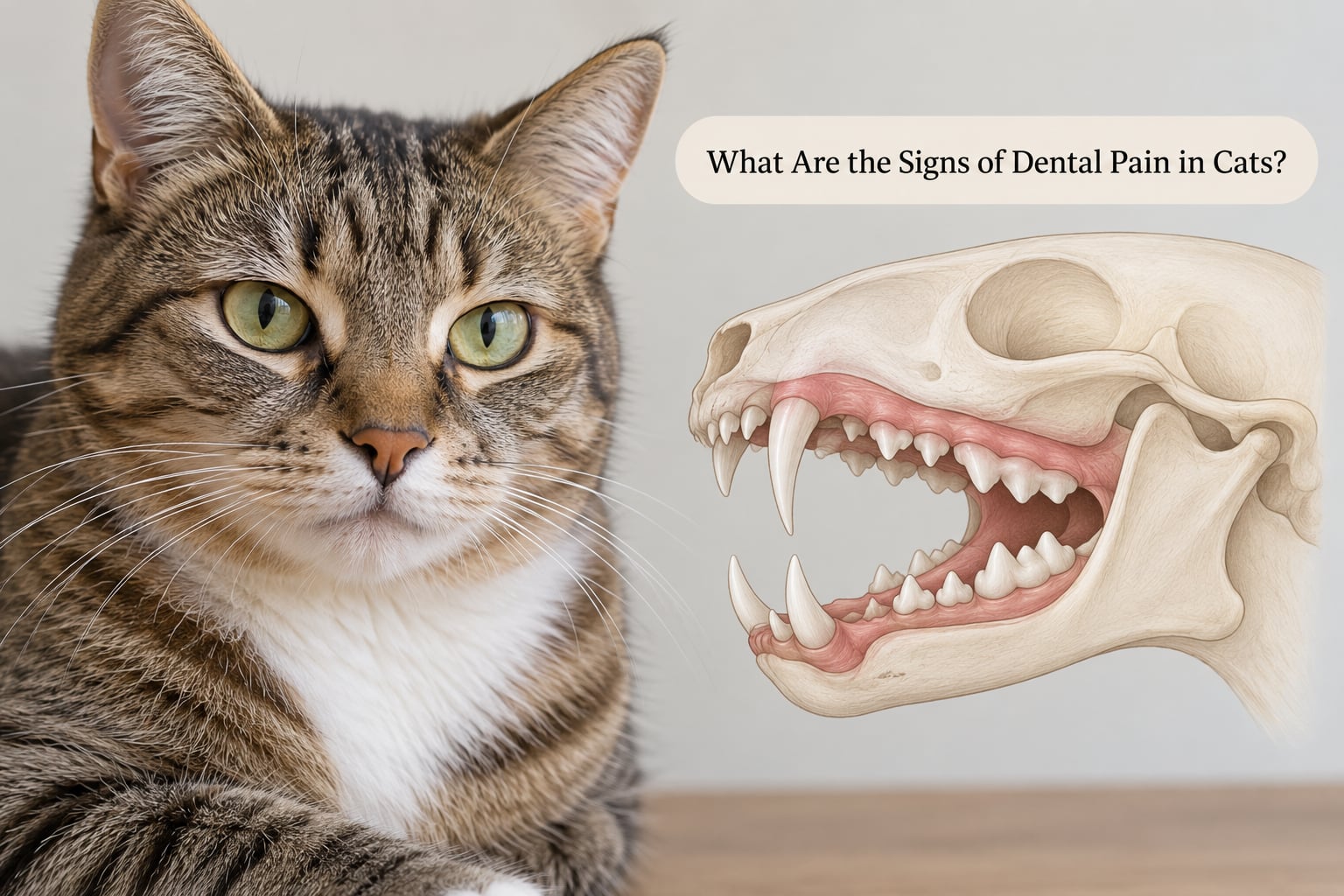
Most dental problems in cats are progressive and treatable, but they hurt long before the cat looks obviously unwell. Here are the eleven clues worth watching for, in rough order of how often owners notice them.
- Eating noticeably slower than usual. A meal that used to take two minutes now takes ten, with long pauses mid-bowl.
- Dropping food or fishing it out of the bowl. Kibble ends up on the floor around the bowl, or the cat picks pieces up and sets them down.
- Chewing on one side. A head tilt while eating, or favoring the same jaw every single meal.
- Refusing hard food. A sudden move to wet food or soft treats, or a dry-food diet quietly abandoned.
- Pawing at the mouth or face. Swiping at the cheek, rubbing an eye, or scratching at the gumline.
- Drooling. Saliva on the chin, chest or paws, sometimes with a pink or red tinge.
- Persistent bad breath. A sour or sweetish smell that does not clear within a day of eating.
- Red, swollen or bleeding gums. A thin pink line along the gum margin, or bleeding when touched.
- Visible tartar, broken or missing teeth. Yellow-brown calculus, a chipped tooth, or a gap where a tooth used to be.
- Muzzle rubbing. Dragging the face along a sofa corner, a rug or the edge of a bowl.
- Hiding, irritability or an unkempt coat. Withdrawing from people, skipping play, or a coat that has gone greasy and matted.
Weight loss often shows up alongside these rather than before them. Owners on r/cats frequently describe drooling as the clue they wish they had taken seriously sooner.
A second group of owners describes the opposite problem: a cat with an obviously broken tooth who insists on eating. Community members on the same forums point out the pain has almost certainly been building for months, and the missing tooth is the late sign, not the early one.
How Do Cats Show Dental Pain Through Eating?
Changes in eating are the most reliable early indicator, because chewing is what a sore mouth cannot fake. Look at the whole pattern rather than a single meal.
A cat with a painful tooth often chews slowly and deliberately, stops mid-chew, or swallows without much chewing at all. Food goes back into the bowl, onto the floor, or gets spat out. Some cats lick their lips and whiskers constantly after a meal, which reads as fussiness but is usually discomfort.
Switching texture is the most common change owners report. Dry kibble needs more crushing than wet food, so a cat with tender gums or a resorptive lesion will quietly move to anything softer. Owners often assume the cat has simply become fussy. In retrospect, the texture switch was the first real signal.
Chewing on one side is a strong clue. If the same jaw gets used at every meal, or the head tilts down and to the same side, that asymmetry points at a specific tooth. The same applies to dropping food: it is a common owner question, and dropping food plus one-sided chewing together is a much stronger signal than either clue alone.
A cat that has not eaten at all in 24 hours needs a veterinarian the same day. Cats that stop eating are at risk of hepatic lipidosis, a dangerous build-up of fat in the liver that can develop after surprisingly short periods of refusing food.
What Behavioral Changes Can Indicate Dental Pain in Cats?
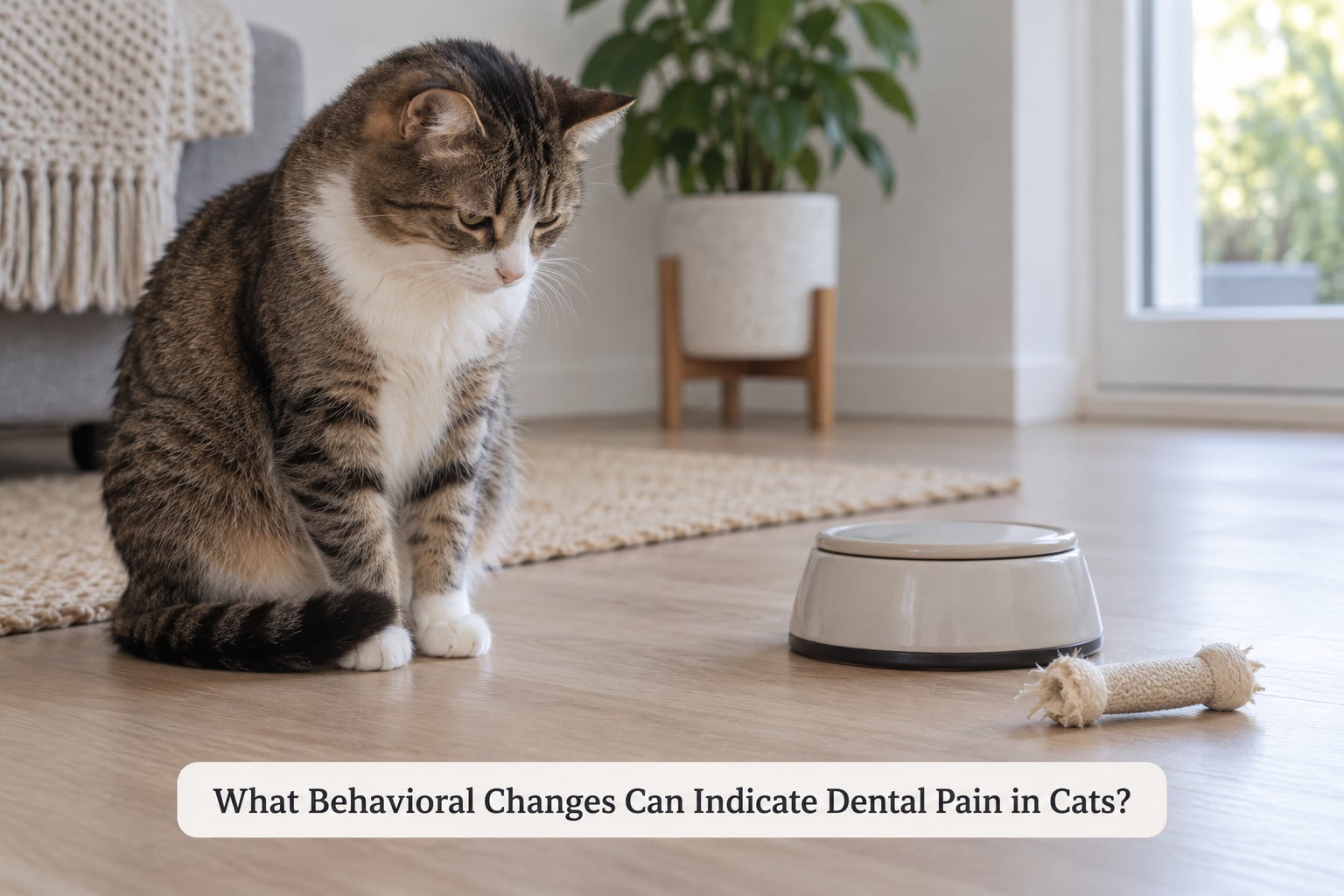
Mouth pain changes how a cat handles the world, not just how it eats. A cat that stops swatting at a toy or starts hiding under the bed may be moving less because opening its jaw hurts.
Irritability is the version most owners miss. A normally affectionate cat that snaps when you reach near its chin or head is often reacting to anticipating a painful touch, not to a mood change.
Grooming drops too. Cats groom the mouth and face as part of a normal routine, so a cat that suddenly stops washing its face may be avoiding the motion because it pulls on sore gums. Owners frequently describe the resulting coat as greasy, matted or unkempt without connecting it to the mouth at all.
Vocalization can shift too: less purring, more low growling, or an unusual amount of meowing around feeding time.
Separate a one-off from a pattern. A single off day after a house move or a new food is noise. The same change repeating for a week or two, or several signs appearing together, is signal. Write down what you saw and when. Vetarians ask for specifics, and short notes from an honest owner are more useful than a vague description of a bad week.
Can Bad Breath, Drooling, or Facial Changes Be Warning Signs?
Yes, all three are worth a veterinary appointment, though none of them proves dental disease on its own. A healthy cat’s breath smells faintly of the food it just ate. A persistent sour, rotten or sweetish odor that lingers hours later points at active bacterial infection in the mouth.
Drooling needs context. A little saliva after a yawn is normal. Constant drooling, or saliva that dries pink on the chin and chest, usually means the mouth is too sore to swallow comfortably. Owners repeatedly flag blood-tinged saliva as the moment they should have called, because the amount is often small enough to miss at first.
Look at the gums and the outside of the mouth. A thin pink line along the gum margin, red or swollen tissue, and gums that bleed under gentle pressure all point toward periodontal disease. Facial swelling, especially on one side or under an eye, and a broken or missing tooth are more serious and should be assessed promptly.
Two things owners regularly confuse with dental signs: teeth chattering and hoarse meowing alongside drooling can also point to a dental abscess, but an ear or respiratory problem can look similar. Mention everything you have seen, not only what you think is in the mouth.
Discoloration deserves a note of its own. A small pink or red spot near the gum margin, sometimes called a pink spot, sits at the neck of the tooth where a cat’s own cells have begun resorbing it. A tooth that looks almost normal from the outside can be resorbing underneath, which is one reason dental X-rays matter.
Signs of Dental Pain in Cats vs. Normal Cat Behavior
Normal feline behavior varies a lot between individuals. This table separates everyday habits from changes that deserve monitoring.
| Behavior | Often normal | Worth monitoring |
|---|---|---|
| Eating speed | Fast, gulping, finishing in under two minutes | Slow, pausing mid-chew, dropping food |
| Food texture | A preference that has been there since kittenhood | A sudden shift from dry to wet or soft food |
| Head position | Level, straight over the bowl | Tilted to the same side at every meal |
| Catching toys | Misses sometimes, especially when tired | Stops playing, or grabs a toy without biting it |
| Being handled near the head | A brief fuss, then settles | Swiping, freezing or running away at the chin or cheeks |
| Grooming | Occasional missed spots | Stops washing the face, coat goes greasy or matted |
| Social time | Independent afternoon, as many cats are | Hiding, avoiding people, constant low growling |
| Drinking | Steady, unremarkable | A noticeable drop, or preferring to lap rather than drink |
Two factors explain most false alarms: a recent change in food or routine, and age. Older cats nap more, groom less and grumble more. Judge the change against your own cat’s baseline rather than against a picture of a generic cat.
How Do Vets Check a Cat’s Teeth Safely?
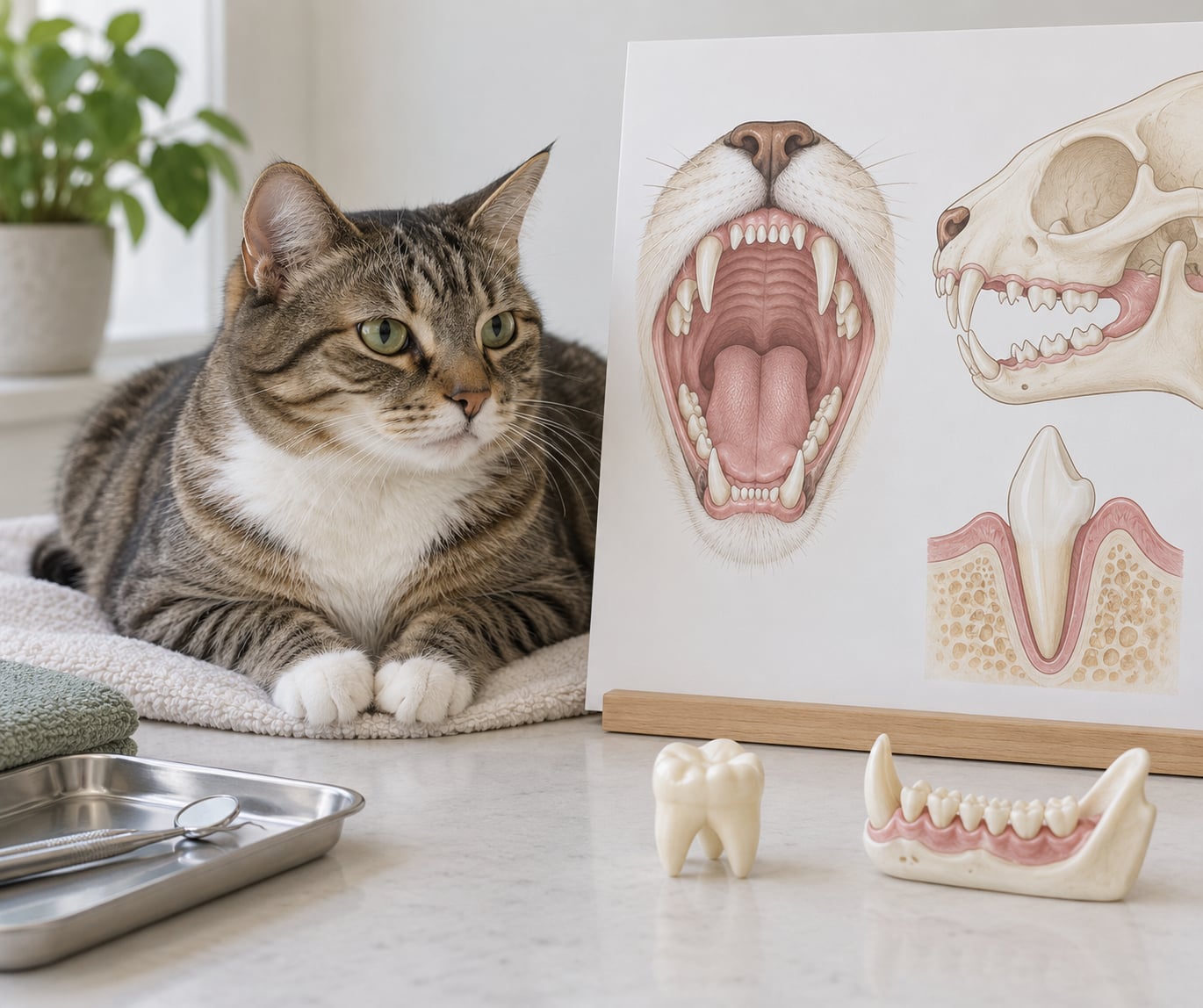
A dental check starts with an awake oral examination. The vet lifts the lips, looks at the gums and visible teeth, and checks the bite. Most of the mouth sits under the gumline and cannot be seen this way, which is the limit of a visual exam.
Dental radiographs are what make a real assessment possible. Two thirds of each tooth sits below the gum, so periodontal bone loss, abscesses and tooth resorption are invisible without X-rays. Scaling and polishing above and below the gumline, and any extractions, are normally performed under anesthesia so the mouth can be opened fully and kept still.
Four conditions account for most of what you will see on a dental report: gingivitis, periodontitis, tooth resorption (FORL), and feline chronic gingivostomatitis (FCGS). Asking what these mean in plain terms helps. Gingivitis is inflamed gums. Periodontitis is the destruction of the bone anchoring the tooth. Resorption is the cat’s own cells dismantling the tooth from the neck inward. FCGS is immune-mediated inflammation spreading from the gums into the cheeks and throat, and it is the most painful of the four.
Some clinics offer anesthesia-free dental scraping. It avoids anesthesia and cannot reach under the gumline, so it misses the disease that matters most. Ask what your clinic’s approach actually covers.
Three things to never do at home: do not pry the jaw open, do not use a sharp tool on hardened tartar, and never give human pain medicine. Cats lack the enzyme that clears several common human painkillers safely, and a single dose can be fatal.
When Should I Contact a Veterinarian About Cat Dental Pain?
Call the same day if your cat has not eaten at all in 24 hours, if there is facial swelling, if the gums or mouth are bleeding, if you see a broken tooth, or if the cat is drooling constantly, crying when eating or unable to open its mouth properly. Refusing food is the one to take seriously. Cats are built to hide discomfort, and pain that stops a cat eating is not a mild case.
Book within the week for persistent bad breath, visible tartar, red or bleeding gums, food dropping, chewing on one side, pawing at the face, or a coat that has gone unkempt. None of these is an emergency on its own, and all of them are reasons to stop waiting for the annual checkup.
Bring the notes. Dates of the first sign, what changed, what your cat eats and how it eats it. If the cat will not travel, mention it when you call; carriers, handling and clinic logistics come up often enough that clinics can advise before the appointment.
Untreated dental disease does not stay in the mouth. Bacteria enter the bloodstream during every meal, and the inflammation that follows puts extra load on the kidneys, heart valves and liver. In senior cats that margin is thinner, which is another reason not to sit on a suspicious mouth.
What Can I Do at Home Until the Veterinary Visit?
Keep the next day or two simple and low-risk.
- Offer soft, warm food. Wet food or a veterinary soft diet keeps the jaw still. Keep water available at all times.
- Remove hard chews and crunch treats. Rawhide, dental biscuits and dry kibble all ask a sore mouth to work harder.
- Note what the cat eats and how. Amount, time, which side of the mouth, whether food gets spat out.
- Leave the mouth alone. A lip lift at a calm moment is fine. Do not push past a flinch.
- Call before the appointment. If the cat stops eating entirely, say so, because the 24-hour mark matters.
Two warnings worth repeating. No human toothpaste: the xylitol and fluoride in it are toxic to cats. No human painkillers, including over-the-counter ones. Cats metabolize several common anti-inflammatories very differently from dogs, and the failure can be sudden.
A quick closed-mouth check is possible without hurting the cat. Pick a calm moment, gently lift the upper lip on one side, look at the gum margin and the cheek teeth for redness, tartar, swelling or a chipped crown, take about ten seconds, then let go and reward with a treat. Never pry the jaw open. If your cat resists, you have your answer: the mouth needs a professional, not a fight.
Frequently Asked Questions
Do cats hide dental pain, or will my cat tell me it hurts?
Cats hide pain as a survival instinct, and mouth pain hides well because eating must look normal. Feline teeth shear instead of grinding, so many cats swallow kibble whole and finish a meal with no visible struggle. That is why eating normally does not rule out dental disease. Watch the texture switch, the dropped food, the head tilt and the drooling instead.
Is bad breath in a cat always a sign of dental disease?
Not always, but persistent bad breath is worth an appointment. A healthy cat’s breath smells faintly of whatever it just ate. A sour, rotten or sweetish odor that lingers hours later points to active bacterial infection in the mouth. Diet and some medical conditions can also affect breath, so a veterinarian needs to examine the mouth to tell you which it is.
My cat’s tooth broke off. Is that an emergency?
Call your veterinarian the same day. A broken tooth can expose the sensitive pulp, and the sharp edge can cut the tongue and cheek with every bite, which keeps the pain going. Do not try to pull it or file it yourself. Bring a photo of the tooth if you can take one safely, and note whether your cat is still eating.
What can I feed a cat with painful teeth?
Soft, warm food asks the least of a sore mouth. Wet food or a veterinary soft diet works well, and soaking dry food makes it easier to manage. Skip hard chews and crunchy treats until the mouth is checked. Keep fresh water available, and call your veterinarian if your cat has not eaten at all in 24 hours, because cats that stop eating face a real risk of hepatic lipidosis.
Can I brush my cat’s teeth at home?
You can, and it helps, but only with a veterinary enzymatic toothpaste made for cats and a soft brush. Never use human toothpaste, which contains xylitol and fluoride that are toxic to cats. Start with the lips and gumline, keep sessions short, and stop if your cat fights. Many owners have more success introducing the brush to kittens before they have a full set of adult teeth.
Why is my cat refusing hard food but eating everything else?
Dry kibble needs more crushing than wet food, so a cat with tender gums, a resorptive lesion or a fractured tooth quietly moves to anything softer. The change is usually the earliest sign owners notice. It is also easy to read as fussiness. Check for tartar, red gums, dropped food or chewing on one side, and book an oral exam rather than waiting for the next checkup.
The First Step for Cats With Suspected Dental Pain
Call your veterinarian. That is the whole first step, and it matters most when your cat is eating less, drooling, bleeding from the mouth or showing any swelling on the face.
If you take one idea from the signs of dental pain in cats, make it this: a cat that eats normally can still hurt, and waiting for the signs to get worse is the expensive option. Eating changes come first, then the mouth signs, then the mood and coat changes that owners often miss.
Between now and the appointment, soft food, no hard chews, no human toothpaste and no human painkillers. Write down what you have seen and when. Your veterinarian will want that detail, and a short honest timeline is more useful than trying to remember it in the waiting room.
This article is educational information about feline dental health. It cannot diagnose your cat or replace an examination. For any warning sign, individual advice belongs with a veterinarian.