Ragdolls are big, soft, semi-longhaired cats with a famously placid streak, and their coat is the one thing most owners underestimate. A healthy adult usually needs a full brush once a week, more during spring and autumn shedding, plus nail, ear and dental care on a loose schedule. Personality and grooming load both vary from cat to cat, so treat everything below as a baseline rather than a rulebook.
Understanding ragdoll cat temperament and grooming needs together matters more than it sounds. A relaxed cat is far easier to comb, and a well-kept coat is easier on a cat that gets handled regularly. Get both right and the daily routine settles into something you barely have to think about.
Table of Contents
- Ragdoll Cat Temperament and Grooming Needs at a Glance
- What Is the Typical Ragdoll Cat Temperament?
- How Affectionate and Social Are Ragdoll Cats?
- Are Ragdoll Cats Vocal, Active or Dog-Like?
- What Grooming Does a Ragdoll Cat Need?
- How Often Should You Brush a Ragdoll Cat?
- When Does a Ragdoll Cat Need More Frequent Grooming?
- Does a Ragdoll Cat Need Baths?
- How Can You Bathe a Ragdoll Cat Safely?
- What Is a Complete Ragdoll Grooming Routine?
- Which Grooming Problems Require a Veterinarian?
- Frequently Asked Questions
- Are Ragdoll cats always calm and affectionate?
- How often should a Ragdoll cat be groomed?
- Do Ragdoll cats shed a lot?
- Can Ragdoll cats be bathed like other long-haired cats?
- How do I prevent tangles behind a Ragdoll cat’s ears?
- What signs mean a Ragdoll’s grooming routine needs veterinary help?
Ragdoll Cat Temperament and Grooming Needs at a Glance
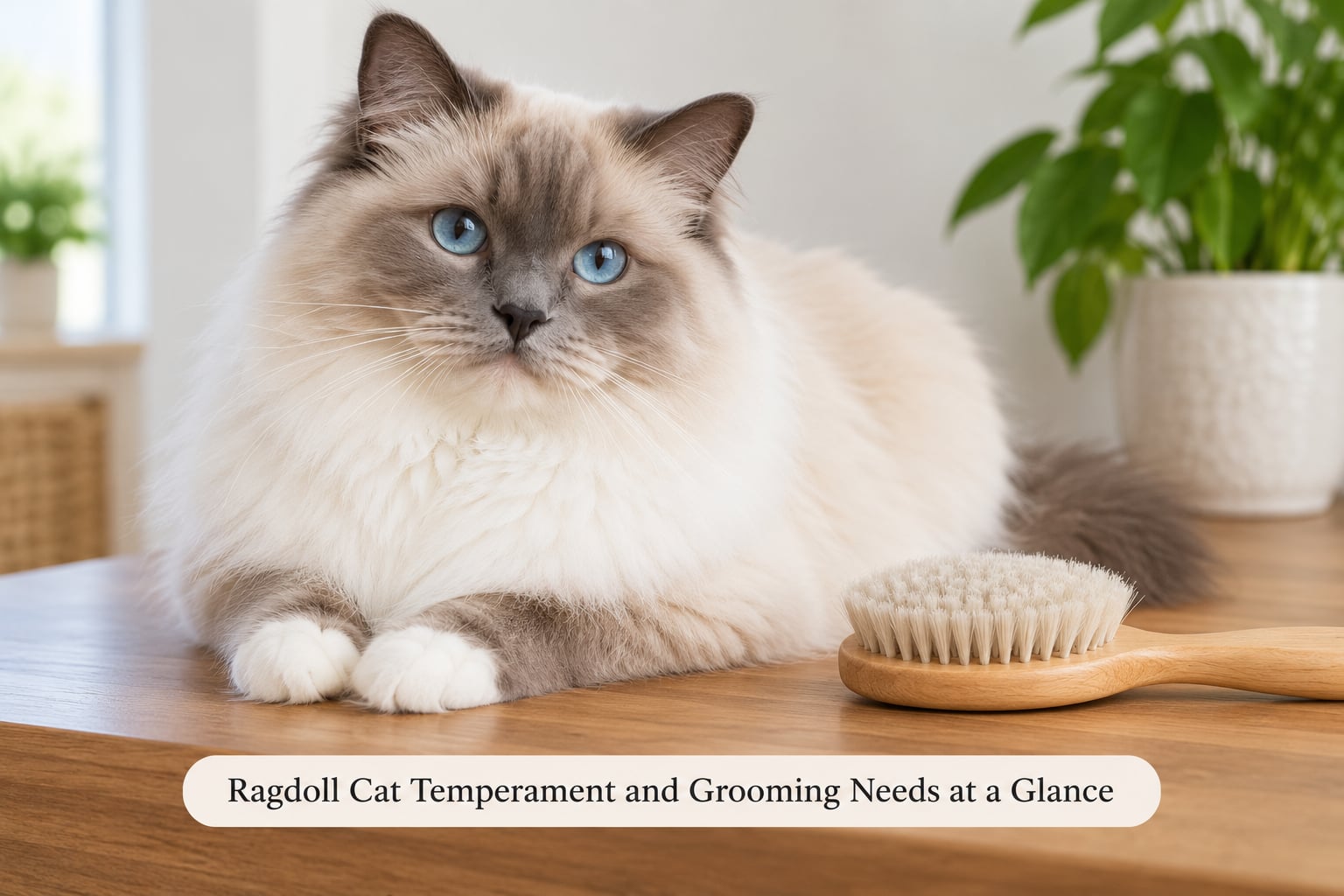
The table below is the short version. Individual cats drift from it, sometimes a lot.
| Area | What to expect |
|---|---|
| Temperament | Calm, affectionate, tolerant of handling, people-oriented |
| Activity level | Moderate; short playful bursts, then long rests |
| Coat type | Semi-longhaired double coat, silky with a dense undercoat |
| Brushing baseline | Once a week for a healthy adult; more when shedding |
| Bathing needs | No routine baths; only for a vet recommendation, contamination or illness |
| Nail care | Check weekly, trim as needed |
| Ear and dental care | Ear check weekly, teeth checked regularly with a cat toothpaste |
| Variation | Wide; a confident Ragdoll can be shy, busy or aloof |
What Is the Typical Ragdoll Cat Temperament?
Ragdolls are generally described as docile and easy to handle. The breed often relaxes in a person’s arms rather than squirming, which is where the name comes from, and many settle into household routines instead of demanding constant novelty. They tend to watch what’s happening and join in rather than hide under a bed for the first week.
That is the average, not a guarantee. Some owners report a Ragdoll that is nervous with visitors or suddenly very energetic at two years old, and that is a normal cat living a normal life. Expect a gentle, people-focused cat and be ready for a handful of kittens who break the stereotype.
How Affectionate and Social Are Ragdoll Cats?
Most Ragdolls seek out people rather than tolerating them. They pick one or two favourite humans and gravitate toward them, but they also tend to follow a person from room to room, including into the bathroom, which is endearing for about a week.
Owners on r/ragdolls describe a very specific kind of clinginess: following someone into the kitchen, sitting in the doorway of whichever room they are using, and vocalising when a door closes. It reads as affection, and it usually is, but the same forums carry plenty of complaints about cats sleeping on a pillow and about separation anxiety when the owner leaves.
Keeping the bond healthy is mostly about predictability. Fixed feeding times, a predictable play slot, and a spot the cat owns rather than shares give a Ragdoll the security it wants without making it dependent on your face for every hour of the day.
Are Ragdoll Cats Vocal, Active or Dog-Like?
They are usually quieter than many popular breeds, with softer chirps and trills than a talkative shorthair. They will complain when dinner is late, and that is about the volume ceiling for most of them.
On activity, Ragdolls sit in the middle. Expect ten or fifteen minutes of chasing, climbing or pouncing, then a long stretch of sleeping somewhere warm. Fetch appeals to plenty of them, and the dog-like reputation is fair enough that some people walk on a harness. Clipping furniture or scratching up the sofa happens too, particularly during the active kitten years.
They also tend to calm down with age, so a jumpy adolescent can turn into a very still adult. If scratching is the problem, give a tall scratching post, a covered bed and a few redirected play sessions before you go looking for a behavioural fix.
What Grooming Does a Ragdoll Cat Need?
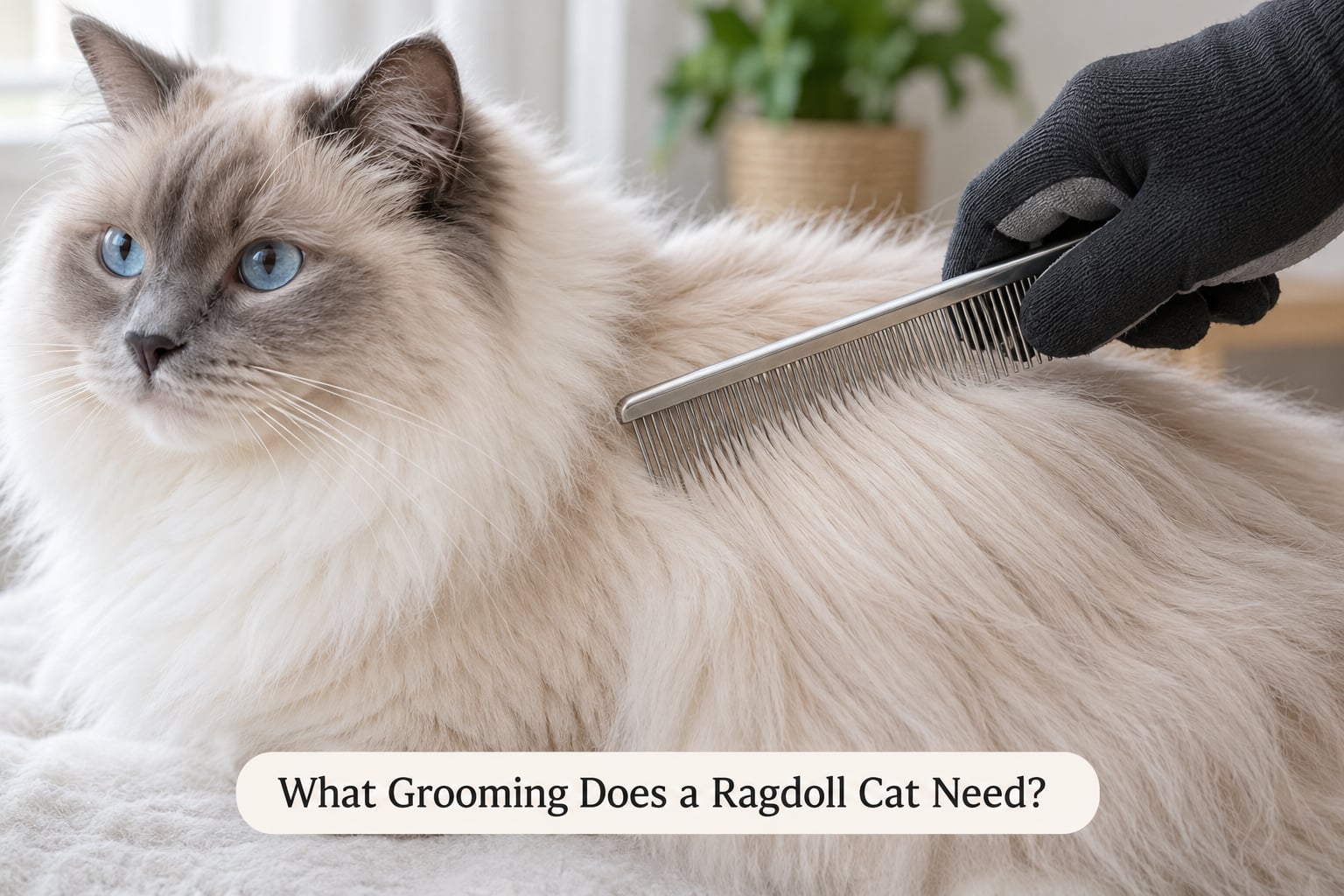
The semi-long, silky double coat is the main reason people underestimate the work. Guard hairs lie over a dense undercoat, and the undercoat is what tangles. Combing gets down to the layer where knots actually start; brushing only the surface feels productive while the real work is still happening underneath.
Ragdolls also groom themselves reasonably well but not reliably enough to skip human help. Owners on TheCatSite and r/ragdolls frequently describe cats that lick one spot obsessively and ignore the rest, which is why a weekly session in the house catches what self-grooming misses.
Beyond the coat, short regular jobs prevent bigger problems. Nails that overgrow curl into the pads, teeth that go unchecked turn into painful ones, and ears that are never looked at can hide irritation. Handling your cat for two minutes a week is also how you learn what normal skin and coat feel like on your cat, which makes an early change much easier to spot.
How Often Should You Brush a Ragdoll Cat?
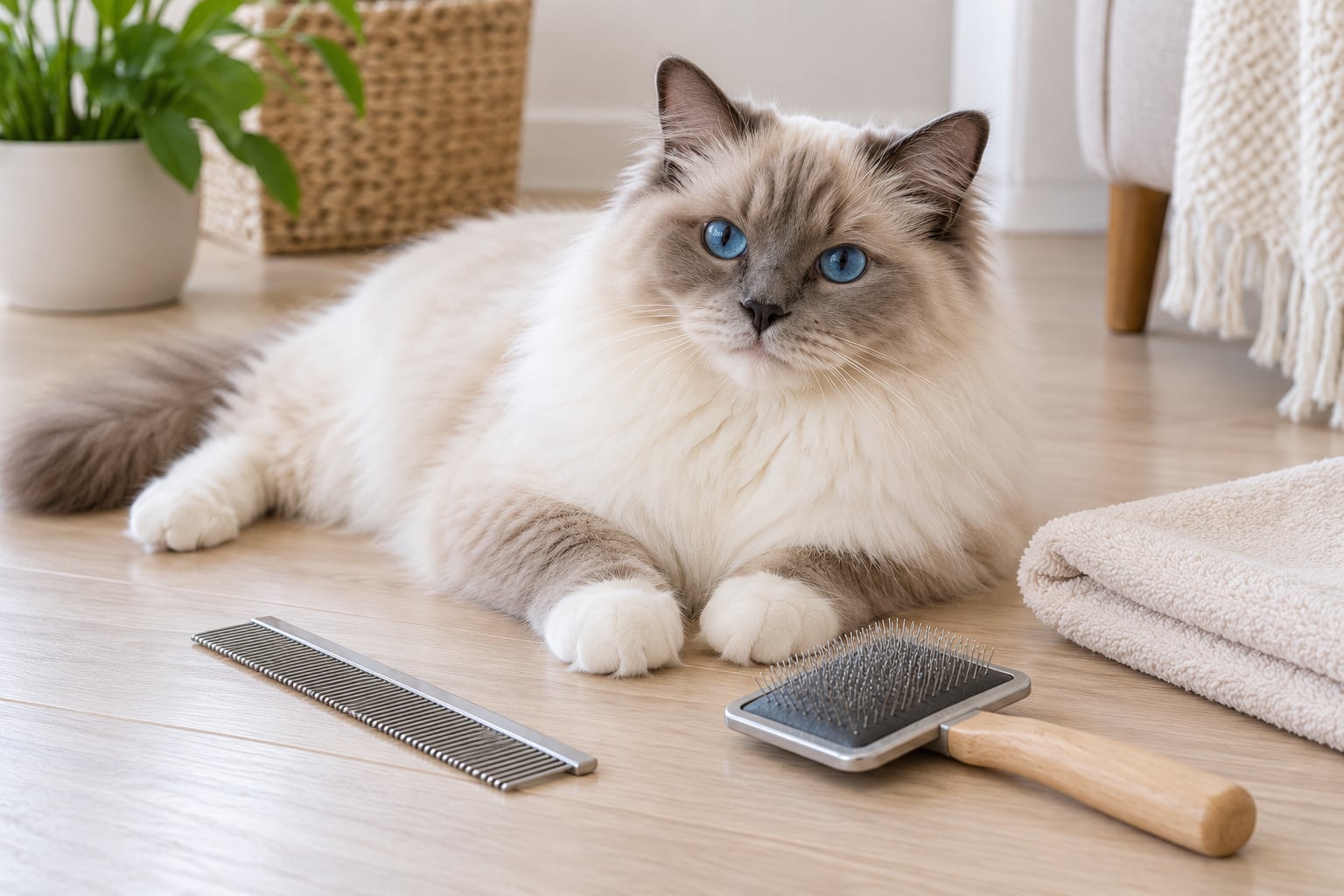
Weekly is the sensible baseline for a healthy adult with no matting, and a full session should take five to ten minutes. A slicker or a detangling brush on the back, then a metal comb through the longer areas, is enough for most cats.
Move to twice a week or more if your cat has a thick winter coat, if the undercoat is coming out in handfuls, or if tangles keep appearing in the same spots. Kittens benefit from short, boring sessions from the start, one or two minutes with plenty of praise, because it turns brushing into something normal rather than a wrestling match at two years old.
Give the friction zones extra attention: behind the ears, under the front arms, the belly, the inner thighs and the back of the hind legs above the hocks. The back and flanks comb out easily, which is exactly why people think their cat is well groomed when the trouble is hidden underneath.
When Does a Ragdoll Cat Need More Frequent Grooming?
Some situations call for more than a weekly brush, and some call for a professional. Match the situation to the response rather than just brushing harder.
| Situation | What it looks like | Recommended response |
|---|---|---|
| Seasonal shedding | Loose fur on clothes, more in the coat, spring and autumn peaks | Brush two or three times a week; expect a heavy coat shed regardless |
| Existing mats | Tight knots in the armpits, belly or hind legs | Finger the mat apart, then comb out small pieces; never cut with scissors |
| Reduced mobility | Arthritis, mobility loss, reluctance to jump | Professional groomer or vet; grooming an uncomfortable cat at home risks injury |
| Overweight | Hard to reach the back and hindquarters, dirty coat | Vet-guided weight plan plus more frequent assisted grooming |
| Illness or pain | Sudden coat change, greasy coat, hiding | Vet first; grooming is secondary until the cause is known |
| Inability to self-groom | Dirty, matted or soiled rear end | Regular home care and a vet check; this is not normal in an adult cat |
The most common complaint on r/ragdolls is brushing daily and still finding knots. That usually points to small dispersed tangles in the undercoat of the friction zones rather than a lack of effort, and it is a good reason to slow down and comb the thick areas properly instead of brushing the easy top layer faster.
Does a Ragdoll Cat Need Baths?
No routine baths. A healthy cat cleans itself, and over-bathing strips the coat, dries the skin and makes a Ragdoll more nervous about handling. Weekly combing and a lint roller handle the loose hair most people complain about.
A bath makes sense in three situations: your vet recommends one for a skin condition, the coat is contaminated with something sticky or foul, or the cat cannot groom itself properly. Some experienced owners on TheCatSite also use an occasional bath as a mat removal tactic, since a soak loosens what a comb will not, and that is a reasonable one-off even though it is not a routine.
How Can You Bathe a Ragdoll Cat Safely?
Have a towel, a non-slip mat and a second pair of hands ready before you turn the tap on. Ragdolls usually accept a bath better than most cats, but a wet longhaired cat is heavy and slippery.
- Brush the cat out first and check for tight mats, because water tightens knots you have not removed.
- Fill a sink or tub with lukewarm water to about the depth of the cat’s belly.
- Use shampoo and conditioner labelled for cats only, and never human shampoo, which can irritate cat skin.
- Wipe rather than scrub where you can, focusing on the back, chest and legs, and keep water out of the ears and eyes.
- Rinse with a second bucket of lukewarm water until no shampoo is left in the coat.
- Wrap the wet cat in a large towel and press the water out rather than rubbing it back and forth.
- Use a dryer on a low, cool setting held at a distance, or air-dry fully in a warm draught-free room.
- Keep the cat indoors and warm until fully dry; a damp longhaired cat chills easily.
What Is a Complete Ragdoll Grooming Routine?
A workable week looks like this, and it takes less time than most people expect.
- Weekly: full comb and brush session, nail check, ear check, quick look at the tail and rear for dirt or mats.
- Twice a week in spring and autumn: extra brush-out, plus a lint roller over cushions and dark clothing.
- Monthly: nail trim as needed, and a slow look at the coat for lumps, flakes, redness or bald patches.
- Ongoing: cat toothpaste and a small brush on the teeth most days, if your cat tolerates it, and a drink of fresh water available at all times.
Build the habit in stages rather than attempting a full groom on day one. Two calm minutes of combing a kitten, ending before the cat objects, works better than a long session that ends in a chase. Keep the same towel, the same corner of the room, and a treat at the end, and most Ragdolls learn to come to the routine rather than run from it.
Some people do better without a comb at all. TheCatSite threads recommend a rolling-teeth comb and even a flea comb for breaking up the edge of a mat, and owners on r/ragdolls say their cat tolerates a slicker fine as long as the steel comb never reaches the skin. Match the tool to the cat, not the other way round.
Which Grooming Problems Require a Veterinarian?
Some coat changes are ordinary. A patchy winter shed, a duller coat in the depths of winter, or a bit of loose hair on the sofa is not a problem on its own.
Book an appointment if you notice sudden hair loss in patches, mats that are tight against the skin and painful, sores, scabs or open skin, or excessive licking that leaves the fur thin. The same goes for a foul smell from the ears or coat, coloured discharge from the eye or nose, heavy head shaking, breathing difficulty, or any change that makes eating uncomfortable.
Two extra notes for this breed. Ragdolls have an association with hypertrophic cardiomyopathy, a thickening of the heart muscle linked to a mutation in the MyBPC3 gene, so ask a breeder for genetic screening documentation and keep up with routine vet checks. And if your cat suddenly stops grooming itself, that is a change worth investigating rather than a grooming task, because pain, illness or an overfull anal gland are more likely explanations than laziness.
Frequently Asked Questions
Are Ragdoll cats always calm and affectionate?
No. The breed averages calm and people-oriented, but individual cats vary a lot. Some are shy with visitors, some are very busy until they turn three or four, and a few are simply aloof. Judge your cat by its own behaviour rather than by the breed label, and give it time to settle into a new home before deciding anything about its temperament.
How often should a Ragdoll cat be groomed?
Once a week is a good baseline for a healthy adult, with a five to ten minute comb and brush session. Increase to two or three times a week during spring and autumn shedding, when the undercoat comes out in handfuls, or if knots keep appearing. Focus extra time on behind the ears, the armpits, the belly and the inner thighs, where friction tangles start.
Do Ragdoll cats shed a lot?
They shed noticeably more than a shorthaired cat, especially in spring and autumn when the dense undercoat turns over. Most of that loose hair is manageable with regular combing and a lint roller rather than frequent bathing. Ragdolls also swallow hair while grooming, so hairballs are more common in the breed and more frequent brushing cuts down on them.
Can Ragdoll cats be bathed like other long-haired cats?
They can, but a healthy cat does not need routine baths and over-bathing dries the coat and skin. Bathe for a vet recommendation, contamination, or when the cat cannot groom itself properly, using lukewarm water and products labelled for cats only. Human shampoo should never be used, and the cat should be kept warm until fully dry.
How do I prevent tangles behind a Ragdoll cat’s ears?
That area is a classic friction zone, where the coat rubs and curls into small knots. Use a metal comb rather than a brush, work in short sections with a light hand, and start at the ends of the hair rather than the scalp. If your cat resists, try a rolling-teeth comb or break the knot up with your fingers before combing it out.
What signs mean a Ragdoll’s grooming routine needs veterinary help?
Ask for a vet visit if you see sudden bald patches, tight painful mats, sores or open skin, constant licking that thins the coat, foul odour, coloured discharge from the eye or nose, or a cat that has stopped grooming itself. These are not routine coat problems. A groomer can deal with mats, but only a vet can tell you why the coat or skin changed.
Start with one ten-minute combing session this week and pick up a metal comb. Find the friction zones, get them used to the sound and the feel, and add the rest of the routine a task at a time. Getting to know ragdoll cat temperament and grooming needs early is what keeps a soft, manageable cat comfortable for years.