Reading a shelter dog’s behavior notes comes down to one habit: treat every line as an observation with a context, not a label about the dog itself. Notes like “reactive” or “needs space” are shorthand written by whoever was on shift, so the real work is asking what happened, what set it off, how bad it got, and how fast the dog came back down. Ten careful minutes with the file plus one good question for staff beats a long label list every time.
That matters more than most shelters advertise. Research led by Mornement and colleagues in 2014 found that a standardized in-shelter evaluation told you useful things about a dog’s activity level and how it handled handling, but predicted little about how that dog would behave in a home. Patronek and colleagues argued in 2016 that many canine behavior assessments perform no better than chance at predicting aggression. So the notes are a starting point you interrogate, not a verdict you accept.
The framework below takes about ten minutes to run on a single dog’s file, and it works whether you are standing in the kennel corridor or reading paperwork you were emailed after a visit.
Table of Contents
- What You Need
- How to Read a Shelter Dog’s Behavior Notes Step by Step
- 1. Identify the context behind each note
- 2. Separate observed behavior from interpretation
- 3. Look for triggers, intensity, and recovery time
- 4. Check whether the behavior depends on context
- 5. Compare the notes with your daily routine
- 6. Ask specific follow-up questions
- 7. Make a safe, gradual adoption plan
- Common Mistakes
- Frequently Asked Questions
- What does “no known bite history” mean on shelter dog behavior notes?
- What does it mean when a shelter says a dog needs an experienced adopter?
- Are shelter dog behavior assessments accurate?
- What are the real red flags in shelter dog behavior notes?
- Can shelter dogs show new behavior in a home after adoption?
- Conclusion
What You Need
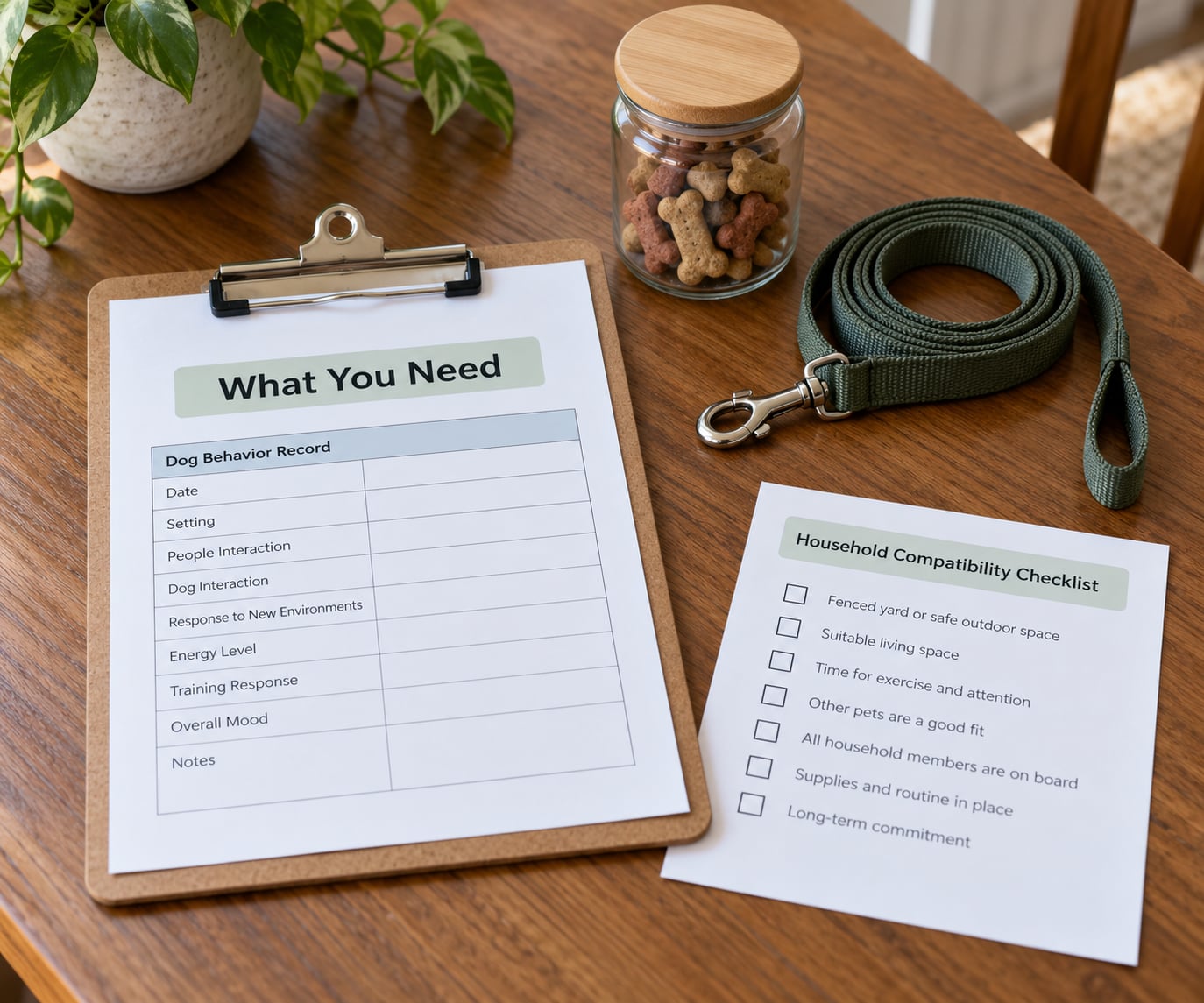
You need three things before the notes mean anything: the dog’s file, an honest picture of your household, and a way to separate what the dog did from what staff concluded about it.
The file should include the intake history (how the dog arrived, whether it came from a breeder surrender, a stray hold, or a returned adoption), the length of time the dog has been at the facility, and any current behavior restrictions. Ask for the written version. Staff will summarize from memory, and memory is where the detail goes missing.
On your side, write down the facts that will not flex: how many hours a day the dog would be alone, whether there are children under twelve in the home, whether there are resident cats or dogs, whether you exercise daily or not, and what you can handle in a bad moment. That last one is the most honest and the least discussed.
Finally, bring something to write with. A note per line, in your own words, is what turns a page of jargon into something you can plan around.
How to Read a Shelter Dog’s Behavior Notes Step by Step
Run the file through these seven steps in order. Each one strips away a different kind of guesswork, and the order matters because the later steps only work once the earlier ones have narrowed the picture.
1. Identify the context behind each note
Every note came from a moment. Find out whose moment it was, where it happened, and what came immediately before it.
A dog that freezes when a volunteer reaches over the kennel fence is telling you something about a stranger leaning over a barrier. The same dog walking calmly on a harness with staff says something different. “Backed away when child approached” and “backed away when we walked past the play yard” are not the same observation, even though the note on the card may read the same.
Also check the date and the observer. A note written in the dog’s first two days reflects a dog that has not eaten, slept, or understood where it is. Most behavior researchers allow a minimum three-day settling period before results mean much, and plenty of dogs need longer than that.
2. Separate observed behavior from interpretation
Factual descriptions are things you could film. Interpretations are conclusions someone drew from those things.
“Growled and snapped at the handler during nail trimming” is an observation: something happened, someone did something. “Aggressive” and “not cooperative” are interpretations. The first tells you what to plan around. The second tells you what a staff member felt, which is real information but a different kind.
This distinction carries weight because language primes you. Once a file says “damaged,” you start interpreting everything the dog does through that word, and the dog never got a vote. Read the observation underneath the label, and set the label aside until you have something of your own to weigh against it.
3. Look for triggers, intensity, and recovery time
The three most useful details in any note are what set the behavior off, how strong it looked, and how fast the dog settled afterward.
Trigger means the specific thing: a hand reaching overhead, a food bowl near another animal, a leash snapping, a vacuum, a child running past, being lifted. Intensity means the scale, from a stiffened body and a hard stare to a lunge or a bite. Recovery time is the one almost nobody writes down, and it is the most useful: a dog that takes two seconds to reset after a startle is telling you something very different from one that stays wound up for twenty minutes.
If a note gives you none of these, that absence is a fact too. Ask for a trigger list instead of accepting a temperament word.
4. Check whether the behavior depends on context
Most behavior is conditional. The same dog can be calm with one group and reactive with another, and neither reading is wrong.
Run the file through these contexts one at a time: children, adult strangers, resident dogs, cats, handling at the face and feet, food and chews, barriers and gates, being left alone, other environments outside the facility. “No cats” is a context-limited statement about testing, not a permanent verdict on a species the dog may never see again.
Restrictions like “not for homes with kids” or “no cats” also carry an implicit question: was this based on a controlled observation, or on one moment that went badly with a foster’s foster, or on a precaution written by someone who did not want a return? Ask which one it was.
5. Compare the notes with your daily routine
This is the step most adopters skip, and it is the one that decides whether the adoption works.
Match each note against six things in your week: energy level and exercise needs, hours alone on a typical day, household activity and noise, how much handling the dog will tolerate, whether you have time and budget for training support, and your own recovery capacity. Dogs with high energy needs and long alone hours are a bad pairing with a sedentary person who works a twelve-hour day, and no amount of sweet talk in a shelter’s summary changes that arithmetic.
Notes almost never cover energy honestly, because a shelter kennel is not a place to measure it well. Ask specifically about how the dog behaves on a long line, how long it walks before it settles, and what it does when the walk is over. Adopters consistently say this is the trait they most wish the notes had covered.
6. Ask specific follow-up questions
Go into the conversation with a written list, because a counter conversation moves fast and a shy dog gives you no second chance to remember what you meant to ask.
Neutral, useful questions get better answers than challenges. How often does the behavior happen? In what situations specifically? What did staff try that worked? Has the dog ever caused an injury to a person or another animal? What is the dog’s history before the facility had it? Are there formal behavior notes, or informal observations? What is the plan if the behavior appears at home, and who do I call? Has the dog been around children, and at what ages? Would the facility consider a home trial before a final adoption?
Two of those carry special weight. An injury history question tells you the difference between “no bite history,” which is a claim about a known record, and “no known bite history,” which is a claim about what the facility happens to know. Those are different sentences with very different meanings, and the second one is what you will usually see. The other is the post-adoption helpline question: a shelter that offers one after adoption is telling you how they intend to handle the behavior they described.
7. Make a safe, gradual adoption plan
Turn the notes into a written plan with dates in it, so you are reacting to a schedule rather than to a bad Tuesday.
The plan should cover a decompression period with a small, quiet setup and no visitors, a veterinary appointment in the first days to address anything medical the notes mention, a training plan built around the triggers you identified, slow introductions to resident animals and visitors, and a contingency if the behavior shows up at home. Write down what returning or rehoming looks like, and check what the facility’s policy says about it before you sign anything.
If the notes describe resource guarding, the plan is the whole discussion. McGuire and colleagues found in 2020 that guarding recorded in shelter evaluations had limited ability to predict guarding in the adoptive home, which cuts both ways: a single guarded-mushroom note does not doom the dog, and it also does not tell you the dog will be fine in a house with a toddler. Train for the behavior, keep the triggers out of reach, and use a qualified force-free professional if the guarding escalates.
Common Mistakes
Almost every mistake here is the same error wearing a different shirt: treating a short written note as if it were a complete, reliable picture.
- Treating a label as a diagnosis. “Reactive,” “dominant,” or “aggressive” is not a clinical term. Correct it by finding the observation underneath it and asking what happened, when, and how often.
- Ignoring context. Behavior recorded at a kennel door, on a leash with staff, or in a play yard does not transfer directly to a living room. Correct it by asking which context produced the note.
- Asking only about the dog’s best qualities. Staff describe what they like about the dog, because that is what makes the conversation pleasant. Correct it by asking the trigger list and the injury history before anything else.
- Skipping the medical side. Pain is a common driver of behavior that looks like temperament, and it is the piece adopters most often miss. Correct it with a veterinary exam before training starts.
- Reading the notes on the spot and signing. Forums describe adopters getting a folder at the counter with no time to read it. Correct it by asking for the file in advance and taking it home.
- Treating “no known bite history” as “never bitten.” It only means the facility has no record. Correct it by asking about any injury history, including incidents at a previous home.
- Assuming a restriction is permanent. Correct it by asking whether the restriction was observed, inferred, or written as a precaution, and how it would be assessed.
One more habit pays off more than any other: write down what you observed yourself, in plain language, and hand that to the shelter or the next person. Behaviorists working with this material say the same thing repeatedly. What staff observe across days is worth more than what one adopter concluded in ten minutes.
Frequently Asked Questions
What does “no known bite history” mean on shelter dog behavior notes?
It means the shelter has no record of a bite, which is not the same as the dog never having bitten anyone. Records arrive incomplete, dogs arrive with undisclosed history, and some incidents are never written down. Treat it as a statement about what the facility knows, and ask directly about any injury history at a previous home and about whether the dog has ever been in a household with children.
What does it mean when a shelter says a dog needs an experienced adopter?
Usually that the dog needs someone who reads a trigger, pauses, and changes the plan instead of repeating the trigger. It can also mean the dog needs training help, secure management, medication, or more time and money than a first-time owner usually has. Ask what specifically the dog needs and whether the facility offers support after adoption. The phrase describes a match requirement, not a flaw in the dog.
Are shelter dog behavior assessments accurate?
Partly. Mornement and colleagues in 2014 found standardized evaluations described a dog’s activity level, compliance, and handling tolerance reasonably well, but predicted little about behavior in a home. Patronek and colleagues in 2016 argued that many such assessments perform no better than chance at predicting aggression. Treat the notes as observations gathered in a stressful, unfamiliar place, and weigh them against what you observe yourself.
What are the real red flags in shelter dog behavior notes?
Look for injury history, any note about a bite or a wound, guarding that has escalated over time, and behavior described as unpredictable across contexts with slow recovery afterward. Treat barking, pulling on leash, being shy at first, and being selective with other dogs as common and manageable. The severity of a note depends less on its wording than on whether it is specific about triggers, intensity, and how the dog recovers.
Can shelter dogs show new behavior in a home after adoption?
Yes, and it is common rather than alarming. Kennel stress suppresses some behaviors and inflates others, so a home reveals things the file never mentioned. Expect an adjustment period rather than a deadline. Build the first days around decompression, keep visitors away, and get a veterinary exam for anything medical. Use a written plan with dates and a clear fallback if a behavior does not settle.
Conclusion
Do this first: take every note in the file and sort it into four columns, written in your own words, with the observation, the context, the trigger, and the intensity and recovery time on one line each. Blank entries are your question list.
Then match that against your household honestly, especially your hours alone and your tolerance for handling, and ask staff the trigger and injury questions before you sign anything. If the shelter cannot answer those questions, treat the gaps as answers of their own. The right dog is out there, and the notes are a description of a dog under stress on a given day, not a profile of who your dog will be with you.