Pit bull type dogs temperament varies far more from dog to dog than any breed chart can explain. These dogs are not inherently aggressive toward people, and the popular image of a blocky-headed snapping dog describes a small number of individuals, not a breed standard. At the same time, they carry a real tendency toward heightened arousal around other dogs, and pretending otherwise does nobody a favor. Here is how the evidence actually lines up.
Table of Contents
- What Is Pit Bull Type Dogs Temperament Really Like?
- Are Pit Bull Type Dogs Naturally Aggressive?
- Why Pit Bull Type Dogs Breed Statistics Mislead More Often Than They Inform
- Why Do Different Pit Bull Type Dogs Behave Differently?
- How Socialization Shapes Pit Bull Type Dogs Temperament
- Does Training Make Pit Bull Type Dogs Safer?
- How to Read a Dog’s Actual Temperament
- Are Pit Bull Type Dogs Good Family Dogs?
- Choosing a Responsible Pit Bull Type Dog
- Frequently Asked Questions
- Are pit bulls good family dogs?
- Are pit bulls more prone to aggression?
- Why are there so many pit bulls in shelters?
- Are pit bulls difficult to train?
- Do pit bulls get along with other dogs?
- What type of person owns a pit bull?
- Conclusion: The Breed Label Is a Prediction, Not a Promise
What Is Pit Bull Type Dogs Temperament Really Like?
The short version: people-oriented, energetic, affectionate, and often quite bouncy, with an above-average interest in other dogs. But that is an average, not a promise.
First, the label itself. “Pit bull” is not a breed. Major registries such as the American Kennel Club do not recognize it. What people mean by pit bull type dogs is a loose group that usually includes the American Pit Bull Terrier, the American Staffordshire Terrier, the Staffordshire Bull Terrier, the American Bulldog, and the newer American Bully. A shelter may label the same looking dog any of five ways.
That matters for temperament because the word travels further than the genetics. Owners often use “pit bull” the way other people use “retriever,” as a stand-in for an individual animal. The average dog in that category has no single inherited personality that pushes it toward snapping at a child or mauling a stranger.
| Myth | Verdict | What the evidence shows |
|---|---|---|
| Pit bull-type dogs attack people more than any other breed | Not supported | Temperament testing rates them at or above the all-breed average, and breed is a poor predictor of an individual dog |
| They bite without warning | Largely false | Most dogs give layered warning signals, but fear can suppress them in any dog |
| They lock their jaws | False | No jaw-locking mechanism exists in any dog |
| They bite the hardest | False | A widely cited television test measured one pit bull-type dog at roughly 320 PSI, lower than the mastiff-type dogs measured alongside it |
| They were nanny dogs for children | False | The breed descends from bull-baiting and fighting stock, and no reliable record supports the claim |
| They are born fighting dogs | Misleading | Most were bred to work and to be handled by people, not to fight people |
| They are impossible to train | False | Many compete in obedience, agility, weight pulling and service work |
| They cannot live with other dogs or cats | Often true, individually | Dog-directed reactivity is common in this group, so multi-pet homes need careful matching |
| Shelters are full of them because they are untrustworthy | False | Surrender follows housing rules, owner income, and landlord policies more often than behavior |
| Breed bans make communities safer | Unsupported | Bans mostly relocate dogs and the people who keep them |
Are Pit Bull Type Dogs Naturally Aggressive?
No. Human aggression is not a defining trait of this group, and treating it as one is the central error behind nearly every myth about them.
The most-cited concrete evidence comes from the American Temperament Test Society, which puts dogs through a standardized series of encounters with strangers, other dogs, and unusual situations. Its results place the American Pit Bull Terrier above the overall average.
| Breed | Reported pass rate |
|---|---|
| All breeds tested (baseline) | About 83% |
| American Pit Bull Terrier | About 86.8% |
| American Staffordshire Terrier | About 84.5% |
So when someone tells you these dogs are a public-safety problem, the honest response is that the numbers do not support it, and the reasons the numbers are cited so confidently are worth understanding.
Why Pit Bull Type Dogs Breed Statistics Mislead More Often Than They Inform
Breed-attack statistics have three structural problems. The first is data collection: the Centers for Disease Control and Prevention stopped collecting breed information on dog-bite fatalities back in 1998, so most headline figures are based on self-reported breed, often supplied by the owner of the dog involved.
The second is identification. Veterinary researchers have found that even shelter intake staff and veterinarians frequently disagree on the breed of the same dog, which means a “pit bull bite” count is really a count of what someone guessed.
The third is reporting bias. Incidents get covered when the dog looks like a pit bull-type dog. The medium-sized mixed-breed dog that bites someone rarely gets a follow-up story, so the media record inflates one group relative to the others.
None of this means aggression is a non-issue. It means the breed label is a weak input and the individual dog is a strong one.
Why Do Different Pit Bull Type Dogs Behave Differently?
Because temperament is built from several inputs at once, and the label only names one of them loosely.
Genetics is real, but more useful for predicting size, energy and prey drive than for predicting whether a dog will bite someone. Physical build and ancestry vary widely across the group: a 40-pound American Staffordshire Terrier and a 120-pound American Bulldog share a nickname and very little else.
Age changes everything. Most of these dogs stay puppy-like until somewhere around age four or five, and adolescent dogs of any breed handle arousal badly. A fourteen-month-old in a multi-dog home may look aggressive on Tuesday and perfectly fine on Friday.
Sex matters, though the effect is smaller than the folklore suggests. Unneutered males in particular show higher rates of roaming, mounting and dog-directed conflict, which is one reason spay and neuter discussions show up so often in shelter conversations.
Health is an underrated factor. A dog in pain from hip dysplasia, arthritis or a spinal issue may snap at a hand that lands on a sore hip. Lyme disease, which is far more common in pit bull-type dogs than in many other groups, can produce sudden behavioral changes that look like temperament shifts, so a veterinarian should rule it out before any behavior is attributed to attitude.
History is the biggest variable of all. A dog raised for fighting, kept chained, or living in a yard for its whole life is a different animal from one raised in a home with a bed and a job to do. Both end up called pit bull-type dogs.
How Socialization Shapes Pit Bull Type Dogs Temperament
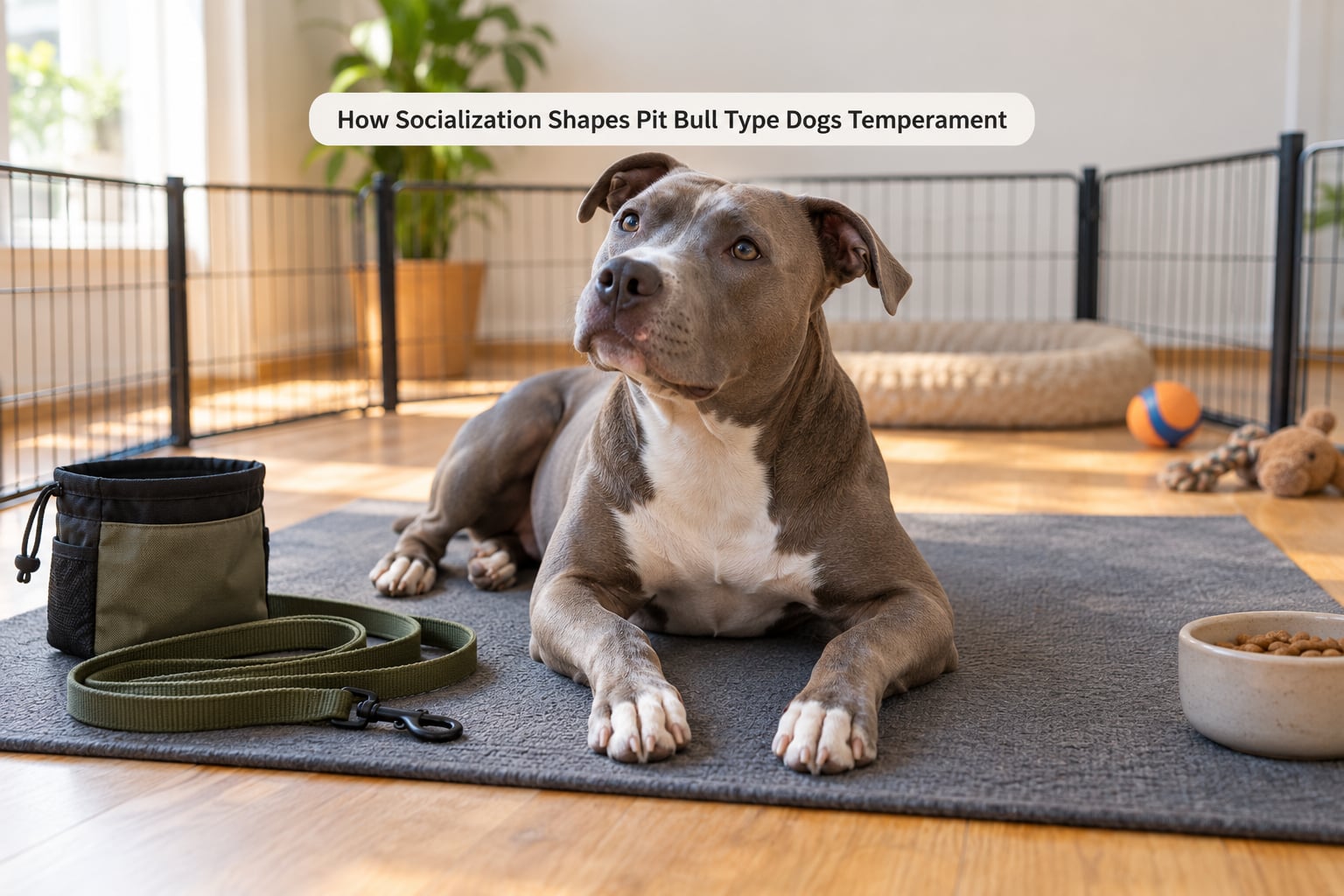
Socialization works because young dogs learn what is normal in the world they live in, and anything unfamiliar defaults to a threat response.
The goal is not to expose a puppy to everything. It is to build positive associations, slowly, before fear takes hold. A week of quiet, boring sessions beats one chaotic trip where the dog gets overwhelmed and learns that the world is dangerous.
Work through categories in this order, one at a time:
- People. Well-behaved adults, kids of different ages, people in hats or uniforms, people who move oddly. Keep the distance short enough that the dog stays relaxed, and feed treats for noticing, not for being approached.
- Dogs. Start with calm, settled adult dogs of varied sizes. This group often needs slower introductions than other breeds because dog-directed interest comes easily.
- Sounds and surfaces. Rain on a metal roof, a vacuum, a skateboard, a slick gym floor, city sidewalks. Let the dog choose to approach; if the ears pin and the body drops, back off.
- Everyday situations. A vet’s parking lot, a busy street corner, a groomer’s table, a friend’s apartment with different flooring.
A useful test: if the dog will take food, the situation is probably fine. If the dog will not eat, something is wrong. Move back rather than pushing through, because pushing is how a sensitive dog learns to hate the thing that scared it.
Keep sessions short, end on something easy, and stop the whole week if the dog is sleeping poorly, pacing or refusing food. That is a vet question, not a training question.
Does Training Make Pit Bull Type Dogs Safer?
Training does not rewrite personality, but it changes what happens in the two seconds when a dog is surprised, and those two seconds matter most.
Reward-based methods are the standard, and for good reason. Dogs work harder for things they want, and punishment-based approaches have been associated with fear and defensive behavior, which is the opposite of the goal.
The specific skills worth building with any dog, and especially this group:
- A reliable recall. Coming when called has to be worth more than whatever the dog is distracted by.
- Leash manners. Loose-leash walking reduces the number of unwanted nose-to-nose encounters in the first place.
- Leave it and drop it. The two most valuable cues around other dogs, food and sticks.
- A settle on a mat. Teaches that leaving something interesting is rewarded, which lowers overall arousal.
- Calm greetings. A dog can approach, sniff for three seconds and move on, without lunging.
- Name and touch. Gains the dog’s attention and shifts focus before arousal peaks.
One caution matters more for this group than most. Never punish growling. A growl is a dog giving you information early, and suppressing it removes the last warning you get before a bite. Owners on behavior forums describe the moment their dog stopped warning and started biting, and it usually followed months of punishing the growl first.
Positive-reinforcement training classes, ideally ones with dogs of many sizes on the floor, are worth the money. For a dog with a bite history or a fight history, skip group classes and go straight to a board-certified veterinary behaviorist or a qualified force-free trainer who works one-to-one.
How to Read a Dog’s Actual Temperament
Judge behavior over time and in context, never from a photo, a head shape or a stranger’s story.
Comfort looks like a loose body, a wagging tail that swings rather than whips, a soft mouth, and a dog who can move away and then come back. Take the fact that the dog can disengage as the most useful signal there is.
Warning signs build in stages, and early stages are quiet:
- Freeze. Movement stops while the dog stares. A freezing dog is not a calm dog.
- Whale eye. The whites of the eyes show as the dog turns its head away without looking at anything.
- Stiff, slow tail wag. A tail held high and moving in tight, fast wags reads very differently from a loose swinging one.
- Flattened ears, tucked tail, lowered body. Classic appeasement and fear signals.
- Lip licking, yawning, tongue flicking, turning away. Displacement behavior used to defuse tension.
- Pinned forward weight, lunging. Full arousal, not a bluff.
Recoverability is the other half of the assessment. A dog who has a noisy encounter with a stranger and is eating from your hand thirty seconds later is handling the moment well. A dog who does not recover for hours is telling you something real.
Watch behavior across several situations rather than one outing. One bad day at a dog park may mean nothing more than a bad day.
Are Pit Bull Type Dogs Good Family Dogs?
They can be excellent family dogs, and there is nothing about the breed that makes them unsuitable for children. The catch is that they need management, and so does any powerful dog in a house with kids.
Non-negotiable rules in a home with children:
- No child is ever responsible for the dog, no matter how capable they are.
- The dog gets a retreat the children never enter, such as a crate in a quiet room or a gated area.
- No free access to kids during high-arousal moments, including play and eating.
- Teach children that a still body, a tucked tail and a growl all mean “step away and tell an adult.”
- Pick up resources. A dog holding a toy, a chew or food is not a dog to be reached for.
On other pets, the honest answer is that this group has a documented tendency toward dog-directed reactivity, and cat compatibility is individual. Rejecting a dog for being reactive on a leash walk can also be self-reinforcing: the more the dog rehearses the frustration, the worse the walks get. Many owners use a basket muzzle for training walks, which changes the whole dynamic and lets the dog learn that other dogs passing is boring.
Many owners have several dogs of this type living together successfully. The ones who make it work describe the same habits: parallel walking instead of park play, parallel feeding, short leashed greetings with a callback, and keeping the household’s arousal down as a general rule.
Housing deserves its own mention. Rentals, homeowners associations and insurers restrict by breed label far more often than by the individual dog, and that is a paperwork problem rather than a temperament problem. Check the rules before you adopt, not after, because the dog usually does not get the benefit of the doubt.
Choosing a Responsible Pit Bull Type Dog
Pick the dog in front of you, not the breed behind it, and gather real information before committing.
Questions worth asking a shelter or rescue, and the reasons they matter:
- How was this dog assessed? Look for a written temperament evaluation, ideally one performed by a qualified behavior professional rather than an intake volunteer.
- What is the dog’s history with children and dogs? Vague answers are data. Watch how the staff handles the leash.
- Has the dog lived indoors? Indoor experience predicts house manners better than age does.
- Is there a bite or fight history? You want the truth now. Any bite changes the plan for the rest of the dog’s life.
- What is the medical record? Ask about skin allergies and any tick-borne disease testing.
- What support comes after adoption? A good rescue will offer behavior help, and that matters more for this group than for most.
If you are buying from a breeder, walk away from anyone who will not show you the parents, will not let you meet the dogs, or sells on urgency. No credible operation sells these dogs as fighters or as guaranteed-nanny dogs.
One more reason these dogs end up in shelters: cost. Housing rules, insurance exclusions and the owner’s ability to manage a strong, energetic dog all show up in the surrender numbers long before behavior does.
Frequently Asked Questions
Are pit bulls good family dogs?
Pit bull-type dogs can be excellent family dogs and are not inherently unsafe around children. Their strength makes supervision non-negotiable: an adult handles all feeding, all walks and all training, the dog has a child-free retreat, and children are taught that a growl, a tucked tail or a still body means step away and tell an adult. Never punish growling, because it is the last early warning you get.
Are pit bulls more prone to aggression?
Toward people, no. Temperament test results place the American Pit Bull Terrier and American Staffordshire Terrier at or above the all-breed average of roughly 83 percent. Toward other dogs, the honest answer is that these dogs show dog-directed reactivity at a higher rate than many other groups, so multi-dog households need careful matching and real management rather than optimism.
Why are there so many pit bulls in shelters?
Mostly because of housing rules, insurance policies and owner income rather than behavior. Pit bull-type dogs are the most commonly surrendered and euthanized type in American shelters, yet the label blocks rentals, housing associations and coverage, which makes an owner more likely to give a dog up when they move or the costs pile up. Genetics and individual history matter; paperwork accounts for a lot too.
Are pit bulls difficult to train?
No. They are generally food-motivated, people-oriented and quick to learn, and many compete in obedience, agility, weight pulling, dock diving and service work. They can be strong-willed, so keep sessions short and reward generously. A dog with a bite or fight history needs one-to-one work with a qualified behavior professional, not a group class.
Do pit bulls get along with other dogs?
Often, but not automatically. This group shows dog-directed reactivity more often than most breeds, so match a new dog to a settled adult dog rather than hoping it works out. Use parallel walking instead of off-leash park play, keep greetings short, leashed and parallel, feed dogs separately, and lower overall household arousal. Many multi-dog homes with two or more of these dogs thrive with these habits.
What type of person owns a pit bull?
No single profile fits, but several patterns repeat: active owners, often outdoors-oriented, who have had dogs before and want a dog that will work and play rather than sit on a lap. Many are first-time adopters of a large dog, many live in rentals or rural areas, and a large share have worked with or alongside dogs professionally. Ownership is less about personality type than about willingness to train and manage.
Conclusion: The Breed Label Is a Prediction, Not a Promise
Most of what passes for fact about pit bull type dogs temperament is folklore with a confident voice behind it. Human aggression is not a trait of this group, jaw-locking does not exist, and the breed statistics that fuel breed bans are built on guesses and self-reports from people who were in a courtroom or a newsroom.
Start by watching the individual dog rather than the category: how it recovers after a stressful moment, how it handles another dog on lead, whether it will take food when a stranger passes. Then socialize gradually, train with rewards, and never punish a growl.
If anything in the dog’s history or behavior worries you, talk to your veterinarian first and ask for a referral to a board-certified veterinary behaviorist. That single conversation resolves more questions than any breed argument will.