If you are trying to work out how much exercise does a dog need each day by breed, the honest answer is a range. Most healthy adult dogs need somewhere between 30 and 120 minutes of activity daily, and where they sit inside that range depends far more on the individual dog than on the breed name.
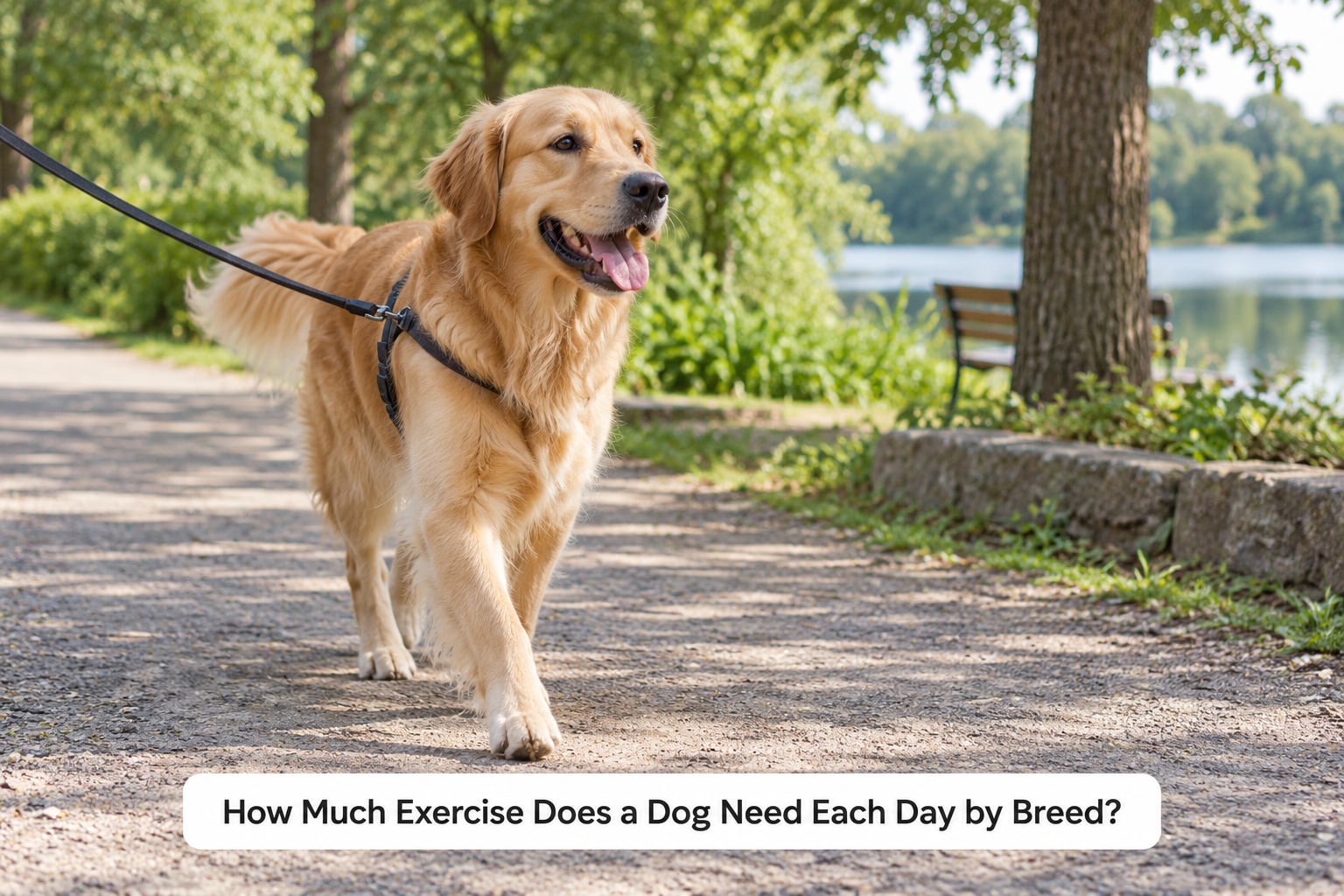
Working and herding breeds sit at the top of that range and usually want two hours or more. Companion and toy breeds sit at the bottom, usually around 30 to 60 minutes of gentler activity.
The trouble is that a single walk on a lead is not the only thing that counts. Sniffing, training, fetch, swimming and food puzzles all load a dog differently, and two 20-minute sessions of scent work can leave a terrier more satisfied than one hour of slow ambling. This guide breaks the answer down by breed group, then by age, health and lifestyle, so you can build a routine that fits the dog in front of you rather than a generic chart.
Table of Contents
- What Factors Change a Dog’s Daily Exercise Needs?
- Age
- Breed group and original job
- Size and body shape
- Temperament and health
- Weather and environment
- Daily Exercise Ranges by Breed Type
- How much exercise does a dog need each day by breed?
- How to Tell Whether Your Dog Is Getting Enough Exercise
- How to Provide Exercise Without Exhausting Your Dog
- Safety and Health Considerations for Daily Dog Exercise
- Frequently Asked Questions
- How many minutes of exercise does a typical dog need each day?
- Do small breeds need less exercise than large dogs?
- How much exercise does a puppy need compared with an adult dog?
- Is walking enough exercise for high-energy breeds such as Border Collies?
- How can I exercise a dog safely on hot days?
- What signs mean my dog may be getting too much exercise?
- Conclusion
What Factors Change a Dog’s Daily Exercise Needs?
Breed gives you a starting point, not a prescription. Five things routinely move the number up or down, and it is worth reading them before you touch a lead.
Age
A puppy’s bones are still growing, and the growth plates at the ends of the long bones stay open far longer in large breeds. Until those plates close, high-impact work such as running, jumping and long downhill stretches can cause lasting joint damage. Senior dogs lose muscle and joint comfort, so they usually need the same amount of activity delivered with less impact.
Breed group and original job
Border Collies were selected to work sheep across rough country for hours. Bulldogs were selected to sit still. That history still shapes how much a dog wants to move in a day, which is why breed group is the most useful first cut when you do not know an individual dog yet.
Size and body shape
Size matters less than most people expect. Small breeds are frequently busier than large ones, and several giant breeds are laid-back rather than athletic. Body shape matters more: flat-faced brachycephalic breeds such as Bulldogs, Pugs and French Bulldogs overheat easily, while short-legged breeds such as Dachshunds and Basset Hounds tire on distance long before they tire on effort.
Temperament and health
Two Labradors from the same litter can need very different days. One may be content with a 30-minute stroll, the other may excavate the lawn given ninety minutes of free rein. Joint disease, obesity, heart conditions and injury also cap what is sensible, and any of those is a conversation for your vet.
Weather and environment
Hot pavement, high humidity, deep snow, a small apartment and a full-time work schedule all change what a dog can safely do. Plan around the environment you actually have, not the one in a park brochure.
Daily Exercise Ranges by Breed Type
The table below groups breeds by energy tier. The minute ranges describe total daily activity across all sessions, not one continuous block.
| Breed group | Example breeds | Minutes per day | Sessions | Intensity | Best activities |
|---|---|---|---|---|---|
| Working and herding | Border Collie, Australian Shepherd, German Shepherd, Husky | 90 to 180+ | 2 to 3 | Vigorous | Off-leash running, agility, hiking, flirt pole, herding games |
| Sporting and gundog | Labrador Retriever, Golden Retriever, Springer Spaniel, Vizsla, Brittany | 60 to 120 | 2 | Moderate to vigorous | Swimming, retrieving, long walks, dock work |
| Terrier | Jack Russell, Yorkshire Terrier, Westie, Fox Terrier | 45 to 90 | 2 to 3 | Moderate, high arousal | Scent work, digging games, puzzle feeders, chase |
| Hound | Beagle, Dachshund, Greyhound, Basset Hound | 30 to 90 | 2 | Moderate | Long sniff walks, scent games, swimming for sighthounds |
| Companion and toy | Cavalier King Charles Spaniel, Shih Tzu, Chihuahua, Maltese | 30 to 60 | 2 to 3 | Light to moderate | Short walks, indoor games, training sessions, grooming-style play |
| Giant breeds | Great Dane, Saint Bernard, Irish Wolfhound, Bernese Mountain Dog | 30 to 60 | 2 | Light to moderate | Long leash walks, swimming, gentle hill work |
| Brachycephalic (flat-faced) | Bulldog, French Bulldog, Pug, Shih Tzu | 20 to 45 | 3 to 4 short | Light | Cool-hour walks, indoor enrichment, gentle floor play, no fetch in heat |
Two things stand out. First, the range inside every row is wider than the gap between rows, which is exactly why breed charts conflict so often. Second, brachycephalic dogs are the one group where the total rarely matters more than the conditions: the same 20 minutes is fine at seven in the morning and dangerous at three in the afternoon.
How much exercise does a dog need each day by breed?
Eight breeds come up constantly, so here is where they usually fall as healthy adults in their prime.
- Labrador Retriever — 60 to 120 minutes, usually split into a morning walk and a longer afternoon outing. Labs are social and food-driven, so they will keep going well past what is good for them.
- Border Collie — 90 to 180 minutes, and that is a floor rather than a target. Mental work carries a lot of weight here; a Collie scent game is more tiring than a slow walk of the same length.
- Golden Retriever — 60 to 90 minutes. Swimming suits them particularly well because the buoyancy spares ageing joints.
- German Shepherd — 90 to 150 minutes across two or three sessions. Sport lines want more, and both benefit from ongoing scent training.
- Beagle — 45 to 60 minutes. A Beagle nose working a long trail burns more energy than a brisk pavement loop of the same length.
- Dachshund — 30 to 60 minutes on the flat. Their spine does not benefit from repeated jumping from furniture or stairs, so keep activities low and level.
- Yorkshire Terrier — 30 to 60 minutes, split into short sessions. Small size does not mean small appetite for activity.
- Bulldog — 20 to 40 minutes of light movement in cool hours. Watch the breathing, not the clock, and stop well before the panting turns heavy.
Owners of working-line dogs often find published charts far too low. One recurring theme in dog forums is that a working-line Border Collie or Australian Shepherd may need six hours or more as an adult, because the breed line matters more than the breed name. Treat breed charts as a floor for those dogs and adjust from what you observe.
How to Tell Whether Your Dog Is Getting Enough Exercise
The number matters less than the response. After a normal day, a dog that is getting the right amount is settled rather than frantic: relaxed at home, interested in play, sleeps through the night, and keeps a steady weight you can feel under your hand.
Signs of not enough exercise show up in behavior first and health second. Watch for constant pacing or whining at the door, chewing furniture or shoes, digging in the yard, and a dog who grabs the same toy within seconds of it landing. Health-wise, owners and vets commonly link inactivity with weight gain, reduced agility, stiffer joints and poor coat condition.
Watch the walk itself, too. If your dog spends half of it staring at you or stopping to urinate, you have got a twenty-minute sniff break padded to forty minutes. Long, uninterested sniffing on a loose lead counts; standing still does not.
Signs of too much exercise are different: heavy panting that does not settle within a few minutes, stiffness or reluctance the next morning, limping, refusal to continue, and raw or bleeding paw pads after high-arousal play. High-drive dogs are the usual offenders because they do not self-regulate during the fun part. Overshooting is a real risk, and a tired dog is not automatically a well-exercised dog.
Stop and call your vet if you notice collapse, breathing difficulty, coughing after mild activity, or an injury. Anything involving breathing, heat or pain deserves a professional look before you try to work through it.
How to Provide Exercise Without Exhausting Your Dog
Splitting the day works better than one long block. Two or three sessions give a dog a chance to recover, and the middle of the day is usually the safest time to skip exercise entirely when it is hot.
Then make the activity match the dog. A Labrador gets retrieving and swimming. A terrier gets digging games, scent puzzles and training that requires thinking. A hound gets an unhurried long line walk where following a trail is the point.
Add mental work deliberately. Puzzle feeders, snuffle mats, lick mats, treasure hunts and short training sessions tire a dog in a way a walk rarely does, which is why they matter most when the weather is bad or the day is short.
For apartments and bad weather, indoor options stack up well: hallway fetch down a corridor, stair climbs at a walking pace, a DIY agility course from a broomstick and two cushions, a treat scavenger hunt in one room, and shaping games where you reward any behaviour the dog offers. Ten focused minutes of these beats an hour of staring out a window.
Build up gradually. Add a few minutes every few days rather than doubling a routine overnight, and keep sessions on softer ground for puppies and senior dogs. If your week only allows fifteen-minute chunks, that is a workable plan; owners who break exercise into 15-to-20-minute blocks throughout the day generally see calmer dogs than owners who skip it.
Safety and Health Considerations for Daily Dog Exercise
Heat is the most common cause of serious trouble during exercise. Walk at dawn and dusk in summer, keep sessions short, carry water, and stop at the first heavy panting rather than waiting for the dog to ask. Asphalt can be hot enough to burn paws well before the air feels warm to you, and the hand test on the pavement for about seven seconds is a quick check. Brachycephalic dogs need the most caution because cooling in them is inefficient.
Protect joints next. Warm up with a slow walk before anything vigorous, keep sessions consistent rather than occasionally brutal, and avoid repeated high-impact running on hard surfaces in puppies whose growth plates are still open. For dogs with hip dysplasia or arthritis, low-impact movement such as swimming or long loose-lead walking is usually preferable to chasing or climbing, and gentle movement often helps joint comfort rather than aggravating it.
Build up adults gradually, watch surfaces, and never give human medication such as ibuprofen, paracetamol or aspirin to a dog. If a dog has an existing condition, is overweight, is recovering from an injury, or is a brachycephalic breed heading into a hot day, get veterinary advice before changing the routine. Veterinary schools and vet-authored sources are worth reading here over brand blogs, since the guidance involves real injury risk.
Frequently Asked Questions
How many minutes of exercise does a typical dog need each day?
A healthy adult dog usually needs 30 to 60 minutes of moderate activity daily, while working, herding and sporting breeds need 90 minutes to two hours or more. Count everything: walks, play, training and enrichment combined. The best measure is not the minutes but your dog’s behaviour afterwards, since a settled, relaxed dog with a healthy weight is usually getting close to the right amount.
Do small breeds need less exercise than large dogs?
Not necessarily. Size is a weak predictor. Many small breeds such as Yorkshire Terriers and Chihuahuas are extremely energetic and want short bursts several times a day, while giant breeds like Great Danes and Saint Bernards are often laid-back and content with 30 to 60 easy minutes. Body shape matters more than size, since short-legged breeds tire on distance while flat-faced breeds tire from heat.
How much exercise does a puppy need compared with an adult dog?
Puppies need far less, and much more gently. The common starting rule is about five minutes of exercise per month of age, taken twice, on soft ground rather than concrete. Running and jumping should be limited until growth plates close, which happens around 12 to 18 months for most dogs and nearer 18 to 24 months for large breeds. Check the timing with your vet for your dog.
Is walking enough exercise for high-energy breeds such as Border Collies?
Rarely on its own. A Border Collie typically needs 90 to 180 minutes a day, and lead walking alone leaves them under-stimulated. What a Collie actually needs is a job to think about, so scent work, agility, herding drills, training games and shaping sessions carry as much weight as distance. Working-line dogs can need far more than breed charts suggest, so judge from your dog’s behaviour each day.
How can I exercise a dog safely on hot days?
Move the activity to early morning and late evening, shorten the sessions, and keep water available at both ends of the walk. Test pavement with the back of your hand for about seven seconds before letting your dog walk on it. Stop at the first heavy panting rather than waiting for tiredness. Flat-faced dogs such as Bulldogs, Pugs and French Bulldogs need the most caution and the shortest exposure.
What signs mean my dog may be getting too much exercise?
Watch for panting that does not settle within a few minutes of stopping, stiffness or reluctance the next morning, limping, refusal to continue mid-session, and raw paw pads after high-arousal play. High-drive breeds are most at risk because they push through pain and heat during play. If you see collapse, breathing difficulty or any injury, stop and contact your veterinarian rather than trying to work through it.
Conclusion
Start by matching your dog to a range rather than a single number: roughly 30 to 60 minutes for companion, toy, giant and flat-faced breeds, 60 to 90 for hounds and terriers, and 90 minutes to two hours or more for working, herding and sporting breeds. Then run that range for two weeks and watch the response instead of the clock, since relaxed behaviour, a steady weight and interest in play tell you more than any chart.
If your dog is a puppy, a senior, overweight, arthritic or flat-faced, or if you see limping, breathing trouble or heavy panting that will not settle, book a vet appointment before you increase anything. Adjust gradually, and check in every few days rather than trusting a single good or bad session.