
Dogs should get flea and tick prevention on the same calendar day every month, all year round, with most products. Some products work on a 12-week, 8-month or yearly schedule instead, so the label sets the interval. Either way, the schedule only works if it matches the product’s protection window.
This is the routine I wish more owners had: one anchor date, one reminder, one place to log it. It takes about fifteen minutes to set up and then roughly two minutes a month. I built this guide around the questions owners actually bring to their vet — winter dosing, puppies, missed doses, and the day they see a flea and assume the product failed.
A word on scope: this is general guidance based on published veterinary sources, not veterinary advice for your dog. Your vet should confirm the product, the dose and the interval, especially for puppies, senior dogs, pregnant dogs, and dogs with seizure or heart conditions.
Table of Contents
- What You Need
- Step-by-Step: Flea and Tick Prevention Schedule for Dogs
- Build a flea and tick prevention schedule for dogs
- Confirm the correct product for your dog
- Set reminders for applications and checks
- Check your dog and home for signs of fleas or ticks
- Adjust the routine for seasons, travel and lifestyle changes
- Common Mistakes
- Frequently Asked Questions
- How often should dogs get flea and tick prevention medication?
- Do I need to give my dog flea and tick medication year round?
- Can an 8 week old puppy have flea and tick medicine?
- What happens if I miss a flea and tick dose?
- Why am I still seeing fleas while my dog is on prevention?
- Conclusion
What You Need
Start with a product your veterinarian has approved for your dog specifically. The right choice depends on age, weight, health and lifestyle, and only the label and your vet can settle it.
You also need the product label itself, printed or on your phone. It carries the dosing interval, the minimum age and weight, the drying time after application, and the warnings about other animals in the house. Dosing from memory is how most schedule failures happen.
Next, a reminder system you will actually see. A phone alert on a fixed day of the month works better than most people expect. A paper calendar stuck to the fridge is the old-school version and works just as well for some households.
A metal flea comb and a pair of fine-tip tweezers round out the kit. The comb finds flea dirt along the spine and neck; the tweezers handle an attached tick. Add your vet’s number and the local tick activity information for your region — state health department or extension office maps are usually free.
Step-by-Step: Flea and Tick Prevention Schedule for Dogs
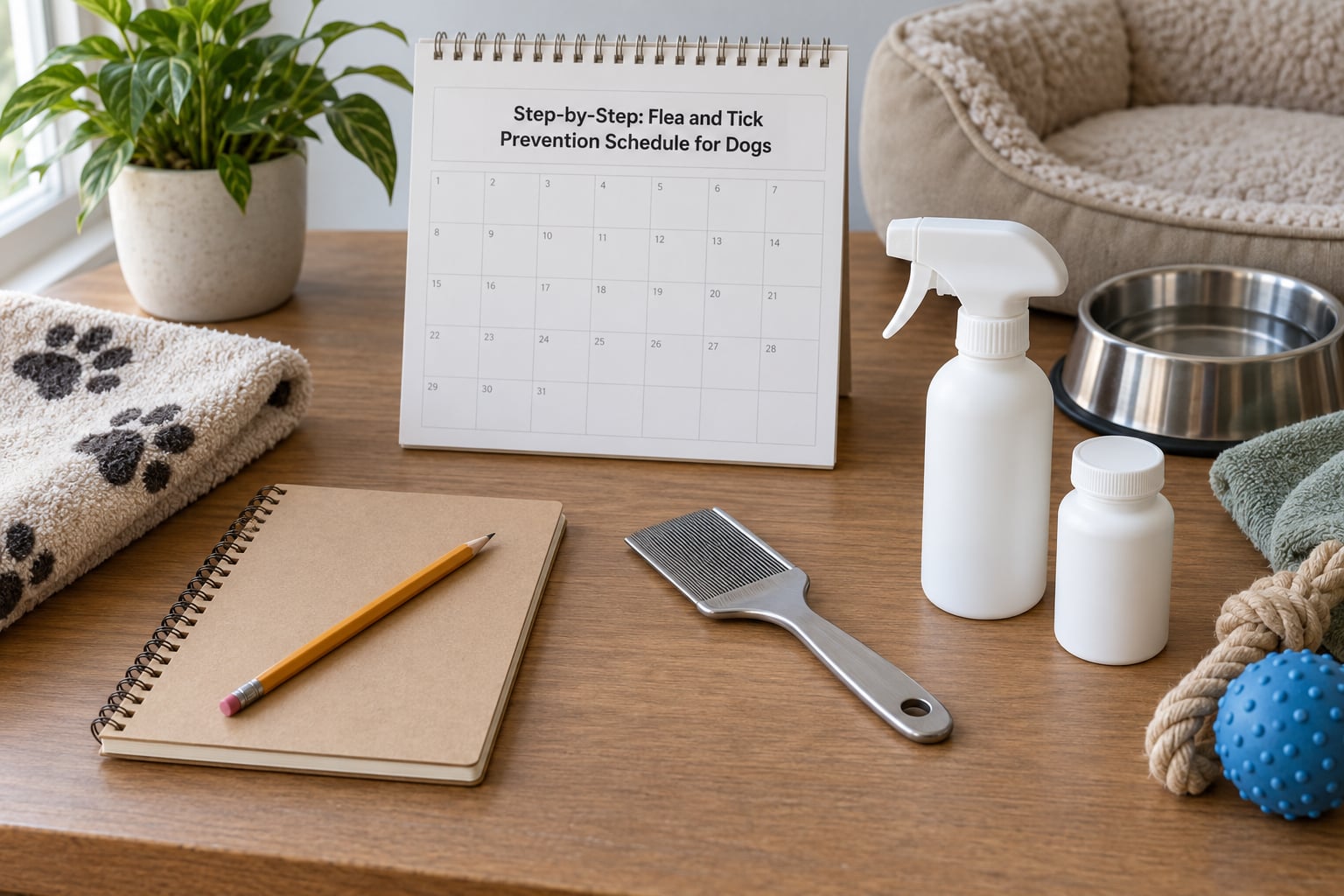
Build a flea and tick prevention schedule for dogs
Pick one anchor date and repeat it. The best choice is a day you will notice is missing, like the first of the month or the day you pay a bill. Give the dose that day and you will never have to work out when the last one was.
Then write down three things: the product name, the interval from the label, and the anchor date. That single line in a notebook or phone note is the whole schedule. Everything else — reminders, refills, annual reviews — hangs off it.
Keep your method types separate. A topical spot-on, an oral chewable, a collar and an injectable are not interchangeable, and using two parasite products at once is a common way to cause a reaction. If you want to switch methods, or your dog is already on a heartworm preventive that contains one of these actives, ask your vet first.
The table below shows the same routine laid out across a full year for the three common cadences.
| Month | Monthly oral or topical | 12-week oral (fluralaner) | 8-month collar | What to add |
|---|---|---|---|---|
| January | Dose on the 1st | Dose if due | No dose | Full tick check after cold walks |
| February | Dose on the 1st | No dose | No dose | Check coat for overwintering fleas |
| March | Dose on the 1st | Dose if due | No dose | Confirm spring weight band |
| April | Dose on the 1st | No dose | No dose | Peak tick season starts in many regions |
| May | Dose on the 1st | Dose if due | No dose | Flea comb check twice a month |
| June | Dose on the 1st | No dose | No dose | Yard treatment if fleas are found |
| July | Dose on the 1st | Dose if due | No dose | Check after every hike |
| August | Dose on the 1st | No dose | No dose | Highest flea pressure of the year |
| September | Dose on the 1st | Dose if due | No dose | New hunting season, new exposure |
| October | Dose on the 1st | No dose | No dose | Ticks hunt for hosts hardest now |
| November | Dose on the 1st | Dose if due | No dose | Refill before holiday travel |
| December | Dose on the 1st | No dose | Replacement if due | Annual vet review and refill order |
Confirm the correct product for your dog
Work through the label checks before the first dose. Minimum age and minimum weight come first, and most products start at 6 to 8 weeks old with a floor of roughly 2 to 4 pounds depending on the brand. A puppy under that weight needs a different product entirely.
Next comes the weight band. Chewables and tablets are dosed by weight range, and a growing puppy crosses bands quickly. Re-check every month while your dog is under a year old, because a chew meant for 10 to 20 pounds is underdosed for a puppy and a full-size chew is overdosed for a small dog.
Health history matters too. The isoxazoline class, which covers most modern oral chews, carries a warning about dogs with a seizure history. Collies, Australian Shepherds and related breeds can carry the MDR1 gene mutation, which changes how some of these drugs are handled. Tell your vet about both, even if your dog has never had a problem.
Finally, lifestyle. A dog that swims weekly, hunts, works cattle or goes to daycare has different exposure than one that stays on a couch. Frequent swimmers need a water-resistant formulation or a different route entirely.
Set reminders for applications and checks
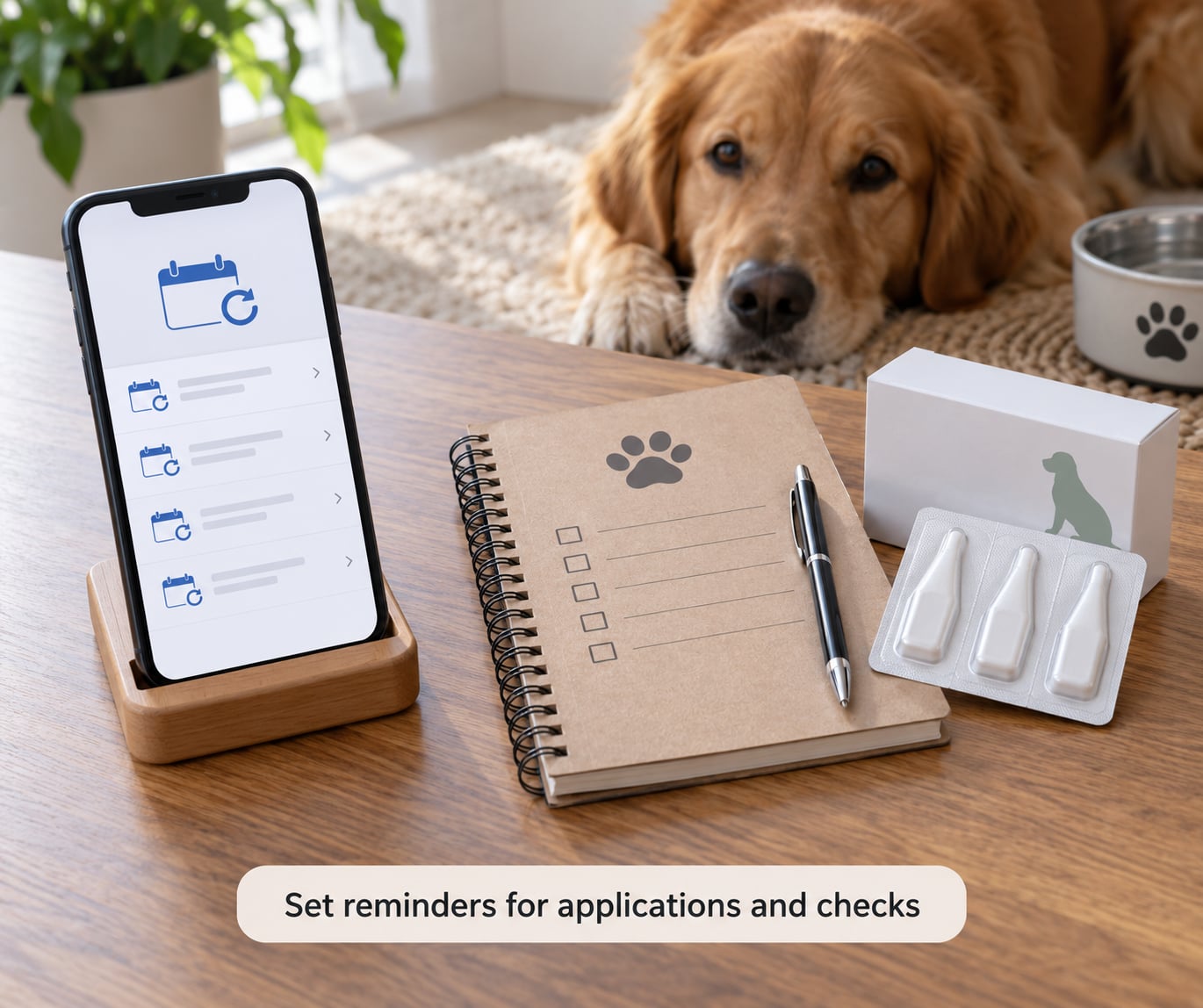
Set the reminder so it repeats monthly rather than as a one-off. If you run a 12-week product, set the alert for the actual due date and mark the next one at the same time. The failure mode is setting an alert, forgetting to advance it, and assuming the schedule is covered.
View the calendar three months at a time if you are on a quarterly product, and six months at a time for a collar. The official reminder on the collar packaging says to give the next dose eight months after the last one, so that is the date your calendar entry needs.
Log each application the day you give it: date, product, and the weight you used for the band. Two minutes of writing saves a phone call to the vet later, and it answers the question immediately if the dose was spat out and you are not sure whether it went down.
Set a second, separate reminder for refills. This is the one most people skip, and it is the reason for the gap that shows up in month three rather than month one. An auto-refill subscription or a standing reminder two weeks before the anchor date both work.
Check your dog and home for signs of fleas or ticks
Prevention reduces the odds, but it is not a reason to stop looking. Run a flea comb along the spine, the base of the neck and the tail base once a month. Black grit that looks like ground pepper is flea dirt, digested blood, and it turns red on a damp white tissue. A single flea is enough to justify a comb-through and a yard check.
For ticks, check the places they hide: inside the ears, under the collar, the armpits, between the back legs, under the tail and around the toes. Pay special attention in spring through fall, when nymphs are the size of a pinhead and easy to miss. Nymphs are the stage most likely to carry infection, and ticks can transmit bacteria within roughly 12 to 48 hours of attaching, which is why a quick check matters.
Remove a tick with fine-tip tweezers, gripping close to the skin and pulling straight up with steady pressure. Do not twist, and do not burn or smother it. Clean the area afterward and call your vet if the tick looks swollen or if your dog shows fever, lethargy or a shifting lameness in the following weeks.
If you find more than a flea or two, treat every pet in the home, then treat the environment. Flea pupae can sit dormant for months and are not removed by vacuuming alone, which is why carpet shampooing on its own often fails. Expect the cycle to take three to six months to break, and keep every animal on prevention throughout that period.
Adjust the routine for seasons, travel and lifestyle changes
The schedule itself does not change with the season, but the priority does. Fleas thrive indoors at about 70°F and 70% humidity, so an untreated house stays live all winter. Ticks stay active above roughly 40°F, so cold weather slows them down without stopping them. Owners in cold states often report a local season of April through November, and that is exactly the gap where an indoor flea population builds unnoticed.
If you missed a dose, do not double up unless your vet says to. Give the next dose on the regular schedule and tell your vet the gap date, especially if you saw fleas in the meantime. If your dog vomited a chew or you are unsure whether it went down, call your vet rather than repeating the full dose, because an accidental double dose of a chewable is a real risk.
Travel and boarding need a handoff. Tell the sitter the product name, the anchor date and the next due date, and leave the packaging where they can read it. Carry the dose in your hand luggage rather than checked luggage if you are flying, and check whether your destination has restrictions on bringing animal medications across the border.
New pets change the household math. A cat that goes outside can bring fleas indoors and can be exposed to a dog product containing permethrin, which is toxic to cats. Treat each animal separately and confirm every product with your vet before you add one.
Review the whole plan at least once a year, or sooner after any weight change of more than a few pounds, illness, surgery, a new puppy, or a change in how much time your dog spends outdoors.
Common Mistakes
Skipping winter because it feels cold. Fleas do not care about your thermostat, and ticks stay active well below freezing. Keep dosing through the cold months, especially indoors.
Using a dog product on a cat. Permethrin, found in many dog spot-ons and some livestock products, can cause fatal poisoning in cats. Species-specific dosing is not a formality.
Stacking two preventives. A spot-on plus a chewable plus a collar is three exposures, and it makes any reaction hard to trace. One method at a time unless your vet directs otherwise.
Relying on household sprays alone. Spraying the carpet treats the environment and does nothing for the animal carrying the fleas in. Treat the dog, every pet, and the home together.
Bathing or swimming too soon. Many topicals need the application site dry for a set window, often a day or two. Check the label and keep the dog away from water until it passes.
Letting a puppy stay on a weight band it has outgrown. Underdosing is as common as overdosing here. Recheck weight monthly while your dog is under a year.
Assuming indoor dogs never get parasites. Fleas arrive on people, shoes and other animals, and ticks ride in on clothing. Indoor-only is lower risk, not zero.
Repeating a dose after a spit-out chew. Call your vet. Most of the time the correct answer is to wait for the next scheduled dose.
Thinking one visible flea means the product failed. It is often the last of an existing infestation. Comb, treat the home, and keep the schedule running for the full cycle.
Starting without a baseline. Rescue dogs often arrive with no reliable last-dose date. Comb and check the coat before the first application so you know what you are starting from.
Frequently Asked Questions
How often should dogs get flea and tick prevention medication?
Most dogs take prevention on the same calendar day every month, all year round. Some products use different intervals: 12-week oral chews based on fluralaner, an 8-month collar, or an injectable that lasts 8 to 12 months. The label on your specific product sets the interval, and your veterinarian should confirm it. The one rule that matters is staying inside that window rather than stretching it, because a gap lets a new flea life cycle start.
Do I need to give my dog flea and tick medication year round?
Yes. Fleas survive indoors at roughly 70°F and 70% humidity, so an untreated house keeps producing them through the winter, and ticks stay active above about 40°F. Cold months slow both parasites down rather than stopping them. Treating only the warm season is what allows a population to build unnoticed and then reappear in summer.
Can an 8 week old puppy have flea and tick medicine?
Most products carry a minimum age of 6 to 8 weeks and a minimum weight of about 2 to 4 pounds, but the limits differ by brand. Puppies below that weight usually need a different formulation. After the first dose, puppies stay on the same schedule as adults, with weight bands rechecked monthly while they are still growing, since they outgrow the dose size quickly.
What happens if I miss a flea and tick dose?
Do not double the next dose unless your vet tells you to. Give the next scheduled dose on the normal date and tell your vet the date of the gap, especially if you have seen fleas in the meantime. If your dog vomited a chew or you are not sure the dose went down, call your vet, since repeating a full dose of a chewable by mistake can be harmful.
Why am I still seeing fleas while my dog is on prevention?
You are probably seeing the tail end of an existing infestation rather than a product failure. Flea pupae can stay dormant for months and are not removed by vacuuming, so adults keep reappearing for a while after treatment starts. Keep every animal in the home on prevention, treat the environment, and expect three to six months for the cycle to break before it slows down.
Conclusion
Start with the first action, not the perfect system: talk to your vet about which product fits your dog’s age, weight, health and lifestyle, then anchor the schedule to one day of the month you will not miss. Write the product name and the interval in one place, set a repeating phone alert and a separate refill reminder, and log each application when you give it.
Keep combing the coat and checking for ticks through every month, including winter. Your flea and tick prevention schedule for dogs only protects your dog as long as the gaps stay closed.