Most first time dog owner mistakes to avoid are not expensive or complicated. They are small habits in the first month: waiting to start training, letting the dog sleep loose in your bed, skipping the first vet visit, or scolding a puppy for an accident it could not help. Fix them early and you get an easy dog. Ignore them and you get a habit that takes months to undo.
Most dogs arrive with no idea what you expect. Whatever you reward, allow, or punish in the first three to four weeks teaches them what normal life looks like in your house, and the pattern sticks far longer than you would expect.
Below are the ten mistakes I see most often, each with the practical correction. Nothing here needs expensive gear or a professional on speed dial. Save the list, work through it before pickup day, and you will be ahead of most first-time owners.
Table of Contents
- First Time Dog Owner Mistakes to Avoid at a Glance
- 1. Not Preparing the Home Before the Dog Arrives
- 2. Choosing the Wrong Dog for Your Lifestyle
- 3. Skipping a Vet Visit and Baseline Health Plan
- 4. Feeding the Dog a Sudden or Unbalanced Diet
- 5. Giving Too Many Treats or Using Food as the Only Reward
- 6. Starting Training Without Clear Rules or Consistency
- 7. Expecting a New Dog to Be Instantly Social and Comfortable
- 8. Underestimating Exercise, Mental Stimulation, and Rest
- 9. Ignoring House Training and Accident Prevention
- 10. Delaying Separation, Safety, and Emergency Planning
- Frequently Asked Questions
- What are the biggest mistakes first-time dog owners make?
- What is the 3-3-3 rule for dogs?
- Where should a dog sleep the first night?
- What dogs are not good for first-time owners?
- Can I let my 9-week-old puppy sleep through the night?
- Is it too late to crate train a 1-year-old dog?
- Conclusion
First Time Dog Owner Mistakes to Avoid at a Glance
Here is the whole list in one place: the mistake, why it causes problems, and the fix you can make this week.
| Mistake | Why it matters | Quick fix |
|---|---|---|
| Not dog-proofing before arrival | Chewing, electrics and houseplants get found before you do | Secure cables, bins and chemicals the day before pickup |
| Picking a dog by looks alone | Energy and grooming needs drive daily life | Match temperament to your hours, not the photo |
| Skipping the first vet visit | You miss vaccines, parasites and dental problems early | Book within the first week and bring any records |
| Switching food overnight | Stomach upset and refusal to eat | Change food over seven to ten days |
| Using food for every reward | The dog learns begging and ignores everything else | Treats small and rare; add praise and play |
| Training without set rules | The dog decides which rules count | Pick five cues, practise two minutes at a time |
| Expecting instant friendliness | Fear turns into reactivity later | Let the dog set the pace for two weeks |
| Skipping mental work | Boredom becomes barking and chewing | Add sniffing, puzzle feeders, daily training |
| Ignoring house training | Accidents become habit | Fixed toilet breaks, supervision, enzyme cleaner |
| Leaving home safety unplanned | Escape, chew-through and quiet emergencies | Gates, ID tag, microchip, vet number by the door |
1. Not Preparing the Home Before the Dog Arrives
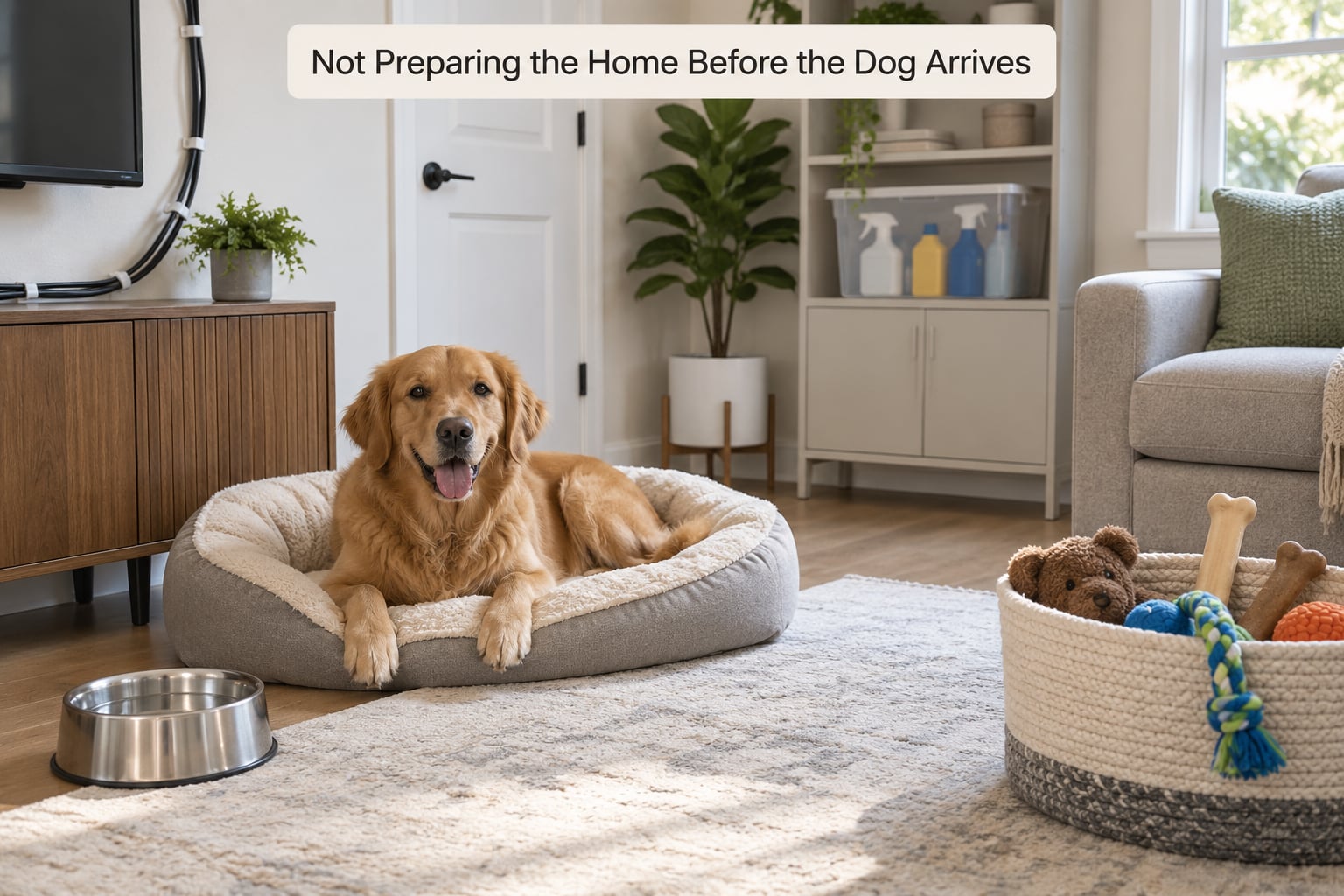
The most useful first night setup happens before the dog is in the house. Walk every room the dog can reach and remove what you would not want chewed: electrical cables, shoelaces, child toys, remote controls and houseplants, including the toxic ones such as lilies, which are dangerous to cats and dogs alike.
Set up one small settling area rather than giving the dog the whole run of the house on day one. A pen or a gated room with water, a bed and a chew you know is safe is easier to manage than an open-plan home and far better for a nervous rescue dog. Keep human medicines and cleaning products in closed, high cabinets.
Buy by function, not looks. A leash and a well-fitted harness, identification tags, a food bowl, a measured feeder, waste bags, and bedding are the essentials. Everything else can wait a few weeks.
2. Choosing the Wrong Dog for Your Lifestyle
Choose a dog whose needs match your actual week, not the breed you imagine. A dog that needs two hours of exercise a day will not suit someone working long shifts in a small flat, no matter how calm the breed sounds in a video.
Be honest about four things: how many hours the dog will be alone, how much exercise you genuinely enjoy, how much grooming you are willing to do, and whether your household has young children. Then look at the individual dog’s actual behaviour, because a breed label predicts nothing about one particular animal.
Puppies are charming and demanding, and the training and house-training work lands on you during the months you would least like extra work. Many adult shelter dogs are easier for a genuine beginner, since some are already house-trained, leash-trained and calm. Senior dogs are quieter still, if you want a companion rather than a project.
The rescue or shelter can tell you a lot. Ask how the dog responds to handling, whether they can live with children and cats, and what the dog was like at the foster home. The right match is about fit, not pedigree.
3. Skipping a Vet Visit and Baseline Health Plan
Book a veterinary appointment within the first week, even if the dog seems perfectly healthy. It is the only way to get a baseline: weight, teeth, heart, skin and parasites, plus a vaccination schedule you can plan around.
Ask about microchipping if it is not already done, and discuss spay or neuter status. Weight matters more than most new owners expect, since carrying a few extra kilos quietly stresses joints, and it is far easier to adjust a puppy’s portions than an adult’s.
One rule to set on day one: never give a dog human medication. Over-the-counter painkillers, ibuprofen and paracetamol can be fatal to dogs, and the ASPCA Animal Poison Control Center routinely ranks human medication among the most common poisoning calls. If your dog has eaten something suspicious, call a veterinarian or the nearest emergency animal hospital straight away.
4. Feeding the Dog a Sudden or Unbalanced Diet
Keep the food the dog is already eating, or transition gradually over seven to ten days by mixing a little of the new food in at each meal. A switch overnight is the fastest route to loose stools and a dog who skips meals.
Feed a complete food appropriate for the dog’s age and size, measure portions with a kitchen scale or a proper measuring cup, and keep mealtimes regular. Puppies usually need several small meals a day, and senior dogs benefit from the same consistent rhythm. Fresh water should be available at all times, changed daily.
Know the toxic list before day one: chocolate, grapes and raisins, onions and garlic, xylitol in sugar-free gum and baked goods, macadamia nuts, alcohol, caffeine, and raw dough containing yeast. Keep the kitchen bin closed and tell guests what is off limits, because most house-soiled dogs come from well-meaning visitors.
5. Giving Too Many Treats or Using Food as the Only Reward
Treats are a tool, not a meal plan. Pieces the size of a small pea are plenty during training, and a dog’s daily treats should stay near ten percent of the total intake, otherwise you have built a dog that refuses dinner and works for crumbs.
More importantly, food is not the only reward that works. Praise, a toy, a game of tug, a sniff break and your attention all reinforce behaviour, and a dog that works for multiple rewards trains faster than a dog fixated on chicken.
Give food at random moments for nothing at all. Hand over a piece while the dog is lying quietly, or when it looks back at you on a walk, and that dog learns that existing near you is itself rewarding. It is the easiest free tool in training.
6. Starting Training Without Clear Rules or Consistency
House rules set the pace. Decide in the first week what is allowed on the sofa, whether the dog eats at the table, and whether jumping gets any attention at all, then agree on it with everyone in the household including children, sitters and visitors.
Positive reinforcement means adding something the dog likes right after the behaviour you want, so the behaviour increases. Punishment means adding something unpleasant to remove a behaviour, and it fails for a simple reason: a dog cannot connect the consequence to the specific thing you wanted changed. It learns to fear your voice, your hands and your presence, which slows every lesson that follows and damages the trust you just built.
Scolding a dog for house-soiling, rubbing its nose in the mess, or yelling after a bite all teach avoidance of you rather than better manners. Owners who trained with punishment before they switched to rewards have told me the switch took weeks and had to be paired with genuinely enjoyable rewards, not just the removal of scolding.
Start with five cues: sit, stay, down, heel and recall, plus a name response. Two minutes at a time, several times a day, beats one exhausting hour on Sunday. When you are unsure, a certified trainer or an obedience class is cheaper than a bite or a chewed sofa.
7. Expecting a New Dog to Be Instantly Social and Comfortable
A new dog is often frightened for a week or more. Crouching, freezing, avoiding eye contact and sleeping a lot are signs of decompression, not of a bad temperament. Give the dog space, keep visitors away, and let approach on its own terms.
Socialization is not meeting every dog you can find. It is building a positive, low-stakes relationship with the everyday world: traffic, doorbells, car rides, floor surfaces, vacuum cleaners, hair dryers and strangers who keep their distance.
For a puppy whose vaccinations are incomplete, short ten-minute outings carrying the puppy on the ground, sitting outside a cafe, or riding in a parked car give safe exposure without unknown dogs. Balanced, positive vaccine status as advised by your vet is the usual guide for when public surfaces are fine again.
Introducing a new dog to resident pets takes scent first: swap bedding or a soft item, put closed doors between them, let each investigate the other’s smell for days, then meet through a gate with a helper on a loose lead. Keep the first session boring. Do not read warning signals as rudeness; go slow and boring and move at the cats’ pace.
8. Underestimating Exercise, Mental Stimulation, and Rest
Matching activity to age matters. A young puppy does not need a two-hour run, and an adult dog left with nothing but a long walk will still be bored for the other twenty-two hours. Short walks, several times a day, suit most dogs better than one exhausting outing.
Mental stimulation is the part new owners skip. Sniffing on a long lead, a puzzle feeder, a lick mat with plain yogurt or peanut butter, a snuffle mat, and five minutes of daily training all count. Walking is enrichment when the dog is allowed to sniff, not a march at heel pace.
Rest is part of the plan too. Dogs sleep a lot, and a puppy settling in a warm, quiet corner for genuine rest is doing exactly what they should. Over-tiring an adolescent produces a chewed cushion and a wound mouth, which is why naps matter more than you would expect.
9. Ignoring House Training and Accident Prevention
House training works on supervision and routine. Take the dog out first thing in the morning, after every meal or nap, and before bed, then reward outside within seconds of the right thing happening, with a quiet “yes” rather than a party.
<pClean accidents with an enzyme-based cleaner from a pet supply store. Household cleaners, ammonia and bleach remove the smell for you but not for the dog, which is why some dogs keep returning to the same spot.
Never punish an accident. The dog cannot explain that the punishment came after, and the only result is a puppy that hides to relieve itself. A puppy that has never slept through the night is normal; a nine-week-old puppy holding urine overnight is asking for a vet visit, not frustration.
If a fully house-trained adult dog suddenly starts having accidents, book an appointment rather than tightening the schedule. Urinary problems and pain are common reasons, and only a vet can tell you which.
10. Delaying Separation, Safety, and Emergency Planning
Accustom the dog to being alone gradually. Start with a minute while you stay in the house, build to five, then to fifteen, closing a door each time. Many owners skip this and discover on day two that the dog howls at the door, which is how separation anxiety starts.
Make the goodbye boring: no fuss, no eye contact, no lingering. Fill a long-lasting chew or a puzzle feeder just before you leave. Do not make the crate or pen a punishment by pushing the dog in and shutting the door; that teaches the association you are trying to avoid.
Set up identification and barriers before the first escape risk, not after. Photo ID on the collar, a microchip with your current number, gates across the stairs and a secure harness and lead for every outing, because a collar alone is not containment.
Know your emergency plan. Keep your regular veterinarian and the nearest emergency hospital number written down, keep a dog first-aid kit with bandages and a styptic powder for nail trims, and note your dog’s weight so a vet can dose anything in a hurry. Call a professional for urgent concerns such as repeated vomiting, collapse, difficulty breathing, a suspected toxin, or a bite to a person or another animal.
Frequently Asked Questions
What are the biggest mistakes first-time dog owners make?
The most common mistakes first-time dog owners make are waiting to start training, punishing accidents or biting, letting the dog sleep loose in the bed, not dog-proofing the house, skipping the first vet visit, and skipping socialization because of incomplete vaccinations. All six are fixable in the first month with short daily training sessions, reward-based methods and a scheduled vet appointment.
What is the 3-3-3 rule for dogs?
The 3-3-3 rule describes how long a newly adopted dog typically takes to adjust: about 3 days to decompress and feel safe, 3 weeks to settle into a routine, and 3 months to feel truly at home. It is a guide, not a deadline. A related 7-7-7 rule counts 7 days, 7 weeks and 7 months for dogs recovering from trauma.
Where should a dog sleep the first night?
Somewhere quiet, warm and close to you but not in your bed. A crate placed near the bedroom, a pen in a hallway or a bed beside yours all work. Many trainers steer clear of the laundry room or far corner, since an isolated crate feels punishing and a puppy is more likely to resist entering it. Reward calm, quiet rest there.
What dogs are not good for first-time owners?
Dogs that need very high exercise, heavy grooming or constant attention cause the most trouble for beginners, as do nervous, reactive or fearful individuals who need experienced handling. Breeds with guarding or barking tendencies can be demanding too. A calm adult rescue is often easier than a puppy, since much of the work may already be done.
Can I let my 9-week-old puppy sleep through the night?
Most nine-week-old puppies cannot hold urine through the night, so expect a trip outside every few hours and expect accidents. Keep the puppy near you overnight with the same setup you use during the day, and use the wake-ups as toilet breaks. Persistent accidents or straining always mean a call to the veterinarian.
Is it too late to crate train a 1-year-old dog?
No. Adult dogs learn a den association quickly, though you should expect a few days of counter-surfing and resistance. Feed meals near the crate, toss treats inside to build a positive association, step up the door gradually, and never shut the door on the dog to force the issue. A dog that was crate-averse can usually be converted within a couple of weeks.
Conclusion
Pick four things and do them before the dog comes home: dog-proof the rooms, choose one safe sleeping spot, keep the current food in the cupboard, and book the first vet appointment. From there, train two minutes a day, reward what you want, and give the dog a quiet week to decompress. The mistakes listed above are the ones that get expensive later, and every one of them is easier to prevent in the first month than to undo in the first year.