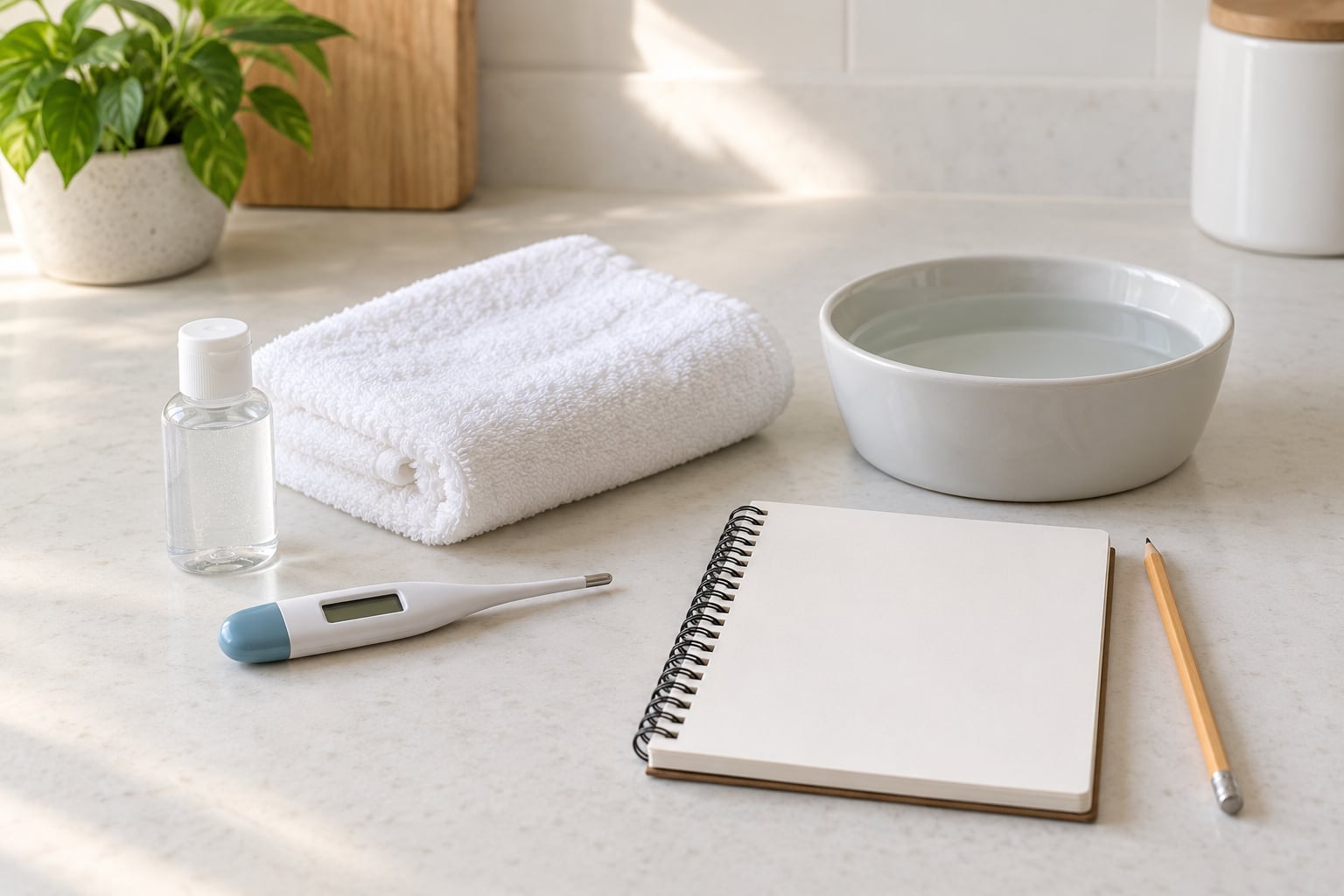
Knowing how to take a dog’s temperature at home takes about five minutes and gives you one of the most useful numbers you can get when your dog seems unwell. The most accurate method is a lubricated digital rectal thermometer, which reads core temperature in under a minute. Dog owners often hesitate because the process sounds unpleasant, but with a treat in one hand and steady technique, most dogs settle within a minute or two.
Dogs run hotter than humans. A healthy adult dog sits around 101 to 102.5 F (37.8 to 39.2 C), so a reading that would look normal on a person can hide a real fever in a dog. Checking at home also saves you guessing whether a symptom deserves a same-day appointment or a night in the emergency clinic.
This guide is general information, not a diagnosis or a treatment plan. Your veterinarian can interpret a reading in the context of an examination, and any concerning number deserves a call to them.
Table of Contents
- What You Need to Take a Dog’s Temperature at Home
- Step-by-Step
- How to Prepare Your Dog and the Thermometer
- How to Take the Rectal Temperature Safely
- Common Mistakes When Checking a Dog’s Temperature
- Tips for a Calm and Accurate Home Check
- Frequently Asked Questions
- What is the normal rectal temperature of a dog?
- Can you take a dog’s temperature with a regular human thermometer?
- How do I tell if my dog has a fever without a thermometer?
- What is the fastest way to bring a dog’s fever down?
- Can I take my dog’s temperature with an infrared or no-touch thermometer?
- What reading means I should go to the emergency clinic?
- Conclusion
What You Need to Take a Dog’s Temperature at Home
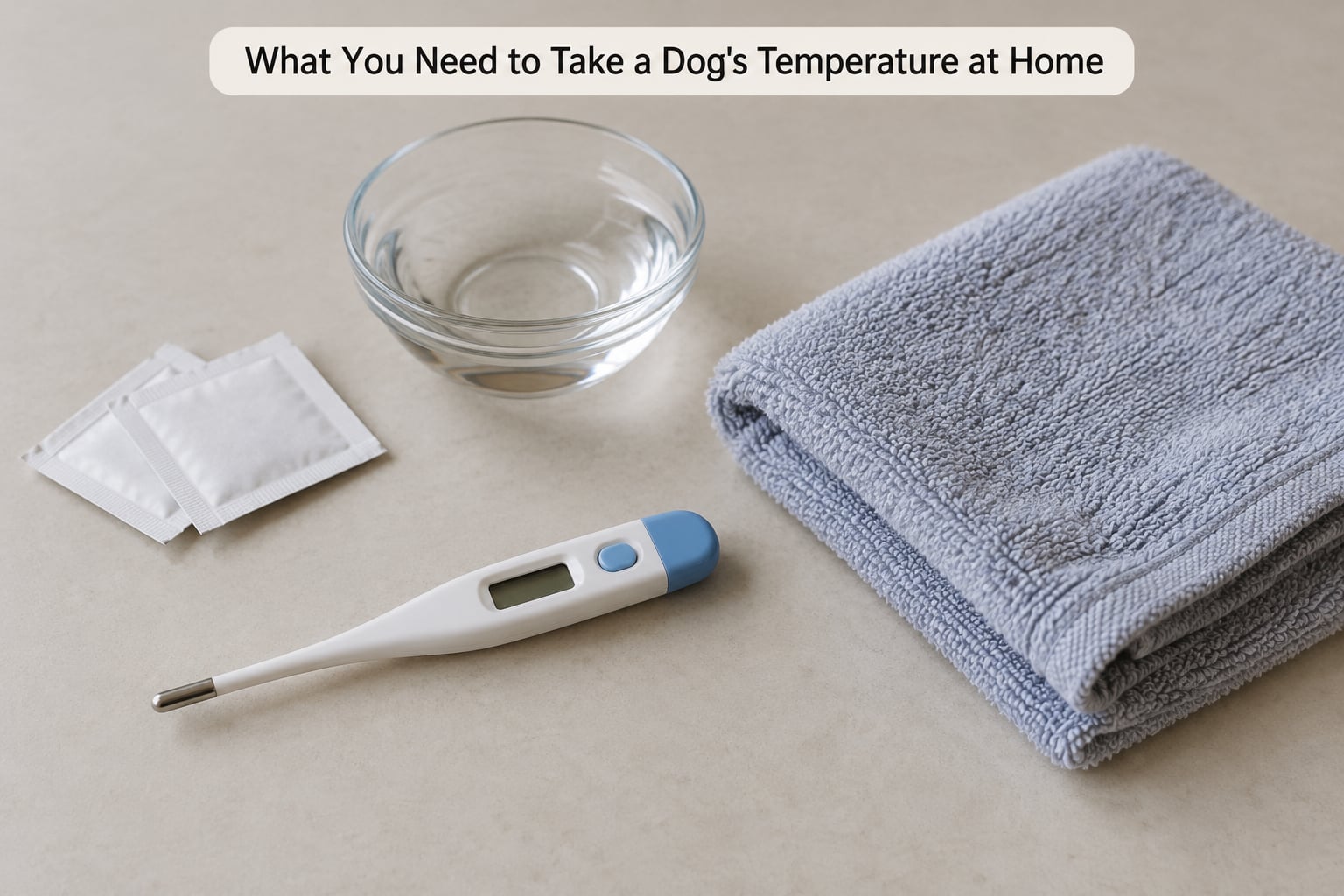
Most of the kit fits in a drawer. What matters is the thermometer itself, because a cheap one gives inconsistent numbers and sends you into a spiral of rechecking.
- A digital rectal thermometer made for animals. It reads fast, beeps when it is done, and is easy to clean. A fast-read pet model is more forgiving if your dog shifts mid-reading.
- Water-based lubricant. This is the best option. Petroleum jelly works in a pinch, and owners often use it, but oil-based products do not wash off as easily and some do not sit well with sensitive skin.
- Cotton balls and alcohol wipes for cleaning the probe before and after.
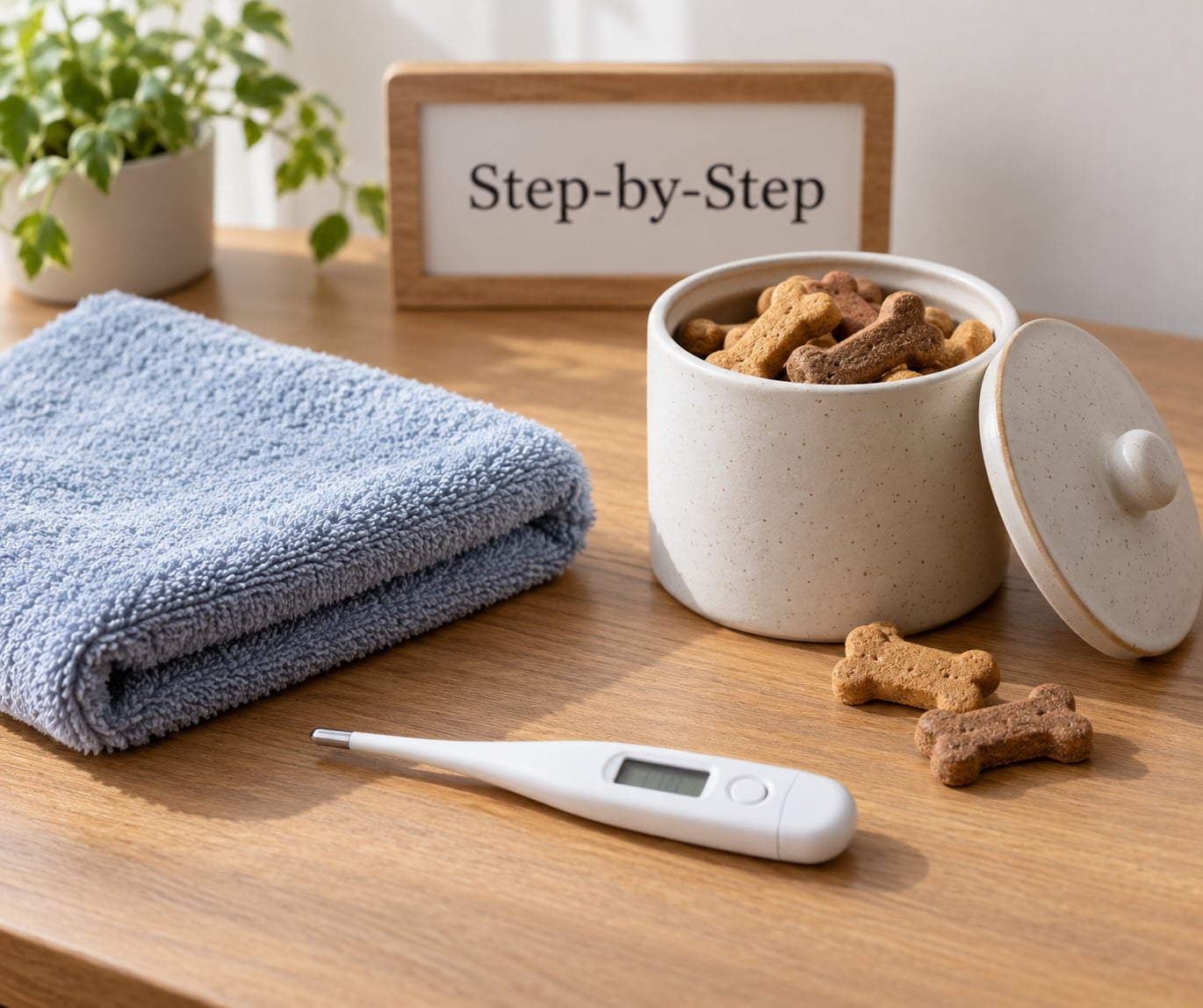
- High-value treats. Use something smelly and soft, like a slice of lunch meat or a chunk of wet food, not the dry biscuit your dog usually ignores.
- A towel to place on the floor, for grip and for catching any mess.
A human digital thermometer will physically work and most clinics will give you the same number, so it is a reasonable backup when you own nothing else. Never use a mercury glass thermometer. It takes several minutes to register, it cannot be moved once it is in place, and a break means mercury in your dog’s rectum.
It is also worth owning a second method. A no-touch infrared thermometer reads the skin rather than the core, so it under-reads by roughly one degree or more, but it is a fast screening tool when you cannot safely hold your dog. Owners in dog training and breed forums say the honest answer is that a rectal thermometer is the only reading they trust for a decision, and a forehead scanner is the fallback when restraint is not possible.
Step-by-Step
How to Prepare Your Dog and the Thermometer
- Let your dog settle first. Sit or lie down, and wait about ten minutes after a walk, a car ride or a burst of barking. Owners report falsely high readings when they measure a dog straight off the sofa and into the car. Panting also inflates a reading, so wait for slow, quiet breathing.
- Test the thermometer. Turn it on before your dog is in position. A dead battery or a device stuck in Celsius produces a number that makes no sense.
- Set the unit and range. Most models have a Fahrenheit or Celsius toggle. Pick one and stay with it, because mixing units is the fastest way to panic over a healthy dog.
- Lubricate the tip. Put a generous amount on the probe, about half an inch of coverage. Skimpy lubrication is the most common reason insertion hurts.
- Decide your restraint plan before you start. Small dogs go on a table or counter at chest height. Large dogs stay on the floor, where you are not lifting weight. If your dog is anxious, has never been handled this way, or has ever warned with teeth, get a second person. Owners consistently describe a helper on the front end with treats as the difference between a reading and a struggle.
How to Take the Rectal Temperature Safely
- Lift the tail and steady the hindquarters. A dog that can move their back legs will not hold still, so brace them gently with your forearm and non-dominant hand. The second person, if you have one, faces the dog and offers treats continuously.
- Insert slowly, with a slight twist. Owners report that a gentle rotating motion rather than pushing straight in makes insertion easier and less distressing. Aim for roughly 1 to 2 inches in an adult dog, and only about half an inch in a small dog or puppy. Let the dog’s body do some of the work.
- Hold it still and wait for the beep. Most digital probes finish in 10 to 30 seconds. Do not move the thermometer while it is reading; shifting it produces an unreliable number.
- Remove and read the display. Write the number down with the time immediately. Memory is unreliable two minutes later, especially if you are worried.
- Clean the probe. Wipe it with alcohol or a warm damp cloth before storing it.
- Retake once if the number surprises you. A second reading through a fresh, lubricated probe catches most technique errors. If both readings agree, trust them.
Inserting to the correct depth matters more than force. Too shallow and you read the warm wall of the rectum rather than the core. The thermometer should never meet resistance; if it does, back off and reassess rather than pushing.
Common Mistakes When Checking a Dog’s Temperature
Using the wrong thermometer. Mercury glass thermometers are impractical for dogs, and no-touch scanners measure skin rather than core. A dedicated fast-read digital probe is the reliable choice.
Forcing a nervous dog. A reading taken while the dog fights produces a false high and risks a bite to you and injury to them. Stop, wait fifteen minutes, and use a helper and treats.
Skipping the lubricant. Dry insertion causes discomfort, which raises the reading and makes the next attempt harder. Lube generously every time.
Inserting too far or pushing past resistance. Going deeper than 1 to 2 inches, or forcing past a blockage, risks discomfort and rectal injury. Depth scales with body size.
Moving the thermometer during the reading. Any shift resets the sensor, and owners often get a number half a degree or a full degree off because of it.
Measuring straight after exercise or excitement. Recent activity, barking and panting all raise core temperature. Wait ten minutes of quiet.
Reading the surface temperature and trusting it. Forehead and armpit readings run one to three degrees cooler than the core, so a 102 F armpit reading can hide a 104 F core temperature. Use surface readings to spot a trend, not to clear a dog.
Treating the number alone. One reading without symptoms tells you very little. Note energy, appetite, water intake and gum colour alongside it.
Giving human fever medication. This is the mistake that turns a manageable fever into an emergency. Aspirin, ibuprofen and acetaminophen are toxic to dogs, and acetaminophen causes liver failure at surprisingly small doses relative to body weight. Never give any of them without a veterinarian directing you.
Repeating readings every two minutes. Frequent rechecks wear the dog down and raise stress-related readings. Retest after 30 minutes at most, and only when you are monitoring a borderline number.
Tips for a Calm and Accurate Home Check
Knowing how to take a dog’s temperature at home works best when you know what the number means before you panic. This table gives the usual thresholds, with the Celsius equivalent beside each figure, based on the ranges published by VCA Animal Hospitals and AKC.
| Reading | Fahrenheit | Celsius | What it usually means |
|---|---|---|---|
| Low end of normal | 100.5 – 101 F | 37.8 – 38.3 C | Fine, especially in small or young dogs |
| Normal range | 101 – 102.5 F | 37.8 – 39.2 C | Healthy adult dog at rest |
| Mildly elevated | 102.5 – 103 F | 39.2 – 39.4 C | Worth a recheck in 30 minutes and a note to your vet |
| Fever | Over 103 F | Over 39.4 C | Call your veterinarian the same day |
| Emergency range | Over 104 F | Over 40 C | Go to the emergency clinic now, with or without other symptoms |
| Hypothermia | Below 99 F | Below 37.2 C | Warm the dog gradually and contact your vet |
Note the difference between fever and hyperthermia. Fever is the immune system raising temperature on purpose, usually in response to infection. Hyperthermia is overheating from heat, exertion or a trapped car, and it can climb past 107 F (41.7 C) with organ damage. Cooling measures help hyperthermia and do almost nothing for an infection-driven fever, which is why the number alone is never enough.
A few other methods come up in searches, and none of them match rectal accuracy:
- Ear or tympanic probe: fast and non-invasive, but needs the correct ear canal position, and an inflamed or infected ear gives a false high.
- Armpit or axillary: easiest for wiggly dogs, and reads 1 to 3 F cooler than core.
- Forehead no-touch: useful as a screening trend when the dog is panicking, and unreliable for any decision.
- Skin and coat: tells you almost nothing about core temperature.
Then log it. A simple notebook with date, time, number and one line of symptoms turns a single reading into a trend, and your vet will ask for exactly that. While you wait for advice, offer fresh water, keep the room cool, and use cool, not icy, water on the paws and belly for a hot dog. Never give human fever reducers.
If you are not sure what the number means, call. A quick call about a reading beats a night of guessing.
Frequently Asked Questions
What is the normal rectal temperature of a dog?
A healthy adult dog usually sits between 101 and 102.5 F (37.8 to 39.2 C) when measured rectally at rest. Puppies and small breeds often run slightly higher, and senior dogs slightly lower. Temperature also shifts a little through the day, so a reading taken right after exercise or excitement is not comparable with one taken after ten quiet minutes.
Can you take a dog’s temperature with a regular human thermometer?
Yes. A standard digital human thermometer gives essentially the same rectal reading as a pet thermometer, and many clinics hand out a human model. Use it only rectally, never in the mouth or ear, and expect only about half a degree of accuracy difference. Avoid mercury glass thermometers entirely: they take minutes to register, cannot be repositioned once placed, and are a hazard if broken.
How do I tell if my dog has a fever without a thermometer?
Look at behaviour rather than nose temperature. A dog with a fever is often flat, quiet and uninterested in food or water, may shiver despite a warm coat, and can pant without having exercised. Watch for vomiting, diarrhoea, coughing, stiffness, limping or bright, glossy eyes. A warm, dry nose is not a fever sign, since healthy and sick dogs both come in both varieties.
What is the fastest way to bring a dog’s fever down?
There is no safe home treatment for an infection-driven fever, and human fever reducers such as aspirin, ibuprofen or acetaminophen are toxic to dogs. What you can safely do is keep the dog cool and comfortable: offer fresh water, use cool, not icy, water on the paws and belly, and keep the room air-conditioned. Then call your veterinarian, because the cause matters more than the number.
Can I take my dog’s temperature with an infrared or no-touch thermometer?
You can, but treat it as a screening tool rather than a measurement. Forehead scanners read the skin surface and usually run one to three degrees below core, so a dog can be at 104 F while the scanner shows 102 F. Readings are also skewed by a thick coat, a feverish dry head or movement. Never clear a dog on a no-touch reading alone.
What reading means I should go to the emergency clinic?
Go now if the temperature is over 104 F (40 C), or if it is high alongside vomiting, collapse, pale or dark red gums, difficulty breathing, a seizure, or suspected heat exposure from a hot car or hard exercise. Those combinations can signal serious infection, heatstroke or shock. Keep the dog cool on the way in and tell the clinic the reading and when you took it, because it speeds up their triage.
Conclusion
Start calm, use a lubricated digital rectal thermometer, insert only 1 to 2 inches, and wait for the beep without moving it. Write the number and the time down next to what your dog is doing in terms of energy, appetite and gums, because that context is worth more to your veterinarian than the number alone.
Call your vet the same day above 103 F (39.4 C), and go straight to the emergency clinic above 104 F (40 C) or with vomiting, collapse, breathing trouble or suspected heat exposure. And whatever the reading says, never give a human fever reducer. If you are still unsure, a phone call is the right move.