
Lyme disease in dogs is a bacterial infection caused by Borrelia burgdorferi, a spirochete passed to dogs by the bite of an infected blacklegged tick. Most infected dogs never show a symptom at all. The ones that do often develop shifting-leg lameness, fever, and swollen joints, and a small number go on to develop Lyme nephritis, a kidney problem that can be life-threatening.
Prevention is mostly routine: keep tick protection on the dog year-round, check after every walk in grassy or wooded areas, and remove attached ticks promptly. This guide walks through what the signs look like, how a diagnosis actually happens, and what to do in the first 72 hours after you find a tick.
This is general information, not a diagnosis for your dog. A veterinarian is the only person who can examine your dog, run the right tests, and decide whether treatment is needed.
Table of Contents
- What Is Lyme Disease in Dogs?
- How Do Dogs Get Lyme Disease?
- Lyme Disease in Dogs: Symptoms and Early Warning Signs
- What Lyme Disease Looks Like in Dogs
- A local tick bite looks different from illness
- Why symptoms appear days to weeks after exposure
- Why a rash is not the main clue in dogs
- How Is Lyme Disease in Dogs Diagnosed?
- How Can You Prevent Lyme Disease in Dogs?
- What To Do If You Find a Tick on Your Dog
- When Should You Call a Veterinarian?
- Frequently Asked Questions
- What are the most common symptoms of Lyme disease in dogs?
- How long after a tick bite can a dog develop Lyme disease symptoms?
- Does finding a tick on my dog mean my dog has Lyme disease?
- Can humans catch Lyme disease from a dog?
- Can Lyme disease in dogs be prevented with a vaccine?
- Should I give my dog human antibiotics if I suspect Lyme disease?
- Conclusion
What Is Lyme Disease in Dogs?
Lyme disease is a bacterial infection. The bacteria live in the saliva of infected ticks and pass into the dog during a bite. Once inside, the spirochete travels through the bloodstream and settles in joints, lymph nodes, and sometimes the kidneys.
Two things are worth separating. The tick bite itself is a local irritation that often looks like a small scab or bump. Lyme disease is the systemic infection that can follow. A dog can be bitten and never become infected, be infected and stay completely well, or be infected and develop signs weeks later.
Veterinary guidelines commonly report that only a small minority of infected dogs — roughly 5 to 10% — ever show clinical signs. That number surprises most owners, and it is the reason a positive test in a dog that feels fine is not automatically an emergency.
How Do Dogs Get Lyme Disease?
Transmission depends on a vector: the blacklegged tick, also called Ixodes scapularis or the deer tick. In Europe the main vector is the related Ixodes ricinus. Nymphs are the stage most often responsible, because they are tiny, hard to see, and numerous in leaf litter and low grass.
Ticks generally need to stay attached for roughly 24 to 48 hours before the bacteria are passed along. That single fact is what makes tick checks and fast removal genuinely useful — remove a tick early and transmission becomes unlikely.
Risk climbs in the places where ticks live: tall grass, brush, woodland edges, leaf litter, and hiking trails. Dogs that hunt, run in fields, or travel in endemic regions of the Northeast, Midwest, and Pacific Coast in the US meet the vector more often. Prevalence data published by the Companion Animal Parasite Council track with that pattern, showing infection rates highest in dogs living in or visiting those areas.
Ticks are not the only vector of tick-borne illness, which matters when a dog looks unwell after a hike. Anaplasmosis, ehrlichiosis, Rocky Mountain spotted fever, and babesiosis can all follow the same kind of exposure and can look like Lyme at first glance.
Lyme Disease in Dogs: Symptoms and Early Warning Signs
Signs tend to show up two to five weeks after the bite, and the classic pattern is a dog that was completely normal, then starts favoring one leg, then a few days later seems fine and starts favoring a different one. That shifting pattern is the single most recognisable clue, and it is not a confirmed diagnosis — trauma and joint disease can imitate it.
- Shifting leg lameness — the dog limps on one leg for a few days, then moves to another, often with no obvious injury.
- Swollen, warm or painful joints — usually the knee or elbow, sometimes both sides at once.
- Fever — owners often notice a warm, quiet dog that feels warmer than usual and drinks more water than normal.
- Lethargy and depression — less interest in walks, play, and greeting people at the door.
- Reduced appetite and weight loss — skipping meals, sometimes for more than a day.
- Enlarged lymph nodes — small, firm lumps under the jaw or near the shoulders that were not there before.
Less common signs include facial swelling, nosebleeds, changes in drinking and urination, difficulty breathing, and neurological changes such as seizures or weakness in the back legs. Facial swelling and signs that come and go are unusual enough that a veterinarian will want to look at the dog promptly.
Just as important: many infected dogs show nothing at all. No symptoms does not mean no exposure, and it does not mean the dog is in danger. It means there is nothing to act on right now, which is a genuinely reassuring answer.
What Lyme Disease Looks Like in Dogs
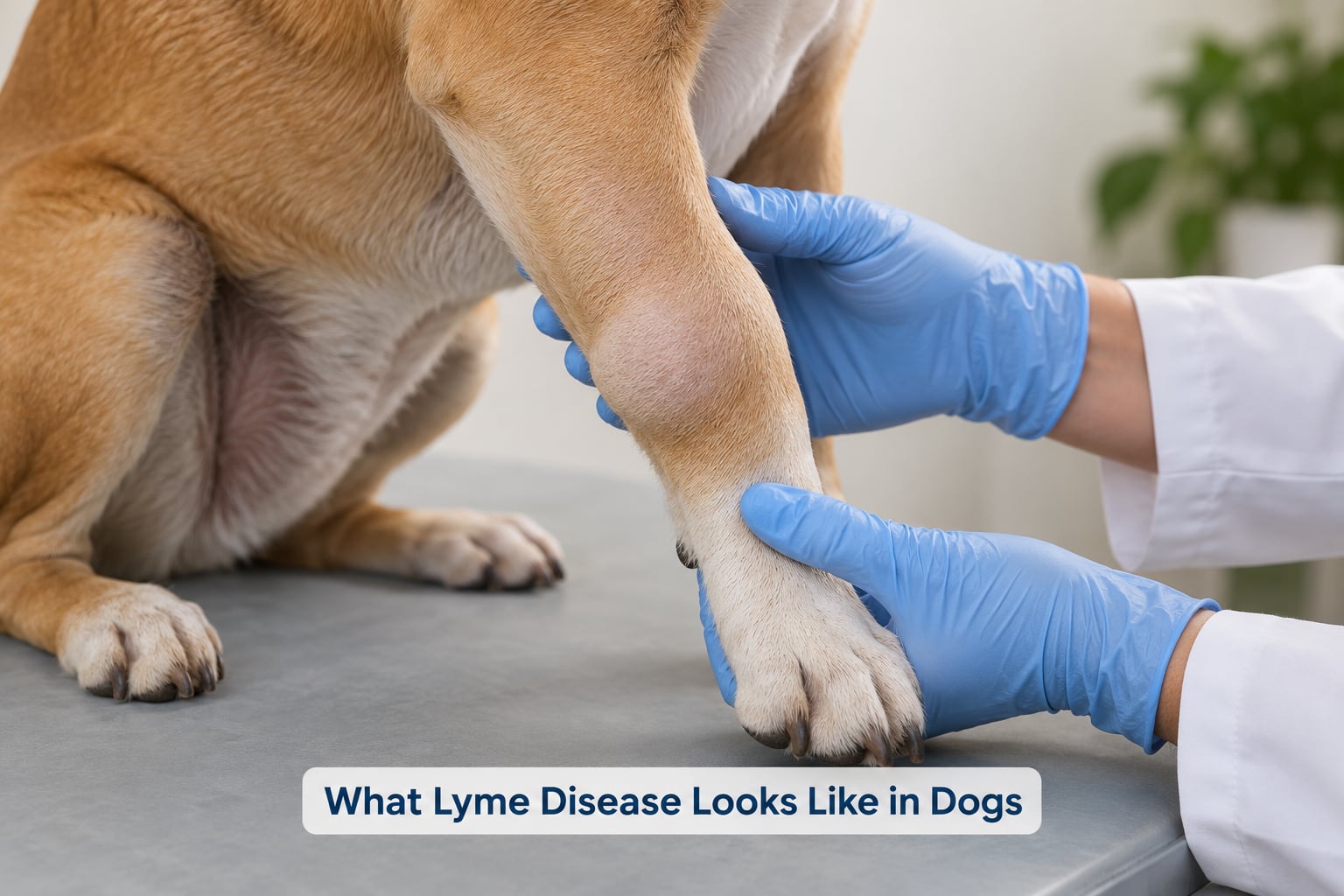
A local tick bite looks different from illness
A fresh tick bite is usually a small raised bump, sometimes with a dark spot at the centre, often hidden in thin fur along the chest, under the collar, in the ears, between the toes, around the tail base, or on the lower legs. The area may be slightly warm or itchy. A bite does not enlarge, does not cause joint pain, and does not make a dog lethargic.
Why symptoms appear days to weeks after exposure
The delay happens because the immune system takes time to mount a response and because the joint inflammation develops gradually. Dogs that are stressed, older, or already dealing with another illness tend to show signs sooner. This delay is why people who spot a tick weeks earlier often remember it as the obvious cause, and why a dog can test positive in late summer after a spring walk.
Why a rash is not the main clue in dogs
Humans are often told to watch for an expanding bull’s-eye rash. Dogs do not reliably get one, and it is a poor diagnostic guide. Owners frequently spend weeks looking for a rash that was never going to appear. If you need a list of what to watch for instead, the symptoms section above covers the pattern that matters: lameness that moves from leg to leg, fever, and swollen joints.
How Is Lyme Disease in Dogs Diagnosed?
Diagnosis never rests on a single test. Your veterinarian combines three things: a physical exam, a history of tick exposure, and laboratory results. The most useful question at the appointment is not only “is my dog positive” but “is my dog positive and sick.”
Antibody tests, often called serology or a C6 test, detect the dog’s immune response to the bacteria. The problem is timing. A dog tested within about four weeks of a bite may not have produced antibodies yet, so a negative result that early does not rule infection out. Seroconversion — the point where antibodies become detectable — is why vets typically wait roughly four weeks before testing.
A positive antibody result also means exposure, not necessarily active disease. Antibodies can persist for years after a dog has cleared the infection, which is why many dogs test positive their whole lives without ever being unwell. When the dog has no symptoms, that result is usually monitored rather than treated aggressively.
Other tests carry the picture further. A complete blood count and chemistry panel show whether there is inflammation, anemia, or kidney involvement. Urinalysis can pick up protein in the urine, which is an early sign of Lyme nephritis. X-rays of affected joints rule out injury or degenerative joint disease. Many owners report that the most confusing part was never the test itself, but not being told clearly whether the result meant exposure or illness — ask your vet to spell that out in plain terms.
How Can You Prevent Lyme Disease in Dogs?
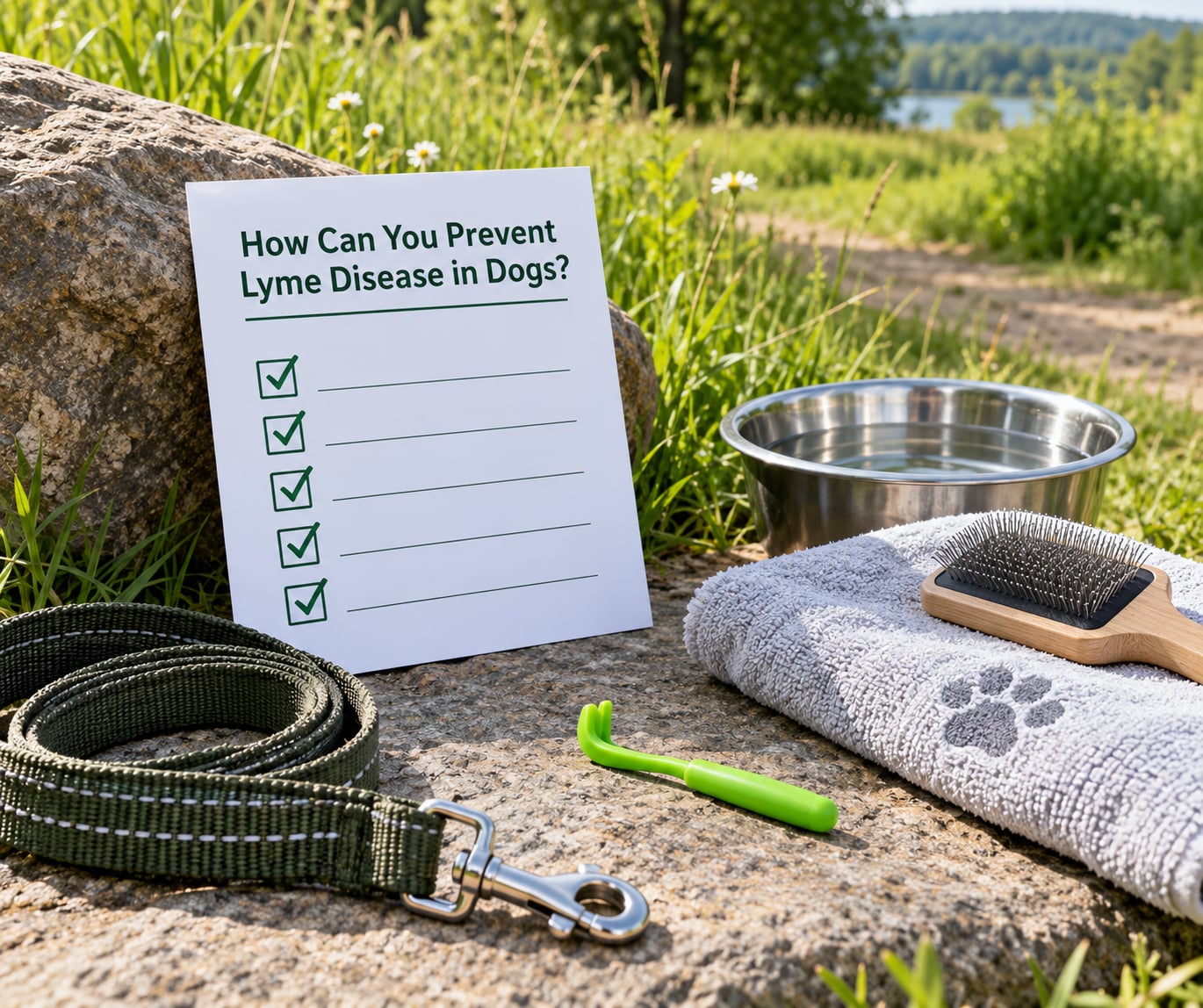
Prevention works best as a stack of small, boring habits rather than one big decision.
- Keep a veterinarian-approved tick preventive on the dog all year. Options include oral isoxazolines, topical spot-ons, and tick collars. Ask your vet which fits your dog’s age, weight, and health, and set a calendar reminder — lapses in July are why dogs get sick in September.
- Check the dog after every outing in tick country. Run your hands over the neck, chest, under the collar, inside the ears, between the toes, around the tail base, and along the underbelly. Nymph ticks are about the size of a pinhead.
- Remove attached ticks the same day. The shorter the time attached, the smaller the chance bacteria are transmitted.
- Manage the yard. Keep grass and brush cut back, clear leaf litter, and treat the edge of the property where ticks travel in from neighbouring land.
- Consider the Lyme vaccine where it makes sense. It suits dogs with genuine repeated exposure in endemic areas, and it can be combined with regular preventives. It is not a replacement for them.
On vaccination, dog owners ask sharper questions than most clinic pages answer. Effectiveness estimates vary widely, and some published figures run roughly 50 to 100%, which is too wide a range to call a blanket guarantee. Side effects are usually mild — soreness at the injection site, tiredness, occasionally vomiting within hours — and severe reactions are uncommon. A first series followed by boosters is typical, and some vets recommend an extra dose where exposure is heavy. A vaccine is pointless for a dog that never leaves the pavement, and pointless on its own if the dog still has fleas and ticks walking in.
What To Do If You Find a Tick on Your Dog
A discovered tick does not prove Lyme disease. Most bites never lead anywhere. What you can do is remove the tick cleanly, keep the tick in a sealed bag or jar for identification, and note the date.
- Part the fur and grip the tick as close to the skin as you can with fine-tipped tweezers or a tick-removal tool.
- Pull straight up with steady, even pressure. Do not squeeze, twist, or jerk — a crushed tick can irritate the skin and makes identification harder.
- Remove the whole tick, mouthparts included. If the head breaks off, leave the area alone; it usually sloughs out on its own within a few days.
- Clean the spot with mild soap and water, and keep an eye on it over the next few days.
Never burn a tick with a match or smother it in oil or petroleum jelly. Those methods make the tick regurgitate, and they push bacteria into the wound rather than away from it.
If you are not confident removing it yourself, call your veterinarian and let them do it. The same call is worth making if you are not sure what preventive your dog is currently on, or whether a test makes sense at this point.
When Should You Call a Veterinarian?
Book an appointment promptly, without waiting to see whether it settles, if your dog shows shifting or persistent limping, joint swelling, fever, lethargy that lasts more than a day, no appetite for more than 24 hours, facial swelling, swollen lymph nodes, or a limp that moves from one leg to another over several days.
Call the same day if the dog is drinking noticeably more, urinating more than usual, losing weight without trying, or develops nosebleeds. Those changes can point toward kidney involvement, which is the complication that deserves speed rather than a watch-and-wait approach.
Go to an emergency clinic for difficulty breathing, collapse, seizures, an inability to stand or walk, uncontrolled bleeding, or any symptom that worsens fast. Anaphylaxis after a vaccine is rare but real, and facial or throat swelling with breathing trouble after any medication is an emergency.
For a dog that tests positive but feels completely normal, the call is calmer. Ask what was tested, what the result means, whether the dog needs treatment now or monitoring, and when the next test should happen. Those four questions turn a frightening word into a plan.
Frequently Asked Questions
What are the most common symptoms of Lyme disease in dogs?
The most common signs are shifting leg lameness, swollen or painful joints, fever, lethargy, reduced appetite, and enlarged lymph nodes. The lameness often moves from one leg to another over days, which sets Lyme apart from a typical injury. Only about 5 to 10 percent of infected dogs show any signs, so many never look sick at all.
How long after a tick bite can a dog develop Lyme disease symptoms?
Symptoms usually appear two to five weeks after the bite, though the range is wider and some dogs show signs months later. Because of that delay, it is rarely possible to point at a specific tick as the cause. Testing is usually delayed about four weeks, since antibodies take that long to become detectable.
Does finding a tick on my dog mean my dog has Lyme disease?
No. Most tick bites never lead to infection, and many infected dogs never show signs. Finding a tick tells you the dog was exposed to ticks, nothing more. Remove it promptly, keep it for identification, note the date, and mention it to your vet so the exposure history is on file.
Can humans catch Lyme disease from a dog?
No. Lyme disease is not passed directly from an infected dog to a person. People are infected through the bite of an infected tick, so the risk in a household is about tick exposure, not the dog itself. A tick that has fed on an infected dog cannot detach and then attach to a person and transmit the bacteria.
Can Lyme disease in dogs be prevented with a vaccine?
Partly. Lyme vaccines exist for dogs living in endemic areas and can reduce the risk of clinical disease, though reported effectiveness varies widely and they do not prevent tick bites or infection. They work best alongside year-round tick prevention and routine checks. Your vet can tell you whether it makes sense for your dog.
Should I give my dog human antibiotics if I suspect Lyme disease?
Never. Do not give human antibiotics to a dog. Doses are not matched to canine weight, some human formulations contain ingredients that are toxic to dogs, and the wrong antibiotic or dose can delay proper treatment. Call your veterinarian, who can examine the dog, run the right tests, and choose a safe course.
Conclusion
Four things move the needle for Lyme disease in dogs: recognise the shifting-leg lameness early, keep a veterinarian-approved preventive on the dog year-round, run your hands over the coat after every walk in tick country, and call a vet promptly if signs appear.
If you have just found a tick, remove it today, save it in a sealed container, and mention the date at your dog’s next visit. That single habit removes most of the worry.