A dog’s limp is serious when it cannot put any weight on the leg, when the leg looks bent or swollen and hot, or when the dog is in obvious pain such as crying, trembling or snapping at a hand that gets close. Knowing how to tell if a dog’s limp is serious takes about five minutes of watching and one careful look at the paw.
Here is the honest part. Dogs are built to hide pain, so the limp you can see is already a signal that something hurts. The limp is not the injury itself, it is the body’s way of unloading a limb that hurts to carry weight.
This guide covers what to gather before you start, how to check your dog without causing harm, and the three-way decision between going to a clinic now, calling your vet today, and resting at home. It is general information, not a diagnosis. Only a veterinary professional can tell you what is actually wrong.
Table of Contents
- What You Need
- Step-by-Step: How to Tell If a Dog’s Limp Is Serious
- 1. Look for an emergency before touching the injured leg
- 2. Observe the limp and the dog’s overall condition
- 3. Check the paw and surrounding area without causing pain
- 4. Decide whether the dog needs same-day veterinary care
- Causes worth knowing about
- The same limp means different things at different ages
- What happens at the vet visit
- Common Mistakes
- Frequently Asked Questions
- Can a dog limp from a sore paw?
- How long should I wait before taking a limping dog to the vet?
- Is it normal for a dog to limp after exercise?
- What should I do if my dog will not put weight on one leg?
- Can I give a human pain reliever to a limping dog?
- Does a dog limp if the injury is serious?
- Conclusion: What to Do First
What You Need
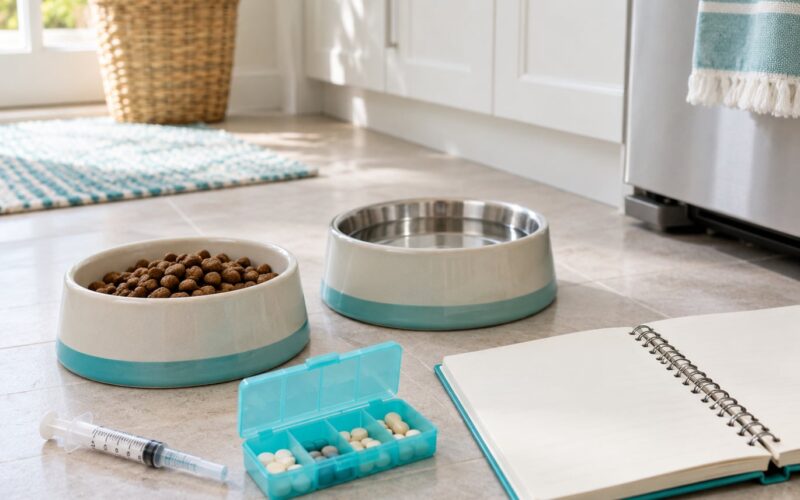
You do not need any special equipment to check a paw. What you need is quiet, a phone, and a way to keep the dog still.
- A phone with your vet’s number already saved. Also save the nearest emergency animal hospital, because it may not be your usual clinic and it is open when yours is not.
- A leash, carrier, or board and towel. A towel can be used as a sling under the belly to support a dog that will not stand well. A board or baking tray makes a stretcher for a dog too painful to lift on its own.
- A non-slip surface. Tile and hardwood make limping worse and make falls more likely. A rubber mat or a rug gives a sore dog something to grip.
- A list of current medications and health history. Include the joint supplement, the flea treatment, the last tick prevention, and any past surgery on that leg.
- A few minutes and quiet hands. Keep children and other pets out of the room before you start looking.
One rule before anything else. If your dog will not bear weight and seems in significant pain, do not make it walk across the room to see if it limps. Carry it, support it, or slide the board under it.
Step-by-Step: How to Tell If a Dog’s Limp Is Serious
1. Look for an emergency before touching the injured leg
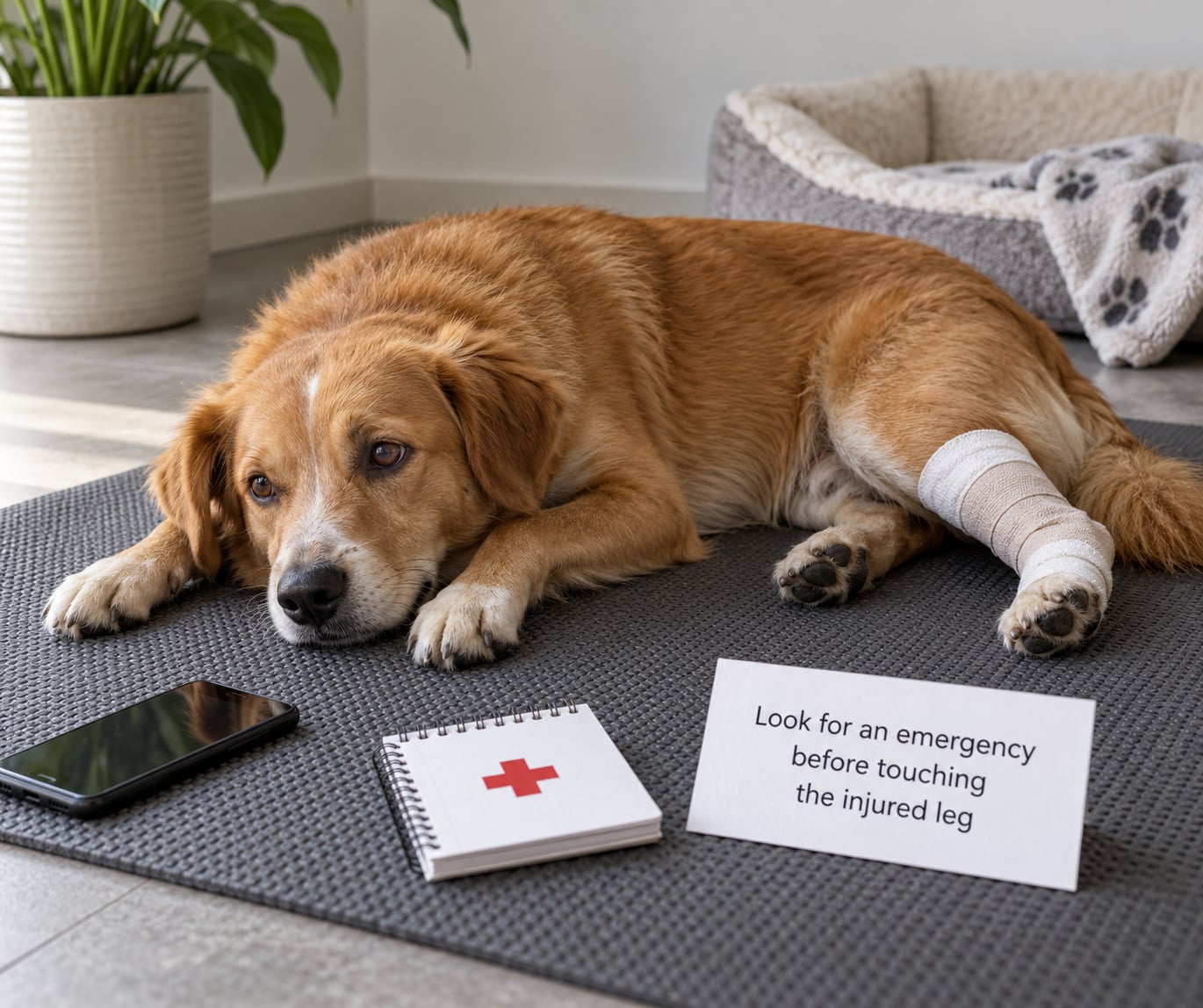
Before you touch anything, take ten seconds and scan for the signs that mean do not wait.
- No weight-bearing at all. The dog holds the foot up, taps it briefly, or carries it completely. This is the single strongest signal of a serious problem.
- A deformed or dangling limb. An obvious bend, a shortened appearance, or a joint that moves where it should not.
- A hot, swollen, or painful joint. Swelling that arrives within minutes of the limp usually points to an acute injury.
- Heavy bleeding, an open wound, or a wound you cannot cover.
- A pale, white, or blue gum color, heavy panting, weakness, collapse, or difficulty breathing. These suggest something affecting the whole dog, not just a leg.
- Screaming or a dog who cannot be approached at all.
If you see any of these, move as little as possible, call the emergency clinic, and head there. Do not try to straighten a leg, do not pop a swollen joint back in, and do not give anything from your own medicine cabinet.
2. Observe the limp and the dog’s overall condition
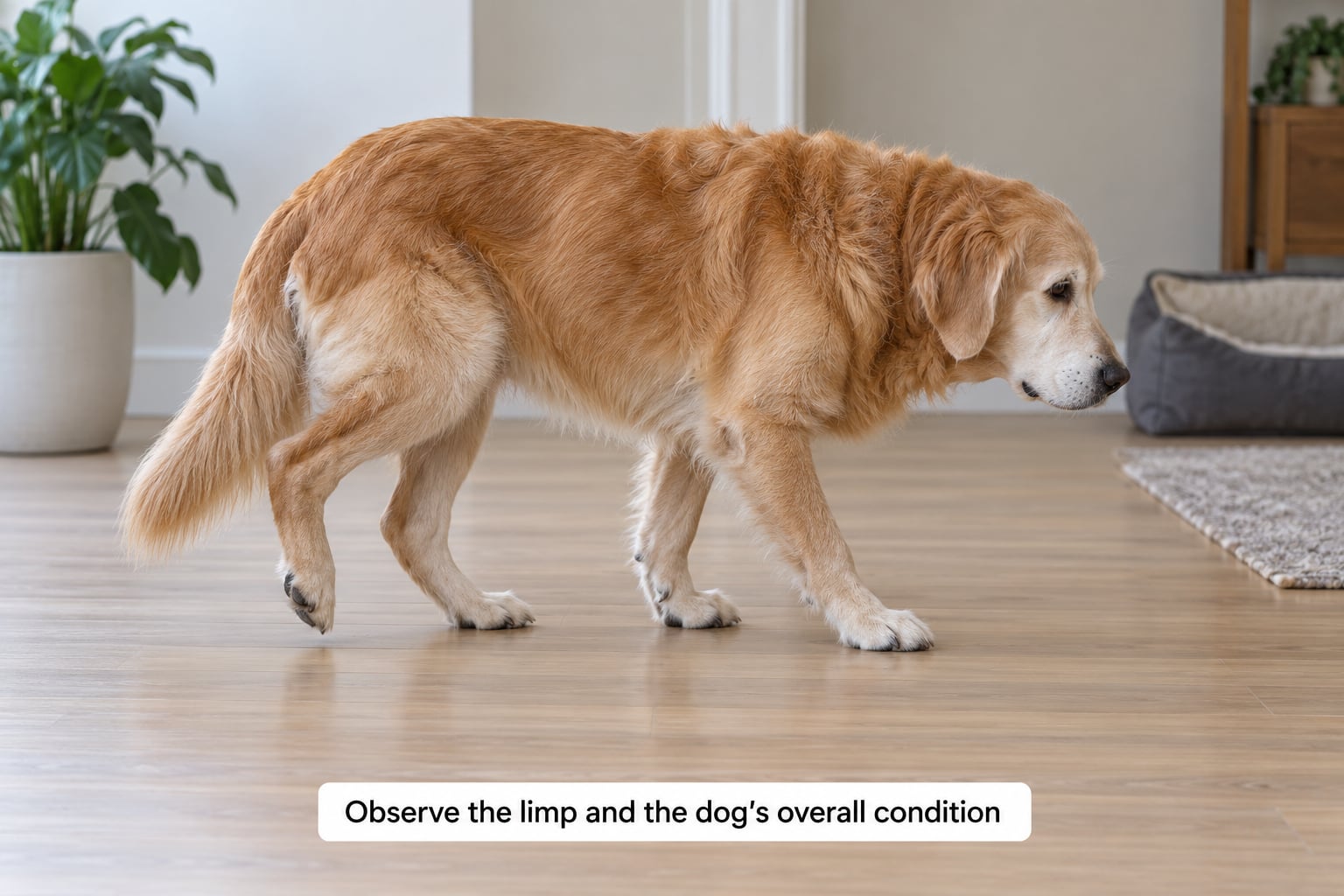
Watch from a distance, several feet away, before you get close. What you are looking for is the pattern of the limp and what the rest of the dog is doing.
Watch which leg is involved. A front-leg limp often shows a head bob, because the dog lifts its head when the sore side takes weight and drops it when the good side does. A back-leg limp often shows a short bunny hop or a crouching, low-backed posture.
Then notice the whole dog. Is he eating, drinking, and asking to go out? Is the limp constant, or does it appear only after he gets up from a long lie and vanish within a minute? Sudden onset, a limp that gets worse over hours, or a dog that has stopped eating, drinking, or showing interest in anything else needs a call to your vet the same day.
Filming helps more than most owners expect. Dogs frequently walk normally in the clinic. A ten-second clip of the limp from the side and from behind saves the vet from guessing, and it costs you nothing.
Two more things to note while you watch. Time it. Whether the limp appeared in the last hour or has been going on for a week changes the whole conversation, and “yesterday evening, right after he jumped off the bed” is far more useful than “a while.” And check both back legs from behind. Dogs shift the weight to the healthy side, which makes a sore hind leg look narrow and a sore front leg make the shoulder dip on each step.
While you are watching, write down the quick answers to the three questions a vet will ask first: can the dog put any weight on it, how long has it been happening, and is anything else different, including appetite, water, bathroom habits, and energy. Owners usually remember the limp and forget the vomiting.
3. Check the paw and surrounding area without causing pain
If the dog is weight-bearing, calm, and lets you near the foot, a paw check takes about a minute and finds a surprising share of cases.
- Look between the toes. Grass awns, burrs, and splinters work their way in and cause intense pain that owners rarely think to check.
- Check the pads. Look for cuts, punctures, a torn or worn pad, and anything sharp like glass or a nail.
- Look at the nails. A cracked, bent, or torn nail, often at the dewclaw, is common and very sore.
- Feel for heat and swelling. Compare both legs with the flat of your finger, not by squeezing.
- Look for a tick. A tick buried in a toe web or the crease of the groin can cause a sudden limp.
Stop the moment your dog pulls away, freezes, growls, or snaps. A growl under pain is information, not disobedience, and pushing on a sore paw can turn a small problem into a larger one. Note what you found and when, then let the vet do the hands-on work.
4. Decide whether the dog needs same-day veterinary care
Here is the decision most people are looking for. Three buckets, and you only need to pick one.
Go to an emergency clinic now. No weight-bearing on the leg, any deformity, a hot swollen joint, heavy bleeding, a dog in severe pain, pale gums, breathing trouble, weakness or collapse, a suspected car accident or fall, or a bite wound. Do not wait to see what happens in the morning.
Call your vet today and get an appointment. The limp is mild but more than a few hours old, the dog is limping on more than one leg at different times, there is swelling that is not growing, the dog is less active or eating less than normal, the limp came on without any obvious injury, or you found something in the paw you cannot clear yourself.
Rest and watch at home is reasonable when all of these are true. The dog puts weight on the leg, the limp started within the last few hours, there is no swelling, bleeding, or deformity, he is eating, drinking, and acting like himself, and the pain is mild. Keep him on a leash for short bathroom trips only, on a non-slip floor, away from stairs and furniture he jumps on.
Two adjustments to that. A dog that limps after exercise still needs attention if the limp does not settle within a few hours, because a soft-tissue injury looks exactly like harmless soreness for the first day. And puppies, senior dogs, and dogs with known joint disease deserve an earlier call, because the same limp means very different things at six months and at eleven years.
Causes worth knowing about
The diagnosis is not yours to make, but knowing the usual suspects makes the phone call to your vet faster.
Sudden, on one leg, right after activity. A sprain, a torn ligament such as a cranial cruciate ligament injury in the knee, a joint that has slipped or popped, or a fracture. Puppies may also show the brief leg pain of growing bone, which comes and goes.
Back leg, intermittent, hopping. A cruciate ligament, a hip problem, or discs pressing on nerves. A dog that yelps when picked up or struggles to jump onto the sofa deserves a same-day call.
Front leg, persistent, no injury you saw. Elbow or shoulder problems, a nail or pad injury, or arthritis that has reached the point where it changes the gait.
Slowly worsening over weeks. Hip or elbow dysplasia, luxating kneecap, osteoarthritis, or in older dogs conditions such as bone cancer. Slow does not mean harmless.
Whole dog unwell, and not just the leg. Fever, lethargy, refusing food, and a limp together point to infection, a tick-borne illness, or an injury elsewhere that the dog is compensating for. That combination is a same-day call even when the limp itself looks mild.
The same limp means different things at different ages
Age changes the odds more than most owners realize.
Puppies under a year. Limps that come and go with growing bone are fairly common and often resolve on their own, but a puppy is also growing and a fracture or an inherited joint problem can look deceptively mild. Puppies mask pain badly and bolt through pain, so a puppy that limps after a fall deserves to be seen.
Adult dogs. This is the age range where sprains, cruciate ligament tears, paw injuries, and nail injuries make up most cases, often after normal activity that simply happened to land the wrong way.
Senior dogs. An old dog limping is far more often arthritis or an age-related joint change than a fresh injury, but a sudden change in an arthritic dog still needs checking, because owners routinely assume the flare is the same problem as last month. A sudden limp in a senior dog that will not settle is also the presentation vets worry about least hopefully, which is why it is worth a prompt exam rather than a wait.
What happens at the vet visit
Knowing the likely sequence takes some of the anxiety out of the call. Most limping dogs start with a physical exam: watching the gait, palpating the joints and spine, and checking the paw again, often with pain mapped out by touch and response.
Radiographs are the usual next step because bone and joint structure do not show up any other way. Depending on what the exam suggests, bloodwork may check for inflammation or infection, and advanced imaging such as MRI or CT is reserved for spine, complex joint, or unclear cases. Some clinics offer sedation for imaging so a sore dog can be positioned safely.
The waiting and the uncertainty about what comes next is usually harder than the appointment itself. Ask what they would rule out first, and ask what would change if the dog stops weight-bearing overnight. Then follow the rest instructions closely, because recovery depends far more on what happens at home than on what happened in the clinic.
Common Mistakes
Forcing the dog to walk so you can see the limp better. It does not give you useful information and it can worsen an injury. Support the dog on a leash for a few seconds, from a standing position, and stop.
Manipulating the leg repeatedly. Bending the knee, massaging the thigh, or trying to pop a joint reduces the chance of finding the cause and adds pain. One careful look, then the phone.
Assuming no pain means no problem. Plenty of dogs keep eating, playing, and greeting you at the door with a torn ligament. Watch the gait, not the drama.
Giving human pain medicine. Ibuprofen, acetaminophen, naproxen, and aspirin are not safe for dogs and some cause serious stomach, kidney, or liver injury. If your dog takes a joint supplement, mention that instead, and let your vet advise.
Applying a household remedy. No alcohol, no essential oils, no turmeric paste, no human creams containing ingredients dogs lick off. A warm compress for a general ache is fine; anything medicated is a vet call.
Waiting past the 24-hour mark while hoping it improves. If the limp is the same or worse after rest, or if it comes back repeatedly over days, book the appointment. Recurring limping in a dog who is otherwise fine often points to an undiagnosed joint or spine problem.
One last safety tip. When you transport a dog in serious pain, slide a board or a thick blanket underneath, support the whole body including the chest, and lift together rather than scooping from the belly. A dog in pain may bite the person it loves most.
Frequently Asked Questions
Can a dog limp from a sore paw?
Yes, and it is one of the most common and most easily missed causes. A splinter, grass awn, burr, cut pad, or cracked nail makes a dog shift its weight off that foot, sometimes with no swelling and no yelping. Check between the toes, the pads, and the dewclaw, and look for heat or a broken nail edge. If you find something shallow and obvious you can clear safely, do it and watch. If you find a puncture, a torn nail, or you cannot see the object, call your vet the same day.
How long should I wait before taking a limping dog to the vet?
For a dog that puts weight on the leg, has no swelling or bleeding, and acts and eats normally, waiting a few hours to a day while restricting activity is reasonable. If the limp has not improved after that rest, book an appointment. Call the same day if the dog is less active, not eating, has swelling, or starts favoring a different leg. Go immediately, without waiting at all, if there is no weight-bearing, deformity, severe pain, or any sign the whole dog is unwell.
Is it normal for a dog to limp after exercise?
Brief soreness that settles within a few hours and leaves no trace can happen, especially after an unusually long or rough outing. What is not normal is a limp that persists, comes back every time the dog runs, or shows no pattern at all. Repeated limping after the same activity usually points to an underlying joint, ligament, or paw problem that gets worse with load. Keep walks short, on the flat, and on the leash while you monitor, and get a vet opinion if it repeats.
What should I do if my dog will not put weight on one leg?
Treat it as an emergency. Take the dog to an emergency clinic the same day. In the meantime, keep movement to a minimum, keep other pets away, and do not try to straighten, bend, or massage the leg. If the dog must be moved, slide a board, baking tray, or thick blanket underneath and support the chest and hindquarters while lifting. Note whether there is swelling, deformity, or a wound, and mention any recent fall, car incident, or rough play when you arrive.
Can I give a human pain reliever to a limping dog?
No. Ibuprofen, naproxen, acetaminophen, and aspirin can cause stomach ulcers, kidney failure, and liver damage in dogs, and dogs metabolize them differently from people. Signs of trouble include vomiting, drooling, belly discomfort, and lethargy. If your dog already swallowed one, contact a vet or an animal poison line straight away rather than waiting for symptoms. Only give medication your own veterinarian has prescribed for this specific dog at this specific dose.
Does a dog limp if the injury is serious?
Usually yes, and often that limp is the only clue you get. Serious injuries such as fractures, cruciate ligament tears, or hip problems typically produce a visible change in gait, and the absence of weight-bearing on the leg is the most worrying sign. But some dogs limp from pain they have learned to work around, and some hide discomfort so well that the change is subtle. Treat a new or changed gait as worth a veterinary exam rather than something to watch for a week.
Conclusion: What to Do First
Keep the dog quiet first. No jumping on the sofa, no stairs, no off-leash walks, just short leash trips to the garden on a non-slip floor. Then look at the paw once, gently, and stop if your dog pulls away or growls.
Call a veterinarian urgently if your dog cannot bear weight, if the leg looks deformed, if a joint is swollen and hot, if there is bleeding, or if the dog seems in real pain or unwell overall. Those signs do not improve with rest at home.
If your dog is weight-bearing and acting normally, you have a few hours to a day of careful watching with activity restricted. If the limp is still there when that is over, book the visit instead of starting another round of waiting.
Only a veterinary professional can diagnose the cause of a limp and recommend the right treatment. Your part is spotting the warning signs, keeping the dog still, and making the call.