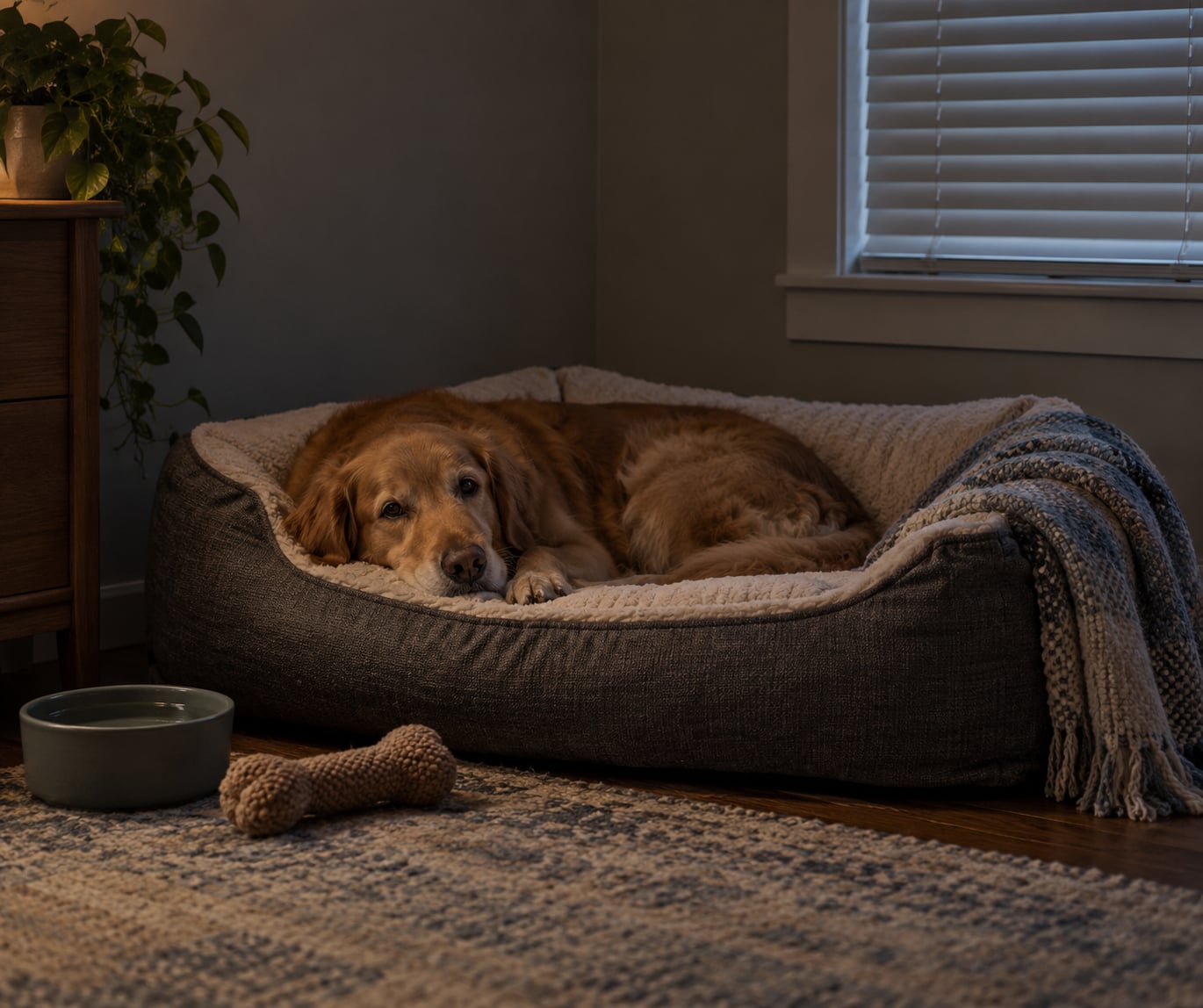
To calm a dog during thunderstorms, cut the light and the noise first. Set up a small windowless room with the dog’s own bed, close blinds and curtains, run steady ambient sound such as a white noise machine or a television, and keep your own voice low and unhurried. Add a chew, lick mat or stuffed food toy so the dog has something calm to do.
Most people searching how to calm a dog during thunderstorms get advice split between “ignore it” and “cuddle them hard”, and both extremes tend to backfire. Storm fear is a fear response, not disobedience, so it responds to a lower-stimulation environment and a predictable routine rather than to reassurance or scolding.
One honest note before we start. Nothing here cures the fear outright, and owners on r/dogs repeatedly say so. What does work is managing the environment in the moment, then training the dog gradually between storms. Severe cases need a veterinarian, and that call comes before the storm, not during it.
Table of Contents
- What You Need
- Step-by-Step: How to Calm a Dog During Thunderstorms
- 1. Prepare a Safe, Familiar Space
- 2. Reduce Noise and Visual Triggers
- 3. Keep Your Body Language Calm
- 4. Offer Comfort Without Forcing Interaction
- 5. Use Desensitization and Counterconditioning Between Storms
- 6. Know When to Contact a Veterinarian
- Common Mistakes
- Frequently Asked Questions
- What can I do to calm my dog during a thunderstorm?
- Should I put my dog in a crate during a thunderstorm?
- Can I give my dog human anxiety medicine during a storm?
- Is thunderstorm anxiety dangerous for dogs?
- How can I help my dog get used to thunderstorms?
- When should I call a veterinarian about my dog’s storm fear?
- Conclusion
What You Need

Gather these before the sky turns grey, because hunting for a white noise machine at the first thunderclap wastes the ten minutes that matter most.
- A small, windowless room the dog already likes, with its bed and a water bowl. A walk-in closet, bathroom or laundry room usually works better than the middle of the living room.
- A blanket or towel to drape over a crate, the doorway or the side of the bed, softening light and edges.
- Steady background sound: a white noise machine, an exhaust fan, a radio or a television left on at a moderate volume.
- Something to chew: an indestructible chew, a lick mat or a stuffed food toy. Food puzzles work too, as long as the dog is not too panicked to focus.
- A leash for the quick bathroom break, plus pee pads in case the dog soils indoors.
- A checked microchip and an up-to-date ID collar, in case a frightened dog bolts.
- Your veterinarian’s phone number, plus a plan agreed in advance if the dog needs medication before a storm.
One item does not belong on that list: human medication. Benadryl and similar over-the-counter antihistamines are made for human allergies, not noise aversion, and they do not treat the fear itself. More on that in the mistakes section.
Step-by-Step: How to Calm a Dog During Thunderstorms
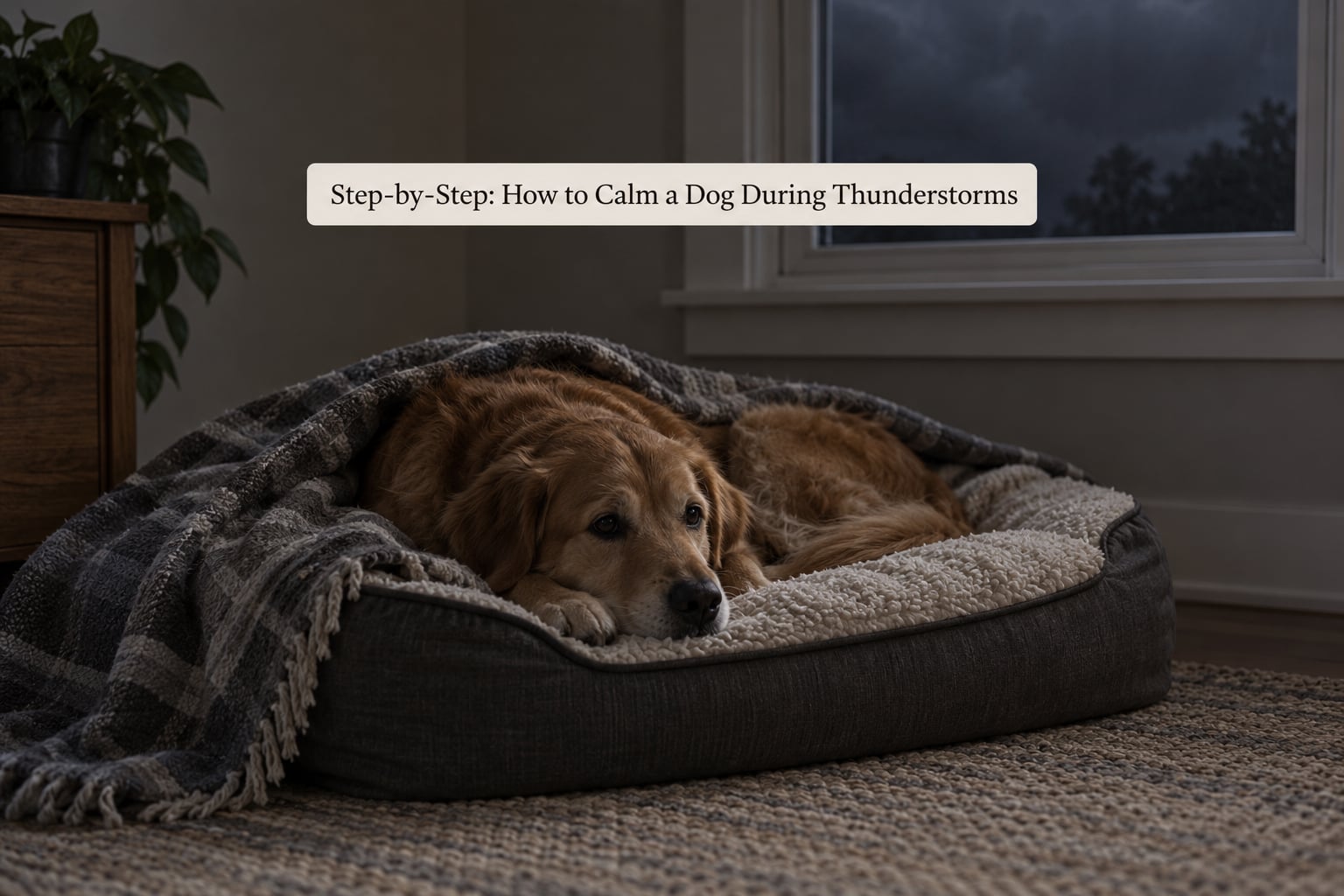
Work through these in order. The early steps change what the dog senses, the middle steps change how you behave, and the last two decide whether the next storm is easier than this one.
1. Prepare a Safe, Familiar Space
Choose the smallest room in the house that still feels normal to the dog, and put its bed, water and a favourite toy there before the storm arrives. Small and predictable reads as safer than a large, open room full of windows and doors.
Getting how to calm a dog during thunderstorms right starts here, hours before the first thunderclap, rather than in the middle of the panic.
Let the dog walk in on its own rather than carrying or pushing it inside. A dog that chooses its own retreat keeps more control, and control is what a frightened animal is missing everywhere else in the house.
A crate only works if the dog already relaxes in one. Owners on r/dogs describe dogs that go “crazy” inside a crate they associate with being left alone, and that panic is worse than simply hiding under the bed.
2. Reduce Noise and Visual Triggers
Close windows, blinds and curtains before the first flash. Lightning strobes through glass, and each bright sheet restarts the whole reaction even when the thunder is far away. If the dog spends most of the storm watching the window, move the setup a room deeper into the house.
Then mask the sound with something steady. A white noise machine, a fan, a radio or a television on a moderate volume all work because the goal is a flat background that makes sudden thunderclaps less jarring, not silence.
Leave whatever you switch on running for the whole storm. Sudden volume changes, switched-off TVs and loud music all read as new events, which is the opposite of what a scared dog needs.
3. Keep Your Body Language Calm
Sit on the floor near the dog without reaching for it, and speak in a low, ordinary voice about nothing in particular. Most dogs relax when their person stays boring, because boring means safe.
On the hugging question, aim for presence rather than restraint. Sit side-on, let the dog sniff an offered hand, and let it decide whether to lean against you. Firm hugging repeated during storms can amplify the fear, and it teaches the dog that the noise means a person is distressed too.
Skip the baby talk. A rising, sing-song tone reads as alarm, and nervous owners move fast and talk loud, which the dog picks up long before it picks up on thunder.
4. Offer Comfort Without Forcing Interaction
Redirection works better than reassurance here. Offer a chew, a stuffed food toy or a lick mat the moment the dog settles, and ask for a cue it already knows, like “mat” or “place”. Familiar, simple tasks fill the time that fear would otherwise fill.
Petting is welcome when the dog seeks it out, and unwelcome when it does not. Watch for the early signals of discomfort: a dog that pulls away, freezes, growls, shows the whites of its eyes, tucks its tail or suddenly goes very still has already told you to stop.
Keep sessions low-key. A calm ten minutes with a chew is worth more than an hour of fussing, because fussing keeps the dog focused on you and therefore on everything that is frightening outside.
5. Use Desensitization and Counterconditioning Between Storms
This is the part that actually changes the dog long-term, and it works in the opposite direction from what most owners try. Play a recording of thunder at a volume the dog ignores, then immediately pair it with something good: treats, a chew, a short game. Over weeks, nudge the volume up a step at a time and stay at that level for several sessions.
The rule is the anxiety threshold. If the dog stops eating, stares at the speaker, hides or barks, you have gone past it. Come back down, repeat the easy version, and only then try again. Deliberately flooding a dog with storm sounds makes the fear worse and is the fastest way to end this process for good.
There is an honest limitation. Behaviourists note that many dogs tell recorded thunder apart from a real storm, which is why severe cases often pair the training with medication a veterinarian prescribes. Start young, too. The shelter-origin 3-3-3 rule, three days to decompress, three weeks to feel safe, three months to fully trust, applies to storms as much as it does to new homes, and a puppy’s first storm tends to set the tone for the next ten years.
6. Know When to Contact a Veterinarian
Call the same day if the dog is scratching at doors or windows hard enough to damage them, has broken out of the house, will not settle even in the safe room, is panting or salivating heavily with no pause, refuses food and water, vomits, or hurts itself trying to escape.
Those are the markers of a phobia rather than ordinary anxiety, and a dog at that level risks injury and a lost dog every time the pressure drops.
A vet visit also rules out what looks like storm fear but is not. Ear infections, an arthritis flare as barometric pressure falls, dental pain and thyroid problems all make storms harder to sit through, and an owner in r/germanshepherds described a dog whose storm fear turned out to be pain that grew worse every time the weather shifted.
Ring before storm season and ask what your dog can have. Veterinarians commonly discuss trazodone, diazepam or a noise-aversion product such as Sileo, dosed to the animal before the storm rather than during the panic. Owners report trazodone working well but leaving their dogs noticeably drowsy, so it is a conversation, not a dose you calculate yourself.
Common Mistakes
Scolding a barking or howling dog is the most common error, and the worst one. Punishment tells the dog the storm is worth barking about, and it removes the only warning sign you had.
Forcing a frightened dog outside to use the garden teaches the yard is a place bad things happen. Take the leash out with a treat, keep it to twenty seconds, praise heavily, and come straight back in.
Giving human sedatives without veterinary direction is dangerous. Diphenhydramine, sold as Benadryl, does not treat noise aversion, and the sedation can produce disorientation or the opposite of calm. No human medication goes into a dog without a vet telling you to give it.
Turning up the television or blasting music partway through a storm adds a new shock to an already overwhelmed dog. Set the sound level once, before the storm, and leave it alone.
Crating a dog that panics turns a container into a trap. Owners on r/dogs and r/Bulldogs both describe the damage this causes, from chewed crate doors to injured muzzles. Give the dog an open room with a way out instead.
Waiting until the dog is already in full panic to try something new is a mistake too. Every method works better when the dog starts it calm, which means setting up the safe space hours ahead.
It helps to know what owners found disappointing. Anxiety wraps and thundershirts help some dogs “a bit” and do nothing at all for others, and pheromone diffusers are widely reported as marginal. None of that means skip them, just do not spend the storm assuming one of them is the answer.
Finally, write down what the dog does during a storm. Dates, times, what happened ten minutes before, whether the dog ate or slept that day. That log is the single most useful thing you can hand a veterinarian, and it takes about two minutes a storm.
Frequently Asked Questions
What can I do to calm my dog during a thunderstorm?
Move your dog into a small windowless room with its bed, close blinds and curtains, and run a white noise machine, fan or television at a moderate volume. Keep your voice low, avoid hugging or scolding, and offer a chew, lick mat or stuffed food toy to redirect. Start before the first thunderclap, not during the panic.
Should I put my dog in a crate during a thunderstorm?
Only if your dog already relaxes in a crate. For a dog that associates the crate with being left alone, crating adds confinement to fear and can cause panicked damage or injury. A small room with a bed, water and a way out is safer. If your dog has panicked in a crate before, keep the door open or skip the crate entirely.
Can I give my dog human anxiety medicine during a storm?
No. Human sedatives and antihistamines such as diphenhydramine, sold as Benadryl, do not treat noise aversion and can cause disorientation, sedation or the opposite of calm. Never give a dog any medication that was not prescribed for that dog by a veterinarian, including leftover pills from another pet.
Is thunderstorm anxiety dangerous for dogs?
Mild fear is not dangerous, but severe storm anxiety is. Dogs at the severe end scratch through doors and windows, chew walls and bedding, injure themselves and sometimes escape into the street. A dog that hurts itself or tries to break out is an emergency. Call your veterinarian the same day rather than waiting for the next storm.
How can I help my dog get used to thunderstorms?
Play recorded storm sounds at a volume your dog ignores, pair them with treats or play, and raise the volume in small steps over several weeks. Stop the session while your dog is still relaxed, since pushing past that point makes fear worse. Severe cases often need a veterinarian, who can pair training with prescribed medication.
When should I call a veterinarian about my dog’s storm fear?
Call before storm season if your dog hides, howls, soils the house, cannot settle or destroys property. Call the same day if there is any self-injury, an escape attempt or heavy panting that will not stop. A vet can check for pain, ear infection or thyroid problems that make storms harder, and discuss pre-storm medication such as trazodone or a noise-aversion treatment.
Conclusion
Most of how to calm a dog during thunderstorms happens before the storm arrives. Start by building the retreat while the forecast is still quiet: a small room, the dog’s bed, water, a chew, closed blinds and a steady background noise. Keep your own behaviour ordinary and low, since a bored owner reads as a safe room.
Then work on the long game between storms, keeping every training session under the point where the dog gets upset, and keep a note of what you see each time. For dogs whose fear is intense, dangerous or getting worse every season, a veterinarian can rule out pain, prescribe pre-storm medication and refer you to a behaviourist. Managed well, most dogs get through a storm without a scratch.