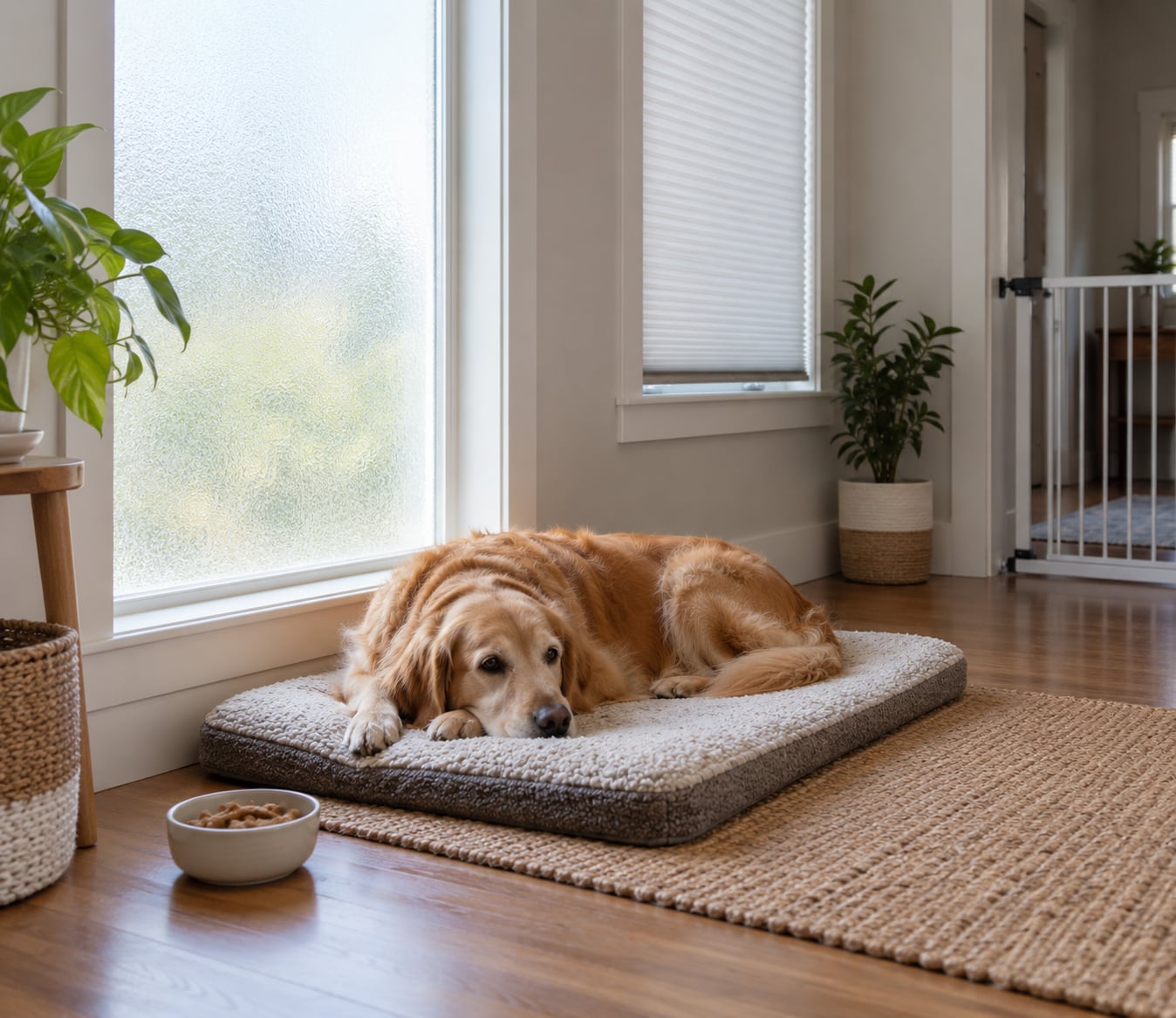
To stop nuisance barking at the window, you do two things in order: cut off the dog’s view and access to whatever triggers it, then reward a calm alternative such as settling on a mat before any barking begins. Management comes first, because window barking is a self-reinforcing behavior that never fades on its own. Most dogs show measurable change within two to six weeks of five-minute daily sessions.
I have watched this pattern repeat in a lot of homes. The owner shouts, the dog barks harder because shouting is attention, and everyone concludes the dog is being stubborn. The dog is not being stubborn. It is doing what worked yesterday.
Table of Contents
- How to Stop Nuisance Barking at the Window: What You Need
- Step-by-Step: How to Stop Nuisance Barking at the Window
- 1. Record What Triggers the Barking
- 2. Manage Access While You Train
- 3. Teach an Emergency Uplift to a Mat
- 4. Reward the First Quiet Moment
- 5. Gradually Reintroduce the Window
- 6. Add a Last-Resort Management Plan
- Common Mistakes When Trying to Stop Window Barking
- Frequently Asked Questions
- Is it normal for my dog to bark at dogs or people passing the window?
- How long does it take to stop nuisance barking at the window?
- Should I use a bark collar to stop my dog barking at the window?
- What if my dog barks at every noise outside instead of one specific trigger?
- Why is my dog suddenly barking more at the window?
- When should I ask a veterinarian or behaviorist for help with window barking?
- Conclusion
How to Stop Nuisance Barking at the Window: What You Need
You need four things before you start training, and none of them are expensive.
- A safe management area. A room the dog can stay in, away from the window, that you can close the door to. A bedroom works. A crate the dog is already comfortable in works better than one he has never been introduced to.
- Long-lasting treats. Something that takes ten to twenty seconds to eat, not a training biscuit he swallows in one gulp. This matters more than owners expect, because a treat that vanishes instantly is not enough of a reward to hold attention.
- One training cue. Pick a single word or hand signal. Popularity is not the issue here, consistency is.
- Ten quiet minutes. Two or three short sessions a day beat one long one. A dog that is already barking cannot learn in the moment, so your job is to catch the behavior before it starts.
Add one more thing that is not on the shelf: a contact point. A vet for the medical questions, and a certified behavior consultant (CPDT-KA or CBCC-KA) or veterinary behaviorist for the hard cases. Having the number saved is what stops you from reaching for a shock collar at 7pm on a bad day.
Step-by-Step: How to Stop Nuisance Barking at the Window
1. Record What Triggers the Barking
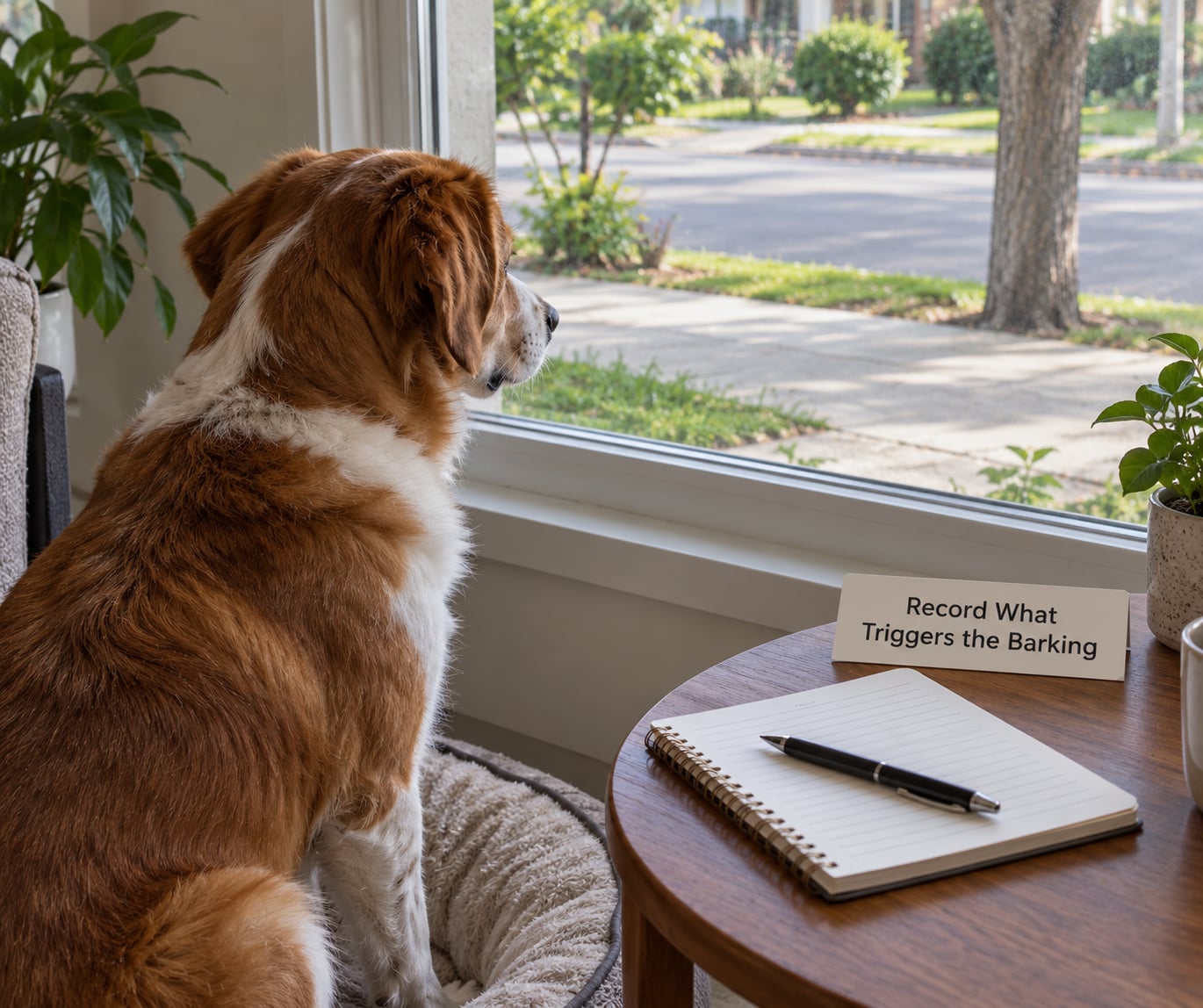
Watch for a week and write it down. Not what you assume triggers the barking, what you actually observe. Owners routinely blame squirrels for behavior that is really mail carriers, or blame the mail carrier for behavior that started the day a neighbor moved in.
Log four columns in the notebook: time of day, what the dog saw or heard, the dog’s body language in the ten seconds before the first bark, and how long the barking lasted. The body language in those ten seconds is the part that tells you what kind of barking you are dealing with.
- Alerting, probably territorial. Stiff posture, ears forward, tail high, quick bursts with pauses to look back at you. First action: block the sightline and reward a check-in with you.
- Fear of what is passing. Crouching, tucked tail, backing away, then barking from a distance. First action: close the curtains and increase the distance from the glass.
- Frustration at the barrier. Whining and scratching at the frame, repeated short barks, spinning. First action: move the dog physically away and offer a chew.
- Rehearsed behavior that has escalated. Barking only at delivery drivers, dropping to a growl then lunging at the glass. First action: block the view now, plan desensitization later.
How you know it worked: you can name the trigger instead of describing it as “anything and everything”. Owners often find the list is much shorter and much more specific than the vague version they had in their head.
2. Manage Access While You Train
You cannot train a dog out of a behavior that pays off eight hours a day. Window barking works because something happens after the barking: the person walks on, the car passes, the squirrel leaves. The dog does not know the person was going to leave anyway.
So close the loop. Close the curtains or blinds. Hang frosted or privacy film on the glass, which is the option most often recommended on r/reactivedogs precisely because it blocks the view and keeps the daylight. One owner there put it plainly: block the windows, use window film if you want to keep the light.
Then block the physical route too. A baby gate across the window, a closed door, or simply moving the bed and the sofa six feet back. Owners on forum threads report the same thing: gates and film changed the situation faster than any training exercise they tried.
Management is not failure. Every major behavior program, from the ASPCA’s to any competent trainer’s, starts with managing the environment so the dog can practice successfully.
How you know it worked: barking episodes drop within days, purely from blocking. That drop is your baseline, and it is worth writing down.
3. Teach an Emergency Uplift to a Mat

Now teach the dog one place to go. Put a mat or bed on the floor a few feet back from the window, in a spot he can see you from. Reward him for touching it, then for lying down, then for staying down. The cue word is yours to pick; owners often use “mat”, “place” or “bed”.
Timing is the whole skill. Deliver the treat about a second before the barking would start, not after. Watch for the early signs: a head turn toward the window, a stiff neck, ears going up, freezing. That is the moment the reward belongs.
Once the dog will settle on the mat on cue, add a release word so he knows he can get up and come back. A dog who lies down and never gets released will eventually invent his own way out, usually by barking.
How you know it worked: the dog starts moving toward the mat when you say the word, before any barking. That is the behavior-change signal, and it usually arrives before the barking stops.
4. Reward the First Quiet Moment
Now you are paying for silence, or at least for the start of quiet. The moment the dog looks away from the window, checks back to you, or steps onto the mat, mark it and reward. A cheerful “yes” works as the marker, and the treat follows within a second.
Do not build up to a demand that the dog must stay silent for ten seconds while a person walks past. That is a high bar, and failing it teaches the dog that quitting does not pay. Start with one second. Grow the duration in small increments, a second or two at a time, on different days.
Reward generously at first. A dog who gets three good treats for a quiet second will repeat it longer than a dog who gets one treat every fourth bark.
How you know it worked: the dog recovers faster. Barking at four episodes a day that become two, or episodes that last eight seconds instead of forty, is real progress even though the sound is still there.
5. Gradually Reintroduce the Window
Once the mat settle is reliable, start working under threshold: close enough to the window to notice movement outside, far enough that the dog can still take a treat and think about something else. That distance is different for every dog, and for a highly reactive one it may start at the far end of the room.
Work below that distance, rewarding calm attention. When the dog locks onto the window and stops responding, stop too. Do not push to the point of barking, and never repeat a session that already ended in a barking fit. Close the view, end on a good note, try again tomorrow at a greater distance.
Success is not silence. Success is a shorter episode, a slower start, or a dog who looks at you instead of the glass. Owners who expect total silence usually quit right before the behavior actually changes.
One warning worth naming: hours of window barking rehearse the same stare-then-explode pattern your dog uses on walks. Reactive owners on r/reactivedogs describe the two getting worse together, and fixing the window is often where leash handling improves too.
How you know it worked: the dog can stand near the window and take food. That is measurable, and you can log it in seconds per day.
6. Add a Last-Resort Management Plan
Some days you cannot train. You are on a call, you are working, the dog is not calm enough to listen. On those days, manage rather than train, and change what the dog is doing rather than what you are saying.
- Longer walk, nose down. A sniff walk tires a dog more than a faster one, and a tired dog has less fuel left for the window.
- Food before the barking window. Feed the evening meal, or a portion of it, before the hour when barking reliably starts. A hungry dog with a full bowl is a different dog at the glass.
- Chew work. A chew in another room buys quiet without a single word from you.
- A protected resting place. A crate, a covered bed, or the bathroom door shut. Rest is a reward, not a punishment, as long as the dog chooses to enter it.
- Background sound. A radio or white noise at low volume softens outside sounds. It is a support, not a fix, and it works best alongside everything else.
Permanent window restrictions are a legitimate answer for some dogs, particularly in ground-floor flats on busy streets. If your dog cannot yet be calm near the glass, keeping it covered permanently is a responsible choice, not giving up.
How you know it worked: you have a plan for the days you cannot train, so a bad day no longer turns into a punishment.
Common Mistakes When Trying to Stop Window Barking
Most window barking that gets worse rather than better is caused by one of these.
Yelling at the dog. Shouting is attention, and attention is a reward. It also teaches you that the dog is the problem, which stops you from looking at the trigger.
Spray bottles, water pistols and “pet corrector” devices. They suppress the sound without changing the reason for it. You get silence that stops the moment you stop holding the bottle, and many dogs learn to bark when they cannot see you coming.
The coin-in-a-soda-can noise hack. You will still see this recommended on home advice forums, and it is worth being blunt about why it fails. It adds an unpredictable startling noise to a situation the dog is already overstimulated by. The dog does not learn what the sound means, only that the room is loud. The American Kennel Club’s guidance on window barking does not include startling devices for that reason.
Bark collars, including shock and ultrasonic collars. A bark collar cannot tell your dog whether barking was correct, so it cannot teach judgment. Punishing the behavior you want to remove does not teach you the behavior you want instead, and it adds an unpleasant association to the window itself.
Waiting it out with “just ignore it”. Ignoring works for attention barking. Window barking is reinforced by the trigger leaving, which happens whether you respond or not, so nothing changes.
Rewarding after the barking has already started. If the treat arrives after the first bark, you have paid for the barking. Move the reward earlier next session rather than giving up on the exercise.
Raising difficulty too fast. Moving the dog closer to the window, or redecorating the curtains on the same day the dog had a good session, sets the work back by days. Judge each step by whether the dog could still take food, not by how brave you feel.
Expecting silence as the finish line. What you are really building is a dog who checks in with you and settles. If you only reward total silence, you will rarely get a reward delivered at the right moment.
One habit that keeps all of this consistent: write the daily numbers in the same notebook. Episodes per day, longest episode, seconds to recover. Owners who track it rarely abandon a plan early, and they can tell the difference between a bad day and a real regression.
Frequently Asked Questions
Is it normal for my dog to bark at dogs or people passing the window?
Yes. Alerting at movement outside is normal canine behavior, and most dogs do it. The problem is not the barking itself but that it is self-reinforcing, so it grows stronger with practice rather than fading. Manage the sightline first, then reward a calm alternative such as a mat settle. The barking usually eases once the dog has something better to do.
How long does it take to stop nuisance barking at the window?
Most dogs show a change in two to six weeks, but the drop in episodes often comes in the first few days of blocking the view. Owners who reward a mat settle usually see the dog choosing the mat before the barking starts within one to two weeks. Treat this as a training plan with a baseline, not a switch. Sudden change in an older dog is the exception, and needs a vet.
Should I use a bark collar to stop my dog barking at the window?
No. A bark collar cannot tell your dog whether barking was the right choice, so it teaches avoidance rather than judgment. It also adds an unpleasant association to the window itself, which can make the problem worse. Some owners report a silent dog and no change at all once the collar is removed. Management plus reward-based training addresses the reason for the barking.
What if my dog barks at every noise outside instead of one specific trigger?
That usually means there is no single trigger, and training has to start earlier in the chain. Log the time, the noise, and the body language for a week, and look for the earliest consistent signal, which is often a head turn rather than a bark. Block the view, teach a mat settle, and reward the very first quiet moment rather than waiting for a full stop.
Why is my dog suddenly barking more at the window?
Common causes are a new trigger in the street, a change in the household, reduced exercise, or a dog now needing more mental work. In a senior dog, a sudden increase in barking can point to pain, hearing or vision changes, or cognitive decline, and a vet visit comes before any training plan. In a young dog, check the calendar first: a new route, a new neighbor, or more time spent alone often explains it.
When should I ask a veterinarian or behaviorist for help with window barking?
Speak to your vet first if barking is sudden, if it comes with panting, pacing, scratching at the door, or any sign of pain, or if your dog is over eight and the change is new. Ask a certified behavior consultant or veterinary behaviorist if barking is intense, if it is paired with lunging at the glass, or if gentle management has not helped within a few weeks.
Conclusion
Start with the trigger, not the dog. Watch and write down what your dog is reacting to, block the view for a few days, and treat that drop as your starting number. Then teach one place to go, reward it a second before any barking would start, and raise the difficulty only when the dog can still take food.
Consistency is what does the work, and so is patience with a plan that improves in small ways rather than all at once. If the barking is sudden, intense, or comes with distress, talk to your vet or a certified behavior consultant before adding any equipment to the window.