You can tell if your dog is too cold outside by watching their body language: shivering or trembling, lifting or holding up their paws, walking slowly or stopping often, hunching with the tail tucked, whining, seeking shelter, and suddenly becoming unusually sleepy. If you see two or more of those, head home. Updated for 2026.
The frustrating part is that there is no single temperature that decides it. A 12-pound smooth-coat dog can be in trouble on a mild day while a husky plays in the snow for half an hour and is completely fine.
Veterinary sources such as PetMD, the Ontario SPCA and GreenCross Vets all frame cold risk the same way: air temperature is one input, and the dog’s size, coat, age and wetness decide how much the reading matters. Owners who feel guilty about cutting walks short tend to want one clean number. What works better is a repeatable check you run every time, whatever the forecast says.
Table of Contents
- What You Need
- How to Tell If Your Dog Is Too Cold Outside: Step-by-Step
- Start With Your Dog’s Baseline
- Look for Behavioral and Physical Warning Signs
- Check the Paws, Coat and Skin
- Step-by-Step: Protect Your Dog During and After the Walk
- Common Mistakes
- How Cold Is Too Cold?
- Warm Your Dog Safely After Going Inside
- Frequently Asked Questions
- What temperature is too cold for a dog outside?
- How do I tell if my dog has hypothermia?
- How can I warm up my cold dog?
- Can a dog stay outside all night in the winter?
- Why is my dog shivering when it is not cold?
- How long can a dog be outside in freezing weather?
- Conclusion
What You Need
The whole check takes less than a minute if you have these close by.
- A rectal thermometer — the only way to know the actual number rather than guess from behaviour. A digital one is fastest and easiest to read.
- A towel — for wet coats, snow clinging to fur and ice packed between the toes after you get home.
- Water — dogs drink less outdoors in winter because the water feels cold, and dehydration shows up fast in a small dog.
- Your dog’s normal leash behaviour in mind — the strongest single sign owners report noticing first is a dog that stops pulling.
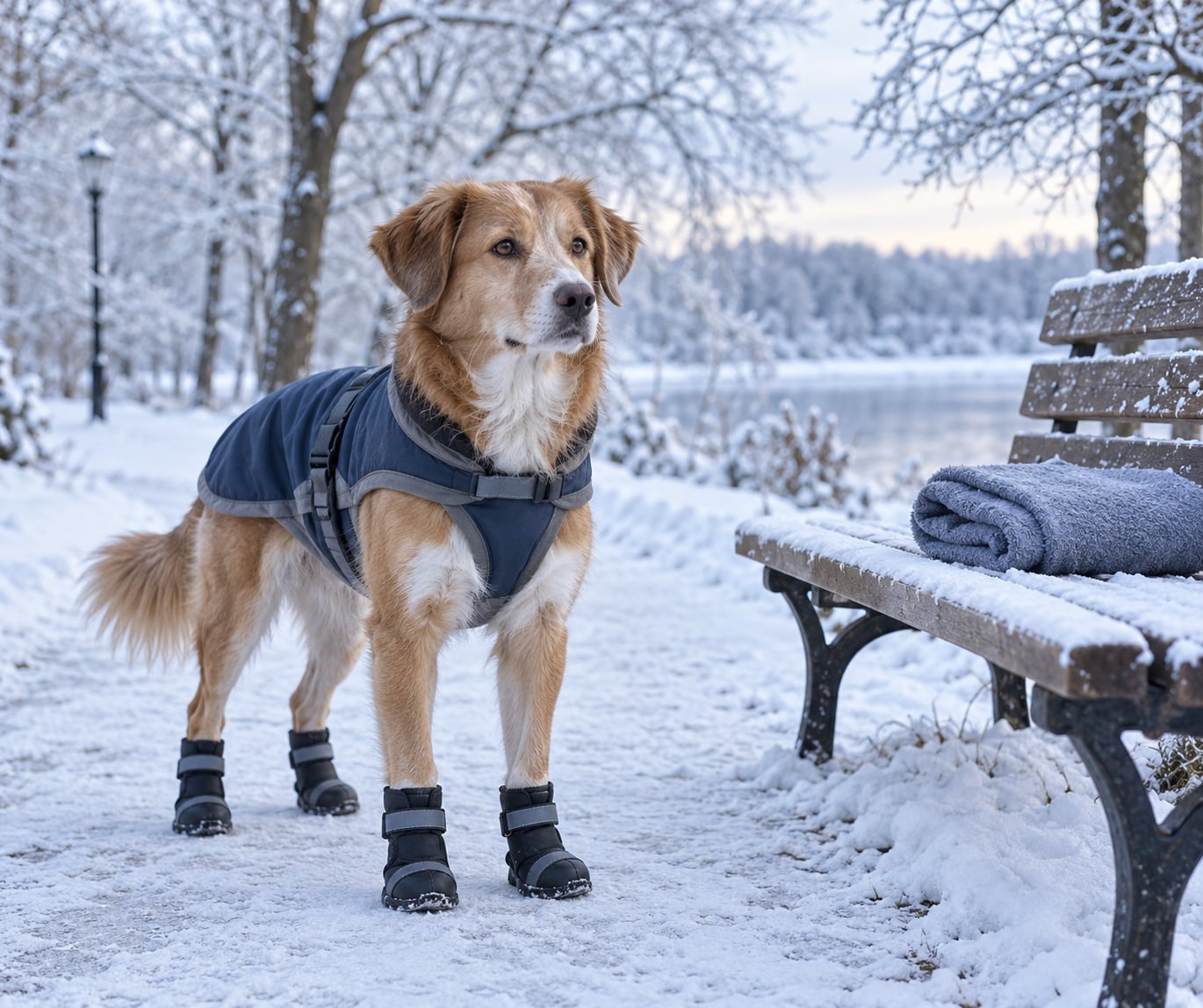
- Paw balm or booties for salted or icy pavement, plus a dog-appropriate coat when the breed needs one.
- A known-risk profile for your dog — age, weight, coat density, body condition, recent bath or swim, and any heart, joint or endocrine condition.
None of that gear replaces observation. It just gives you something concrete to check when the behaviour is ambiguous.
How to Tell If Your Dog Is Too Cold Outside: Step-by-Step
Start With Your Dog’s Baseline
Every dog has a normal walk, and cold stress shows up as a change from it. Before you go out, know two or three things: how fast they usually move, whether they pull ahead or drop back, and how long they normally stay out before asking to go home.
Forum threads on r/dogs and r/DogAdvice repeat the same observation over and over — the first reliable warning is behavioural, not physical. A dog who normally charges down the street and then walks with its head low, or stops every few metres and looks back, is telling you something before any shivering starts.
Risk is higher for puppies and senior dogs, small and thin breeds, dogs with short or recently clipped coats, dogs that are wet from rain, snow or a lake, and dogs with heart, thyroid, adrenal or joint problems. Thick double-coated breeds such as huskies and malamutes handle cold far better, and that difference is expertise, not hedging. Still, no breed label is a substitute for looking at your own dog.
Look for Behavioral and Physical Warning Signs
No single sign diagnoses anything. Two or more together, in a dog that is not normally like that, is the trigger to head home.
| What you see | What it means | What to do |
|---|---|---|
| Shivering or trembling in the shoulders, flank or legs | The body’s first heat reflex. The dog’s core is being defended. | Note the time. Keep walking briskly and shorten the outing. |
| Lifting, holding up or licking one paw | Ground contact hurts. Common with ice, grit and de-icing salt. | Head home, then check and rinse all four paws. |
| Slowing down, stiff movement, reluctance to continue | Muscles and joints lose efficiency in the cold; pain surfaces. | Turn around immediately. Shorten every later walk. |
| Hunched posture, tucked tail, curling into a ball | The dog is trying to conserve heat. | Move to a warmer, sheltered spot or end the outing. |
| Whining, insistent barking or staring at you | A request, not fussiness. Most owners miss this one. | Respond to it the first time, not the third. |
| Cold ears, cold paws, a cold or dry nose to the touch | Blood has been pulled away from the extremities toward the core. | Limit time outside and gear up next walk. |
| Hiding, seeking shelter or turning back to the door | The most consistent early cue reported by owners. | Stop. This is your dog asking to go home. |
| Unusual sleepiness, dullness or reluctance to move indoors | Warning sign. Fatigue in a cold dog is not the same as a tired dog. | Warm gradually and call a veterinarian. |
| Pale, white or blue gums, slow breathing, unresponsiveness | Possible hypothermia. This is an emergency, not a bad walk. | Call an emergency vet now. Warm on the way in. |
One thing confuses owners more than anything else: shivering on its own does not prove cold. Fear, excitement, pain, nausea and anxiety produce the same muscle movement. The distinction is context — a dog shivering while pulling towards a car, on a familiar route in a light wind, is probably excited; the same dog shivering while slowing down, lifting its paws and looking for a doorway is cold.
Check the Paws, Coat and Skin
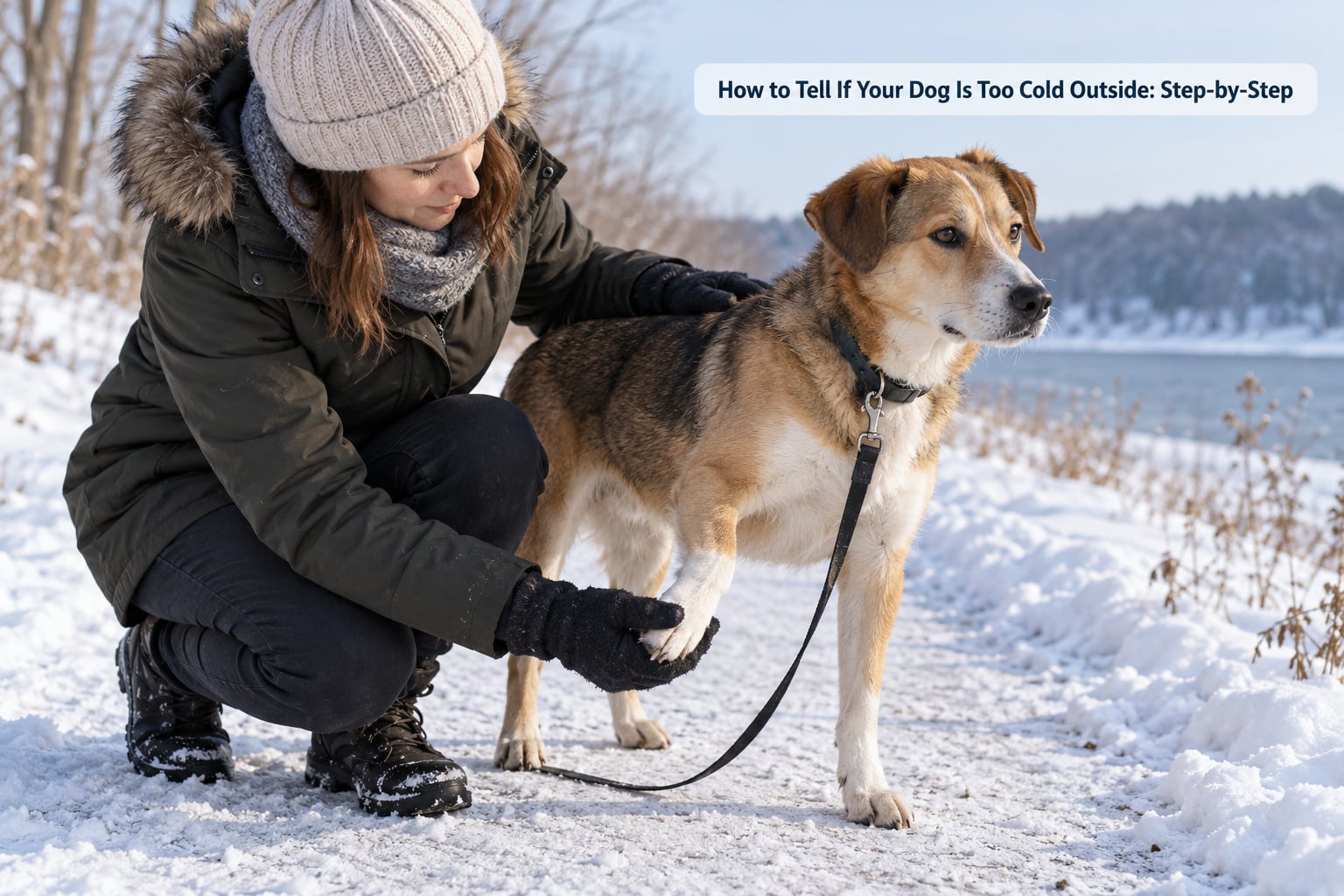
Pick up each paw and look between the pads. In winter you are looking for ice balls packed into the webbing, redness, damp or peeling skin, grit, and cracks along the pads. Rinse and dry every paw after every walk when salt is on the pavement. Rock salt is genuinely corrosive, and it is one of the easiest cold-weather injuries to prevent and hardest to spot early.
Run your hand along the ears, the tail tip and the nose. Skin that is bright red and blistered, or skin that has gone white, grey or black, is frostbite and needs veterinary advice the same day. Frostbite usually hits the thinnest skin first, so the ear edges and tail tip are where it starts.
Check the coat too. Wet fur loses far more heat than dry fur — a soaked dog chills several times faster than the air temperature suggests. Outfitting that holds water, or thick matting that never dries, makes the problem worse rather than better.
Step-by-Step: Protect Your Dog During and After the Walk
- Decide the outing length before you leave. Pick a number, set a timer, and treat that as the maximum, not the target.
- Keep moving. Slow, stationary loitering lets heat drain away. A brisk walk generates warmth; standing at a bus stop does not.
- Skip the outing entirely when conditions are severe or your dog has just been bathed. A quick bathroom break on the porch is fine.
- Use gear that fits. A coat helps short-haired, thin, senior and small dogs. Boots help on ice and salt. Anything tight across the chest or hips changes how the dog moves, and a dog that cannot move normally generates less heat.
- Offer water when you get back, and get the coat dry straight away.
- Warm gradually indoors in a draft-free room, away from direct heat.
- Watch the dog for 30 to 60 minutes. Signs that show up after you have taken the coat off were already there.
Never give human medication to a dog. Painkillers such as ibuprofen, naproxen and paracetamol are toxic to dogs, and cold-related discomfort should be handled by a veterinarian who can see the animal.
Common Mistakes
Assuming every dog handles the same cold. A 20°F day is a romp for a malamute and a serious risk for a 10-pound Italian greyhound. Fix: judge your dog, not the forecast.
Waiting too long because the dog is still walking. Dogs push through far past the point where they are comfortable. Owners regularly report this. Fix: set a timer and obey it even if the walk feels unfinished.
Using human clothing or unsafe warming methods. Human sweaters, and hot-water bottles or heating pads left against a dog’s skin, cause burns without the dog being able to move away. Fix: dog-specific gear, dry and indirect warmth only.
Leaving a dog unattended in a cold car or yard. Cold weather does not require snow to be dangerous, and a car loses heat quickly even on a bright winter day. Fix: the dog comes inside with you.
Protecting the paws and ignoring everything else. Boots are useful and irrelevant if the dog is soaking wet, underfed, or lying on a cold, damp floor at home. Fix: bedding and dryness matter as much as boots.
How Cold Is Too Cold?
Read the temperature bands as actions, not verdicts. Any dog in the first two rows still needs the behaviour check above.
| Temperature | Who is most at risk | Action |
|---|---|---|
| Above 45°F (about 7°C) | Almost nobody; watch very small, thin, wet or senior dogs. | Normal walk. Check behaviour as usual. |
| 32°F to 45°F (0°C to 7°C) | Small breeds, short coats, puppies, seniors, wet dogs. | Keep walks to 15 to 20 minutes. Coat and water on hand. |
| 20°F to 32°F (-7°C to 0°C) | Every dog except healthy thick double coats. | 10 to 15 minutes, supervised, moving the whole time. Boots on salted paths. |
| Below 20°F (below -7°C) | All dogs. Frostbite and hypothermia are real risks. | Brief supervised outings only. Large double-coated dogs can manage short periods; small and thin dogs stay in. |
Time outside matters as much as the number. Risk builds with every minute of exposure, and the same 20 minutes a large dog handles easily can push a small dog into trouble.
| Dog type | Above 45°F | 32°F to 45°F | 20°F to 32°F | Below 20°F |
|---|---|---|---|---|
| Small, thin or short-coated (under 20 lb) | 20 min | 10 to 15 min | 5 to 10 min | Brief bathroom break only |
| Medium adult dog | 30 min | 20 min | 10 to 15 min | 5 to 10 min, with a coat |
| Large double-coated or thick-coated adult | 40 min | 30 min | 20 min | 15 min, moving, watched closely |
| Puppy, senior or wet dog (any size) | 15 min | 10 min | 5 min | Indoors |
Conditions can make the air temperature misleading. Wind strips heat from exposed skin, and wind chill can put a dog at risk when the thermometer still reads safely. Wet ground, snow that holds moisture against the belly and legs, and rain all increase heat loss, which is why a dry 35°F can be safer for a dog than a damp 40°F.
Warm Your Dog Safely After Going Inside
A dog coming in from cold weather needs a slow, indirect warm-up, not speed.
- Move to a warm, draft-free room and remove wet outer layers, blankets or coats.
- Towel the coat dry, including the belly, the legs and the inside of each ear.
- Check the paws and skin for ice, redness, blisters and anything that feels unusually cold or hard.
- Offer water and let the dog rest quietly on a dry, comfortable bed.
- Take a rectal temperature if the dog seems off. A healthy dog’s temperature sits between roughly 100°F and 102.5°F (about 38°C to 39°C).
If a reading falls below 98°F (36.7°C), the dog is hypothermic and needs veterinary advice. Below 90°F (32°C), or with pale or blue gums, slow breathing, collapse or an inability to respond, treat it as an emergency and head to the nearest emergency vet immediately.
What not to do: no hair dryer on the skin, no hot-water baths, no direct heat against the body, no rubbing on suspected frostbitten tissue, and no rubbing alcohol of any kind. Frostbitten skin is numb and easily damaged, and heat applied to it can turn a cold injury into a burn. A warm damp towel held against the body, plus a blanket, is safer and steadier.
Call a veterinarian the same day if shivering continues after your dog is warm and dry, if the dog stays weak, disoriented or unusually quiet, if the skin on the ears, tail, paws or nose is red and blistered or turning dark, or if you cannot get the dog warm within 30 minutes.
Frequently Asked Questions
What temperature is too cold for a dog outside?
There is no safe cutoff for every dog, but risk climbs sharply below 45°F. Below 32°F, short walks of 10 to 15 minutes suit most dogs. Under 20°F, only brief supervised outings are reasonable, and large thick double-coated dogs manage those better than small, thin or short-coated ones. Check your dog’s behaviour rather than relying on the number alone.
How do I tell if my dog has hypothermia?
Early signs are shivering, lifting paws, slowing down, hunched posture and tiredness. Signs that mean hypothermia is underway include pale, white or blue gums, slow or shallow breathing, weakness, confusion, collapse and loss of response. A rectal thermometer settles it: normal sits between 100°F and 102.5°F, below 98°F is hypothermic, and below 90°F is an emergency requiring a vet now.
How can I warm up my cold dog?
Towel the coat dry, move into a warm room away from drafts, check the paws, and offer water. Warm the dog gradually with blankets and warm damp towels rather than direct heat. No hair dryer, hot-water bath or heating pad against the skin, and never rubbing alcohol. If shivering continues after the dog is warm and dry, or the dog stays weak or disoriented, contact your veterinarian.
Can a dog stay outside all night in the winter?
Not unless you have a properly insulated, dry, windproof shelter, constant water, and a breed that handles cold well, and even then overnight outside is risky for small, thin, senior, young or ill dogs. Owners searching this question usually have a healthy adult large dog in mind, where conditions matter more than the temperature alone. Keep the dog indoors whenever possible and provide a heated indoor bed instead.
Why is my dog shivering when it is not cold?
Shivering is a symptom, not a diagnosis. Fear, excitement, anxiety, pain, nausea and even just arriving somewhere new all produce the same muscle movement. Context separates them: a dog shivering while pulling towards a car and moving fast is probably excited, while a dog shivering while slowing down, lifting paws and looking for a doorway is cold. Persistent shivering with no obvious cause deserves a vet visit.
How long can a dog be outside in freezing weather?
Scale it to the dog. Small, thin or short-coated dogs generally manage 5 to 10 minutes below 32°F, medium adult dogs 10 to 15 minutes, and large thick-coated dogs around 20 minutes. Puppies, seniors and wet dogs need less than any of those. Set a timer before you leave and obey it, because dogs push through cold far longer than their owners would.
Conclusion
Start with your dog’s normal behaviour, because that baseline tells you more than any forecast. When a sign appears — a paw lifted, a walk that slows, a dog looking back at the door — cut the outing short rather than reasoning about it.
Warm your dog gradually, watch them for the half hour after you get back, and call a veterinarian the same day for shivering that will not settle, weakness, confusion or pale gums, and for skin on the ears, tail, paws or nose that looks red and blistered or turning dark.