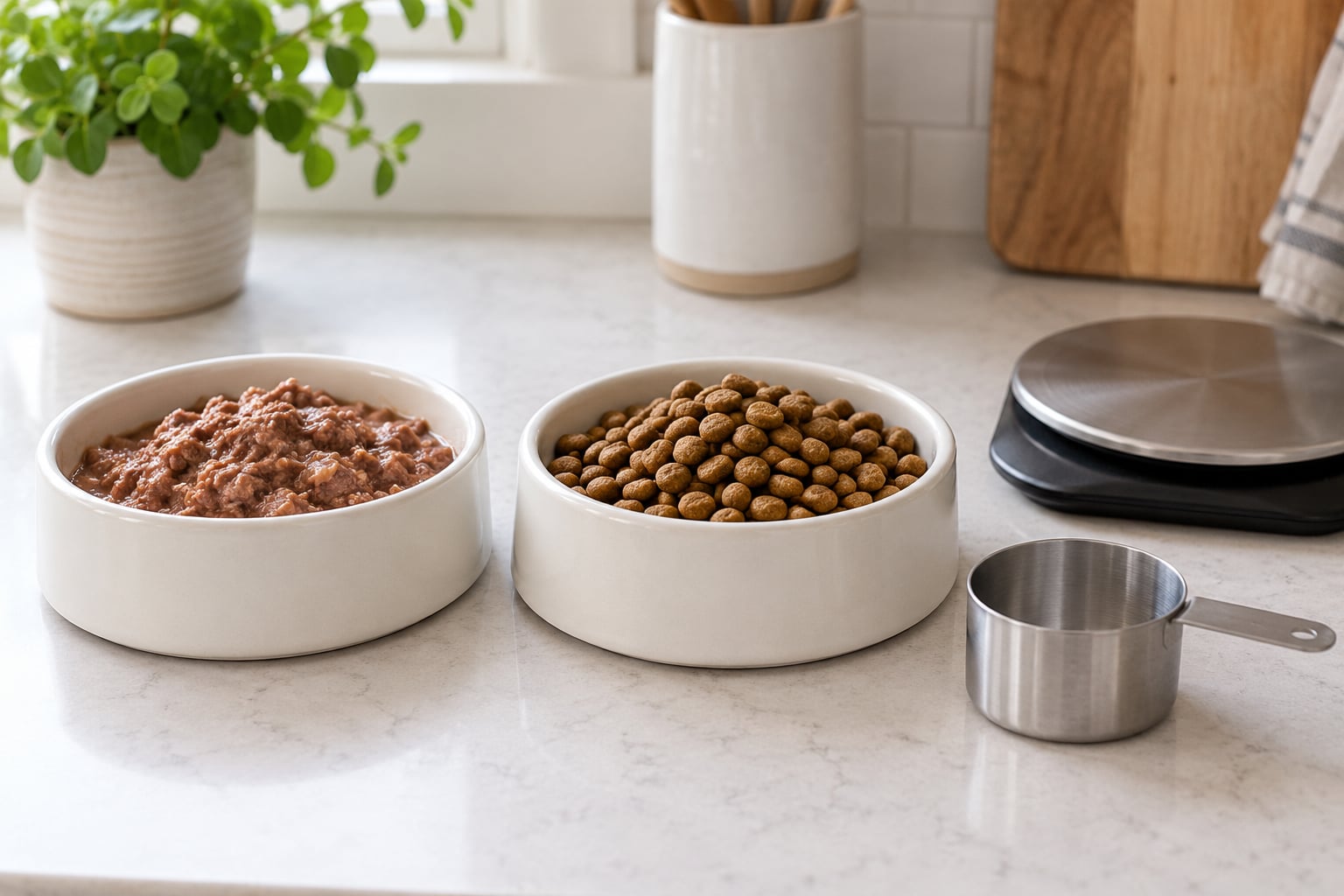
There is no single answer to wet dog food vs dry kibble which is better, because both formats can be nutritionally complete and the right choice depends on your dog’s age, teeth, appetite, health, activity level and your budget. What decides it is the complete and balanced statement on the label, not the format. Use the comparisons below to work out which one fits your dog in 2026.
The honest answer frustrates people looking for a winner. A ten-year-old terrier with worn teeth and a dog that runs six miles a day can need opposite formats, and both can be fed well.
So this guide compares the two on the things that actually change daily life: moisture, calories, portioning, storage, cost and how each suits a particular dog. Pick the row that matches your situation.
Table of Contents
- Wet Dog Food vs Dry Kibble Which Is Better at a Glance
- How Do Wet Dog Food and Dry Kibble Compare Nutritionally?
- Reading the label fairly
- Which Is Better for Hydration?
- Which Has More Calories and Is Easier to Portion?
- Which Is Better for Digestion and Sensitive Stomachs?
- Wet Food or Dry Kibble for Puppies, Senior Dogs, and Large Breeds?
- Which Is Easier to Store, Travel With, and Use Daily?
- Which Is More Costly?
- Which Should You Choose?
- Wet dog food vs dry kibble which is better for your dog?
- How to Change Between Wet Food and Dry Food
- Frequently Asked Questions
- Can I mix wet dog food and dry kibble?
- Is dry kibble healthier than wet food?
- Should I soak dry dog food before feeding it?
- How much wet food should I give my dog compared with kibble?
- How long should I take to switch my dog to a different food?
- Conclusion: What to Do First
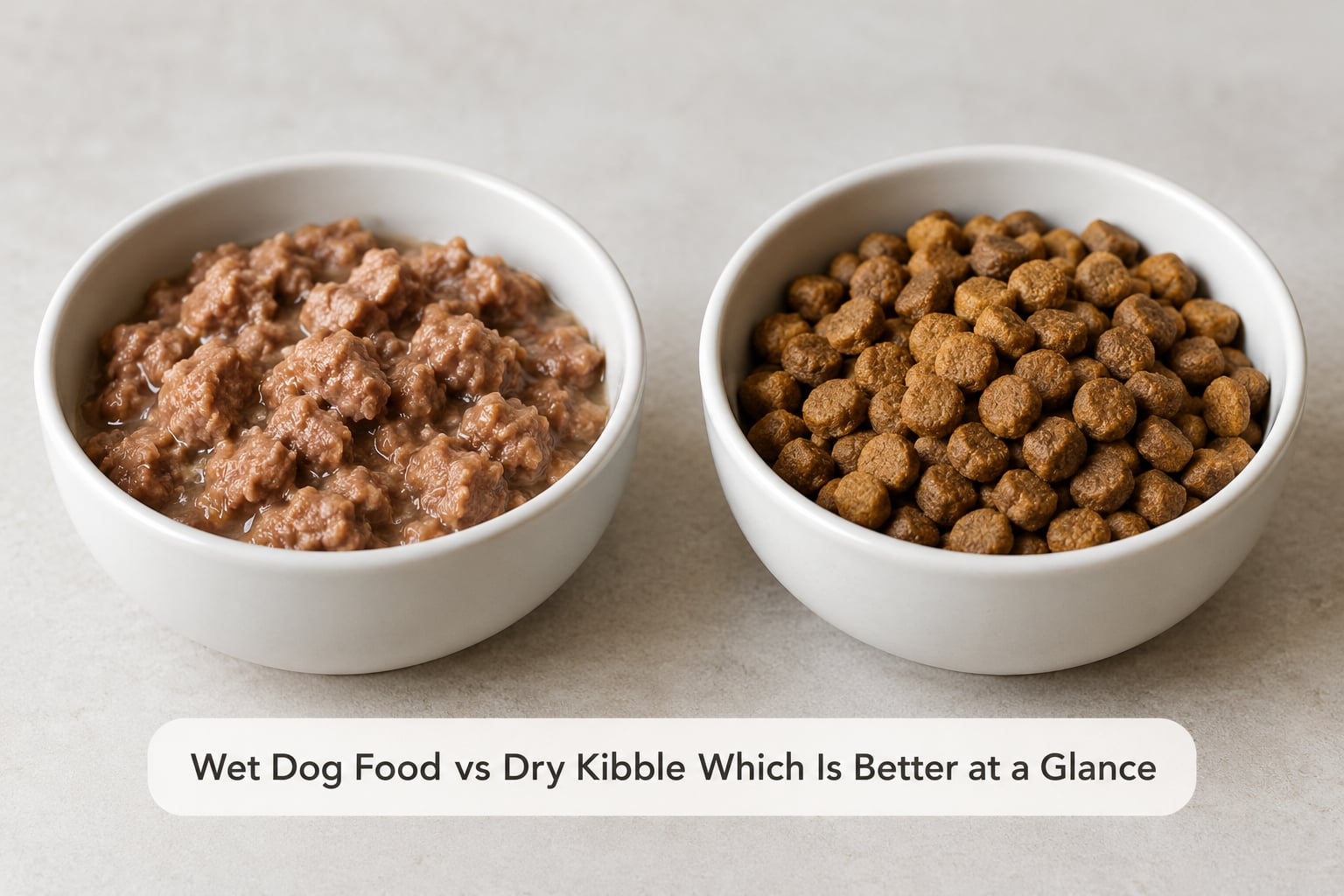
Wet Dog Food vs Dry Kibble Which Is Better at a Glance
| Factor | Wet dog food | Dry kibble |
|---|---|---|
| Moisture content | Roughly 70-80% | Roughly 5-10% |
| Calorie density | Lower per gram, higher per can | Higher per cup |
| Texture | Soft, easy to chew | Firm, requires a full bite |
| Palatability | Strong aroma, usually more appealing | Needs more convincing for some dogs |
| Portion control | Easy to weigh, easy to overfeed | Simple scoop, easy to spill |
| Storage | Refrigerate once opened, use within about 3 days | Resealable bag, roughly 4-6 weeks |
| Travel and boarding | Awkward, needs cooling | Simple to carry and portion |
| Cost per calorie | Usually higher | Usually lower |
| Dental effect | Little mechanical action on teeth | Some abrasion, not a replacement for brushing |
| Best suited to | Puppies, seniors, picky eaters, dogs that under-drink | Budgets, active dogs, grazers, dental enrichment |
| Common drawbacks | Cost, refrigeration, waste, dental neglect | Low moisture, calorie density, palatability issues |
Neither format is automatically better. Both can carry an AAFCO complete and balanced statement for the life stage your dog is in, and a well-made kibble will beat a poorly formulated can every time.
How Do Wet Dog Food and Dry Kibble Compare Nutritionally?
Both formats are nutritionally equivalent when they are properly formulated. The real question is whether the specific recipe you are feeding carries the AAFCO complete and balanced statement for your dog’s life stage, such as for growth, for adult maintenance, or for all life stages.
The difference is in how they are made. Kibble is ground into a dough, cooked under heat and pressure, extruded and dried, which leaves roughly 5-10% water. Wet food is cooked with water and gravy, sealed in a can or pouch and sterilised, ending at roughly 70-80% water.
Reading the label fairly
This is where most comparisons go wrong. The guaranteed analysis on a can is printed as fed, so a wet food showing 10% protein is not richer than a kibble showing 30%. The water difference alone accounts for most of that gap.
A rough way to compare them is to multiply the wet food’s as-fed protein figure by three and treat it as roughly comparable to a dry-matter figure. Check the label on both sides before deciding anything about quality.
Watch for the nutritional adequacy statement itself. Adequate for intermittent or supplemental feeding is not the same as complete and balanced, and that single line decides whether a food can be the whole diet.
Which Is Better for Hydration?
Wet food wins on hydration because 70-80% of it is water, and the dog gets that fluid at every meal. Kibble at 5-10% moisture contributes very little, so a dog eating only dry food has to drink enough water to compensate.
Some dogs drink reliably. Many do not, and they drink less in hot weather, in summer walks and whenever the bowl is not close by. That makes wet food the easier choice for a dog that under-drinks.
A second advantage of water intake through food is that it works even for a dog who will not drink from a bowl on its own. That is a small daily win on wet food.
Veterinary guidance matters here. Dogs with urinary, kidney or cardiac conditions often need their water and mineral intake managed deliberately, and dogs with swallowing problems need a texture they can handle safely. Ask your vet before changing format for any of those cases.
Which Has More Calories and Is Easier to Portion?
Per gram, kibble is denser with calories. Per can or per bowl, wet food often delivers more energy than the small volume of kibble that looks like the same portion.
That is why wet food is often recommended as a weight loss aid. Dogs fed a measured wet portion tend to feel satisfied on a smaller volume, while a larger bowl of kibble can look modest and still be calorie dense.
The trap runs the other way too. Many owners add a can of wet food to a full measured portion of kibble and end up feeding two full rations. Label feeding amounts assume the dog is eating only that food, so adding them together quietly doubles calories.
Which Is Better for Digestion and Sensitive Stomachs?
A sensitive stomach is not automatically better served by wet food. Soft, moist food moves through the gut gently, but wet food often carries more fat, and fat is a common trigger for dogs that vomit or have loose stool.
Dry food has less water to absorb, so it can mean more water needs inside the gut, and dogs that eat fast or bolt food sometimes cope better with softer wet food for the same reason.
Neither format settles the question. The trigger is often a specific ingredient, a rich meal or a sudden switch rather than wet versus dry, and only a consistent single-food diet can tell you which.
If your dog has repeated digestive upset, talk to your vet instead of switching formats back and forth. Keep one food steady, note the stools, and bring those notes to the appointment. Anything persistent, with vomiting, blood or weight loss, needs an examination rather than a food swap.
Wet Food or Dry Kibble for Puppies, Senior Dogs, and Large Breeds?
Puppies usually do best on food labelled for growth. Wet food suits young puppies because the texture is soft during weaning and the moisture helps in hot weather, though dry puppy kibble works well too and helps a puppy who should slow down.
For large breeds, the label statement matters more than the format. Growth formulas are formulated for large sized dogs, which mature on a slower curve, and a puppy destined for 70 lb or more as an adult needs that control during development.
Senior dogs lean toward wet food for one reason: teeth. Worn or missing teeth make kibble hard to manage, and soft food lets an older dog keep a full meal without pain, which also supports weight in a dog with a fading appetite.
Very small breeds and dogs that eat fast are worth their own note. Small portions of wet food spoil quickly once they hit the bowl, and fast eaters need a slow feeder or a puzzle feeder rather than a wet meal they inhale.
Which Is Easier to Store, Travel With, and Use Daily?
Kibble wins on logistics, and it is not close. A resealable bag keeps for roughly four to six weeks once opened, needs no fridge, measures quickly with a cup or a scale and packs into a bag for a walk or a boarding kennel.
Wet food needs refrigeration once opened and is generally used within about three days. Portions are small, so a dog who does not finish a meal quickly wastes it, and bowls left in warm rooms should be cleared rather than left to sit.
Travel, boarding and crate feeding are simpler with dry food. A sitter can scoop a bowl without thinking about the fridge, which removes a lot of the friction when your routine changes.
Simple food handling keeps both formats safe. Wash bowls between meals, refrigerate opened wet food promptly, and follow the best by date on the bag or can.
Which Is More Costly?
Wet food usually costs more per calorie, and that gap is the most common reason owners stay on kibble. Cost depends on the recipe, the package size and your dog’s needs, not on the format label alone, so compare the two on a calorie basis.
Here is the method. Take the calories listed per can or per cup, then divide the cost of the package by total calories to get cost per 1,000 calories. Run the same calculation for the kibble. That number is the only fair comparison.
Calories per can matter, because a single can of wet food can hold about 150 to 250 calories while a cup of kibble holds roughly 350 to 400. A can looks deceptively small because it is mostly water.
Two things change the total. A mixed diet, where wet food is used as a topper rather than the full ration, lowers the cost while keeping palatability high. And a dog eating wet food may waste less, or more, depending on appetite.
Price alone tells you nothing about nutritional adequacy, so check the complete and balanced statement before the cost column ever enters the decision.
Which Should You Choose?
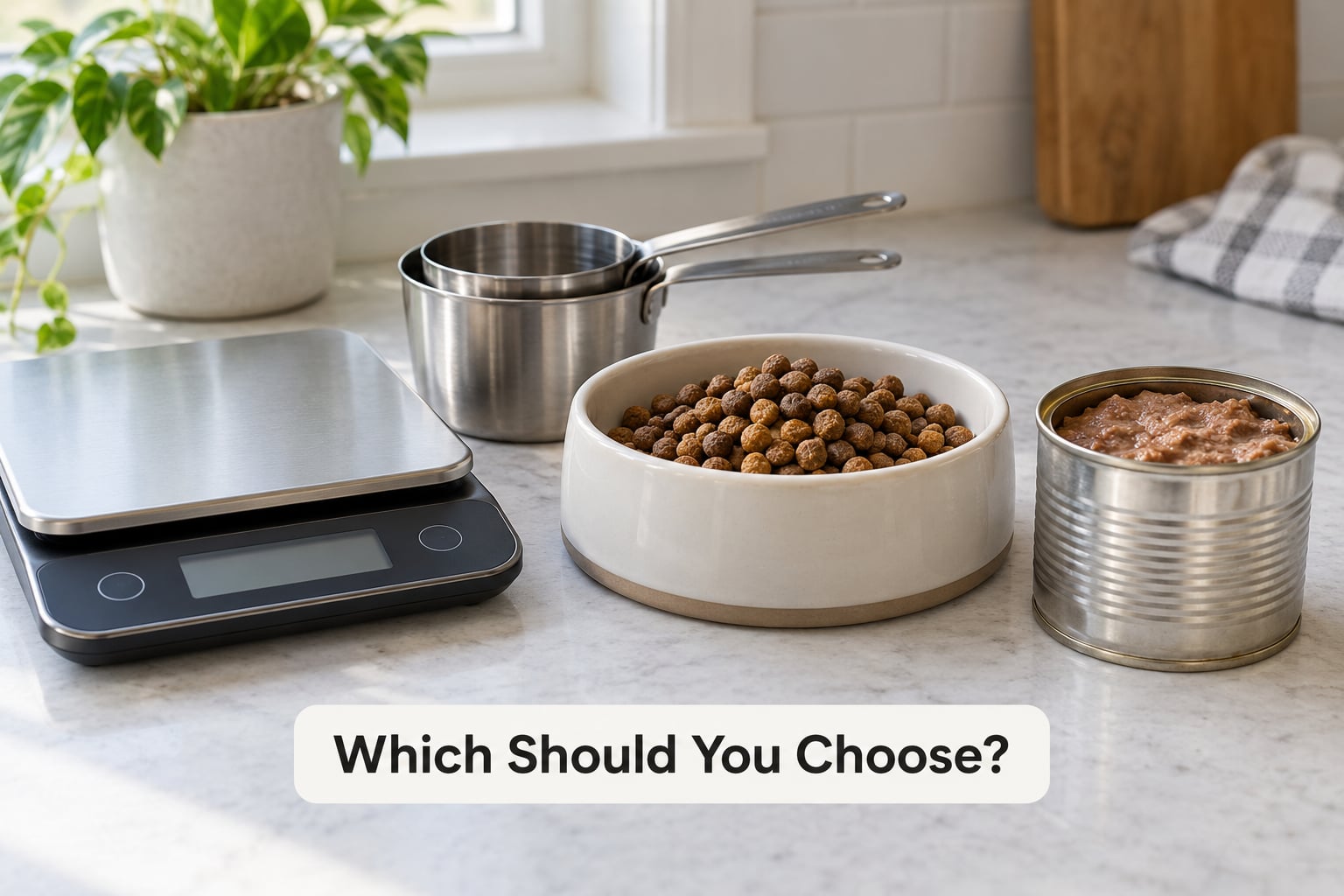
Choose wet food when your dog benefits from extra moisture, has worn teeth, is a picky eater, or needs the satiety that helps with weight management. Choose kibble when budget, travel, boarding, active energy needs or dental enrichment matter most.
Feed either format when both options are complete and balanced, palatable and affordable for you. Plenty of dogs thrive on one format their whole lives, and mixing is a reasonable choice rather than a rule you must follow.
A mixed diet is common in practice. Use wet food as a topper on kibble, or split the calories, and many owners report the best of both worlds: dry food for cost and teeth, wet food for flavour and fluid. Do recalculate calories when you combine them.
Wet dog food vs dry kibble which is better for your dog?
Work through these four steps in order, and the answer usually arrives on its own.
- Check the statement. Confirm the food says complete and balanced for your dog’s life stage, not supplemental feeding only.
- Compare calories per serving. Read calories per can and per cup so portions are compared like for like.
- Match the dog. Consider age, size, activity, chewing ability, medical needs and stool tolerance.
- Pick what you can sustain. Choose the food you can buy consistently and feed every day without the routine falling apart.
How to Change Between Wet Food and Dry Food
Change over seven to ten days, not overnight. Sudden format switches are one of the most common causes of loose stool during a change, and the problem is usually the pace rather than the food.
Keep the total daily amount the same and swap in the new food gradually. Days one and two, one quarter new food and three quarters old. Days three and four, half and half. Days five and six, three quarters new. From day seven, feed the new food only, and hold that for several days.
If your dog refuses the new food, slow down and go back a step. Staying at the current stage for another couple of days works better than pushing forward and losing the transition.
Contact your vet if vomiting, diarrhoea, marked lethargy or refusal to eat appears during the change. Those signs mean something other than a routine transition needs attention.
One last note. Hold one stable diet while you judge it, since comparing two new foods at once tells you nothing. Give it the full four weeks before you decide anything.
Frequently Asked Questions
Can I mix wet dog food and dry kibble?
Yes, most dogs handle a mixed diet well. You can split the daily calories between both, or use wet food as a topper on kibble. Recalculate portions so the total calories stay the same, since adding full label amounts of both foods together tends to overfeed a dog quickly.
Is dry kibble healthier than wet food?
Neither format is healthier by default. Both can be complete and balanced for a dog’s life stage, and both can be made well or made poorly. Compare the nutritional adequacy statement, the calories per can or cup and the ingredient list rather than assuming the format decides quality.
Should I soak dry dog food before feeding it?
Soaking kibble in warm water makes it easier for puppies and for dogs with painful teeth, and it is a common practice among owners. Soaking changes the texture and the calorie concentration per volume, so check with your vet first if your dog has dental disease, is on a weight plan or is on a urinary diet.
How much wet food should I give my dog compared with kibble?
Work from calories, not volume. Wet food usually shows around 150 to 250 calories per can while a cup of kibble often shows 350 to 400, so a can that looks small can be a large portion. Start from the label guidance, then adjust using your dog’s body condition and weight trend with your vet.
How long should I take to switch my dog to a different food?
Seven to ten days is the usual window. Increase the new food gradually while reducing the old one, in quarters rather than all at once. Slower is safer for large breeds and dogs with sensitive stomachs. If your dog stops eating or develops loose stool, step back a stage and call your vet.
Conclusion: What to Do First
The better choice is the complete and balanced food that suits your individual dog, your routine, your budget and your dog’s health needs. Format comes second, which is why wet dog food vs dry kibble which is better has no fixed answer.
Start by reading the nutritional adequacy statement and the calorie information on both foods. Then feed one chosen food consistently and watch weight, appetite, stool and drinking for a few weeks, and raise any concern with your vet before switching again.