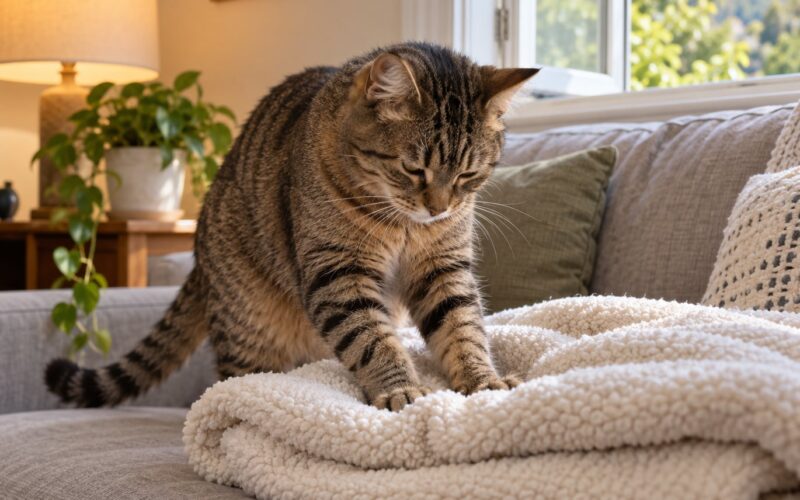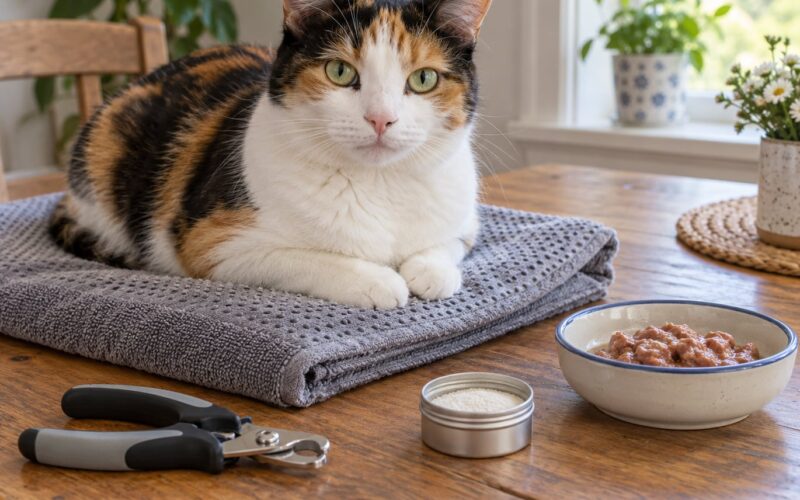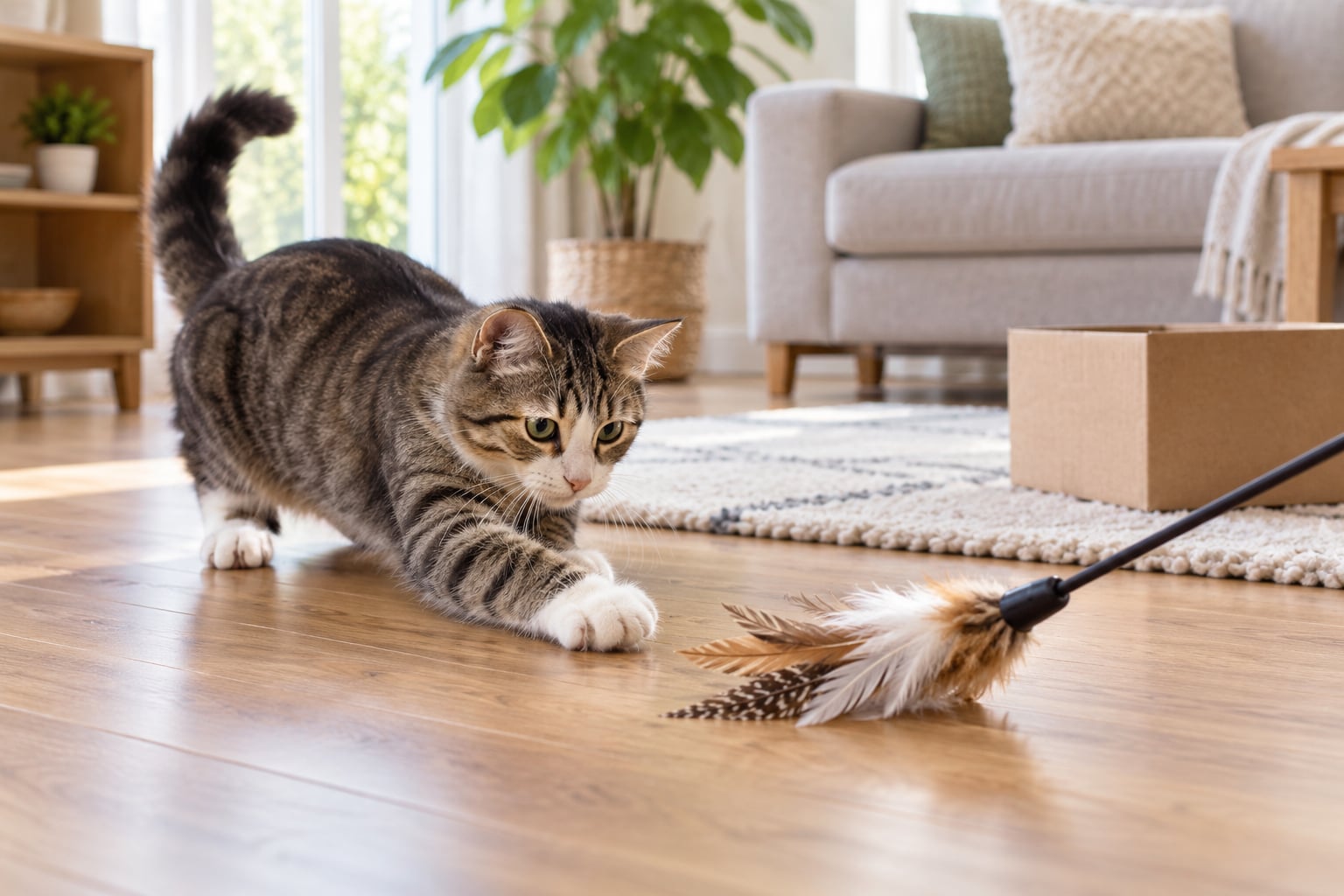
To play with a cat the right way, move the toy away from your cat along the floor instead of waving it at their face, let them stalk, chase, pounce and catch it, then feed them when the hunt ends. Cats are obligate predators with a fixed sequence — search, stalk, chase, pounce, catch, eat — and play is the only way an indoor cat gets to finish it. Ten focused minutes done well beats half an hour of waving a mouse toy around the room.
I have two cats, and they play as differently as they eat. One chases anything dragged across the rug. The other ignores toys on the floor entirely and only plays when something dangles just above head height. Same house, same toys, opposite technique.
The good news is that every cat can be taught to play. It comes down to reading signals, moving the toy like prey, and stopping before your cat gets frustrated.
Table of Contents
- What You Need
- Step-by-Step: How to Play With a Cat the Right Way
- 1. Prepare a Safe Play Area
- 2. Let Your Cat Start at Their Own Pace
- 3. Use a Wand Toy: How to Play With a Cat the Right Way
- 4. Rotate Toys and Play Styles
- 5. Read Your Cat’s Body Language
- 6. End with a Calm, Positive Finish
- Common Mistakes
- Frequently Asked Questions
- How long should I play with my cat each day?
- How often should I play with an adult cat?
- Should I use my hands to play with my kitten?
- What toys are safest for cats?
- Why does my cat lose interest in the toy?
- How do I know when my cat is overstimulated?
- Conclusion
What You Need
Play does not need a big shopping list. You need five minutes and three or four things, most of which you probably own already.
- A wand or rod toy — a long stick with string, a feather or fur on the end. This is the single most useful tool for interactive play because it keeps your hands out of the game.
- A clear play area — a room with enough floor space for the toy to move in wide arcs, and no breakables within reach.
- A few small treats — optional, but ending a session with a few pieces of your cat’s normal food completes the hunt-eat step and keeps things positive.
- Two or three other toys — a kicker plush, a ball, a puzzle feeder or a cardboard box. Rotation matters more than variety.
- Your attention — the part most people skip. A distracted human means a wand toy that jerks around at random.
Treats are the one thing to stay measured about. Keep them under about 10% of your cat’s daily calories, and use the cat’s regular kibble instead of calorie-dense treats if you play often.
Step-by-Step: How to Play With a Cat the Right Way
1. Prepare a Safe Play Area
Clear the floor first. Pick up yarn, string, rubber bands, small objects and anything a cat could swallow, then push breakables — vases, cables, low shelves — out of reach.
A familiar room beats a new one. My cats play far more in the hallway than in a spot I clear specifically for them, probably because nothing there smells like an event.
Also check the ceiling fan. I once had a wand session end early because a feather went under a spinning blade. Now I check it every time.
If this step worked, the floor is empty, the room is quiet, and nothing is dangling that shouldn’t be.
2. Let Your Cat Start at Their Own Pace
Do not pick your cat up and carry them to the toy. Sit down, stay still, and let the toy do the inviting — a slow drag on the floor a couple of feet away from them is enough.
Many cats watch from a distance before committing. That watching is the stalk phase, not boredom. Owners often quit too early here and conclude their cat does not want to play.
You will know it is working when the ears turn forward, the pupils widen, and the body drops low. If the cat stays flat and still with a relaxed tail, keep going quietly.
3. Use a Wand Toy: How to Play With a Cat the Right Way
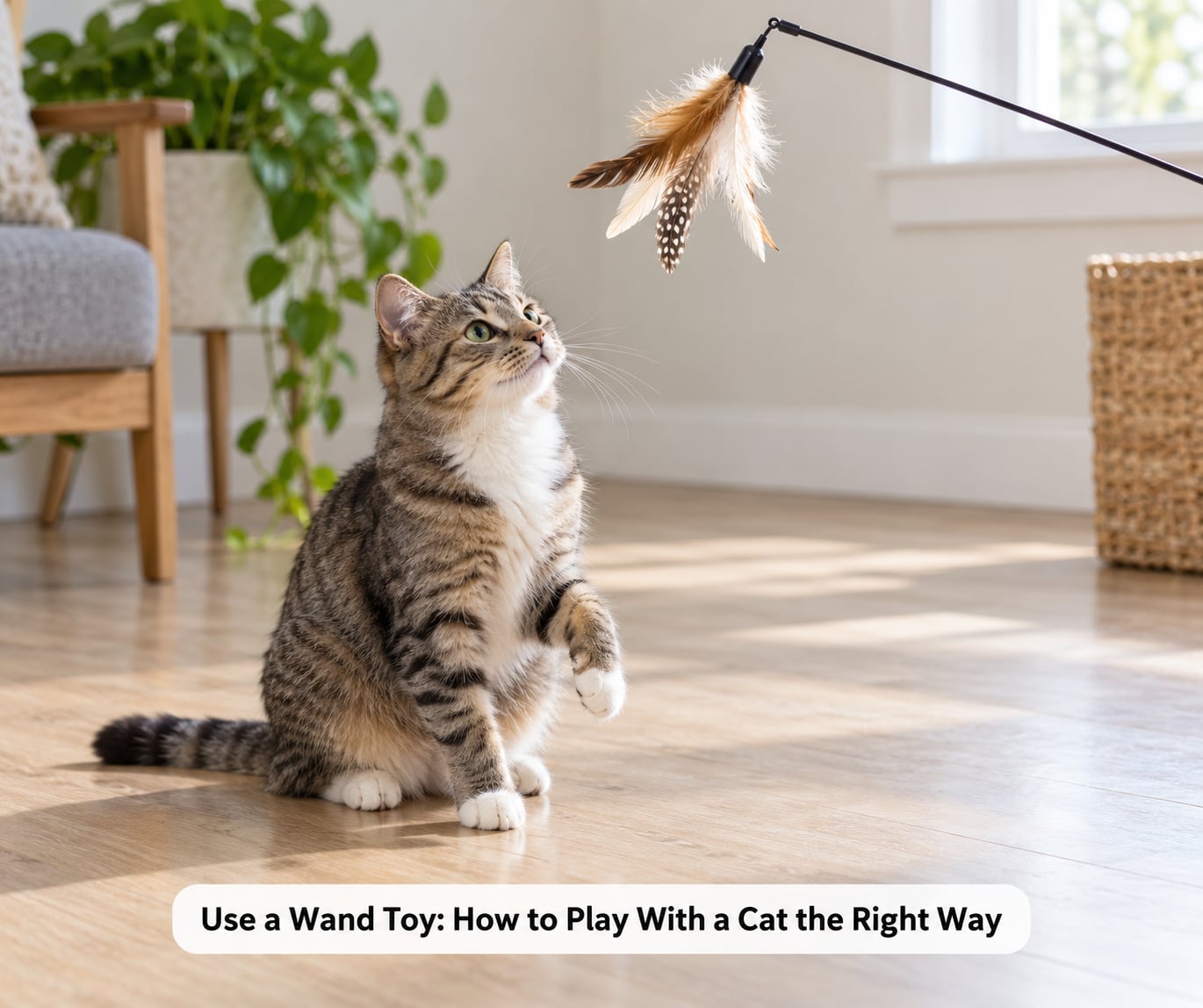
This is the technique that changes everything: drag the toy away from the cat, never toward it. Prey runs away, so the toy should too.
Hold the wand low, about 10 to 20 cm above the floor, and drag it slowly behind you as you walk across the room. Let the cat chase the string rather than the toy head. Owners on cat forums describe this slow, low drag as the single most reliable technique for cats who ignore everything else.
Then vary the movement. Stop and start — Jackson Galaxy calls it “boil and simmer” — because a real mouse does not run at a constant speed. Throw short bursts of speed, pause, then a slow creep. Tuck the toy behind a chair leg or a box so the cat has to hunt for it.
Two rules matter more than anything else. Never swing the toy at your cat’s face; it reads as a threat, not a chase. And let them catch it, repeatedly, or they learn that play is a tease with no payoff.
You will know it worked when you see the butt wiggle before the pounce and hear a chirp or a trill of excitement.
4. Rotate Toys and Play Styles
Once the hunt is going, add variety. Cats hunt in different ways, and a session that only ever involves chasing misses most of what they enjoy.
- Chasers want fast ground-level movement — the wand dragged along the floor, a ball rolling away down a hallway.
- Climbers prefer toys raised above head height, dangling from a wand or dropped from a perch.
- Hunters engage with toys that hide, pause and hide again — wand toys behind furniture, treats tucked in boxes.
- Wrestlers grab and kick. A kicker plush, a crinkly sock ball or even a rolled-up sock ends up under their front paws.
Store most of the collection in a drawer and swap a few out each week. Owners on cat forums repeatedly report that hiding a favourite toy for a week and bringing it back resets interest better than buying something new.
Solo play counts too. Puzzle feeders, treat hunts in a box, tunnels made from cut-off cardboard tubes and batting a bottlecap under a sheet give a cat something to do when you are at work.
5. Read Your Cat’s Body Language
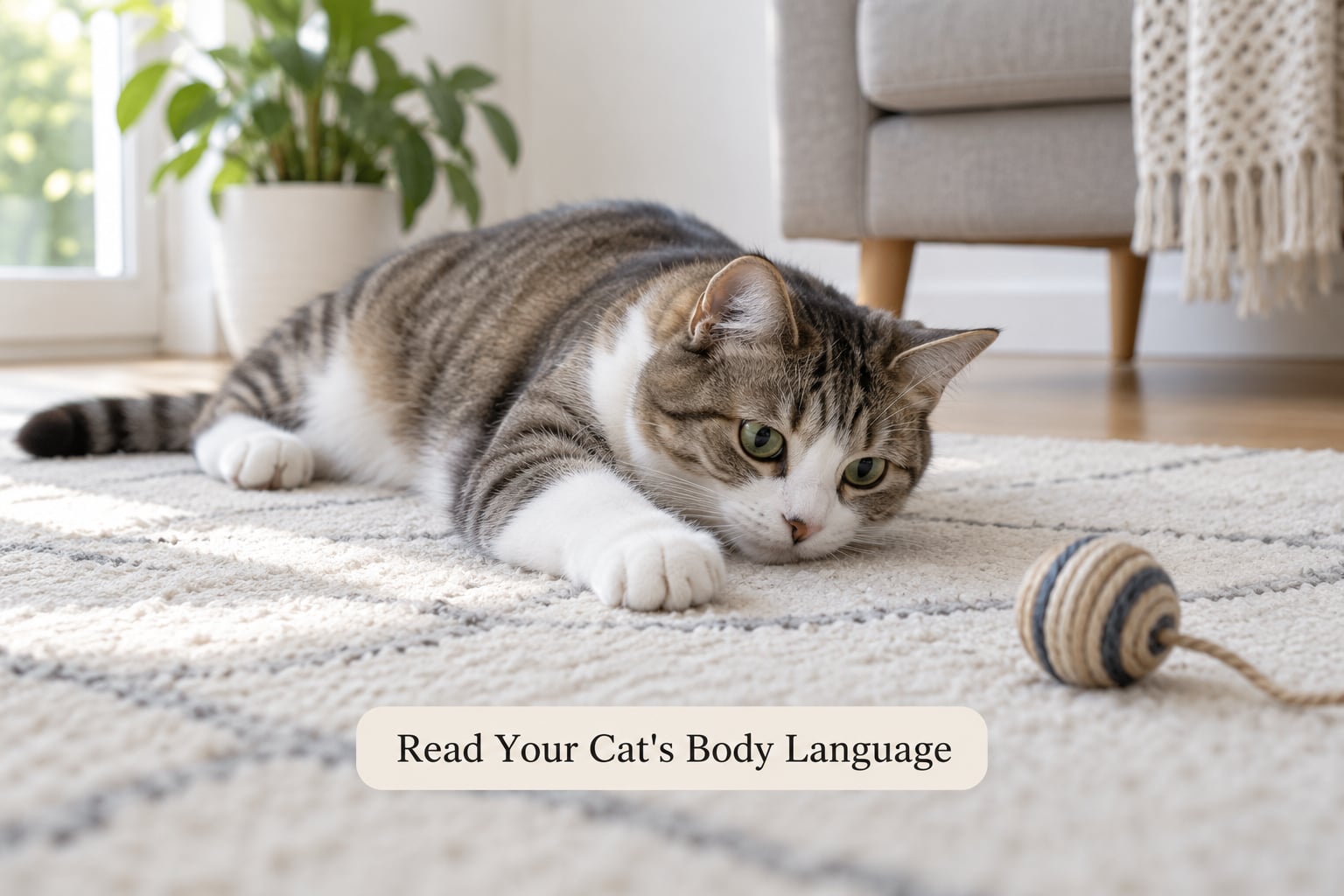
Good sessions run on signals. Here is the short list that tells you what to do next.
- Ears forward, pupils wide, tail lashing or quivering — your cat is locked in. Escalate the speed slightly and bring it closer.
- Crouched, butt wiggling, slow blink at you — a pounce is coming in the next two seconds. Freeze the toy and let them go.
- Chirping, trilling, short bleats — excitement, and often a request for more. Keep the toy moving.
- Walking away mid-session — do not stop the game. Most often this means slow down. Bring the movement back to a crawl near their paws rather than packing the toy away.
- Flattened ears, lashing tail, skin rippling on the back, dilated pupils with a stiff body — your cat is overstimulated or frightened. Put the toy down quietly and let them leave.
The overstimulation signs matter most because pushing through them teaches a cat that play is unpleasant. Ending early is usually better than ending late.
6. End with a Calm, Positive Finish
Do not run a session to total exhaustion. Stop while your cat is still interested — around 10 to 15 minutes of good hunting, with a couple of catches and a meal at the end.
Slow the toy down for the last stretch rather than snatching it away mid-pounce, then place it down and let your cat grab the final catch. Follow it with a few pieces of food from the bowl. That close-the-loop finish is why cats stay interested in the toy tomorrow.
Then put the toy away, in a drawer, out of sight. A wand toy left on the floor gets dragged under the sofa within a day, along with whatever string is attached to it.
One extra habit worth adding: play before meals rather than only when you happen to have five minutes. Cats that hunt before they eat settle down faster afterward, and the evening zoomies usually land earlier.
Common Mistakes
Using your hands or feet as toys. This is the most common mistake and the one that creates the hardest habit to undo. A kitten that gets fingers will keep expecting fingers. Put the toy between your cat and your hand every single time, so the toy is always the thing being caught.
Forcing play on a cat that is walking away. Follow a retreating cat with a wand toy and you are chasing something that wants space. Sit still instead. Many cats return within a minute on their own.
Making sessions too long. Fifteen focused minutes beats forty dull ones. Long sessions end in overstimulation, and overstimulation is what a cat remembers next time the wand comes out.
Losing interest mid-session and blaming the cat. The fix is usually yours: slow the toy down, move it closer to the floor, or let the cat catch it.
Leaving string, yarn or feather toys out unattended. Ingested string is a serious emergency and needs a vet straight away. Feather toys are fine while someone is playing and belong in a drawer the moment the wand is put down.
Ending a laser session with nothing physical. Laser-only play produces two minutes of excitement and then nothing to catch. If you use a pointer, finish by leading your cat onto a real toy they can grab.
Never giving the same toy every day. Boredom is fixable with a drawer and a bit of rotation, not with another purchase.
Punishing a cat for biting mid-play. Never swat, spray or shout. The correction that works is to go completely still, then withdraw your hand and redirect to a toy. Owners report this beat saying “no” every time.
One more: if a cat that normally plays suddenly stops, check with your vet. A sudden drop in play alongside normal eating and drinking can signal pain or illness rather than boredom, and it deserves a checkup.
Frequently Asked Questions
How long should I play with my cat each day?
Aim for about an hour of active play across the day, split into short sessions of 15 to 20 minutes. Cats hunt in bursts rather than in one long stretch, so three short sessions usually satisfy them better than one long one. Two of those sessions work well before meals. The hunt sequence ends there; the rest is catch and eat, which you finish by putting a few pieces of food down.
How often should I play with an adult cat?
Every day, in at least two sessions. Indoor cats get no exercise on their own, and daily play is one of the cheapest ways to prevent obesity, boredom and furniture scratching. If your cat is alone during the working day, add a puzzle feeder or a treat hunt so there is something to engage with while you are out.
Should I use my hands to play with my kitten?
No. Kittens that learn to bite fingers carry that habit into adulthood, and the bites get stronger as the teeth come in. Always put a toy between the kitten and your hand so the toy takes the punishment instead of your skin. Redirect rather than scold: go still, withdraw your hand, and offer the toy again the moment the biting stops.
What toys are safest for cats?
Wand and rod toys with supervised use, kicker plush toys, cardboard boxes and tunnels, and treat-dispensing puzzle toys are all low-risk choices. Keep string, yarn, ribbon and loose thread out of reach, because swallowed string needs emergency veterinary care. Put feather and string toys away after every session rather than leaving them on the floor.
Why does my cat lose interest in the toy?
Most often the toy has stopped moving like prey, or the cat has already had it for weeks. Move it faster, lower it to the floor, and drag it away rather than waving it at their face. If interest is still low, hide the toy in a drawer for a week and bring it back out as something new. A cat that loses all interest suddenly, despite normal eating, is worth a vet check.
How do I know when my cat is overstimulated?
Watch for flattened ears, a lashing tail, rippling skin along the back, and a stiff body with very wide pupils. Breathing gets faster and they may suddenly run off or hide. Put the toy down quietly, let them leave on their own, and keep the next session shorter. Continuing to chase an overstimulated cat teaches them that play is stressful.
Conclusion
Play the prey sequence, not the toy: drag the wand along the floor and away, vary the speed, let your cat catch it, and finish with a meal. Read the body language and stop before the session turns into overstimulation.
Start with one short session using a toy your cat already likes. Watch what the ears and tail do, adjust the speed and length to suit that individual cat, and build from there.
For anything medical — a cat that stops playing suddenly, or one that seems in pain while moving — talk to your vet before changing the routine.