If you know how to tell if a cat is happy or stressed, you catch trouble weeks before it becomes a vet emergency. A content cat keeps a loose body, an upright tail, forward ears and slow blinks. A worried cat flattens its ears, tucks its tail, hides, over-grooms, or changes how it eats, pees and plays.
Most guides hand you a checklist and expect every cat to match it. Cats do not. Personality, age, breed and health all change what normal looks like, so the useful skill is comparing this cat today with this cat’s own baseline.
I meet owners every year who are certain their cat is miserable because he hides during the day. That cat has hidden since kittenhood and sleeps perfectly well through it. Change is the signal that matters, not the behavior itself.
Table of Contents
- What Does a Happy Cat Look Like?
- A loose body that stretches and settles
- Tail up, ears forward, eyes soft
- The small rituals that mean content
- What Does a Stressed Cat Look Like?
- When the body goes small and low
- Grooming, eating and litter box changes
- Warning signs that go past mood
- Happy vs Stressed: A Side-by-Side Comparison
- How to Read Your Cat’s Body Language
- Watch the whole signal, not one part
- The FAS scale: green, yellow and red
- Context beats any single signal
- Stress Signs in Everyday Cat Behavior
- The triggers that show up most often
- New cats and the 3-3-3 rule
- When a temporary reaction becomes a pattern
- How to Help a Stressed Cat Feel Safer
- Keep the routine predictable
- Give room, height and a safe space
- Remove the trigger and reward calm
- When Should You Call a Veterinarian?
- Frequently Asked Questions
- Does purring always mean my cat is happy?
- Why is my cat hiding suddenly, even if the home has not changed?
- Is slow blinking a sign that my cat trusts me?
- How can I tell whether a cat is stressed or in pain?
- Should I give my cat human medication for stress?
What Does a Happy Cat Look Like?
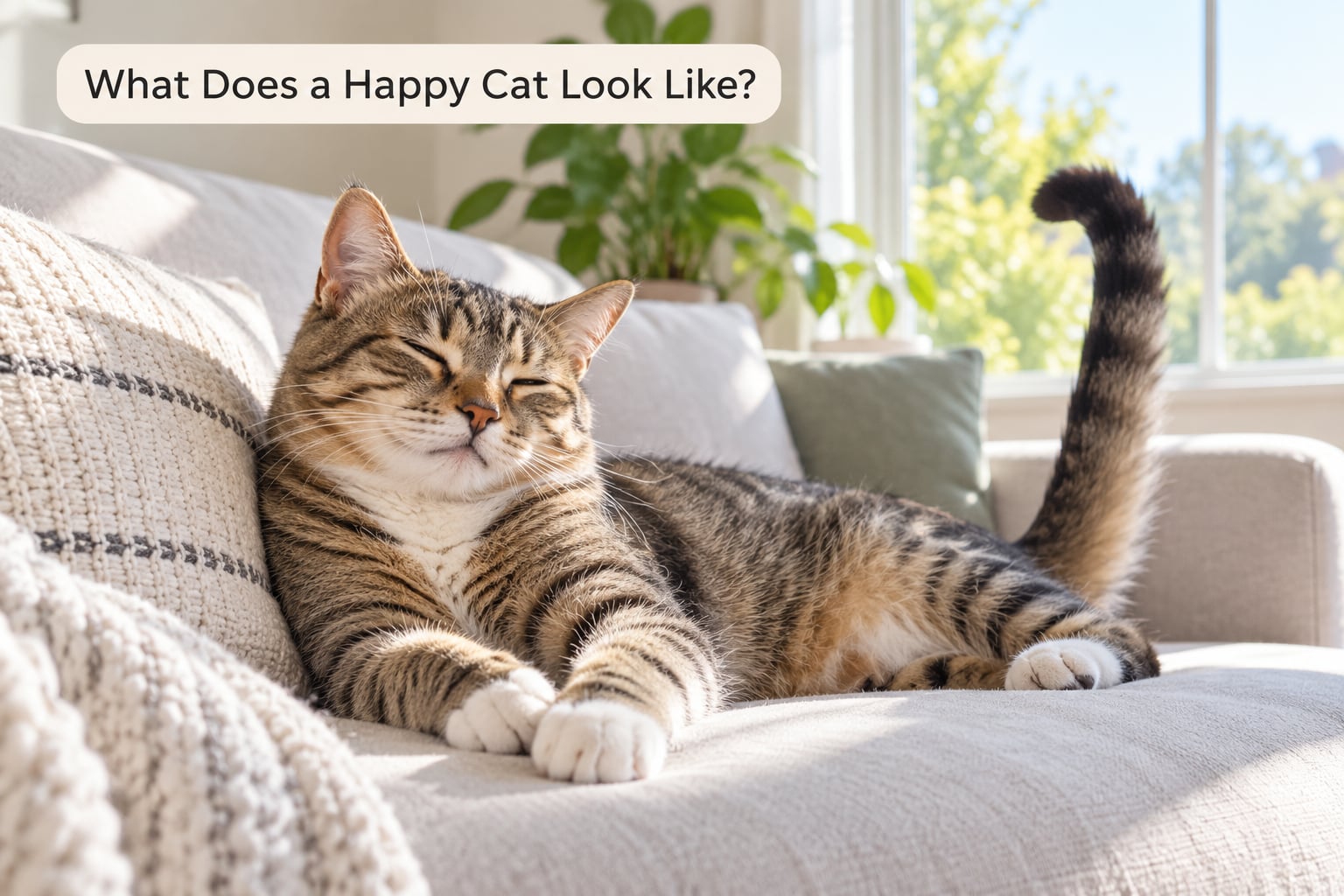
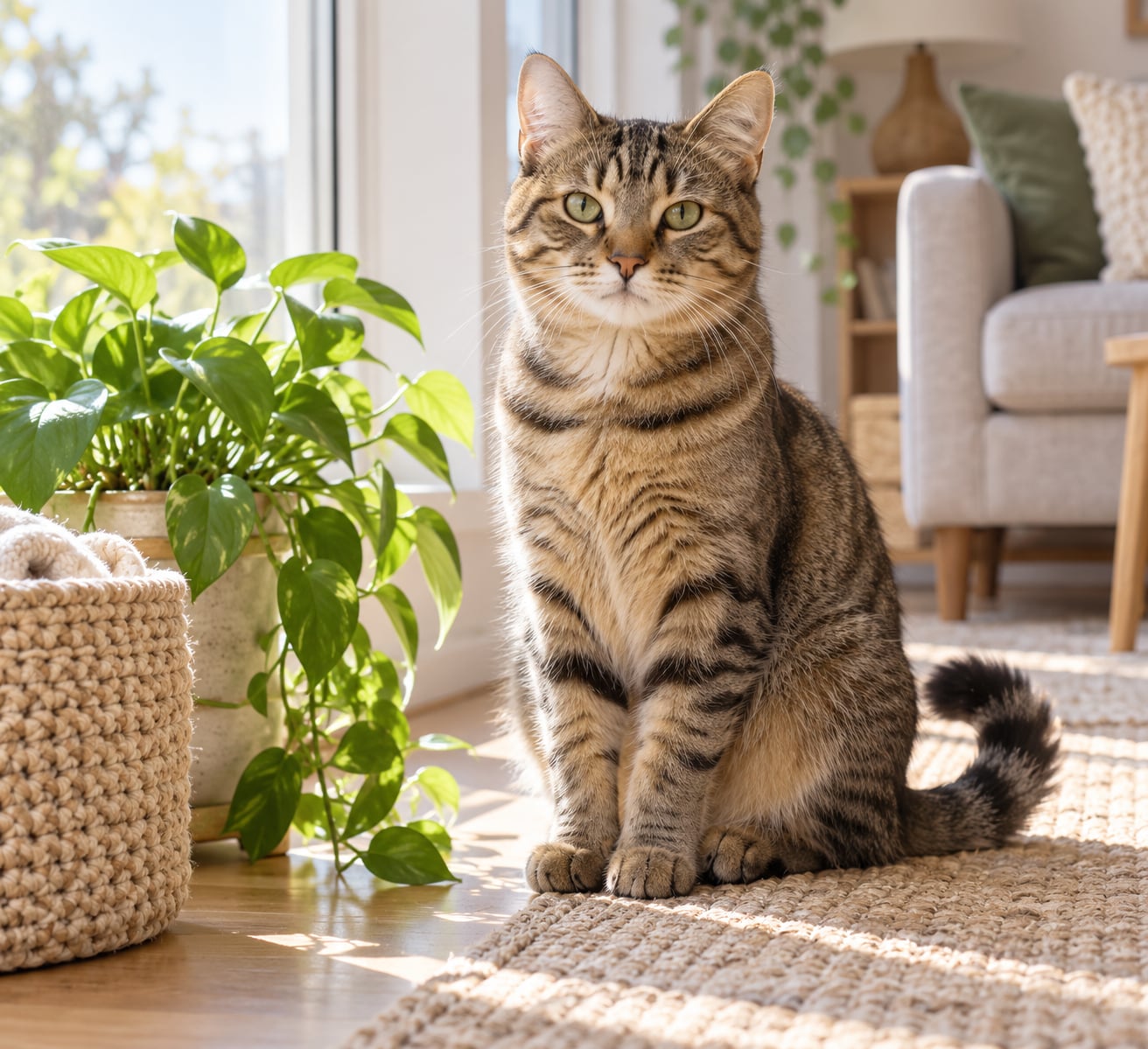
A content cat looks loose. Nothing in the body is visibly held, movement is unhurried, and the cat settles into a spot instead of scanning the room from it.
A loose body that stretches and settles
Watch what happens in the first few seconds after a nap or a play session. A relaxed cat stretches out long, tips sideways, rolls onto its back or folds into a tight loaf and closes its eyes. Cats that never lie down near you, never sprawl, and perch only on high edges are often living on alert.
Muscle tone tells the same story. A calm cat’s shoulders and hips move fluidly. A tense cat holds itself in one shape, keeps its weight evenly distributed and can look frozen mid-step, which is a classic freeze response to something it does not want to look at directly.
Tail up, ears forward, eyes soft
An upright tail with a soft curve at the tip is the everyday greeting signal: friendly, confident and interested. A tail held low or tucked under the body says the opposite. A tail that flicks sharply or lashes side to side without any play going on usually means irritation building, and a puffed tail means fear.
Ears give away more than most people notice. Forward and slightly cupped means interest. Turned sideways, “airplane ears,” means uncertainty or unease. Flattened back against the skull is fear or irritation. Because cats cannot move their ears as expressive as humans can move a face, a single flattened moment is easy to catch on camera and easy to miss in the room.
Eyes matter too. Soft half-closed eyes and slow blinks signal comfort. Wide eyes with large dark pupils mean the cat is scaring itself a little, whether or not anything is actually there.
The small rituals that mean content
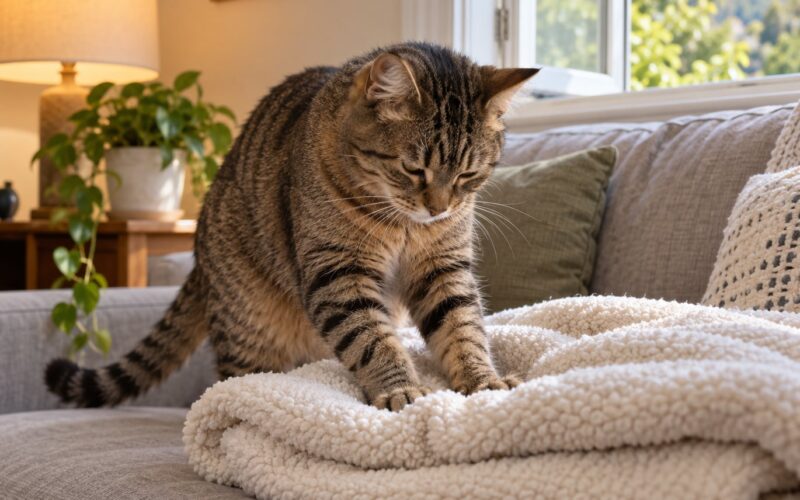
- Kneading with the front paws on a blanket or your lap, often with a low trill.
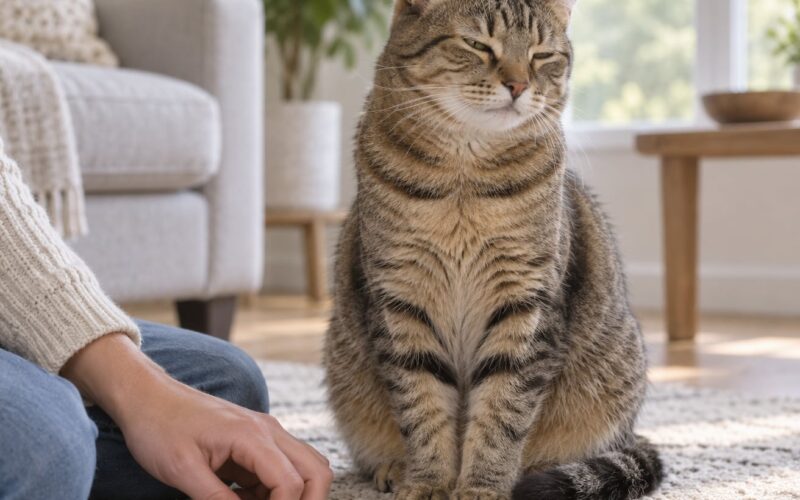
- Slow blinking at you, then looking away. Many cats will blink back.
- Head bunting, where the cat presses its cheek or forehead into your leg or hand.
- Belly exposure in a loose sprawl rather than a tense, tucked presentation. A belly up with ears back and a swatting paw is a different message.
- Steady appetite and normal litter box habits, with no accidents outside the box and no hovering over the litter.
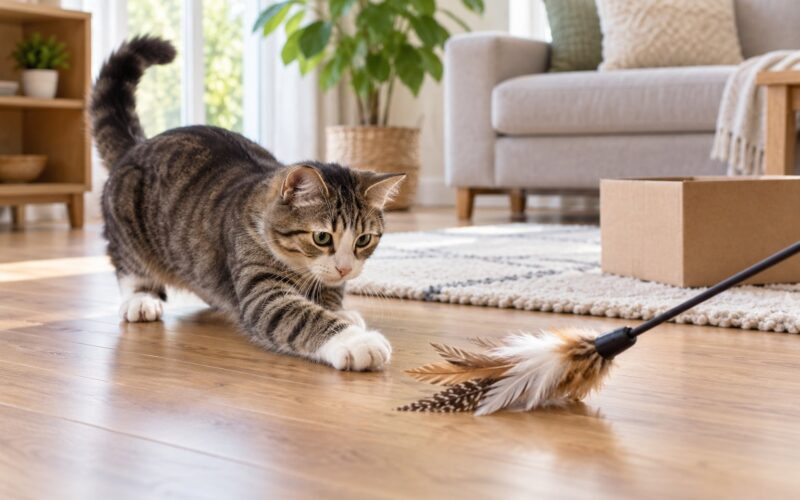
- Normal play, which includes ambushes, chasing, and those sideways “crouching with a wiggle” dances.
- Willingness to be near you without being summoned, on the sofa, in the doorway of the room you are in.
Cats sleep a great deal, often through most of the daylight hours. Do not count hours of sleep as a symptom on its own. Look at whether the sleep is relaxed, with the body loose and the paws tucked, or tight and twitching.
What Does a Stressed Cat Look Like?
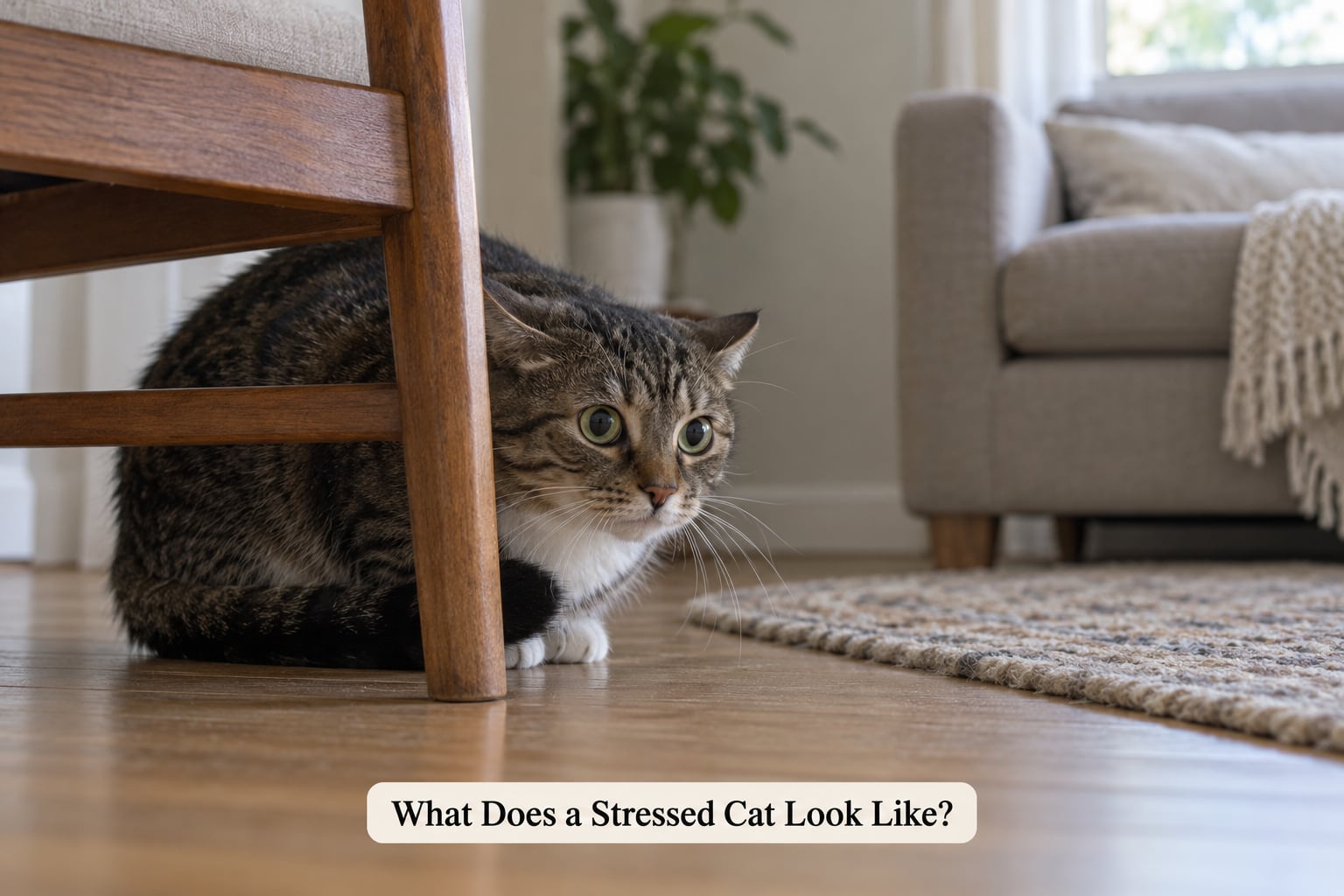
Stress makes a cat small and quiet. The body drops toward the floor, movement slows down, and the cat tries to reduce its own profile.
When the body goes small and low
- Crouching or freezing on the floor, under furniture, or pressed against a wall.
- Hiding in a spot that is new to them, or hiding more than usual.
- Tail tucked under the body or wrapped tightly around it.
- Piloerection, where the fur stands up along the back and tail. This is often nicknamed a “pumpkin tail” or “halo tail.”
- Dilated pupils that stay large in normal light.
- Ears flattened or turned sideways, holding them that way for minutes rather than seconds.
- Panting or trembling, which in cats is a distress signal rather than a cooling trick.
Grooming, eating and litter box changes
Over-grooming is the most common stress behavior owners miss because it looks like tidiness. Watch for thinning fur, bald patches on the belly or inner legs, matted fur, or licking at one spot until the skin is red. That is not grooming, it is a coping behavior.
Appetite usually changes first. Some cats stop eating within hours, others eat constantly and put on weight. Urinary habits often shift too: straining in the litter box, going just outside it, hiding while they pee, or producing very small amounts. Any of those need a vet, because urinary problems and stress look identical from the sofa.
Vocalization is the other big one. Persistent yowling at 3 a.m., or following you around the house calling, is worth watching alongside the ears and tail, because it is also a common sign of discomfort in older cats.
Warning signs that go past mood
Behavioral changes that appear with stress and then get worse over days deserve attention rather than reassurance. Aggression that appears out of nowhere, a stop in play, withdrawal from a favorite person, or a cat that hides constantly and no longer greets you at the door are all reasons to book an appointment.
So are physical changes: limping, hunched posture, a reluctance to jump, or a sudden change in how the cat lands from a normal leap. Pain makes cats hide and behave oddly, and most cats are built to hide weakness.
Happy vs Stressed: A Side-by-Side Comparison
The same body part can mean opposite things, so it helps to read the pairs together.
| Signal | Relaxed or happy cat | Stressed cat |
|---|---|---|
| Body posture | Loose, stretched, settles into spots | Crouched, arched back, frozen, weight low |
| Ears | Forward, or sideways in play | Flattened back, or held sideways in uncertainty |
| Eyes | Soft, normal pupils, slow blinks | Wide, dilated pupils, hard stare |
| Tail | Upright with a soft curl, gentle sway | Tucked under, low, puffed or lashing |
| Fur | Smooth and flat | Raised along the back and tail |
| Whiskers | Neutral, held forward | Pulled back flat against the face |
| Voice | Relaxed purr, chirps, short meows | Hissing, growling, or purring with a twitching tail |
| Eating and litter use | Steady, and the box is used normally | Appetite shifts, straining, accidents outside the box |
| Daily behavior | Play, kneading, bunting, greeting | Hiding, over-grooming, aggression, withdrawal |
How to Read Your Cat’s Body Language
Reading a cat is a sequence, not a snapshot. Give it ten quiet seconds and watch what the body settles into, not just how it looks in the first instant.
Watch the whole signal, not one part
Cats communicate in combinations. A tucked tail alone could be a cold floor, but a tucked tail with flattened ears and dilated pupils is fear. A slow blink alone means little, but a slow blink followed by a relaxed body, an upright tail and settled posture is a cat that feels safe.
Pick three things to check at once: ears, tail and overall muscle tone. If all three say the same thing, trust it. If they disagree, the context usually explains the disagreement, which is the next step.
The FAS scale: green, yellow and red
Veterinary behaviorists often sort feline states on what is called the FAS scale, for fear, anxiety and stress. It is a simple way to keep your read consistent.
- Green means relaxed. Body loose, tail upright or casually curled, ears forward, normal appetite, play and sleep in balance. This is the zone you want to spend most of the day in.
- Yellow means cautious or mildly stressed. Ears sideways, tail low or twitching, watching rather than engaging, hiding occasionally, appetite slightly off, or over-grooming after a busy moment.
- Red means acute fear or extreme stress. Crouching, freezing, piloerection, hissing, lunging, screaming, complete withdrawal, refusing to eat, or panic-level panting and trembling.
A cat that lives in yellow most of the day is living in stress, even without dramatic scenes. The goal is not to remove every yellow moment. It is to keep the cat out of red and to shorten yellow.
Context beats any single signal
Ask what just happened before you read the cat. A flattened ear during a chin scratch is overstimulation, not fear. A puffed tail when a second cat bolts through the living room is a startle response, not a plan. The same posture carries a different meaning depending on what preceded it.
Stress Signs in Everyday Cat Behavior
The triggers that show up most often
- Visitors and new people, especially ones who reach straight over the head.
- Carrier and car trips, which often produce crying, scratching, urination in the carrier or violent stillness.
- Veterinary appointments. A cat that purrs through an exam is frequently stressed, not happy. Purring in a context where nothing good is happening is a self-soothing behavior.
- Noise, including construction, fireworks, thunderstorms and a neighbor’s dog.
- Moving house or rearranging furniture, which can hide or unsettle a cat for weeks.
- New people in the household, including a new baby, whose unpredictable noise and movement unsettle many cats.
- Another pet arriving, particularly if the cats have been introduced through scent and a closed door was skipped.
- Route and timing changes, including a different feeding time or a person being away.
New cats and the 3-3-3 rule
The 3-3-3 rule is a guideline used for cats adjusting to a new home or a new environment: roughly three days to settle into the space, three weeks to start forming a routine, and three months to feel fully at home.
During those three days, hiding, eating little and using the box immediately or not at all is common. Between week one and week three you should see the cat start using the room, come out for meals and tolerate your presence. By the third month most cats are near their normal baseline.
It is a guide, not a deadline. A shy cat can take longer, and pushing before the cat has relaxed usually sets the process back rather than speeding it up.
When a temporary reaction becomes a pattern
A cat that hides for an afternoon during a house move and comes out for dinner is reacting. A cat that has hidden for two weeks, stopped eating in the room with people, and started soiling outside the box is living with it.
Multi-cat households add a layer worth watching. Cats do not negotiate verbally, so one cat bullying another looks like the aggressor playing hard or being loud while the other one quietly stops eating, stops using the shared box, or spends the day somewhere high and out of the way. Two cats with no obvious conflict can still be managing a tense relationship, and resources placed apart beat a shared bowl in a shared room.
Age changes the picture too. Kittens bounce back from stress quickly. Senior cats stress more easily, hide more readily, and can show the same signs when cognitive change or pain is really the cause.
How to Help a Stressed Cat Feel Safer
Keep the routine predictable
Cats are creatures of pattern, and the things that look like small details are the ones they track. Feed at the same times, keep litter scooping daily, and avoid moving the food and water bowls around for no reason. If your hours changed, change them back gradually rather than in one step.
Give room, height and a safe space
Vertical space is consistently the first thing owners report when they describe a calmer cat. A tall cat tree, a window perch or a shelf gives the cat an option to leave the room without leaving you, which is a large part of what safety feels like to a cat.
Set up one quiet retreat where nothing happens, no other pet goes, and the cat cannot be cornered. A covered bed, a cardboard box or a closed-off spare room all work. Put resources there, including water, food for multi-cat homes, and a litter box in a room the cat actually likes.
Remove the trigger and reward calm
The most effective change is usually removing the thing causing the stress. Move the litter box away from a loud appliance, move the feeding area away from the dog bed, give the cat an escape route from every room where visitors gather, and keep the carrier out in the open all year so it is not a surprise object.
Reward calm behavior rather than comforting a frightened cat. Quiet sessions, clicker training, wand toys, and puzzle feeders give the cat a way to feel in control. Pheromone diffusers sold for cats, Feliway being the best known, get mixed reviews from owners, so treat them as one tool among several rather than a fix.
Two warnings. Never give a cat human medication, including over-the-counter painkillers, sleeping tablets or a remedy meant for another animal, and never work out a dosing plan at home. And keep lilies out of the house: they are acutely dangerous to cats, and the pollen on a bouquet is enough.
When Should You Call a Veterinarian?
Call the same day for difficulty breathing, rapid open-mouth breathing at rest, collapse, repeated vomiting, or repeated attempts to urinate with nothing produced. A cat straining in the litter box can be in real trouble and needs to be seen quickly.
Book an appointment for sudden or marked behavior changes that last more than a day or two, loss of appetite, a stop in eating that goes on for even a day in a cat that normally loves food, over-grooming with hair loss, or aggression with no obvious trigger.
Go in for an exam when stress signs overlap with signs of pain or illness, since these look the same from the outside. Your veterinarian can rule out the medical causes, and can refer you to a veterinary behaviorist when the problem is behavioral rather than physical.
Frequently Asked Questions
Does purring always mean my cat is happy?
No. Cats purr for more than contentment, including when they are frightened, in pain, or soothing themselves. A stress purr usually comes with a tense body, a tucked tail, flattened ears, or pupils that stay wide. Judge the purr alongside the rest of the body, never on its own.
Why is my cat hiding suddenly, even if the home has not changed?
Because the change is often not in the room. Cats hide when they feel ill, when the weather shifts, when a neighbor’s cat appears outside, or when a routine slips. Quiet withdrawal in an adult cat that never used to hide is worth a vet call, because pain and illness look exactly like stress from the outside.
Is slow blinking a sign that my cat trusts me?
A slow blink is one of the best trust signals cats give. When a cat closes its eyes slowly while looking at you and then looks away, it is lowering its guard. You can slow blink back, and many cats respond. A cat that never blinks at you is often simply distracted rather than distrustful.
How can I tell whether a cat is stressed or in pain?
Stress is mostly behavioral and eases once the trigger is removed. Pain usually shows up in movement: a reluctance to jump, hunched posture, licking one area repeatedly, or landing differently from a normal leap. If both the behavior and the way the cat moves have changed, have a veterinarian check.
Should I give my cat human medication for stress?
No. Human painkillers such as ibuprofen, paracetamol and aspirin are toxic to cats, and cat medication still needs a vet to set the dose. Never give an over-the-counter pill, a leftover, or a remedy meant for another animal. Reducing the trigger and behavior support come first.
Start with one observation today: note your cat’s ears, tail and posture at one normal moment and one busy moment. Once you know the baseline, knowing how to tell if a cat is happy or stressed takes seconds, and you will know when something has actually changed.