If you have ever been watched by your cat without moving a muscle, you already know that an unblinking feline stare feels intense. Why does my cat stare at me without blinking? Usually because the cat has fixed its attention on you out of curiosity, hunger, affection, or plain alertness, and cats simply do not blink as often as we do.
The stare on its own never means one thing. You have to read it alongside the ears, tail, pupils, posture and whatever else your cat is looking at in the room.
Table of Contents
- What Does It Mean When a Cat Stares Without Blinking?
- How Cats Communicate With Their Eyes
- Why Does My Cat Stare at Me Without Blinking?
- 1. Your cat heard or saw something move
- 2. Your cat wants food
- 3. Your cat wants your attention
- 4. Your cat is being affectionate
- 5. Your cat is checking whether something is safe
- 6. Your cat is bored with leftover hunting instinct
- 7. Your cat is checking on you while you sleep
- Why does my cat stare at me without blinking but meow?
- The Difference Between a Slow Blink and a Stare
- What Other Body Language Can Help You Interpret the Stare
- A quick four-way checklist
- When a Stare May Indicate Fear, Irritation, or Overstimulation
- How to Respond Safely to Your Cat’s Stare
- When to Contact a Veterinarian
- Frequently Asked Questions
- Why should you not stare a cat in the eyes?
- Why is my cat just sitting and staring at me?
- What is the highest form of affection from a cat?
- Why do cats just randomly stare at you?
- How to tell if a cat is bonded with you?
- Conclusion
What Does It Mean When a Cat Stares Without Blinking?
A slow, unblinking stare usually means your cat has locked its attention on you. That happens when it is curious, wants food or attention, feels relaxed and affectionate, or has heard or smelled something it is still working out.
It also looks more intense than it is. Cats lubricate their eyes with a tear film and a third eyelid, so they need far fewer blinks than you do. An open stare for a few seconds is ordinary cat behaviour; the meaning changes with posture, timing and what the rest of the body is doing.
How Cats Communicate With Their Eyes
Cats use eye shape more than eye colour to send messages, and several distinct looks get confused with each other.
- Slow blink — the eyelids close halfway, hold, then close fully. This is the friendly one, often called cat eyes or a cat kiss.
- Prolonged stare at you — wide open, fixed, with the body still. Interest, request or watchful assessment.
- Hard direct stare — tense, unblinking, often with a still or stiff body. This is the look cats trade before a fight.
- Wide-eyed look — pupils blown large, whites showing. Fear, surprise or overstimulation.
- Sideways glance — head turned but eyes on you, usually with flattened ears. Uncertainty rather than confidence.
Here is the anatomy people miss. Your cat has a nictitating membrane, the third eyelid, that sweeps across the eye, plus a stable tear film that keeps the surface moist. Because blinking is less about lubrication for a cat than it is for you, a cat can hold a fixed gaze for a long stretch without discomfort.
Cats also dilate pupils in low light and constrict them in bright light, and arousal changes the size regardless of brightness. A huge pupil in daylight usually means excitement or stress, not a relaxed afternoon on the sofa.
Why Does My Cat Stare at Me Without Blinking?
Here are the reasons owners report most often, with the context that usually goes with each one.
1. Your cat heard or saw something move
Cats notice small motion long before people register it. A curtain, a shadow, dust in a sunbeam or something outside the window can hold a cat’s gaze for minutes, and you happen to be sitting in the direction of the target.
2. Your cat wants food
Owners describe the same pattern repeatedly: the stare starts in the hour before dinner, comes with a solicitation purr, and ends the moment the bowl is filled. A solicitation purr is a different sound from contentment, higher and more insistent, and it is meant to work on you.
3. Your cat wants your attention
If the stare lands when you are on the phone, reading or working, it is usually a request rather than a warning. Many cats escalate with a tail flick or a single meow if the first silent attempt gets nothing.
4. Your cat is being affectionate
Soft eyes with half-closed lids, an upright loosely curled tail and relaxed ears are the classic combination for a comfortable cat looking at you. Add a slow blink and that is a cat saying hello in the clearest way it has.
5. Your cat is checking whether something is safe
This is threat assessment. Before a cat decides to relax, it watches. The stare gets paired with forward-facing ears, a still body and a tail that is low or flicking, and it often ends the moment the cat decides you are not a problem.
6. Your cat is bored with leftover hunting instinct
House cats are built for short hunts and long rests, and a bored cat with energy to spend will hunt anything that moves. When that does not work out, the cat often sits and watches instead, which is what you are seeing.
7. Your cat is checking on you while you sleep
This is the 3am stare most owners post about, and the wake-up-at-night version of it. A night-active cat cycles through sleeping, waking and watching, and a sleeping human is the most interesting thing in a quiet dark room.
Why does my cat stare at me without blinking but meow?
The meow is the giveaway here, because adult cats reserve it almost entirely for communicating with people. A silent stare followed by a repeated, insistent call is a request, usually for food, a door opened or a play session. A stare that comes with a low growl or a hiss is something else entirely.
The Difference Between a Slow Blink and a Stare
The clearest way to tell a friendly cat from a tense one is to compare the whole picture, not just the eyes.
| Signal | Relaxed slow blink | Intense unblinking stare |
|---|---|---|
| Eyelids | Half closed, closing fully and slowly | Wide open, held open for long stretches |
| Head | Level or tilted, soft | Fixed, sometimes lowered or pushed forward |
| Pupils | Normal for the light, even | Large even in bright light |
| Ears | Forward or relaxed to the side | Flat to the head, or rotating hard |
| Body | Loose, may be kneading or rolling over | Stiff, crouched or leaning in |
| Tail | Upright with a relaxed curl | Low, lashing or puffed |
| Whiskers | Forward or neutral | Pulled back tight against the face |
| What triggers it | Greeting you, settling down, being petted | A sound, a stranger, another cat, resource guarding |
One table row is worth its own line. Half-closed lids plus an upright curled tail plus forward ears is the version of this behaviour that owners sometimes call the highest form of affection a cat gives.
What Other Body Language Can Help You Interpret the Stare
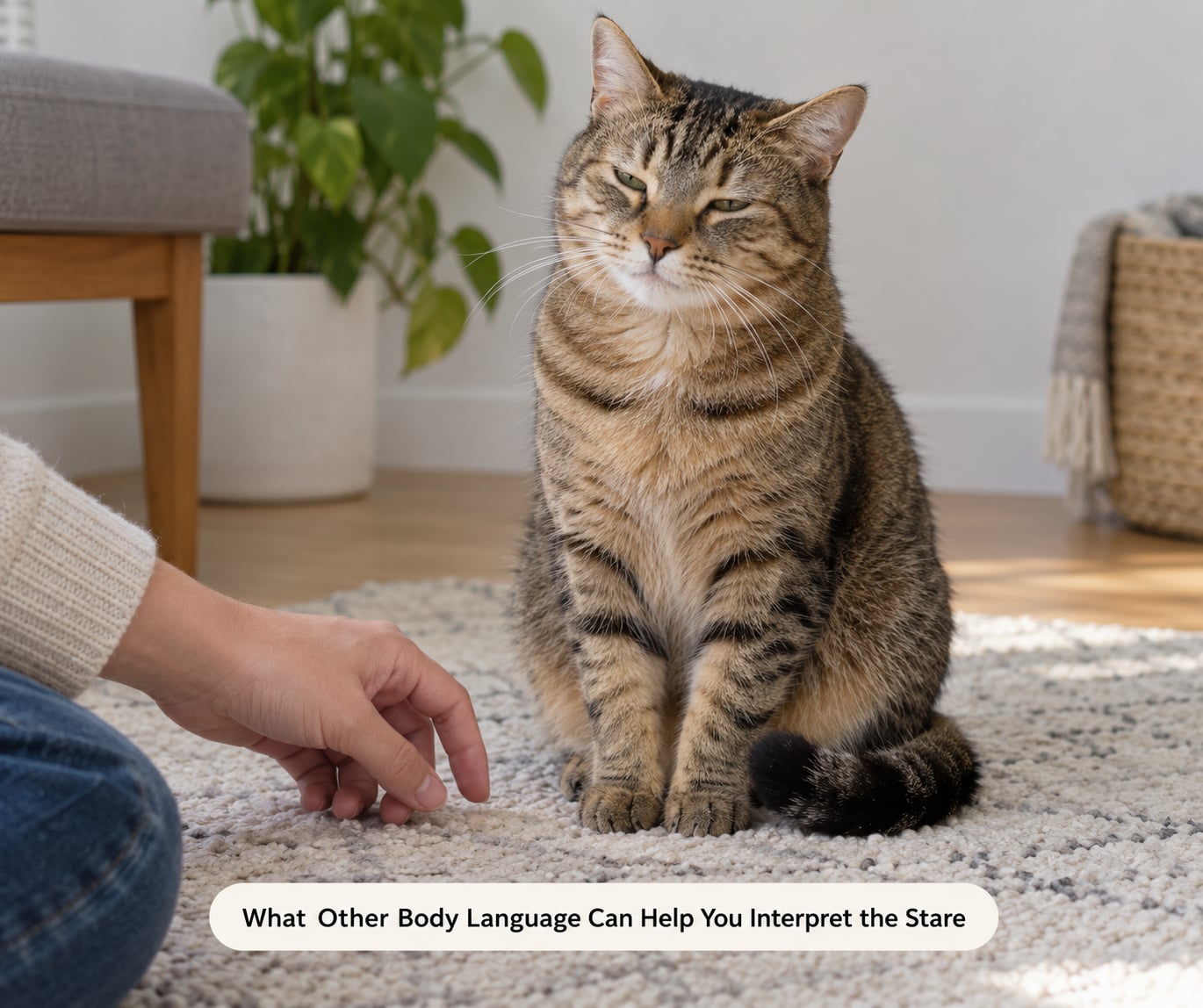
Eyes are the loudest signal a cat gives and also the easiest to misread alone. Read the rest of the body in this order.
| What you see | What it usually means |
|---|---|
| Ears forward or loosely to the side | Interested and comfortable |
| Ears flattened or turned hard backward | Fear, irritation or defensive warning |
| Tail upright with a relaxed curl | Relaxed, friendly greeting |
| Tail low, lashing or puffed | Aroused, angry or frightened |
| Pupils pinned to narrow slits | Fear or defensive aggression |
| Pupils very large in a lit room | Excitement, arousal or stress |
| Body loose, belly exposed, kneading | Content and secure |
| Crouched, arched back, sideways stance | Threat assessment or readiness to flee |
| Whiskers forward | Curious or interested |
| Whiskers pulled back tight | Stressed or wary |
| Skin twitching along the back | Overstimulation or startle response |
| Deep slow breathing, purring | Calm and safe |
A quick four-way checklist
- Friendly: soft eyes, forward ears, upright curled tail, purring or kneading.
- Neutral: still body, neutral ears, slow blinking, watching without tension.
- Stressed: wide eyes, tail lashing, skin twitching, ears sideways, trying to move away.
- Defensive: flattened ears, crouched or arched posture, dilated or slit pupils, hissing or growling.
Distance is part of the message too. A cat that stares from two metres away and relaxes when you ignore it is one thing; a cat that stares from inside a hiding spot it has just refused to leave is another.
When a Stare May Indicate Fear, Irritation, or Overstimulation
Some stares are a cat giving you a chance to back off. The signs travel together: flattened ears, a lashing tail, a crouch, a puffed coat, pupils blown wide in a bright room, whiskers pulled back against the face.
Add hissing, growling, swatting with a paw or a sudden dash away and the reading is clear. Overstimulation is the quieter version, where a cat that enjoyed petting ten seconds ago has gone still, is watching your hand, and is about to bolt.
The right response is distance, not engagement. Stop looking at the cat, put your hands down and move away, and let the room settle. Overstimulation usually passes in minutes once the cat is left alone with an exit.
How to Respond Safely to Your Cat’s Stare
Do not stare back as a challenge. Cats read a long, fixed stare from a person as the same thing another cat would give, and some cats escalate from staring to swatting or biting. Looking away and breaking eye contact takes the tension out of the moment.
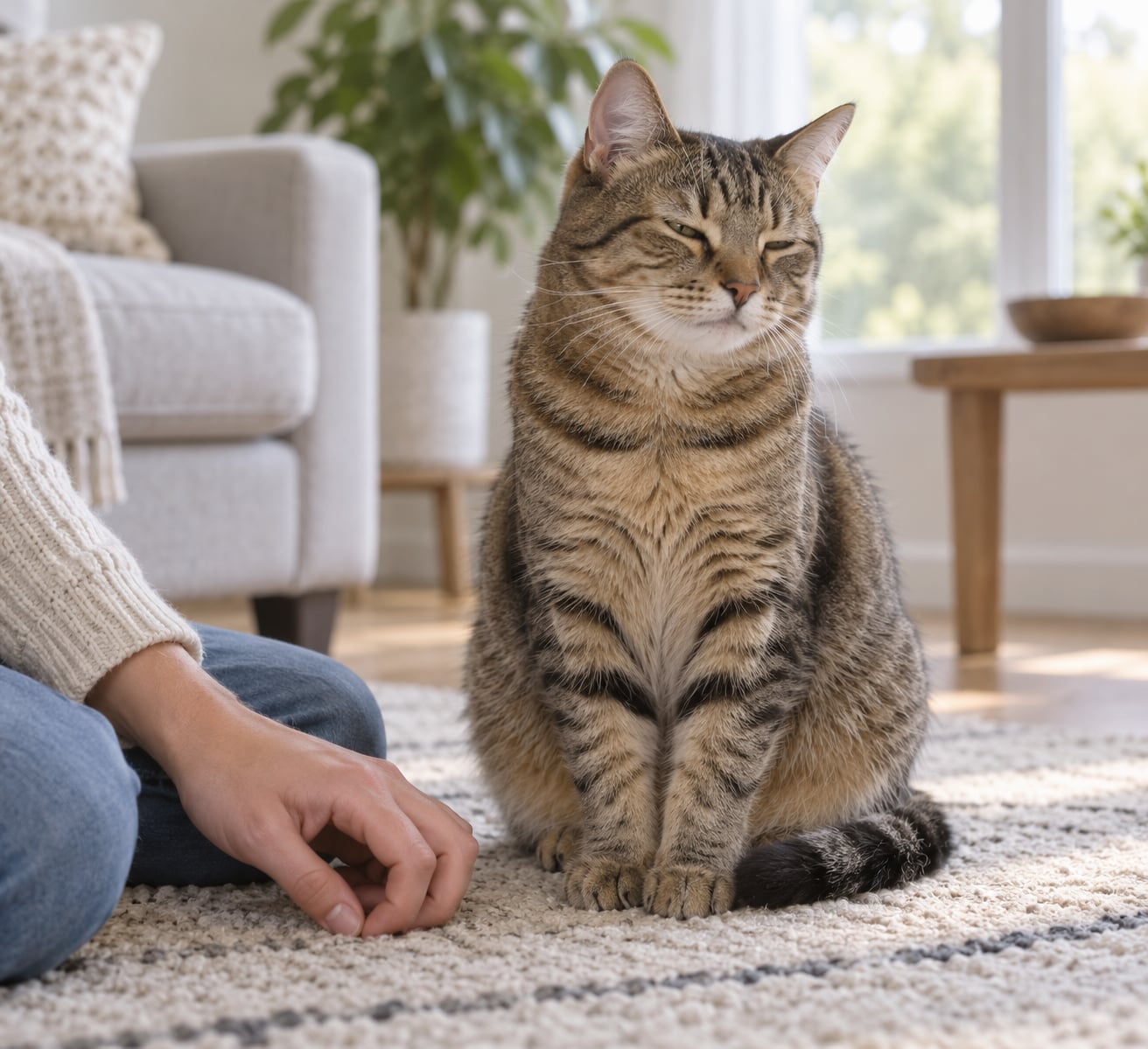
Slow blinking back is the one response that usually does the opposite, and here is how to do it properly.
- Sit or lie down so your eyes are level with your cat’s instead of above them.
- Look at your cat softly, then look slightly aside so your gaze is not a challenge.
- Lower your eyelids halfway, hold for a second or two, then close them fully for a couple of seconds.
- Open them and let your cat decide whether to blink back, approach or walk off.
A soft voice works well alongside it. Saying the cat’s name in a calm, low tone often draws a slow blink or a head tilt, and both are good signs.
For a cat that is staring because it wants something, offer a hand to sniff, toss a toy, or open the door it is waiting at. For a cat that is watching you sleep, ignore it and let it settle nearby on its own, which is what most of them end up doing.
And do not punish a stare. It is normal feline communication, and correcting it teaches the cat that hiding its attention is safer than showing it.
When to Contact a Veterinarian
An occasional stare is normal, but a sudden change in staring behaviour deserves a call, especially in an older cat.
- An eye that looks cloudy, hazy, red or suddenly different from the other.
- Squinting, holding an eye partly closed, or blinking more than usual.
- Any discharge, crusting around the eye or excessive blinking that looks painful.
- A third eyelid that stays visible across the eye when the cat is awake.
- Staring combined with a head tilt, pawing at the face or bumping into things.
- Staring that starts suddenly in a senior cat and comes with appetite loss, confusion, disrupted sleep or vocalising at odd hours.
- A fixed, unblinking stare alongside panting or rapid breathing.
Cognitive dysfunction in older cats and high blood pressure can both change how a cat uses its eyes, and eye pain is the most urgent of these. Call your veterinarian and describe what you saw rather than trying to judge it yourself, and treat any eye injury as same-day.
Frequently Asked Questions
Why should you not stare a cat in the eyes?
A long, fixed stare looks the same to a cat whether it comes from another cat or a person, and cats read it as a challenge or a threat assessment. That is why some cats tense up, flatten their ears or swat when someone holds eye contact. Break the stare by looking aside or standing up and walking away.
Why is my cat just sitting and staring at me?
Sitting still and staring is how cats watch before they commit to anything, and it covers most normal reasons: hunger, wanting attention, curiosity, boredom or keeping an eye on a sound they cannot place yet. Check the timing. Stares clustered around meal times point to food, while stares during a noisy afternoon often point to alertness or overstimulation.
What is the highest form of affection from a cat?
Most cat owners point to the slow blink, often called cat eyes or a cat kiss. Closing your eyes near another animal is a vulnerable act, because a cat cannot see what is approaching while its lids are down. A slow blink with half-closed eyes, forward ears and an upright curled tail is the clearest affectionate signal a cat gives.
Why do cats just randomly stare at you?
It rarely feels random from the cat’s side. Something shifted in your posture, a shadow crossed the floor, the fridge clicked, or you simply became still enough to be interesting. A cat with energy to spare and nothing to hunt will sit and watch whatever is moving most, which is often you.
How to tell if a cat is bonded with you?
Look at what happens after the stare rather than during it. A bonded cat settles near you, sleeps close, kneads and purrs on you, greets you at the door, and turns toward you rather than away. Cats that have been well socialised tend to slow blink more readily, while cats that never return a slow blink may simply have learned to watch from a distance.
Conclusion
So why does my cat stare at me without blinking? The short answer is curiosity, hunger, affection, attention-seeking or watchful interest, and cats blink far less than people because of their tear film and third eyelid. Read the stare with the ears, tail, pupils and posture, slow blink back instead of staring, and give a tense cat room to leave.
Call your veterinarian if the staring starts suddenly, or if the eye looks different, squints, discharges or hurts. Behaviour guides for cats change as research does, and this one was checked against current guidance in 2026.