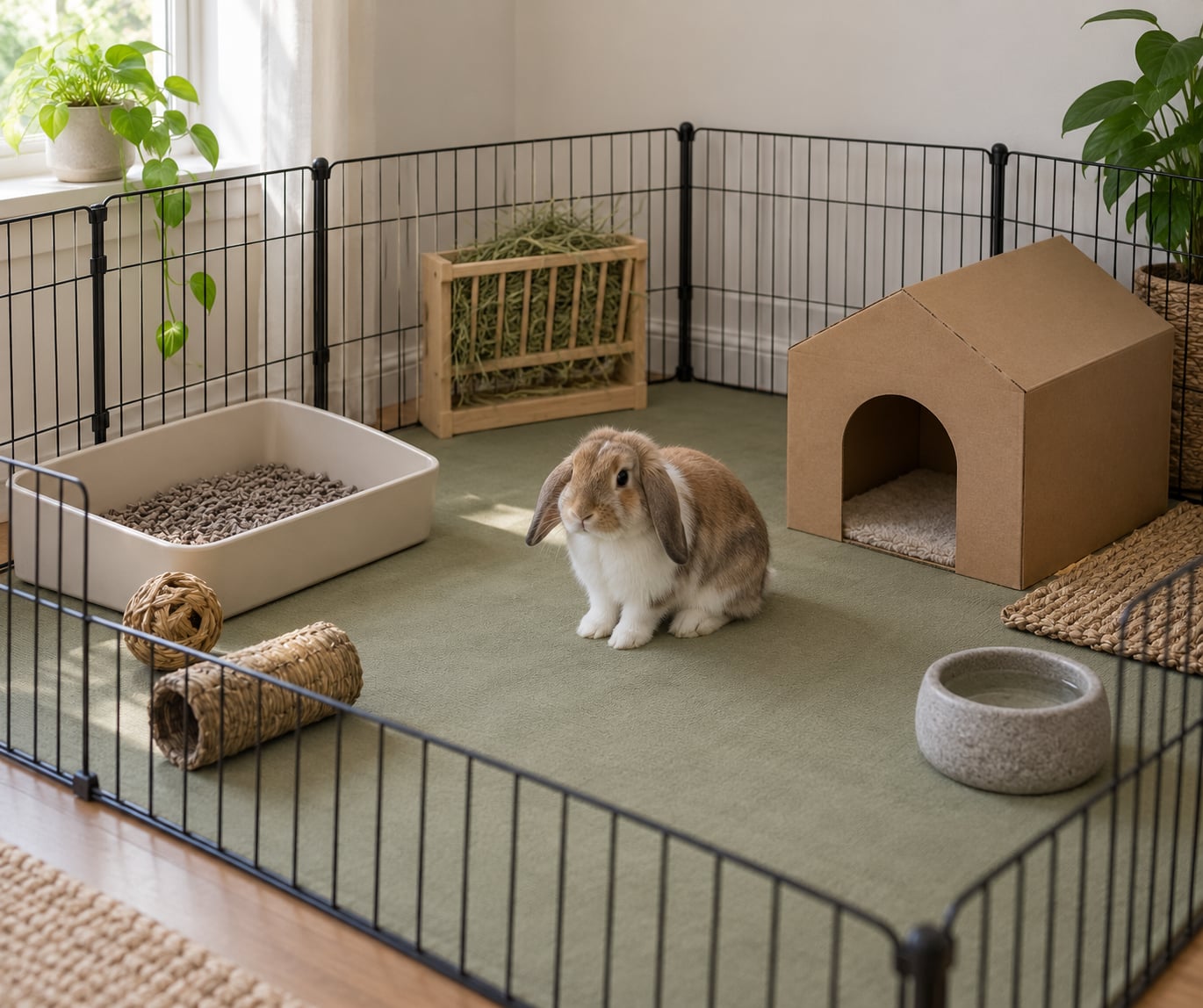
A good rabbit cage setup is a solid-floored pen that is big enough for three full hops, three full stretches and three relaxed landings, furnished with a low-sided litter box in a corner, unlimited grass hay, a heavy water bowl and a place to hide. Learning how to set up a rabbit cage and litter area takes about an hour, costs little, and saves you rebuilding it in a month.
Most starter cages sold in pet shops are the wrong shape for the job. They are tall and narrow rather than wide and flat, they sit on wire, and they force the rabbit to toilet wherever it happens to be standing. Fixing all three is straightforward.
This guide walks through the whole job in order: what to gather, where to put the pen, how to build the floor and the litter area, what to add for food and comfort, and how to keep the whole thing clean. Last updated October 2026.
Table of Contents
- What You Need
- How to Set Up a Rabbit Cage and Litter Area Step by Step
- Choose and Position the Rabbit Cage or Exercise Pen
- Install a Safe Solid Floor
- Set Up the Litter Area
- Add Food, Water, and Comfort Items
- Test the Setup and Introduce the Rabbit
- Common Mistakes
- Daily Care and Cleaning Tips
- Frequently Asked Questions
- How big should a rabbit cage be?
- What size litter box should I use for my rabbit?
- What is the best bedding for rabbits to reduce odor?
- Should I shut my rabbit in at night?
- How often should I clean a rabbit litter box?
- How long does it take to litter train a new rabbit?
What You Need
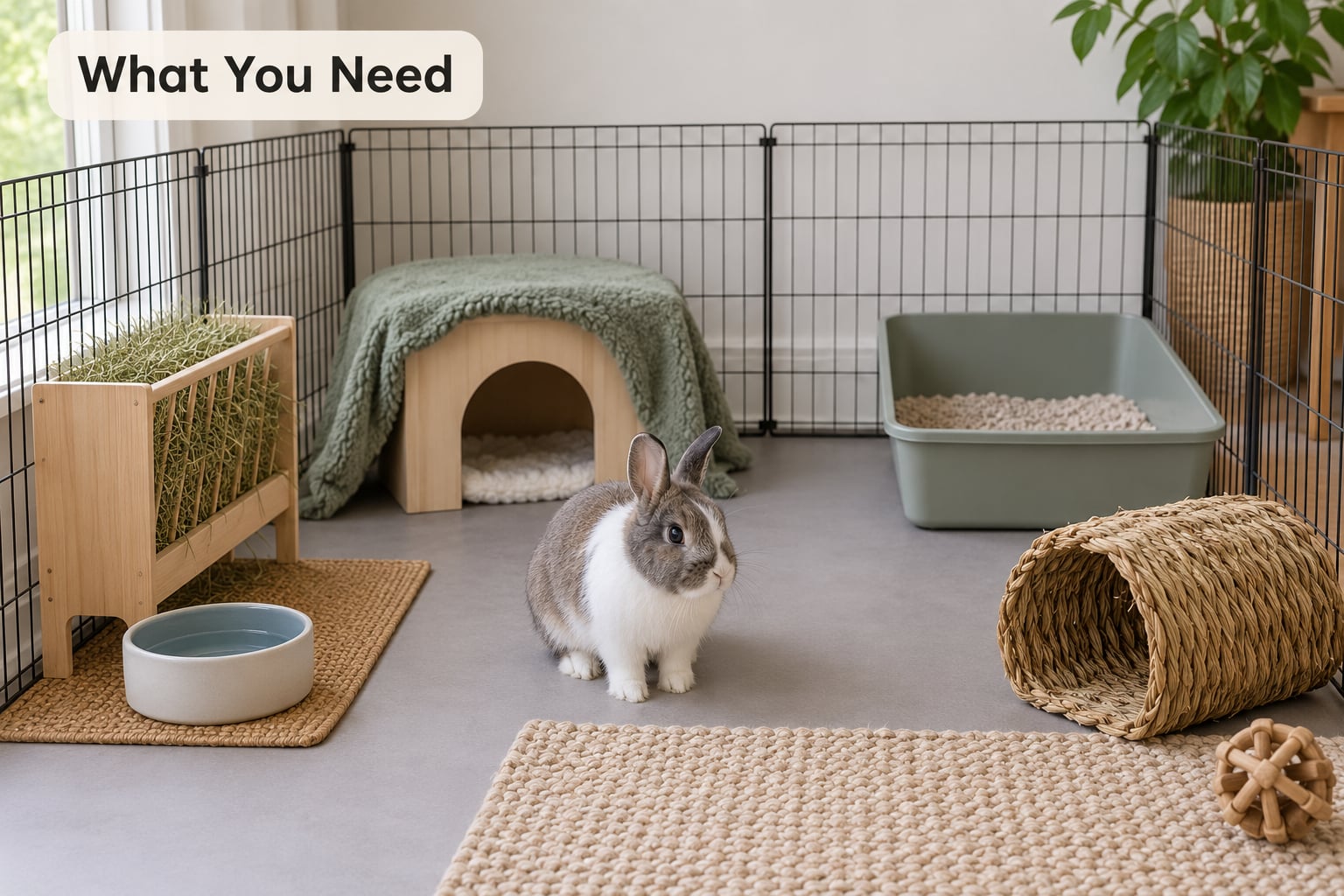
Gather everything before the rabbit arrives, because a half-built enclosure is a stressful place to put a nervous animal. Most owners underestimate the litter box, which should be the single largest item in the list.
- An enclosure: a dog exercise pen (x-pen or playpen), a cube-grid condo, a two-storey indoor cage, or a custom wooden build. Wide and flat beats tall and narrow every time.
- Solid flooring: foam tile, a washable vinyl mat, sealed wood panels, or a stack of newspaper under a washable mat.
- A litter box: a large plastic or ceramic tray with low sides. Under-tray boxes with a gridded top suit larger breeds.
- Safe litter: paper-based pellets, kiln-dried grass hay, or aspen wood shavings. Skip cedar, pine, and clumping clay.
- A feeder or hay rug: something that holds a large amount of grass hay off the floor.
- A heavy ceramic or stone bowl: wide enough that the rabbit cannot tip it or chin-check it too hard.
- A hide box: a cardboard hideaway, wooden hut, or fabric hide with two exits if you can find one.
- Cleaning kit: a small scoop, a stiff brush, gloves, and an unscented pet-safe cleaner.
- Enrichment: a digging box filled with paper-based pellets and clean soil, untreated apple wood chews, willow sticks, cardboard tubes, and tunnels.
The sizing rule that matters: your rabbit must be able to stand upright on its hind legs without its ears brushing the ceiling, stretch out fully when lying down, and take at least three comfortable hops in a straight line.
What is the 3-3-3 rule for rabbits? It is the sizing shorthand welfare organisations use: three hops in a line, three full body-length stretches, and three back-and-forth hops between the two ends of the enclosure. A pen that passes all three, for a fully grown rabbit, is comfortably in the right range.
You will see 3-4 times body length, 4 times stretched length, 6 times body length and 10 by 6 feet for a pair all quoted online. These are not contradictions, they are measurements of different things: resting space, pen floor area and pair housing. Aim for the largest of them that your room allows.
How to Set Up a Rabbit Cage and Litter Area Step by Step
Choose and Position the Rabbit Cage or Exercise Pen
Start with the base. Pick an enclosure that is well ventilated, wider than it is tall, and open on top so you can reach in and check on your rabbit without a struggle. Two 36-inch exercise pen panels joined together give you roughly 4 by 4 feet of floor, which suits one average adult rabbit and is the most common DIY starting point on rabbit forums.
Check the vertical clearance before you buy. A rabbit that can jump 18 inches will clear a 24-inch panel given a running start, and dwarf breeds and kittens are escape artists. Either buy panels around 36 inches tall or plan for a 36-inch perimeter. Open-top pens work only if the rabbit is over that jumping age or you have built a lid.
| Enclosure type | Typical size | Best for | Watch out for |
|---|---|---|---|
| Dog exercise pen (x-pen) | 4 by 4 ft for two panels | Apartment living, quick builds, temporary pens | Weak latches, panels the rabbit pushes against, gaps at the joins |
| Cube-grid condo | 2 by 2 ft base, often two storeys | Small rooms where a pen will not fit | Floor area is tight; add a solid mat and expect frequent spot-cleaning |
| Two-storey indoor cage | 3 by 2 ft per level | Vertical space in a small home | Top-opening doors can be pushed up from inside; check the latch daily |
| Custom wood build | Whatever you design | Durability and a look that suits the room | Untreated wood gets chewed; seal every edge and skip wire flooring |
Position the pen away from radiators, air conditioning vents, direct sun and busy doorways. Rabbits are crepuscular and startle easily, so a corner that stays quiet through the morning rush is better than the middle of the living room, even though owners naturally want the rabbit where the family is.
Keep it out of reach of cats and dogs until you know the rabbit is confident in the space. Secure every panel, every clip and every door before anything goes inside.
Install a Safe Solid Floor
Cover the pen base with a solid, non-slip, washable surface. Foam tile, a vinyl mat, sealed plywood or a stack of newspaper covered by a washable mat all work. The test is simple: when you nudge it with your foot, does it slide?
Never use wire flooring. Rabbits that sit on wire develop sore hocks, a painful condition affecting the heels of the feet, and it is one of the most common and most preventable welfare problems in small pet housing. If the pen came with a wire tray underneath, remove it or cover it completely.
Watch for anything the rabbit could trap a leg in or swallow the corner of: loose fleece blankets, frayed rug edges, exposed wire clips, untreated wood with splinters, and any gap wider than its head but narrower than its body.
Set Up the Litter Area
Most rabbits pick one corner of an enclosure and toilet there instinctively, so place the litter box in the corner they already favour. If the rabbit is new and you have not seen the pattern yet, put it in a corner away from the feeder, at the opposite end from where food is served.
Size the box generously. It should be big enough for the rabbit to turn around in, sit fully inside without touching the sides, and lie down to sleep in. Small litter trays are the reason so many owners report accidents next to the box.
Use a plastic or ceramic box. Owners on rabbit forums often repurpose under-bed storage bins, which are wide, deep and cheap, and larger breeds like gridded under-tray boxes that keep droppings out of the bedding. Skip galvanised or bare metal trays, which corrode over time.
| Litter or bedding | Verdict | Odor control | Note |
|---|---|---|---|
| Paper-based clumping pellets | Safe | Good | Soft underfoot, low dust, good for hay on top |
| Grass hay, kiln-dried | Safe | Good | Encourages eating while the rabbit eliminates |
| Aspen or beech wood shavings | Safe | Fair | Unscented only; avoid dusty bags |
| Untreated aspen pellet bedding | Safe | Good | Popular mixed with paper pellets |
| Pine shavings | Avoid | Fair | Aromatic oils irritate the airways over time |
| Cedar shavings | Avoid | Poor | Strong aromatic oils, genuinely hazardous to small airways |
| Clumping cat litter | Avoid | Very strong when wet | Clumps are ingested if eaten; use no inedible litter in the box |
Build the litter area in layers: a deeper layer of litter at the bottom, a handful of droppings and hay on top to send the message that this is a toilet and a dining spot at the same time. Keep the box heavy enough that a rabbit cannot slide it, and place it so a cat cannot reach it from a neighbouring surface.
Add Food, Water, and Comfort Items
Grass hay is about 80 percent of a rabbit’s daily intake, so it needs to be available at all times. A wall-mounted hay rack keeps it clean; a heavy ceramic hay bowl works too, but check that it cannot be tipped and that the rabbit cannot get a paw or head stuck behind it.
For water, a heavy ceramic or stone bowl is the better choice. Drip bottles force an unnatural neck angle and owners on rabbit forums frequently report reduced drinking and recurring urinary problems with them. Either way, refresh the water daily and scrub the bowl at least once a week.
Add somewhere to hide. A cardboard hideaway is fine and gets replaced for free; a wooden hut lasts. Add a digging box, untreated apple wood chews, willow sticks, cardboard tubes and a tunnel, and rotate them rather than leaving everything out permanently.
Keep the feeder, the water bowl and the litter box in three separate zones. Mixing them is the fastest way to a rabbit that stops using its box.
Test the Setup and Introduce the Rabbit
Before the rabbit arrives, crouch down at floor level and look at the enclosure from that height. You are looking for gaps, exposed clips, sharp edges, loose wires and anything within chewing reach that should not be chewed.
Then put the rabbit in and sit on the floor nearby, doing nothing at all. Most rabbits freeze for the first hour or two, then start exploring. Check within a day that they are eating hay, drinking, hopping around and using the litter area.
Expect a mess for the first one to two weeks. That is normal and it is a setup problem, not a behaviour problem, if the box is placed well.
Common Mistakes
1. An enclosure that is too small. The fix is to measure the space the rabbit needs before buying furniture. If a pen only fits the litter box and a hide, it is too small.
2. Wire flooring. Remove the wire tray entirely and cover the base with foam tile, vinyl or newspaper and a mat. Sore hocks are difficult to reverse.
3. The litter box sitting beside the hay or the water bowl. Move it to the far corner from any food, and place the feeder as close to the opposite end as you can.
4. Scented, dusty or clumping litter. Switch to paper pellets, grass hay or unscented aspen. Cedar and pine shavings cause respiratory irritation, and clumping clay is not made to be eaten.
5. Cramming the pen with furniture. Every hide, tunnel and toy takes away hopping room. Measure the clear floor space after furnishing, not before.
6. A light water bowl the rabbit can tip. Use a heavy ceramic or stone bowl, or a bottle with a stable mount that you check daily for a working spout.
7. Chewable or sharp furnishings. Use only untreated wood, cardboard and ceramic, and cover or route electrical cords out of reach.
8. Skipping cleanings because the box is awkward to scrub. Choose a box you can kneel beside and reach into. A box that is hard to clean gets cleaned badly, and stale urine turns into ammonia, which irritates airways far more than any litter brand does.
Daily Care and Cleaning Tips
Scoop droppings and soak bedding out of the litter box every day. Daily spot-cleaning keeps ammonia near zero, and ammonia is what you smell, not the litter itself. This is the single highest-impact habit in rabbit keeping.
Once a week, empty the box completely, wash it with hot water and an unscented pet-safe cleaner, rinse it well and let it dry before refilling. Change the bedding elsewhere in the enclosure on the same schedule.
Top up hay at least daily and check water twice a day in warm weather. Hay disappears fast; a rabbit that eats nothing for half a day is a medical emergency, not a slow patch.
Weekly, walk around the pen and look for damage: a chewed panel, a lifted clip, a frayed hide, a cracked bowl. Also watch the litter habits. A rabbit that suddenly stops using the box is worth investigating. Check litter depth, box size and placement first, and if the behaviour continues, call your vet, because urinary problems and pain from dental disease are common causes.
Never give a rabbit human medication. Anything medical goes through a rabbit-savvy vet.
Frequently Asked Questions
How big should a rabbit cage be?
A rabbit needs an enclosure where it can stand upright without touching the ceiling, stretch fully when lying down, and take three comfortable hops in a line. The 3-3-3 rule captures this: three hops, three stretches, three relaxed landings. For one average adult rabbit, two joined 36-inch exercise pen panels give roughly 4 by 4 feet, and a bonded pair needs notably more.
What size litter box should I use for my rabbit?
Buy the largest box your space allows, with low sides. It should be wide enough for the rabbit to turn around and sit fully inside without touching the sides, and deep enough to sleep in. Small trays are the most common reason owners report accidents beside the box. Large breeds and giant breeds often do better with an under-tray box with a gridded top.
What is the best bedding for rabbits to reduce odor?
Paper-based clumping pellets, kiln-dried grass hay and unscented aspen shavings are the safest choices, and they control odor well. Stay away from cedar and pine shavings, whose aromatic oils irritate small airways, and from clumping cat litter, which forms hard clumps if eaten. The bigger factor is frequency: ammonia, not the litter, causes the smell that lingers in a room.
Should I shut my rabbit in at night?
A secure indoor setup can be left closed overnight, and many owners prefer it, because it stops nocturnal accidents, chewing and escapes. The enclosure still has to be large enough and furnished with hay, water and a hiding place for the whole night. If the rabbit seems stressed, stops eating or paces constantly, keep the setup under observation and talk to your vet.
How often should I clean a rabbit litter box?
Scoop droppings and soak bedding out every day, and do a full empty, wash and dry once a week. Daily spot-cleaning keeps ammonia levels near zero, which is the smell people notice in a room. Use hot water and an unscented pet-safe cleaner, rinse well and let the box dry before refilling it with litter and a hay layer on top.
How long does it take to litter train a new rabbit?
Most rabbits toilet-select one corner within days, and putting the litter box in that corner usually speeds things up dramatically. Expect a messy one to two weeks while the rabbit settles, then a steady record. If accidents continue, work down the list: medical causes first, then box size, then placement away from food, then litter type. A vet check rules out urinary and dental pain.
Start with two things: measure the space so the rabbit can stand upright and stretch out, then buy one generous litter box and put it in a corner on a solid floor. Everything else, the hay feeder, the hide, the digging box and the cleaning kit, can follow once those two pieces are right.