How to quarantine new fish before adding them is simple to do and easy to get wrong: keep them in a separate, bare-bottom tank for four to six weeks, then move them across slowly. Two weeks is the bare minimum. Two hard rules never change — the fish live in their own tank, and you never pour the bag water into your display.
Most outbreaks start within days of a new arrival, and one infected fish can take a whole display tank with it. The reason goes back to shipping stress: transport, handling and sudden swings in temperature and chemistry suppress a fish’s immune system, so parasites and bacteria that were sitting quietly in the bag multiply once the fish settles in.
Quarantine protects the new arrivals too. A fish moving from store water into your display can pick up whatever your tank already carries. The separate tank is the only place where you can watch a fish feed, test the water, and dose medication into a small volume without disturbing anything you already own.
This guide covers the equipment, the day-by-day process, how long to wait, and what to do when you spot a problem. Guidance here is general information; a veterinarian who treats fish or a qualified aquatic professional should advise on dosing and any treatment for a sick animal.
Table of Contents
- What You Need
- Step-by-Step
- 1. Prepare the Quarantine Tank Before the Fish Arrives
- 2. Check the New Fish and Its Packaging
- 3. Add the Fish to the Quarantine Tank Slowly
- 4. Observe the Fish Daily
- 5. Treat Problems Only With Fish-Safe Methods
- 6. Introduce the Fish to the Main Tank
- Common Mistakes
- Tips for a Safer Quarantine
- Frequently Asked Questions
- How long should I quarantine new fish before adding them to my tank?
- Do I have to cycle a quarantine tank before adding fish?
- Should I medicate new fish as soon as they arrive?
- Is quarantine different for marine and reef fish?
- What if I only have one tank?
- How long do you keep a sick fish in the quarantine tank?
- Conclusion
What You Need
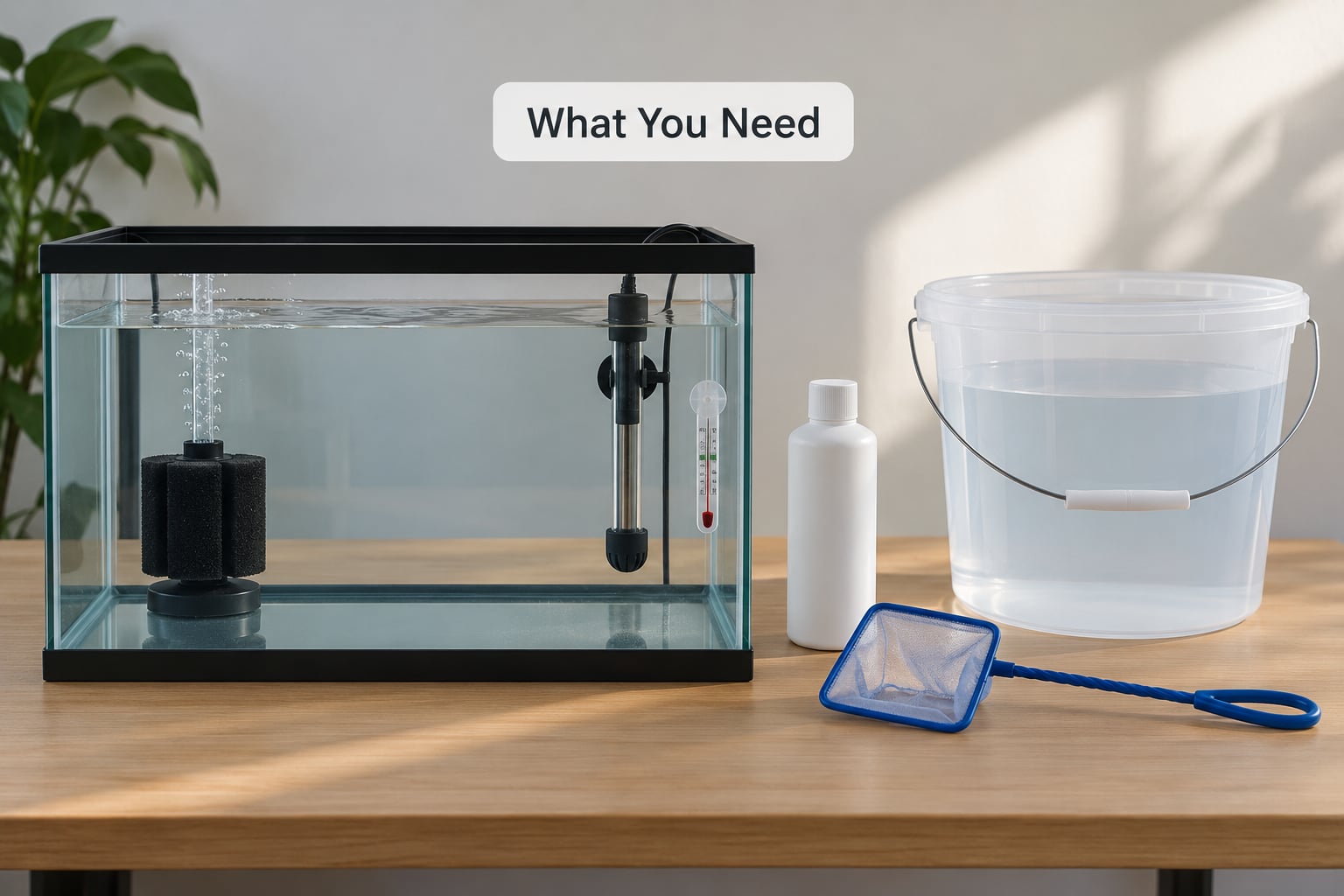
Gather everything before the fish arrive, not after. Setting up the tank on the same afternoon you bring a fish home is how half the mistakes happen.
| Item | Why you need it |
|---|---|
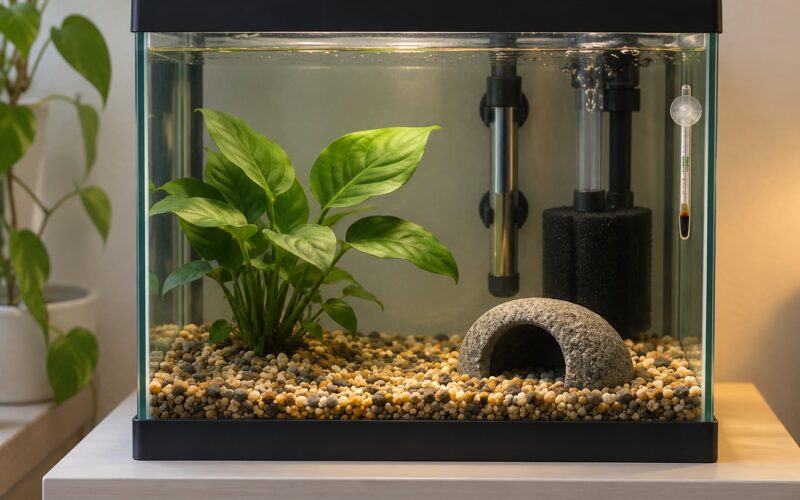
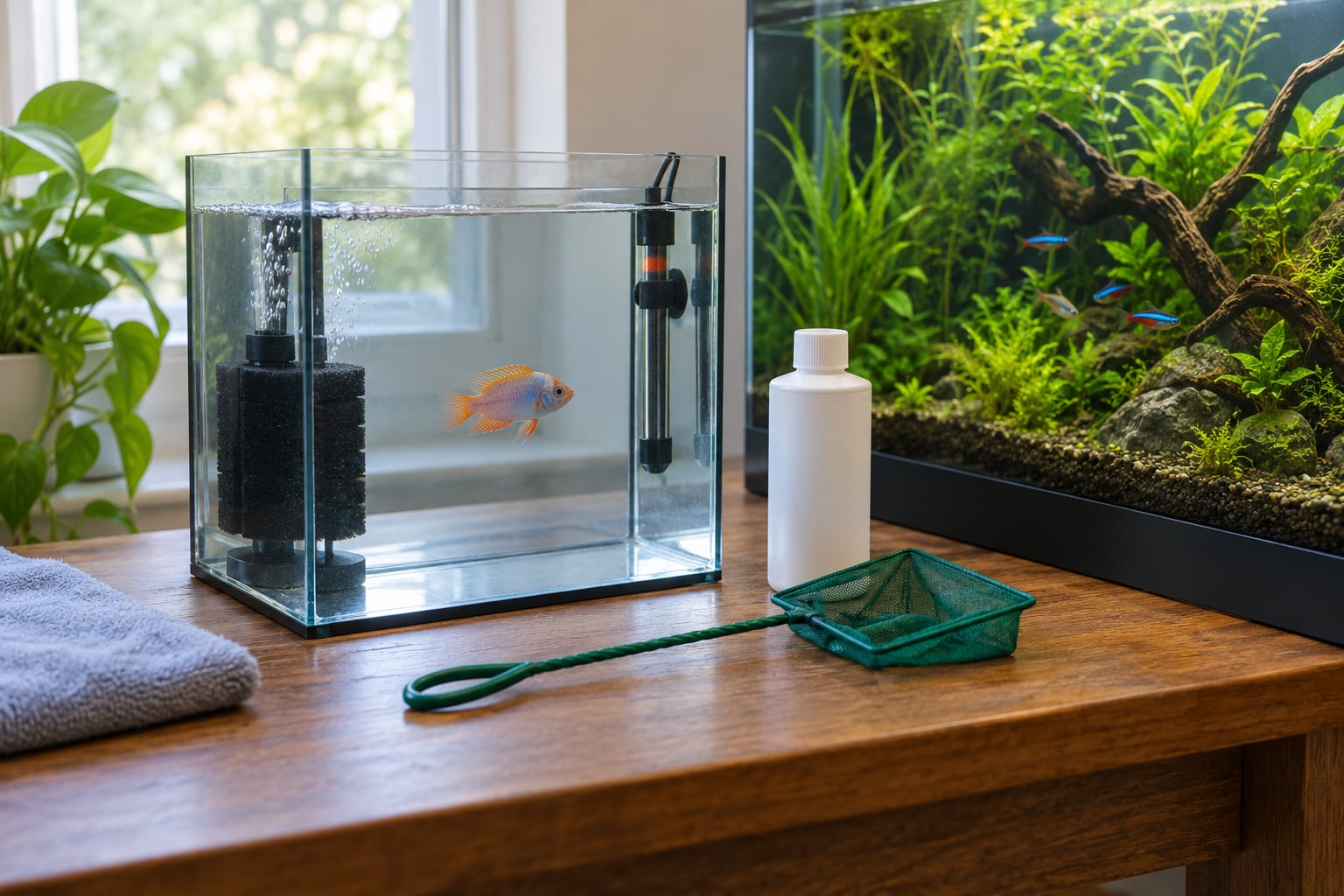
| Tank or storage tote, bare bottom | A simple 10 to 20 gallon container with no gravel. A bare floor keeps waste visible and lets you siphon the whole volume. |
| Tight-fitting lid | New arrivals jump. A lid with a gap is an invitation to a fish on the carpet. |
| Adjustable heater with a guard | Holds temperature steady. A cheap preset heater cannot be matched to your display tank’s reading. |
| Thermometer | The only way to confirm the heater is doing its job. |
| Seeded sponge filter | Runs media that has already matured in an established aquarium, so ammonia and nitrite get processed from day one. |
| Water conditioner that neutralizes chlorine and detoxifies ammonia | Tap water and new-bag water are both treated before anything living goes in. |
| Liquid test kits for ammonia, nitrite and nitrate | You cannot eyeball a cycle. Ammonia and nitrite are the two tests that matter most. |
| Air stone or air pump | Adds oxygen during treatment, when fish often breathe faster and dissolved oxygen drops. |
| Dedicated net, siphon and bucket | Equipment that never touches your display tank. Cross-contamination is how a hospital tank becomes a source. |
| PVC elbows or a small cave | A stressed fish needs somewhere to hide that is not the corner of the tank. |
| Dim light on a timer | Ten hours of low light a day keeps the fish calmer and lets you sleep. |
| Food matched to the species | Appetite in the first week is one of the most useful health signals you will get. |
| A notebook or a phone note | Temperatures, test readings, feedings, water changes and anything odd you noticed. |
A plastic storage tote works fine as a hospital tank. Drill a small hole near the top rim on each side for an airline tube, set it on a level surface out of direct sun, and mark the water line in permanent marker along the side so you can measure volume and dosing accurately later.
Step-by-Step
1. Prepare the Quarantine Tank Before the Fish Arrives
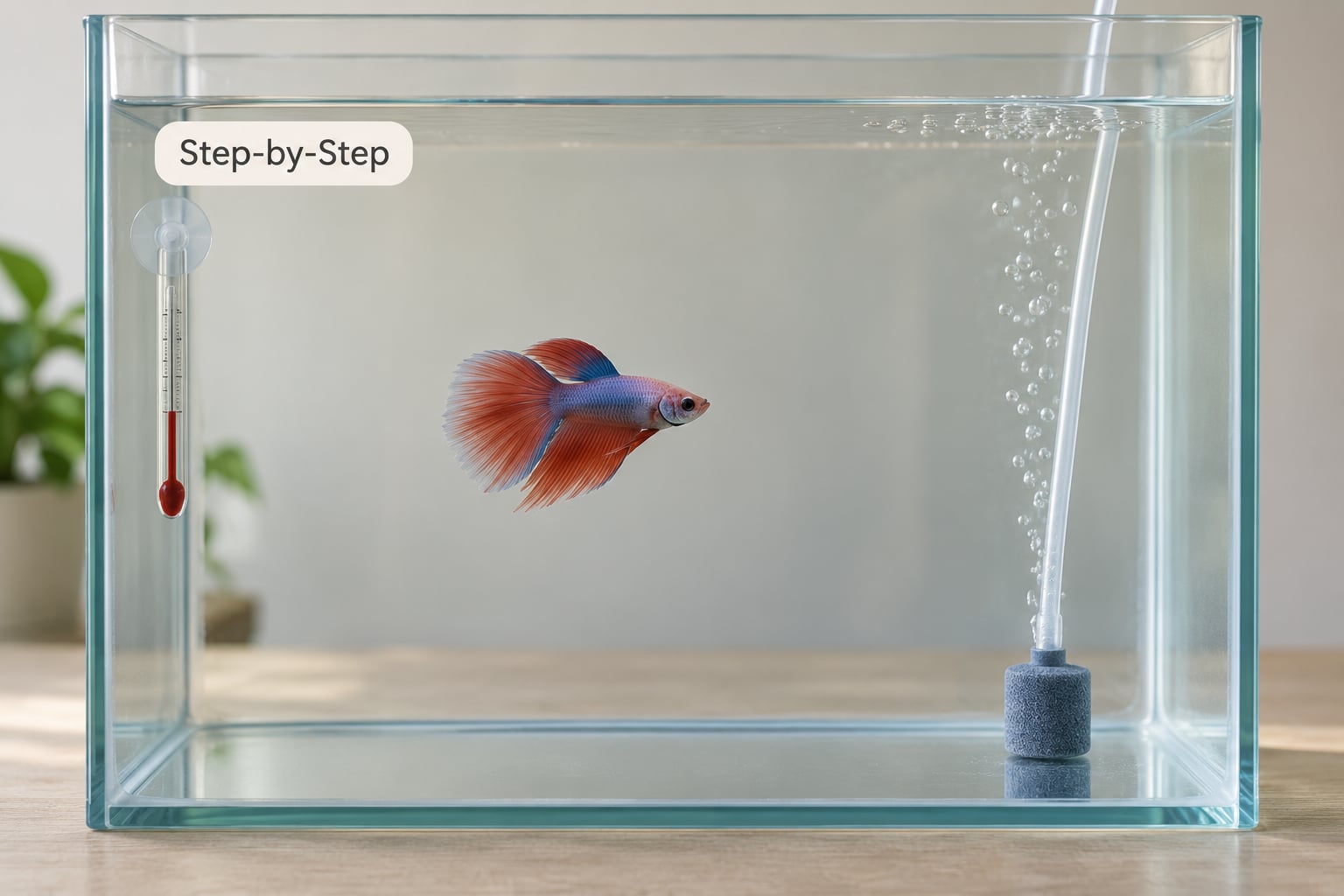
Fill the tank with dechlorinated water treated with conditioner, then run the heater and the seeded sponge filter. Set the temperature to match your display tank and leave everything running for a few hours so the heater is stable.
A brand-new filter is the most common reason quarantine tanks fail. Media that has never been seasoned carries no beneficial bacteria, so the first fish you add produces ammonia that nothing consumes. Long-time keepers almost universally move established sponge media from a healthy tank rather than starting fresh.
Run a second sponge in your display tank as a spare. Sponge media holds enough bacteria to seed a hospital tank quickly, and having one already seeded saves you a week of waiting whenever the next batch of fish shows up.
2. Check the New Fish and Its Packaging
Open the bag or transport container and look before you look away. Healthy fish hold their fins upright, breathe evenly, and react when you move the light. Clamped fins, a fish hanging near the surface, rapid gill movement or white streaks along the body are all reasons to slow down.
Check the water in the bag for temperature and smell. Strong ammonia, a cloudy film or an obvious temperature gap against your quarantine tank means the fish needs a gentler acclimation than the standard routine. Note the seller’s name and the date on the shipment, because that tells you how much risk you are carrying.
Unpack quickly, keep the container covered and out of sun, and decide now where the fish goes. Undecided fish end up in a bucket overnight, which is where a lot of avoidable losses happen.
3. Add the Fish to the Quarantine Tank Slowly
Float the sealed container in the quarantine tank for 20 to 30 minutes so the temperatures equalize, turning it once halfway through. Discard the shipping water, never add it, because that water can carry high ammonia, excess food and whatever the retailer used to keep it stable.
Then match the water. The simplest reliable method for a home quarantine tank is to add fish net in stages with small equal volumes of your conditioned quarantine water, waiting a few minutes between each, until the container is mostly your water. Keep the fish in the net or a clean container between pours so the transport water is not topped up into the tank.
For sensitive species and marine transfers, a drip line running from the tank into a clean bucket gives finer control, adding a slow stream that continues until the difference in temperature and salinity is negligible. Move fast with freshwater community fish from a reliable seller, and go slowly with discus, loaches, catfish, shrimp and anything marine.
Whatever the species, the whole acclimation should take at least 30 minutes. A rushed drip is the fastest way to burn a new arrival that survived shipping in the first place.
4. Observe the Fish Daily
Look at the fish before you touch the water, and spend a couple of minutes doing it. Feeding behaviour, breathing rate, fin condition, skin and the consistency of the waste tell you more in ten quiet minutes than a week of glancing in after work.
- Breathing — fast gilling, or a fish holding itself at the surface, points to low oxygen, poor water quality or gill parasites.
- Appetite — fish that ignore food for a day after shipping is normal. Refusing food on day three or later is a signal.
- Fins and skin — ragged, receding, reddened or milky fins and white pinhead spots both matter. White stringy waste and a swollen abdomen point inward instead.
- Behaviour — flashing, rubbing against hardscape, clamped fins or hiding nonstop.
- Water — test ammonia and nitrite every few days. Both should read zero in a properly seeded tank. Nitrate tells you how much filtration is working.
Feed sparingly, once a day, with small amounts you can see cleared within a few minutes. In a bare-bottom tank overfeeding goes straight to the water, and clean water matters more than heavy feeding in a stressed fish.
Change 20 to 30 percent of the water every few days once the tank is established, using water from the display tank so the new fish meet a small, familiar dose of its own bacteria. Rinse the sponge in the water you just removed, never under chlorinated tap water, and skip the gravel vacuum because there is no gravel.
5. Treat Problems Only With Fish-Safe Methods
Decide up front whether you are an observe-and-treat keeper or a preventive-treatment keeper, and stick to it. Many experienced hobbyists wait for signs, then treat the specific problem in a small, known volume of water, which is far safer than blank-treating a fish that may not be ill.
Other keepers run a preventive course on arrival, most often for imported or trans-shipped stock where the disease risk is high and unknown. Either path is defensible; mixing them at random is not. Whichever you choose, medication, dosage and duration should come from a fish veterinarian or a qualified aquatic professional, following the product label exactly.
Match what you see to the general category of the problem:
| What you see | What it usually points to | What to do in the quarantine tank |
|---|---|---|
| Pinhead white spots that spread over a few days | Ich, or white spot | Isolate in the hospital tank, raise temperature gradually where the species tolerates it, and ask a professional about a treatment course. |
| Fine gold or rust-coloured dust, fish rubbing, rapid breathing | Velvet, or gold dust disease | Keep the fish in the hospital tank, dim the light, and get dosing advice before adding anything to the water. |
| Cloudy white film, flashing on hardscape | External parasites such as flukes or brooklynella | Leave the fish in quarantine and get a diagnosis; some of these need specific medication rather than salt alone. |
| Fin edges eaten away, red or white base of the fin | Fin rot, usually secondary to poor water quality | Fix the water first, then treat the fin damage in the small volume where dosing is reliable. |
| Reddened body, sores, sudden loss | Bacterial infection | Get professional advice quickly; bacterial infections move fast and are a vet call. |
| White stringy waste, sunken belly, hole-in-the-head pits | Internal worms and other internal infections | Treat as a vet case. Internal problems are the one category where guessing is worst, because the visible signs overlap. |
Two practical rules. Remove activated carbon before treating, because it strips the medication out of the water, and put it back afterwards. And never use human medication, leftover antibiotics or anything not labelled for aquarium use — the dosing does not transfer, and it can kill the fish outright.
Marine and invertebrate rules differ. Copper-based treatments are common in marine quarantine but are lethal to shrimp, crabs, snails and most invertebrates, so those animals need a separate plan. Plain salt at roughly 0.1 to 0.3 percent helps some freshwater species and is unsafe for live plants, loaches and most catfish.
6. Introduce the Fish to the Main Tank
A fish is ready when it has eaten normally through quarantine, breathed easily, shown no symptoms for the full observation period, and the quarantine tank has tested free of ammonia and nitrite throughout. A preventive treatment course is finished and the tank has been water changed afterwards.
Match the timing to the source. A fish from a trusted local breeder you have used before may only need a couple of careful weeks. Stock from a chain supplier, an online retailer or a trans-shipped importer gets the full four to six, because those are the sources most often associated with outbreaks in community threads.
Before you move anyone, add two healthy fish from your display tank to the quarantine tank for the final stretch. If those two stay well, that is a good sign the newcomers are clean. This costs you nothing except a few days of observation and catches a surprising number of problems before they reach the display.
On transfer day, float the fish in its own container until the temperatures match, match salinity for marine, then net the fish across. Do not net it through the display’s water to reach the display, and keep the quarantine water out of the display entirely.
Expect a few days of hiding. That is normal settling behaviour, not a failed introduction, and most fish are eating and swimming normally within a week.
Common Mistakes
Skipping quarantine because the fish looked healthy. This is the one everybody regrets, and it is the most common story in fishkeeping forums: fish looked perfect on arrival, then showed ich or velvet several days later, and the whole display was affected. A clear appetite and clean fins on day one are not a diagnosis.
Pouring the bag water into the tank. Transport water often carries high ammonia and whatever the seller used to keep it stable. Fish get netted across; the water gets thrown away.
Sharing nets, siphons and buckets between tanks. Give the hospital tank its own tools and keep them there. A single shared net has undone more quarantines than any disease has.
Moving media out of a tank where a fish was ill. Never seed a hospital tank from a display that had an outbreak. Use a healthy established tank, and if you have nothing healthy, buy bottled bacteria and let the tank cycle before the fish arrive.
Medicating everything on arrival. Treating a fish that is already sick with a broad preventive cocktail adds stress and can mask symptoms. Treat the specific condition, at a dose from a professional.
Using human medication. Never. Human drugs are dosed for human bodies, and aquarium-safe and pharmacy products are not interchangeable.
Overfeeding and skipping water changes. Waste builds fastest in a bare-bottom hospital tank. Small amounts, eaten within minutes, and regular partial changes keep the water readable.
Adding fish straight after treatment without a break. Finish the course, change the water, remove the carbon briefly if you used it, then observe for several more days before anything moves tanks.
Trusting the store’s word that the fish were already quarantined. Even keepers who do it report problems tracing back to chain-supplier stock. That is not distrust of the shop, it is just an honest risk assessment of a shared system.
Tips for a Safer Quarantine
Keep the log. Write down the date, temperature, ammonia, nitrite and nitrate each time you test, plus anything that looked off. Several keepers say a daily log is what turns a vague three weeks into a clear decision at the end.
Hold spare seeded media. Run an extra sponge in a display tank at all times. It is the cheapest insurance in the hobby, because it removes the waiting period whenever you need a hospital tank fast.
Match the display’s temperature on purpose. Quarantining at a different temperature sets up a shock at the moment you transfer. Set the quarantine tank to the display’s actual reading, not to a species ideal.
Quarantine fish from the same source together, different sources apart. Grouping by source means one course of treatment covers the batch. Mixing sources means you cannot trace any problem back to its origin.
Quarantine without a spare tank. If space and money are the obstacle, use a 10 gallon tank, a clear storage tote, or even a large bucket with a lid, a sponge filter and an air stone. It is a poor substitute for a proper setup, but it is far better than adding untreated fish to the display. Seeding it with established media keeps it functional between batches.
Know when quarantine is not needed. If these are the first fish in a brand-new, empty tank, there is no established display to protect, and a separate tank adds little. Quarantine is for protecting fish you already have.
Include plants, snails and shrimp in the plan. Snails usually need no quarantine, though they can carry pest snails. Plants are best kept in a separate container for several weeks rather than rinsed and added, since they can harbour pests and hitchhiker snails.
And take advice for what it is. Forum threads are good for practical experience and for spotting patterns across many keepers, but dosing decisions belong to a fish veterinarian or a qualified aquatic professional, and this article is general information rather than a treatment plan for a specific animal.
Frequently Asked Questions
How long should I quarantine new fish before adding them to my tank?
Four to six weeks is the standard range, and two weeks is the absolute floor. Trusted local breeders you have used before can get by with the shorter window; stock from a pet-store chain, an online retailer or a trans-shipped importer deserves the full six. The clock starts the day the fish arrive, not the day you get around to it.
Do I have to cycle a quarantine tank before adding fish?
You need bacteria, not a full cycle. A sponge filter that has been running in a healthy display tank carries enough beneficial bacteria to handle the ammonia a few small fish produce. A brand-new filter does not, which is why so many first hospital tanks produce ammonia spikes. If you only have new media, dose bottled bacteria and cycle before the fish arrive.
Should I medicate new fish as soon as they arrive?
It depends on your risk level. Observe-and-treat keepers wait for symptoms and then address the specific condition, which is the most common approach for local freshwater fish. Preventive treatment is more common with imported or trans-shipped stock, where the pathogen list is unknown. Either way, get the medication, dose and duration from a fish veterinarian or aquatic professional rather than from a forum post.
Is quarantine different for marine and reef fish?
Yes, in two ways. Marine transfers need salinity matched during acclimation, and a copper-based treatment is often used in marine quarantine, which kills shrimp, crabs, snails and most invertebrates. Keep those animals out of a coppered tank entirely, and run a separate plan for them if you are introducing invertebrates to a reef.
What if I only have one tank?
Use a 10 gallon tank, a clear storage tote or a large bucket with a tight lid, an adjustable heater, a thermometer and a seeded sponge filter. It is not a proper hospital setup, but it is a real one, and it stops unquarantined fish going straight into your display. Keep a spare sponge seeded in your display so the container is ready to cycle quickly.
How long do you keep a sick fish in the quarantine tank?
Keep a sick fish isolated until it has eaten normally, breathed easily and shown no symptoms for at least several days after treatment finishes, with ammonia and nitrite at zero. Internal infections and hole-in-the-head cases take longer because the visible signs overlap. If a fish is not improving after a full course, contact a fish veterinarian rather than repeating the same treatment.
Conclusion
The first thing to do is build the separate quarantine aquarium before any new fish arrive: a bare-bottom tank, a lid, a heater, a thermometer and a sponge filter seeded from a healthy established tank. Then hold the fish, test the water and watch the fish every day for four to six weeks, and only then acclimate them across slowly.
That is the whole method, and it is a lot less effort than rebuilding a display tank after an outbreak. This guide was refreshed for 2026 and is general information; anything involving a sick fish belongs with a fish veterinarian.