There is no single number that works for every aquarium. How many fish per gallon is reasonable depends on the adult size and body shape of the species, the real water volume after substrate and decor, how much filtration the tank has, and how the fish behave. One small fish per gallon is a rough starting point that can badly overstock a tank.
Here is the honest version: that famous rule counts centimetres of fish and ignores almost everything that actually wears a tank out. It was invented for unfiltered goldfish bowls, and it still gets repeated as if it were a limit. Two tanks with the same advertised volume can hold completely different numbers of fish.
So the answer to whether the rule works is: only as a very rough first guess. Here is how to replace it with a number you can actually defend.
Table of Contents
- How Many Fish Per Gallon Really Works?
- Quick Stocking Guide by Fish Type
- How Many Fish per gallon really works for community tanks?
- Which Factors Change the Safe Number of Fish?
- Why Bioload Matters More Than the Gallon Count
- How to Estimate Stocking Without Overloading the Tank
- Common Stocking Mistakes That Harm Fish
- How to Tell Whether the Tank Is Too Crowded
- Frequently Asked Questions
- Is the one-fish-per-gallon rule ever accurate?
- How many large fish can a 20-gallon aquarium safely hold?
- Does a stronger filter make a small aquarium suitable for more fish?
- Why do schooling fish need a minimum group size?
- Can I add fish while a new aquarium is still cycling?
- Conclusion
How Many Fish Per Gallon Really Works?
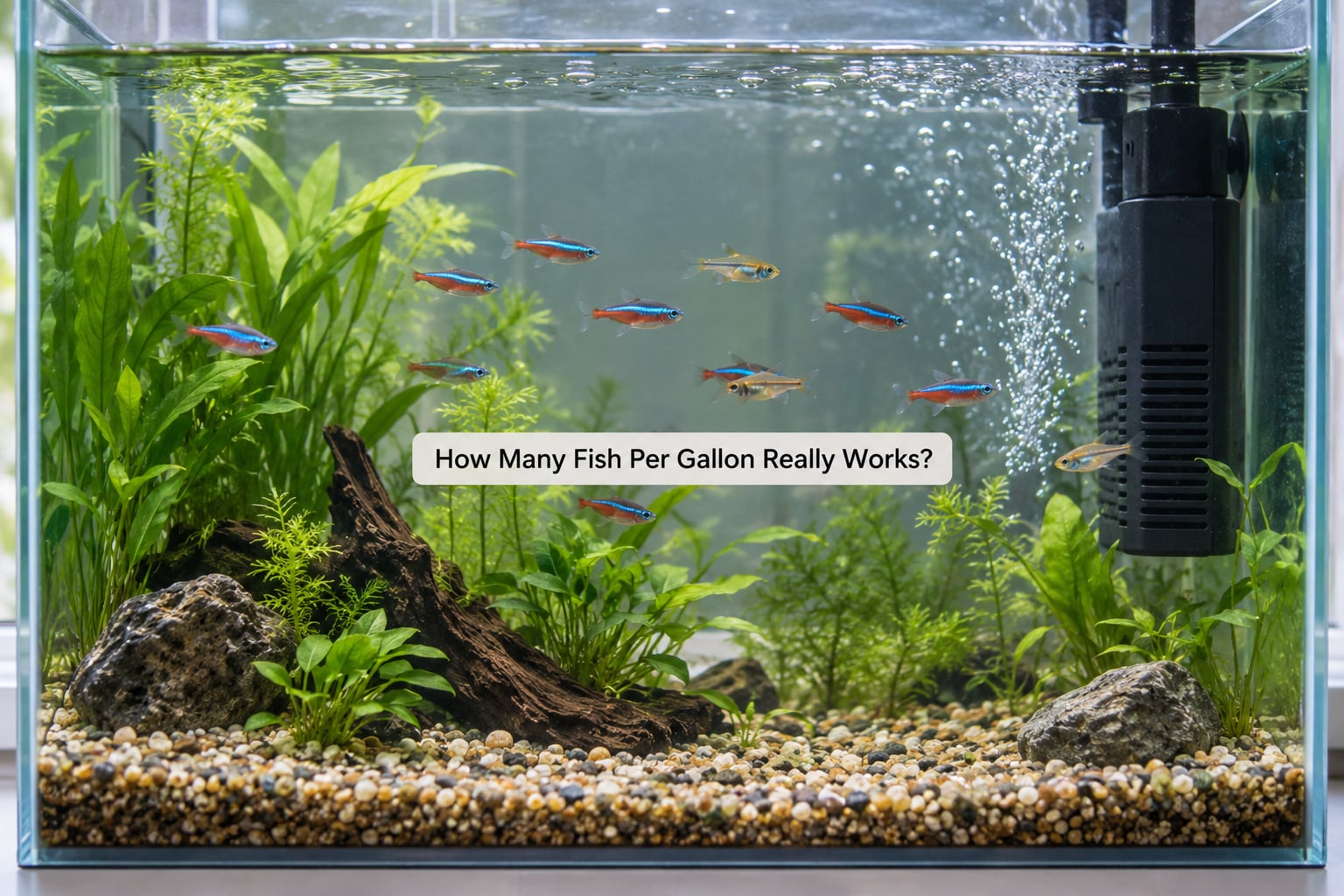
The rule works for exactly one situation: a beginner asking whether a single small fish could survive in a new tank. Beyond that it fails, because a fish is not a length of pipe. A 10 cm cichlid produces far more waste than a 10 cm tetra, and both count identically under the rule.
It also ignores the water your fish actually have. A tank advertised as 40 litres rarely holds 40 litres of water once you add gravel, a filter, a heater and hardscape. Running the number at 85 to 90 percent of the label is the standard correction.
And it says nothing about swimming space. A tall, narrow tank can hold the same total length of fish as a long one while giving them a fraction of the usable swimming area. Length of body is not length of swim.
Quick Stocking Guide by Fish Type
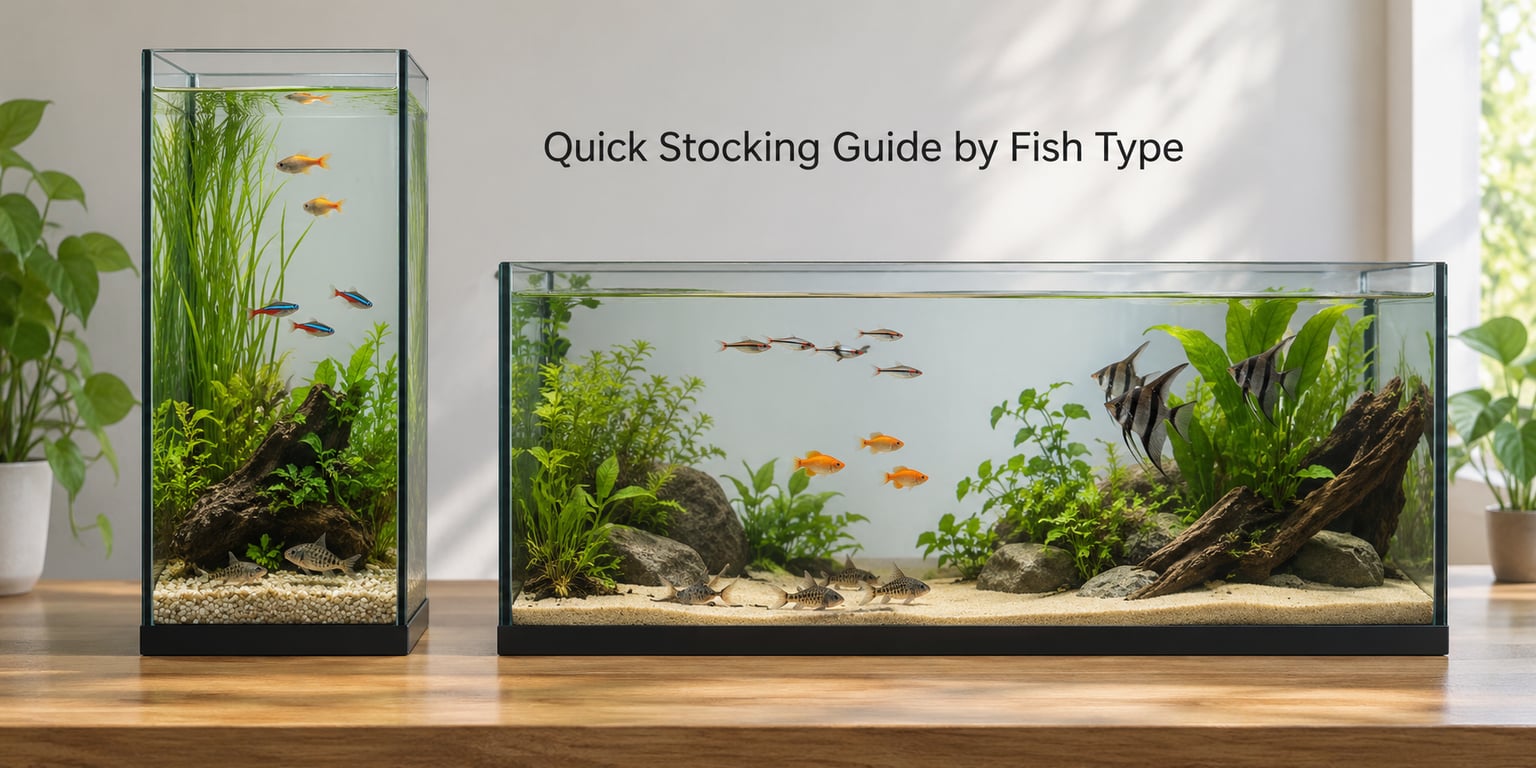
| Fish type | Adult size | Adult length | Minimum group | Swimming zone | Bioload tier |
|---|---|---|---|---|---|
| Small schooling fish (tetras, danios, rasboras) | 2-4 cm | 2-4 cm | 6 or more | Mid and upper water | Low |
| Livebearers (guppies, mollies, swordtails) | 4-7 cm | 4-7 cm | 3-5 for guppies, more for the others | Mid water | Medium to high |
| Labyrinth fish (bettas, gouramis) | 6-8 cm | 6-8 cm | 1 for bettas, 4-6 for gouramis | Upper water | Medium |
| Large solitary fish (oscar, severum, goldfish) | 20-35 cm | 20-35 cm | 1 | Whole tank | Very high |
| Long-bodied fish (discus, angelfish, koi) | 15-25 cm | 15-25 cm | 4-6 discus, 1-2 angelfish | <td Whole tank, tallHigh | |
| Bottom dwellers (corydoras, plecos, loaches) | 5-15 cm | 5-15 cm | 6 or more | Bottom only | Medium, bottom waste stays put |
| Bottom-dwelling invertebrates (snails, shrimp) | 2-5 cm | 2-5 cm | Varies | Bottom only | Low, but they breed |
Two things jump out of that table. Minimum group sizes sit next to adult size because a group requirement is not a nicety; two tetras is a stressed pair, not a school. And bottom dwellers count fully even though they never leave the gravel, because their waste settles exactly where the substrate cannot dilute it.
How Many Fish per gallon really works for community tanks?
For a mixed tank, work from usable swimming volume rather than the tank label. Short and wide tanks give more usable area per litre than tall ones, so a long 60 litre tank holds more comfortable fish than a tall 60 litre tank with the same filter rating.
Then add up adult lengths by category instead of counting fish. Schooling species contribute their group length to the mid-water budget, bottom dwellers get their own bottom budget, and solitary fish get whatever horizontal room they need across the front. If those three budgets overlap, the tank is overplanned.
A practical ceiling many experienced keepers use is around 2.5 cm of adult fish per 4 litres of real water for slim schooling species, and half that for full-bodied fish such as goldfish or discus. Treat those as ceilings for a lightly stocked first attempt, not targets.
Which Factors Change the Safe Number of Fish?
Adult size and body shape. Full-bodied fish such as goldfish, koi and discus produce waste in proportion to their mass, not their length. Slim tetras and danios are the opposite. Two species of the same 10 cm length are not the same fish.
Schooling or territorial behaviour. Schoolers need their minimum group to feel safe. Territorial fish such as many cichlids need enough floor space that they can live without constant fights.
Temperature and pH compatibility. Mixed tanks force one compromise on everyone. Species that only tolerate each other at the extremes rarely thrive, so the compatible list is shorter than the store shelf.
Swimming space and tank shape. Long fish need length. Bottom dwellers need substrate. The zone a species uses tells you how much room it actually claims.
Substrate height. A thick gravel bed hides waste where it decomposes instead of letting the water carry it out. Sand or bare bottom in the filter area moves more debris to the filter and away.
Filtration capacity. A common target is a filter rated to turn the tank volume over four times an hour. That supports biology, not space, and it assumes the media is established.
Feeding routine. More food in means more waste out. A heavily fed group of discus produces a very different load from a lightly fed group of guppies.
Why Bioload Matters More Than the Gallon Count
Bioload is the total waste output of everything alive in the tank: fish, snails, shrimp and uneaten food that rots. It is not the same as filtration. Filtration is what removes waste; bioload is how much waste there is to remove in the first place.
The practical picture is a chain. Fish excrete ammonia, which is toxic. Beneficial bacteria first convert ammonia into nitrite, which is also toxic, and then convert nitrite into nitrate, which is much less harmful and is removed with water changes. A young filter has too few bacteria to finish that job, so ammonia and nitrite climb.
That is the real reason fish die in tanks that were not overstocked by any length rule. The rule counts fish, not food, not filter media age and not whether the bacteria colonies had time to grow.
Extra filter capacity buys you margin. A larger filter holds more media, holds more bacteria and moves more water, so it tolerates a heavier load and forgives a missed water change. It does not create swimming space, it does not settle aggression, and it cannot oxygenate a tank with no surface movement.
How to Estimate Stocking Without Overloading the Tank
- Measure the real water volume. Multiply length by width by height in centimetres, divide by 1000 for litres, then subtract 10 to 15 percent for substrate and decor.
- Look up adult size and adult length for every species, not the size in the shop bag.
- Check the minimum group or minimum tank the species requires, and treat that as a floor you cannot stock below.
- Total the filtration demand and check the filter rating against four turnovers per hour of real volume.
- Add bioload generously, then apply the full-bodied discount if any large heavy-feeding fish is in the plan.
- Count future fry and exclusions. Livebearers will breed, and territorial fish need at least one extra empty zone to escape into.
| Rated size | Real water (approx.) | Imperial equivalent | Ceiling for slim schooling fish | Ceiling for full-bodied fish |
|---|---|---|---|---|
| 20 L | 17-18 L | 5 gal | 10-12 cm total | 5 cm total |
| 30 L | 26-27 L | 7 gal | 15-17 cm total | 7 cm total |
| 40 L | 34-36 L | 10 gal | 20-23 cm total | 10 cm total |
| 60 L | 51-54 L | 15 gal | 32-34 cm total | 15 cm total |
| 100 L | 85-90 L | 25 gal | 53-56 cm total | 25 cm total |
| 200 L | 170-180 L | 50 gal | 100-110 cm total | 50 cm total |
A worked example. A 60 litre tank gives roughly 52 litres of water and needs a filter rated near 210 litres per hour. A low bioload plan might be eight small schooling fish totalling 24 cm plus a group of six small bottom dwellers. A medium bioload plan drops to six schooling fish and four bottom dwellers. A high bioload plan with a pair of large full-bodied fish might hold only those two.
All three can work. What does not work is buying a pair of large full-bodied fish on the strength of the one-fish-per-gallon rule and then adding a school on top of them.
Common Stocking Mistakes That Harm Fish
- Counting juveniles as adults. The fish in the shop is a fraction of its adult size, and a juvenile that looks tiny can be a large territorial adult. Plan for the adult.
- Adding fish during the cycle. A tank with no established bacteria cannot process the waste new fish produce, so ammonia spikes within days.
- Choosing on length but not swimming needs. A group of long fish that constantly turns and bumps in a short tank is overcrowded no matter what the arithmetic says.
- Mixing temperature and pH ranges. Something has to give, and it is usually the fish at the edge of the range.
- Overcrowding and calling it a community tank. Adding more fish to spread aggression, as some cichlid keepers do, only works with heavy filtration and frequent large water changes.
- Treating acclimation boxes or water changes as a fix. They ease the transition into the tank. They do not add oxygen, space or territory.
How to Tell Whether the Tank Is Too Crowded
Watch behaviour before you test anything. Fish crowding the surface and working at the waterline usually means they are short of oxygen or the water is carrying too much waste. Constant hiding, aggression that was not there before, frayed fins and a general drop in activity are all early warnings.
Water tells the same story. Persistent cloudiness, visible waste that never breaks down, rising nitrate and an ammonia reading above zero are all signs the biological load has outgrown the filter.
Also watch appetite. Fish that ignore food that they used to clear up are telling you something, and so is a school that no longer spreads out across the tank.
These are observations, not diagnoses. Unusual breathing, severe lethargy or sudden death needs prompt advice from an aquatic veterinarian or a qualified fish-care professional, because those signs can also point to disease, and disease and overcrowding need different answers.
Frequently Asked Questions
Is the one-fish-per-gallon rule ever accurate?
It is accurate only for one small, slim-bodied fish in a short, well-filtered tank, and even then it is a starting point rather than a limit. The rule counts adult length and ignores body shape, bioload, swimming space and filter maturity, so it will overestimate capacity for full-bodied fish like goldfish and underestimate it for heavily planted tanks with mature filters. Use it to size the tank, not the stock.
How many large fish can a 20-gallon aquarium safely hold?
One large fish, at most two very small ones. A 20-gallon tank holds roughly 70 litres of real water, and a single adult oscar, goldfish or severum claims all of it. If you want a community tank at that size, choose small schooling species instead and keep the adult length of the whole group under 10 cm.
Does a stronger filter make a small aquarium suitable for more fish?
It helps with waste processing, and it does not help with space. A larger filter holds more beneficial bacteria, so it absorbs more bioload and forgives a missed water change, but it cannot create swimming room, settle territorial disputes or add oxygen to a still tank. Filtration buys margin, not capacity.
Why do schooling fish need a minimum group size?
Schooling species use the group for safety, and a pair in a bare tank behaves nothing like the same fish in a group of eight or more. Kept below the minimum, they stay skittish, may pick at each other, and often die younger. The minimum group size is a floor, so check it before you count the fish your tank can hold.
Can I add fish while a new aquarium is still cycling?
Not fish that you want to keep. A cycling tank is still growing the bacteria that convert ammonia into nitrite and then nitrate, and the first fish added are what grows them. One or two tough fish in a big volume of water is a common approach. Add your real stock once nitrate is measurable and the tank has been tested weekly for several weeks.
Conclusion
There is no reliable universal fish-per-gallon number, and anyone who gives you one is skipping the part that matters. Start with the smallest tank you can keep properly filtered, research every species’ adult size and minimum group before you buy, and treat filtration, water quality and swimming space as the real limits.
If you only remember one thing from this guide on how many fish per gallon really works, make it this: count what the water has to process and what the fish need to swim in, not how many bodies fit. That calculation takes ten minutes and it saves fish.