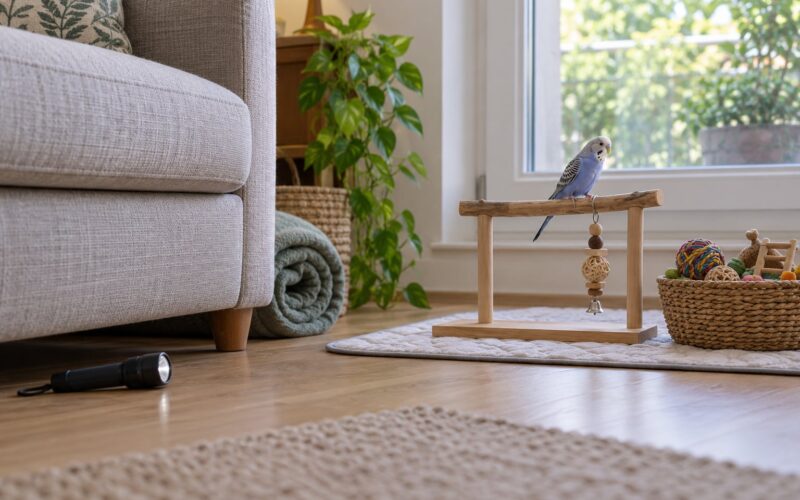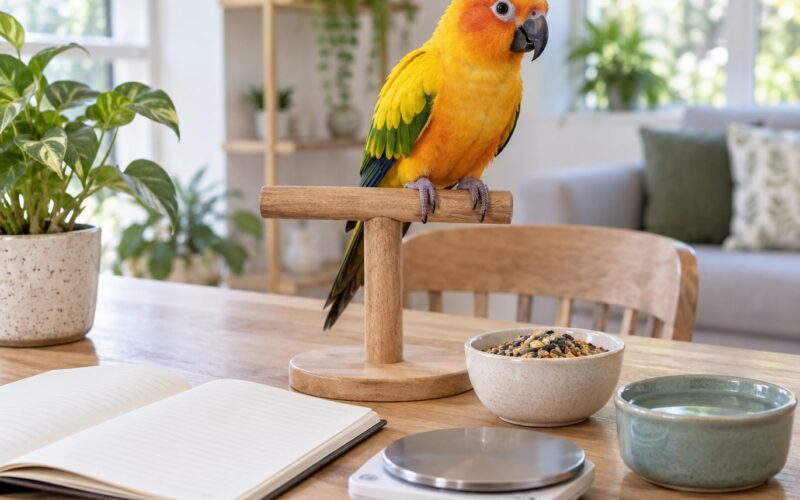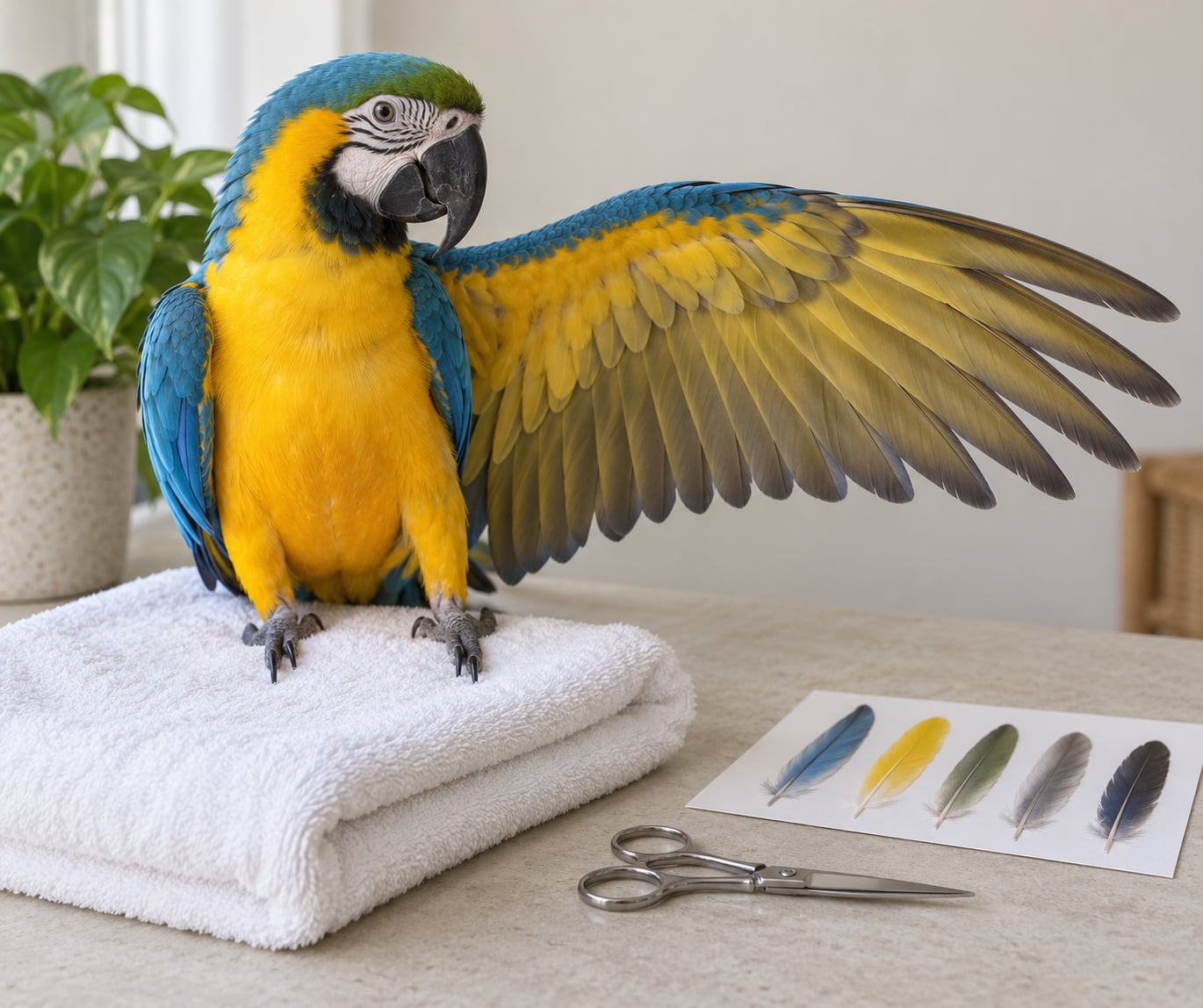
Clipping a bird’s wings is not surgery, and it is not a health requirement either. A standard trim shortens the outermost four to six primary flight feathers on each wing so the bird can still flap, glide and drop onto a perch, but cannot build enough lift for powered flight. The feathers grow back through the next moult. Whether that trade is right depends almost entirely on your home.
This guide walks through how to clip a bird’s wings or leave them flighted, so you can make the call on your own bird rather than guessing from forum arguments. Read the decision section first. Most people who regret a trim regret the decision, not the technique.
Two things worth knowing before you go further. Clipped birds can still travel surprising distances by gliding and flapping, so a trim is not a guarantee against escape or collision. And any bird that is unwell, moulting heavily, or has an injured wing should be assessed by an avian veterinarian before a feather is cut.
Table of Contents
- What You Need
- Step-by-Step: How to Clip a Bird’s Wings or Leave Them Flighted
- How to clip a bird’s wings or leave them flighted: make the decision first
- How to clip a bird’s wings or leave them flighted: check the bird and the feathers
- How to clip a bird’s wings or leave them flighted: position and trim safely
- How to clip a bird’s wings or leave them flighted: finish and observe
- Common mistakes to avoid
- When to leave wings flighted
- Aftercare and feather regrowth
- Frequently Asked Questions
- Does clipping a bird’s wings hurt?
- Will a bird with clipped wings still be able to fly?
- How long does it take for clipped wing feathers to grow back?
- Should I clip the wings of a young or small bird?
- When should I take my bird to an avian veterinarian instead?
- Make the safest choice for your bird
What You Need
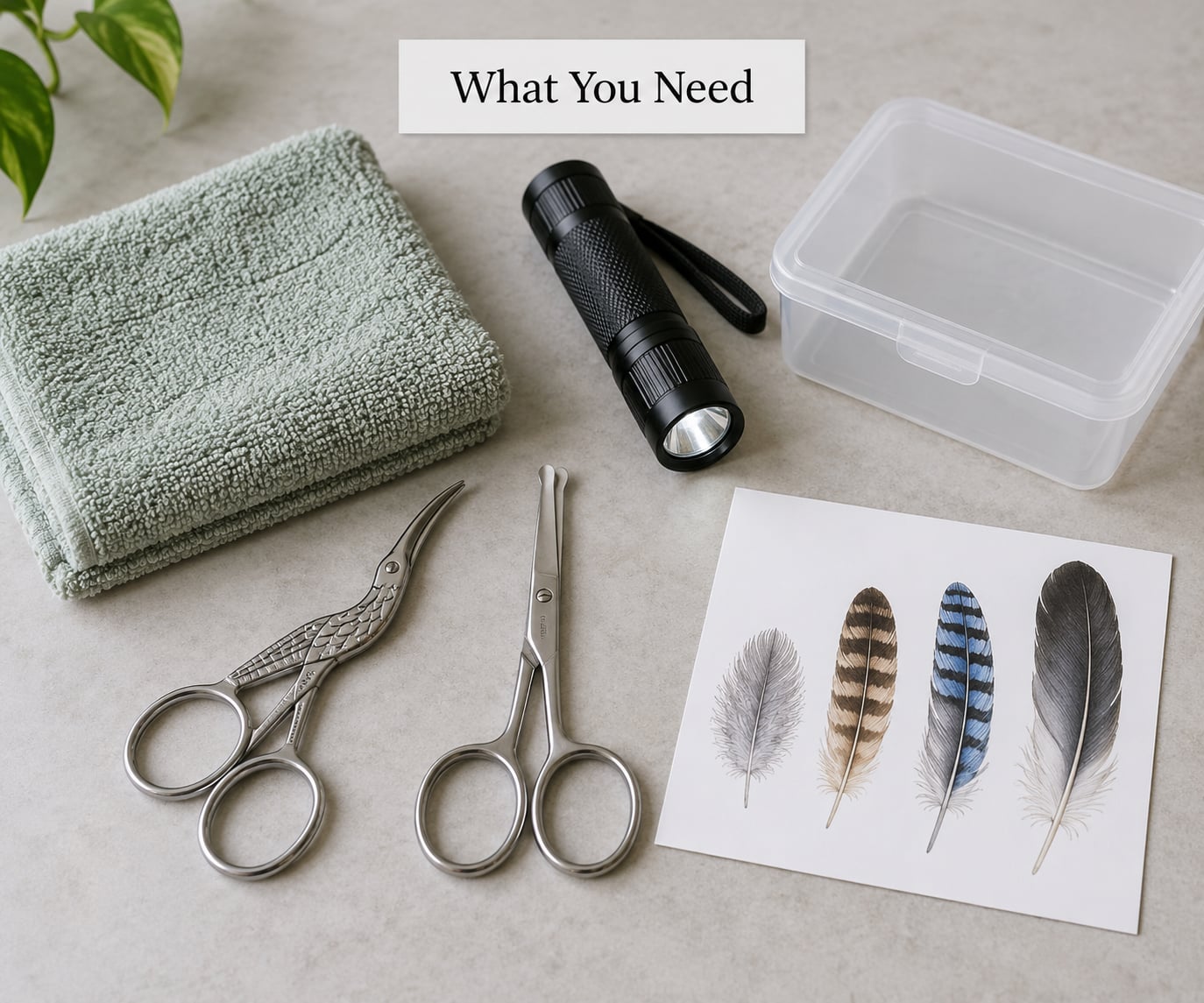
A home wing trim needs very little. Most of the preparation is about keeping the bird calm and seeing the feathers properly, not about the tools.
- A small towel. Wrap it around the body, leaving the head and the wing you are working on free. Towelling is the standard low-stress restraint for a short trim.
- Good light. A desk lamp or a strong overhead light. Mature feathers are easy to see; a blood feather inside a growing feather is not.
- Blunt-tip scissors or small stainless bird scissors. Sharp, small blades let you take a short, angled cut instead of crushing the shaft.
- A flashlight. Hold light behind the wing and you can often see a growing blood feather darkening at the base, which is exactly what you want to avoid.
- Cornstarch or styptic powder. Within reach for the one accident that should not happen but sometimes does.
- Your patience. A trim that takes four calm minutes beats a ten-minute wrestling match.
That list is for a routine maintenance trim on a healthy, adult, non-moulting bird. See an avian veterinarian instead when the bird is a juvenile learning to fly, when the feather condition is poor or the wing has an old injury, when the bird is moulting, or when you cannot get it settled within a few seconds.
It also helps to separate two things people mix up. A full clip takes the outer primaries back to roughly the level of the coverts and removes nearly all lift. A conservative trim removes a shorter length of shaft, enough to blunt the wing and reduce distance, but the bird retains some downward control and a much better view of where it is going. Most avian vets and experienced keepers now default to the shorter version, because it is gentler and easier to reverse.
Step-by-Step: How to Clip a Bird’s Wings or Leave Them Flighted
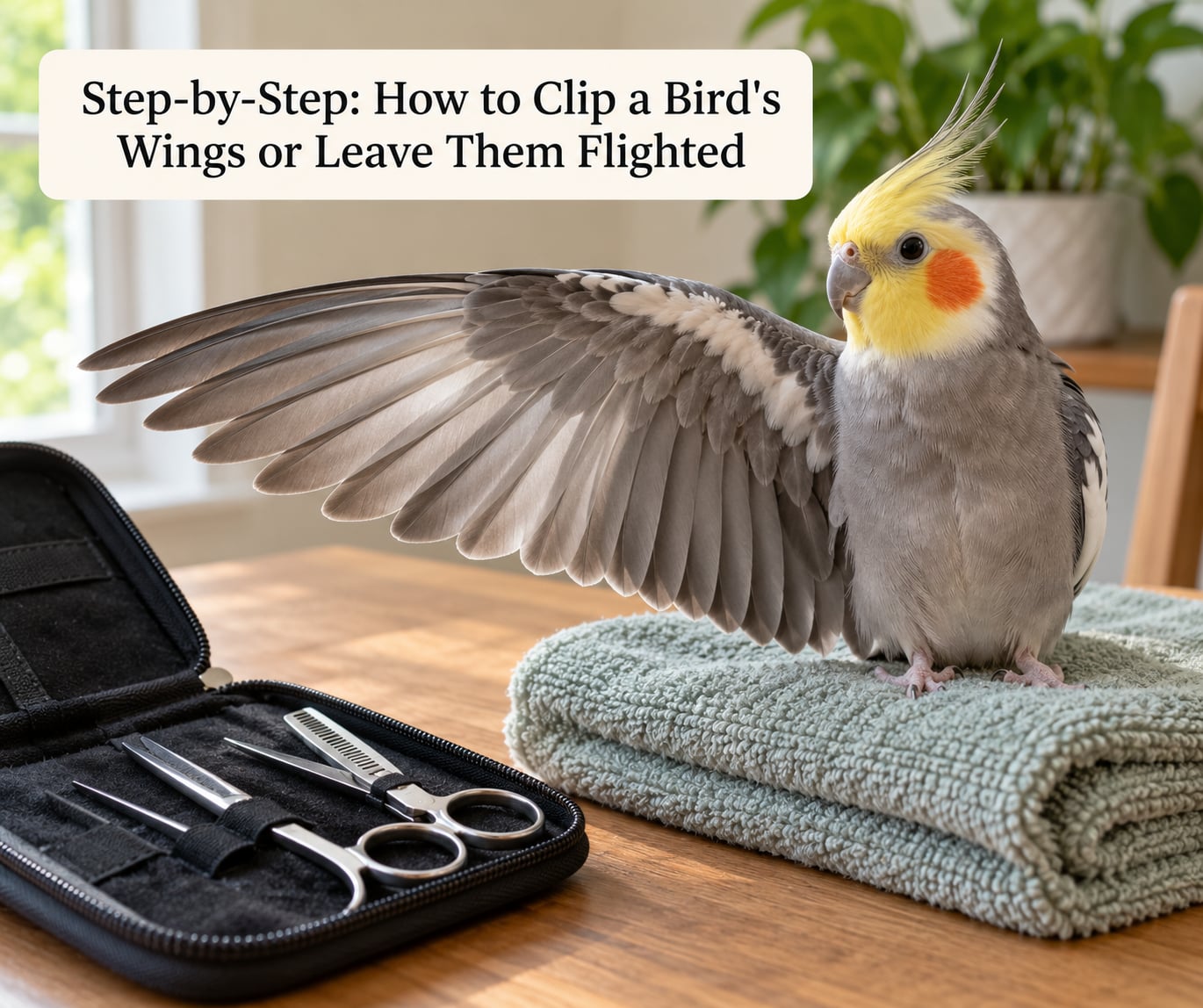
How to clip a bird’s wings or leave them flighted: make the decision first
Clipping is a management decision, not a treatment. Nobody’s bird develops a disease because it can fly, and no avian organisation treats a trim as necessary husbandry.
Leave the wings alone when most of these are true. The bird is fully feathered and past the stage of learning to fly. You can close every door and window, or you have a safe exercise space such as a screened room or an aviary. Ceiling fans, tall uncovered windows and open doors are gone or guarded. There are no cats, no open kitchen, and no unsupervised young children. And the bird has daily out-of-cage time that you can supervise honestly.
Clip when the honest answer is that you cannot supervise a flying bird. Mixed feelings, an unpredictable schedule, an open sunroom door, a home full of ceiling fans — those are legitimate reasons to arrange a trim. It is not legitimate to clip a bird in order to ignore an environment that would hurt it if it flew.
One more honest question before you decide: how will you feel in a year? Feathers regrow. The trim is temporary, and so is the feeling.
How to clip a bird’s wings or leave them flighted: check the bird and the feathers
Watch the bird for a minute before you touch it. A bird that is alert, moving around, eating and vocalising normally is a candidate for a routine trim. A bird that is sitting on the cage floor, fluffed up, breathing heavily or unusually quiet needs a vet, not scissors.
Then look at the wing. Extend it gently and identify the layers. The primaries are the long outermost feathers, numbered from the outside in, and they are the only feathers a routine trim touches. The secondaries sit inside them and provide most of the wing’s surface area and lift. The coverts are the small overlapping feathers that lie on top of everything and form a smooth, waterproof surface.
Check every feather twice before cutting. A blood feather, also called a pin feather, is a feather still growing, and it carries a live blood supply inside a soft keratin sheath. Mature feathers are hollow, hard, dry and pale all the way along. A blood feather looks darker, sometimes bluish or purple, feels soft and fleshy rather than crisp, and is wider at the base. That visual difference is why you backlight the wing: light passing through a mature shaft makes it glow pale, while a blood feather stays dark and opaque.
If you find one, move to the next feather and leave it alone. If you are unsure about several of them, stop and book a vet appointment. Cutting a blood feather causes real pain and real bleeding, and a small bird carries very little blood to lose.
How to clip a bird’s wings or leave them flighted: position and trim safely
Settle the bird first. Talk quietly, offer a treat, and let it perch naturally. Wrapping the towel happens after that, not before. If the bird is thrashing, panting, or screaming repeatedly and cannot be settled, put it back in the cage and try again later or call a professional.
Wrap the towel snugly around the body with the head exposed, wings folded, and the leg out of kicking range. Never press on the chest or the keel, and never wrap so tightly that the bird cannot move its head. Most birds settle within a minute or two.
Now extend one wing. Hold the bird’s body and the base of the wing together, then slide the wing out in one smooth movement along its natural line. Twisting the shoulder is what causes injury, not the scissors. Supporting the wing from underneath at its midpoint keeps the joint aligned.
Count the primaries from the outside. The outermost primary is number one. Take the cut across the shaft at roughly a 45-degree angle, sloping so the trimmed edge sits about one to two centimetres beyond the tips of the coverts. Start with four to six of the outer primaries on the first wing and stop to see how the bird flies before doing the second — that staged approach lets you check for an uneven result and adjust rather than discovering it after the bird has already been moved.
Keep the scissors steady and take small snips across the shaft. Do not attempt to shear a long feather in one squeeze. And never cut across the whole wing in a single line with no reference point, because the feathers are not all the same length and that is how you end up with a wing that turns oddly.
The single-wing trim deserves a note. Some owners clip only one side deliberately, on the argument that an unbalanced bird cannot glide straight and will be easier to catch. The result is an asymmetrical wing and a bird that banks hard in one direction. Avian vets generally advise against it as a routine practice, and if you do decide on it, be aware that you are choosing a bird that will fly crooked.
How to clip a bird’s wings or leave them flighted: finish and observe
Repeat on the other wing, then hold both wings out and compare them side by side. The trimmed edges should sit at roughly the same length relative to the coverts on each side. Check for any feathers that are split, torn, or shorter than the rest, and check that you have not nicked a covert or a secondary.
Return the bird to a secure landing area, not back onto a high perch. For the first few hours after a trim, keep flooring clear of hard edges and anything it could tumble into, and provide low perches and a solid floor-level option. A bird that has just lost lift will sometimes drop unexpectedly, and this is the window where keel injuries happen.
Watch the first flights closely. A bird that is trying to go somewhere, hitting the floor, and panicking will build negative associations with open space, and that habit can outlive the trim itself. Keep the room quiet, keep it uncluttered, and let the bird practise flapping and gliding on the floor before you offer anything higher.
Let the bird recover without pushing. Do not try to force exercise or coax repeated flights in the first day. A calm bird regains confidence much faster than a bird being hurried through a lesson.
Common mistakes to avoid
Most clipped-wing problems come down to six repeating errors. Each has a straightforward correction.
Cutting across the shaft at the wrong angle. A flat, square cut across several primaries leaves ragged tips that catch and snag. Cutting across the feather at 45 degrees, in the direction of natural feather overlap, produces a smooth trailing edge.
Trimming the two wings differently. A small length difference between sides makes every flight attempt turn. Measure from the coverts on each wing rather than eyeballing it, and compare the wings before you let the bird go.
Cutting secondaries or coverts. Removing secondaries strips the wing surface that generates most of the lift and can leave the bird with far less control than you intended. Coverts are the small layered feathers on top; leave them all intact. If your trim reaches into them, you have gone too far.
Clipping a bird that is moulting or unwell. Growing feathers are fragile and some of them are blood feathers. A bird under stress or in poor health should not be restrained for a routine trim at all. Postpone, or see a vet.
Chasing the bird around the house. Every attempt to grab a bird that is already off balance leads to a torn feather, a dropped bird, and a bird that now associates your hands with something frightening. Towel-wrapping a calm perch bird takes a fraction of the stress.
Assuming clipped wings remove the need for a safe home. This is the mistake with the worst consequences. A clipped bird still flies, it just flies badly. Windows, ceiling fans, doors, dogs and open stairwells are still dangerous. Proofing the room does not stop being necessary.
When to leave wings flighted
Flight is the primary exercise a parrot gets in a natural life. Birds that fly daily develop stronger pectoral muscle, better bone density, better balance and better cardiovascular fitness than birds that do not, and a flighted bird generally has more enrichment available to it in a normal day. Where you can make that work, leaving the wings intact is the better answer.
| Household situation | Better choice | Why |
|---|---|---|
| Single bird, doors and windows closable, daily supervised out-of-cage time | Leave flighted | Exercise, muscle tone and mental stimulation without a trimming decision to manage |
| Open-plan room with tall uncovered windows or a ceiling fan in use | Proof the room, then leave flighted | Window decals and a fan guard solve the actual risk |
| Cats, dogs or small children in the same space, bird often unsupervised | Clipped, plus a locked cage and safe room | A clipped bird is far less likely to reach a predator or a boiling pot |
| Frequent travel, boarding and vet visits | Either, with planning | A clipped bird is easier to transport in a carrier; a harness or a secure travel cage works for a flighted bird |
| Bird in an aviary or with other aviary birds | Leave flighted | Aviaries need flight; clipping an aviary bird removes its function and adds stress |
| Workable feathers, short hatch, rescue bird needing controlled exercise | Ask an avian vet | Feather condition and history change what is safe to do |
The honest objection to clipping deserves to be stated plainly, because bird owners raise it on the forums constantly: a clipped bird can still fly. It does not drop straight down. It loses lift, loses the ability to turn tightly and brake, and has to spend far more energy for a much shorter distance. Bird keepers describe it as reduced lift and lost maneuverability rather than removed flight.
That makes clipping a partial safety measure, not a solution. For a bird that is careless around open doors, even a partial trim helps. For a bird that is being ignored because its owner assumes the wings are the solution, nothing helps.
Some owners solve the night-time without clipping at all, by dimming the lights and covering part of the cage in the evening. It takes a few evenings of routine to establish, and it removes the single most common trigger for nocturnal startle flights.
Aftercare and feather regrowth
For the first day or two, expect fluffed-up sleeping, some irritability, and less willingness to perch high. Most birds are visibly back to normal within a week. Give the bird low perches, a wide clear floor area, and normal daylight and feeding routine.
Watch for signs of frustration rather than dismissing them as temperament. Repeated screaming, toe-tapping on the cage floor, biting at the feathered parts of the wing, plucking feathers from the chest or thigh, sitting in one corner, or refusing food all suggest that the bird is not coping well with the loss of flight. Feather-destructive behaviour in particular deserves a vet visit, since plucking can become self-perpetuating and hard to reverse.
Also watch for falls. A newly trimmed bird that launches from a perch and hits the bottom of the cage can bruise or fracture the keel, the large bone along the breastbone that flight muscles anchor to. A bird that falls repeatedly or lands oddly should be seen by an avian vet.
Regrowth is not on a fixed timetable, and any page that promises one is overselling. The trimmed primaries are shed and replaced during the next moult, and the rate depends on age, nutrition, season, health and the species involved. Typically the gap becomes noticeable within a few weeks and the feathers are usable again within a couple of months, but a stressed or poorly nourished bird can take far longer.
A bird whose feathers regrow does not automatically remember how to use them. Some birds relearn quickly with practice. Many never fully do, especially if they were clipped young and never built flight muscle in the first place. Owners report birds that stayed hesitant even after full regrowth, which is one more reason to delay clipping until a bird is flight-ready.
Frequently Asked Questions
Does clipping a bird’s wings hurt?
A proper trim does not hurt, because mature flight feathers are dead keratin, like your own fingernails. What does hurt is cutting a blood feather, the growing feather with a live blood supply inside a soft sheath. Hold light behind the wing first, skip anything dark and soft, and stop if you cannot tell the difference between the feathers.
Will a bird with clipped wings still be able to fly?
Yes, and this is the point most people get wrong. A standard trim shortens four to six outer primaries so the wing cannot generate enough lift for powered flight, but the bird can still flap, glide, flutter, climb and travel a surprising distance. It flies badly rather than not at all, so a clipped bird still needs a room that is safe for flight.
How long does it take for clipped wing feathers to grow back?
The trimmed primaries are replaced during the next moult, and there is no fixed schedule. Age, nutrition, health, season and species all change the rate. The gap usually becomes obvious within a few weeks and the feathers work again within a couple of months. A bird that has never learned to fly may have full feathers and still not fly well.
Should I clip the wings of a young or small bird?
Not a juvenile that is still learning to coordinate flight, because early clipping can leave a bird that never develops the muscle and confidence to fly properly. Small birds are also the hardest to trim safely and the most fragile if a blood feather is cut. Wait until the bird is fully feathered, or ask an avian veterinarian to do the first trim for you.
When should I take my bird to an avian veterinarian instead?
Any bird that is unwell, moulting heavily, feather-destructive, or has an old wing or shoulder injury should be assessed before a single feather is cut. So should any bird you cannot settle within seconds, or any bird where you cannot confidently identify a blood feather. A first trim on a large parrot such as a macaw or cockatoo is best done by a professional.
Make the safest choice for your bird
Start by fixing the environment, not the bird. Guard the windows, deal with the ceiling fan, close the door, move the cat out of the room, and set up a routine you can actually keep. Do that honestly and the clipping question often answers itself.
Where flight can be made safe, leave the wings alone. Your bird gets exercise, muscle and bone strength, and a lot more to do with its day.
Where it cannot, book a conservative trim with an avian veterinarian and ask for the short version that keeps some downward control. Four to six outer primaries, angled across the shaft, on a calm and feathered bird. Then keep watching, because how to clip a bird’s wings or leave them flighted is a decision you revisit as your home changes.