Aquarium snails are among the easiest invertebrates to keep in a freshwater tank. How to care for aquarium snails comes down to three things: steady water chemistry, a calcium source for the shell, and food beyond whatever algae the glass can grow. Add a lid they cannot climb past and a tank that is already cycled, and most snails live one to three years with very little fuss.
Nearly every problem you will read about comes from one of four mistakes: adding snails to an uncycled tank, feeding more than they can finish, letting the water go soft or acidic, or using soap and copper near the water. All four are easy to avoid once you know they matter.
Which snail do you have, and how big is the tank? Mystery, nerite, rabbit and ramshorn snails all want slightly different things, and a snail-only 5 gallon tank needs a different setup than a 55 gallon community tank.
Table of Contents
- What You Need
- Step-by-Step
- How to Choose the Right Aquarium Snail
- Prepare the Tank and Water
- Acclimate and Introduce the Snails
- Feed Aquarium Snails the Right Amount
- Maintain Shells, Water, and Healthy Behavior
- Common Mistakes
- Frequently Asked Questions
- How long can aquarium snails live without food?
- Do aquarium snails need a filter in their tank?
- Why is my aquarium snail floating upside down?
- Are empty aquarium snail shells a sign of too many snails?
- Can aquarium snails live with fish?
- Why is my snail shell turning white or soft?
- The First Thing to Do
What You Need
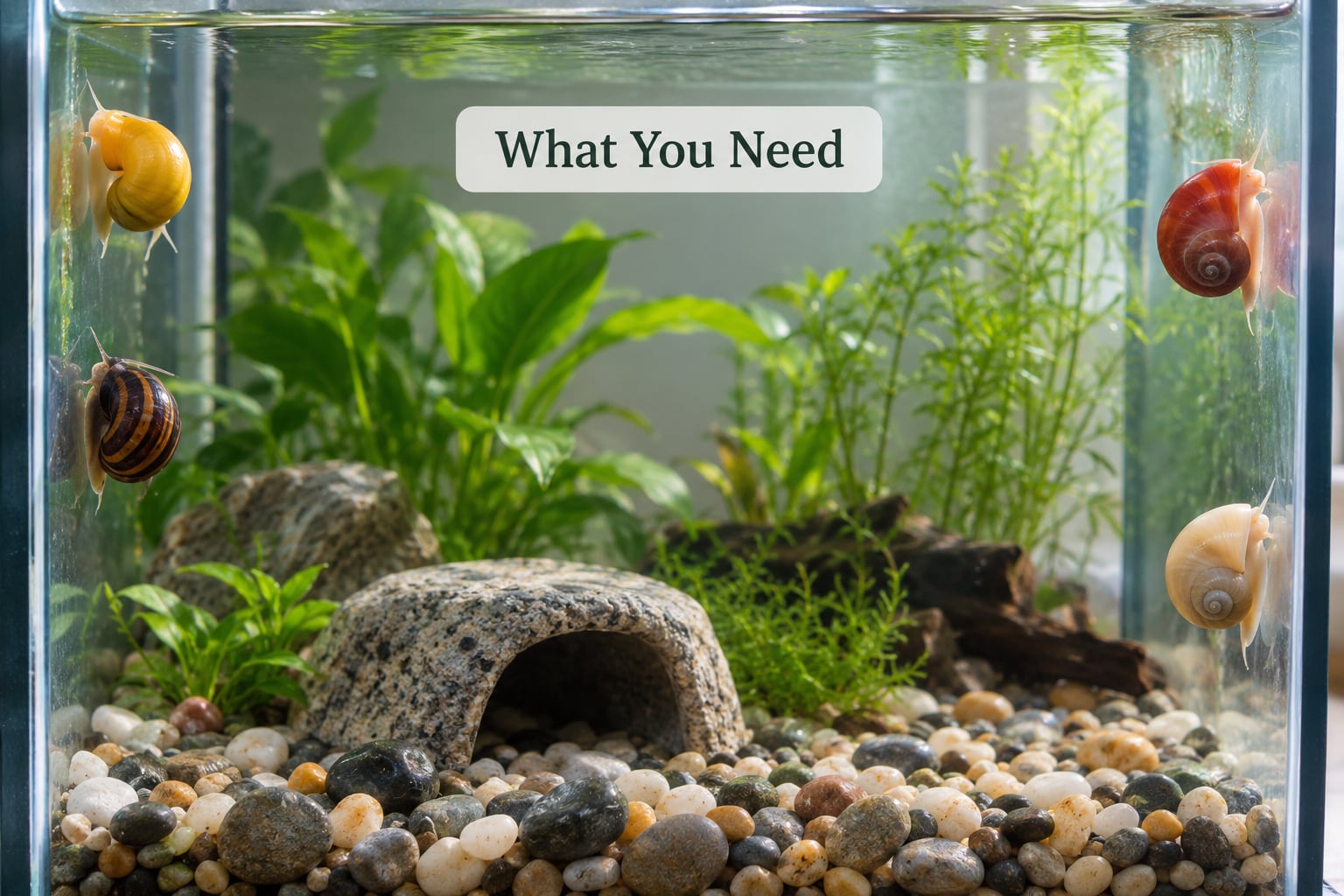
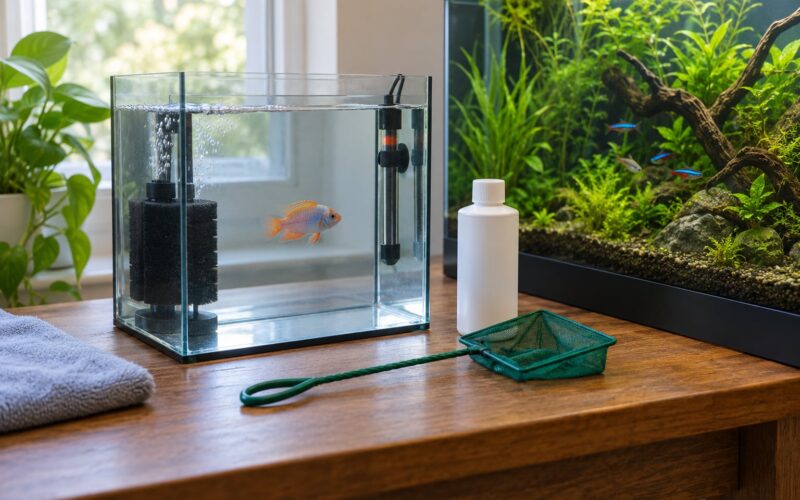
Snails ask very little of you, but each item below solves a specific failure. If you already keep fish, most of this is already in place.
- A tank of at least 5 gallons. Small tanks swing in temperature and chemistry fast, and snails suffer from that more than fish do.
- A water conditioner that removes chlorine and chloramine. Untreated tap water is the fastest route to a dead snail.
- A heater if the room gets cold. Keeping a steady 68 to 82°F (20 to 28°C) matters more than hitting one exact number.
- A lid. Snails climb out of open tanks, and a dry snail usually dies within a day.
- Food: sinking pellets or algae wafers for small species, plus blanched vegetables for larger ones.
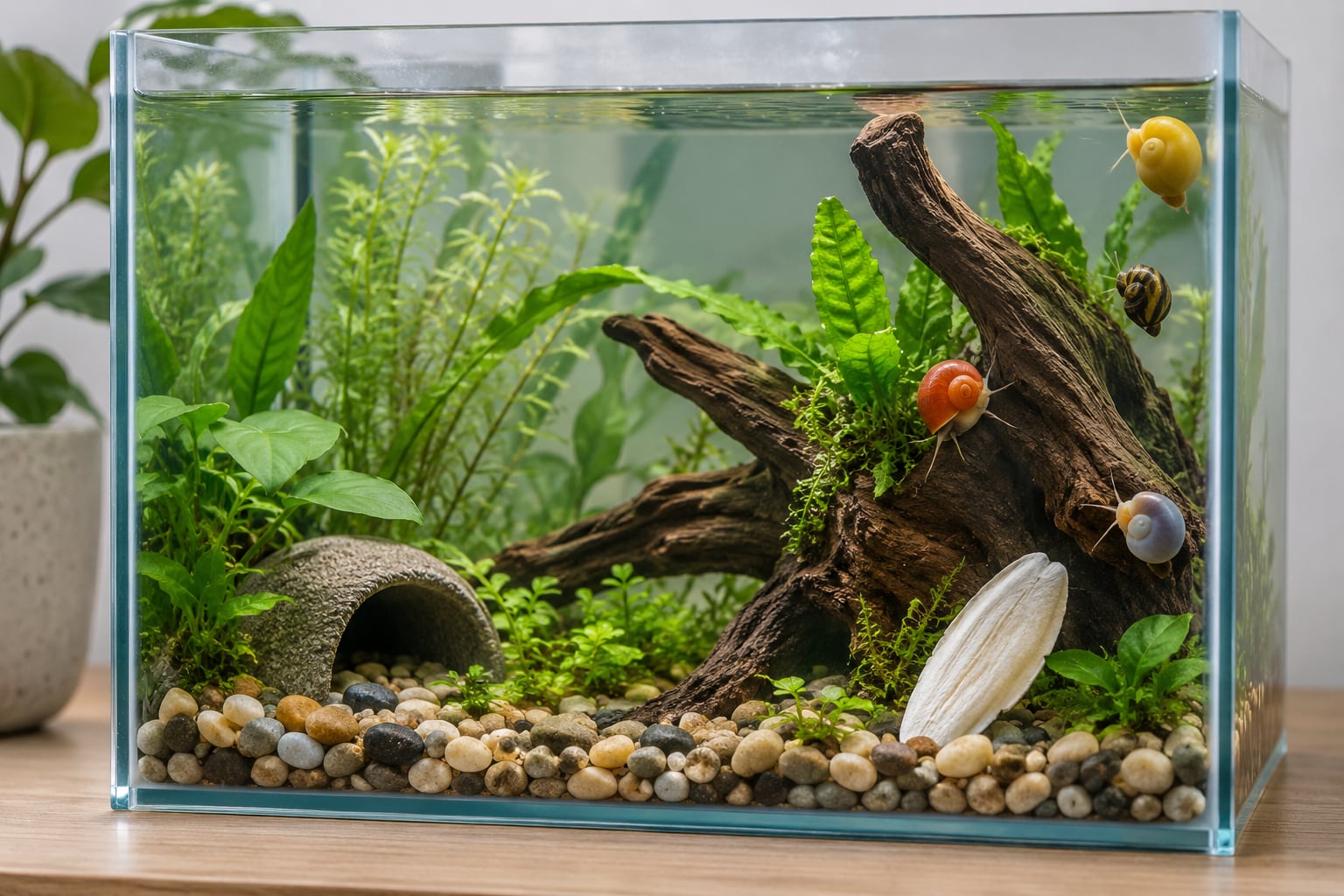
- A calcium source, usually a cuttlebone or a calcium block, which is the single most repeated tip on every snail forum.
- A siphon or gravel vacuum so you can reach the bottom without draining the whole tank.
- Test kits for ammonia, nitrite, pH and general hardness. Guessing at hardness is why so many keepers cannot explain a sudden death.
If you are starting a brand new tank: let it cycle first. Snails are not good cycle starters in a tank where nothing else lives, because there is not enough bioload and no established biofilm. Wait until ammonia and nitrite both read zero for several days in a row, then add one snail and watch the tank for a week.
If you have an established aquarium: you are in the easy position. Match the snails to the hardness and temperature you already keep, and do not change your water routine to suit them.
Step-by-Step
How to Choose the Right Aquarium Snail
Nerites, mystery, ramshorn and apple snails are the four most common freshwater aquarium snails, and they behave differently enough that picking the wrong one causes most early frustration. Nerites eat algae obsessively but rarely breed. Mystery snails grow large, eat almost anything, and breed readily. Ramshorns breed so fast that keepers often treat them as pests.
| Species | Adult size | Typical lifespan | Main appeal | Breeding |
|---|---|---|---|---|
| Mystery snail (Pomacea bridgesii) | 1.5 to 2 inches | 1 to 2 years | Personality, colour, easy to feed | Yes, lays clutches above the waterline |
| Nerite snail | About 1 inch | 1 to 3 years | Best algae grazing of any common snail | Very rarely in a home tank |
| Apple snail (Pomacea canaliculata) | 2 to 3 inches | 1 to 3 years | Largest and most dramatic | Yes, and restricted in some regions |
| Ramshorn snail | Under 1 inch | 1 to 2 years | Hardy, thrives in hard water | Yes, continuously |
| Trumpet or bladder snail | Under 0.5 inch | 1 to 2 years | Eats leftover food and detritus | Yes, hard to remove once established |
For a first snail, a nerite is the calmest choice: no clutches on the glass, no population explosion, and it will visibly clear a green tank. A mystery snail is the better pick if you want something interactive and if you are willing to feed it properly. Both are hardy compared to fish.
One note before you buy: some apple snail species are restricted or banned in parts of Australia, New Zealand, Florida and elsewhere, because escaped populations damage native wetlands. Check your local rules before bringing one home.
Prepare the Tank and Water
The parameters below are the working range most freshwater aquarium snails do well in. Match your tap water as closely as you can and you will avoid almost every shell problem.
| Parameter | Recommended range | Why it matters |
|---|---|---|
| Temperature | 68 to 82°F (20 to 28°C) | Below about 60°F snails go dormant and stop eating; heat speeds decay and ammonia |
| pH | 7.0 to 8.4 | Acid water below roughly 6.5 dissolves and weakens shells |
| General hardness (GH) | 6 dGH minimum, 8 to 12 preferred | Soft water leaves shells pitted, thin and cracked |
| Carbonate hardness (KH) | 3 dKH minimum | Buffers pH so it does not swing between ammonia spikes |
| Copper | 0 ppm, always | Snails are extremely sensitive to copper; many medications and trace elements contain it |
| Tank population | 1 to 2 snails per 5 gallons, fewer for larger species | Mystery snails produce more waste than nerites and need a bigger bioload |
| Lid | Closed, with no gap at the rim | Snails climb the glass and leave through the smallest opening |
| Waterline | At least 1 inch of dry glass below the rim | Gives climbing snails nowhere to go |
Substrate matters less than most people think, but rough gravel and sharp rock will abrade the foot as the snail crawls. Smooth gravel or bare glass is safer, and a piece of cuttlebone or calcium block should sit in the tank where snails can rasp it as they grow.
For filtration, a gentle sponge or hang-on filter with a pre-filter sponge over the intake is enough. A strong current is worse than no filter, because snails are not built to hold on in moving water. The intake also needs covering, since a smaller snail can end up inside the tubing.
Add copper-based medication and you will lose snails. That includes many parasite treatments and some trace element supplements, so read the label before putting anything into a tank with invertebrates.
Acclimate and Introduce the Snails
Snails rarely need the slow drip acclimation fish get. Most experienced keepers drop the bag in the tank, let it float for fifteen minutes to equalise temperature, and release them. They are far more tolerant of small swings than a betta is.
Add one or two snails per 5 gallons to start. If the species breeds readily, go lower. On day one you will probably find them wedged in a filter sponge, under a piece of wood or clamped tight inside a shell, which is normal settling-in behaviour rather than a problem.
What tells you it worked: within a day or two the snail starts grazing on the glass and hardscape, climbs the glass at night, and leaves a visible trail of eaten algae behind it. A snail that stays sealed in its shell for days, floats motionless, or has lost body mass is a different story, and that is a water quality or calcium problem rather than a settling-in one.
Keep the waterline at least an inch below the rim. Snails wander mostly at night, and most escapes happen because a snail crawled up the glass past the water and out through a gap nobody noticed.
Feed Aquarium Snails the Right Amount
Snails graze constantly, so the instinct is to keep feeding. Overfeeding is the most common cause of snail death, because uneaten food turns into ammonia in a small tank, and ammonia burns their skin.
What aquarium snails eat:
- Algae wafers and sinking pellets for nerites, ramshorns and trumpet snails.
- Blanched vegetables for larger species: cucumber, zucchini, green leaf lettuce, cabbage. Boil for a minute or two so the shell can actually break them down.
- Protein in small amounts, such as crushed bloodworm or sinking shrimp pellets, once or twice a week for growth.
- Biofilm and leftover fish food, which is the free food that keeps trumpet and ramshorn snails going.
- A calcium source, cuttlebone or a mineral block, always available.
A good routine is one small pinch of food two or three times a week for nerites, and a slightly larger portion two or three times a week for mystery snails. Remove anything still sitting uneaten after 24 hours. Treat uneaten food as a problem to clean up rather than as food the snail will get to eventually, because it usually does not.
Watch for the classic starvation case: a nerite in a spotless tank. The algae ran out, the wafer was finished, and the snail started eating its own shell. If your glass stays clean, feed vegetables and wafers on a schedule instead of relying on grazing.
Maintain Shells, Water, and Healthy Behavior
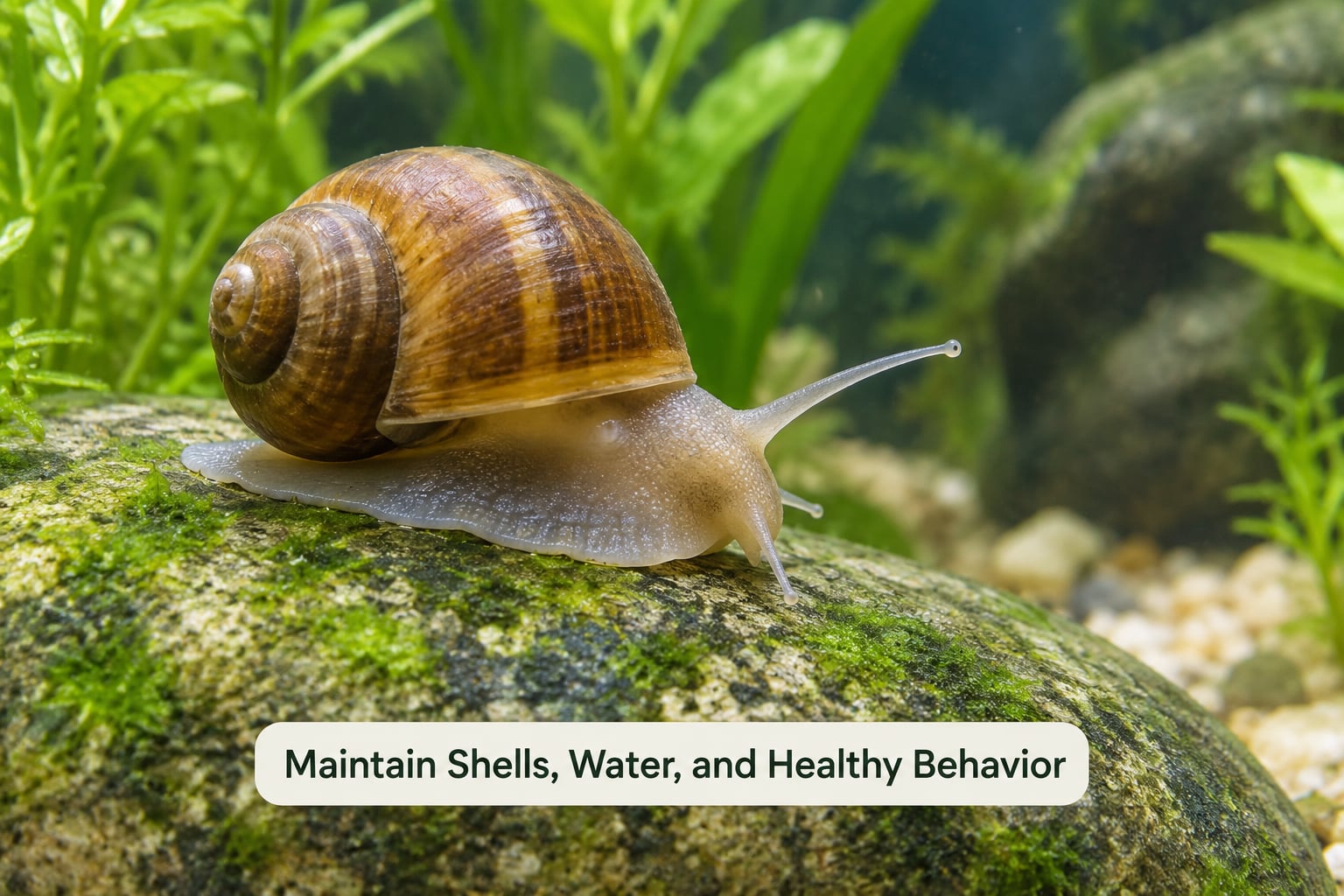
A weekly routine is plenty. Change 25 to 30 percent of the water with conditioned, temperature-matched water; test ammonia, nitrite, pH and hardness; wipe algae off the glass with a soft pad; siphon debris from the substrate; and feed on schedule. Skip the full teardown, and never use soap, glass cleaner or an abrasive pad, because residues left in the tank are lethal to snails and the residue concentrates right where they live.
Keep the lid on and the waterline low. Snails escape more often in tanks that look fine, because the glass is wet and inviting above the water.
| Growth stage | Typical age | Shell size | What you should see |
|---|---|---|---|
| Hatchling | 0 to 1 week | About 1 mm | Feeding constantly, staying hidden in substrate |
| Juvenile | 1 to 6 weeks | 2 to 8 mm | New whorls appearing, active on glass at night |
| Adult | 2 months and up | Up to species maximum | Full size, roaming the hardscape, feeding on offered food |
| Older snail | 1 to 3 years | Fixed, no new growth | Slower movement, more time buried in the substrate |
Shell health: a healthy shell feels firm and solid, has an even colour with no fuzzy white patches, and shows visible growth rings at the opening. Fine white growth lines on a growing snail are normal. Pitting, softening, a chalky surface or a crack along a growth ring means the water is too soft or too acidic, and the fix is raising GH above 6 dGH and adding calcium, not feeding more.
Behaviour: grazing on glass and hardscape, climbing, hiding during the day and roaming at night, and using the siphon at the surface to breathe air are all normal. A siphon that stays out for a long time, a snail that never leaves the shell, a foot that looks soft or rotting, or a shell that floats on its own and does not sink when nudged are the warning signs worth acting on.
| What you see | Likely cause | What to do |
|---|---|---|
| White, rough or pitted patches on the shell | Soft water, low calcium, acidic pH | Test GH and pH, raise hardness, add cuttlebone |
| Crack along a growth ring | Sudden water change or a drop in hardness | Stabilise the parameters and change water more slowly |
| Shell has thin, transparent areas | Long-term soft water | Raise GH toward 8 dGH and offer calcium |
| Snail stays clamped inside the shell | Stress, recent introduction, copper, or poor water quality | Test for ammonia, remove copper sources, leave undisturbed |
| Empty shell, body missing | Normal death, then decomposition | Remove the shell, rinse it, and check ammonia and stocking levels |
If a snail is sealed in its shell and you are not sure whether it is resting, stressed or dead, leave it alone for a day and watch the foot. A resting snail reopens and moves at night. A dead snail does not move, and lifting it out leaves a strong smell within a day or two.
Anything that looks like illness rather than husbandry needs a vet who sees invertebrates. Aquarium clinics and exotics practices are the right call for a snail that is losing body mass, leaking, or refusing food after you have corrected the water.
Common Mistakes
1. Adding snails to an uncycled tank. Fresh water plus a small animal means ammonia builds with nowhere to go. Wait for zero ammonia and nitrite over several days, then start with one snail.
2. Overfeeding. A pinch of food twice a week is plenty for a small species. Feed less, remove leftovers after 24 hours, and clean the substrate more often.
3. Using soap or glass cleaner. Never clean tank glass with anything but a dedicated algae scraper or pad and plain water. Rinse anything used near the tank, and keep cleaning products in a separate bucket.
4. Treating an empty shell as proof of overcrowding. It is usually one snail, not a population problem. A dead snail that was old, a snail that was picked off by a fish, or a failed introduction all produce one shell. Check the stocking level against your tank volume rather than reacting to a single shell.
5. Making abrupt water changes. A full swap with cold, untreated water is a shock that shows up as shell cracking weeks later. Change 25 to 30 percent, condition the water, and match the temperature.
6. Crowding incompatible tank mates. Bettas and some cichlids pick at snail tentacles and opercula, and loaches and pufferfish eat snails outright. Peaceful community fish such as tetras, corydoras and shrimp are the safe pairing.
7. Letting the tank sit open. The most common forum complaint is a snail found on the floor outside the tank overnight. Close the lid, drop the waterline an inch, and check the rim for gaps.
8. Adding copper-based medication. Snails are extremely sensitive to copper, and it is not always obvious on the label. Keep invertebrates out of the room while treating fish, and remove them if the product allows.
One habit prevents most of the above: test your water on a schedule and write the numbers down. Problems that were invisible for six weeks become obvious on a spreadsheet in one glance.
Frequently Asked Questions
How long can aquarium snails live without food?
A well-fed adult mystery or nerite snail can go several weeks without eating, and they often slow down in cooler water. But a snail that goes without food eventually starts eating its own shell, and nerites are the fastest to suffer, since algae is their main diet. Offer a wafer or a piece of blanched cucumber every few days rather than testing how long they last.
Do aquarium snails need a filter in their tank?
A filter is strongly recommended but not strictly required in a small, well-planted tank with no overfeeding. Snails produce waste like any animal, so a gentle sponge filter keeps ammonia down and the tank stable. Strong current is worse than no filter, so choose a low-flow filter and cover the intake with a pre-filter sponge so no snail ends up inside the tubing.
Why is my aquarium snail floating upside down?
A shell that floats on its own usually means the snail inside has died and gas has built up in the empty shell, which makes it buoyant. It can also happen briefly after a snail dies or when a trapdoor snail has sealed itself and trapped air. Gently nudge the shell, then lift it out and check for smell, and test ammonia, because a sudden spike is the common cause.
Are empty aquarium snail shells a sign of too many snails?
Not usually. One empty shell is one death, which is normal over a year or two of keeping snails, and it is often caused by old age or a failed introduction rather than crowding. Leaving the shell in the tank collects algae and detritus with no benefit, so remove it, rinse it in tank water and look again. Repeated losses over weeks point to a real stocking or water quality problem.
Can aquarium snails live with fish?
Yes, with the right fish. Tetras, corydoras, danios and most shrimp are safe company, and nerites are often added purely for algae control. Avoid loaches, puffers and some cichlids, which eat snails, and be careful with bettas and large aggressive fish, which may pick at a snail’s tentacles. Snails also add bioload, so count them when deciding how many fish the filter can handle.
Why is my snail shell turning white or soft?
White patches, a chalky texture or a soft shell almost always point to soft or acidic water, not to feeding. Acid water below about 6.5 dissolves calcium, and general hardness under 6 dGH leaves the snail unable to build a solid shell. Test GH and pH, raise hardness toward 8 to 12 dGH where your fish allow it, and keep a cuttlebone or calcium block in the tank at all times.
The First Thing to Do
Test your general hardness and pH before you change anything else. That single measurement explains most shell problems, most unexplained deaths, and most of the care questions people bring to a snail forum. Once the numbers sit above 6 dGH and around neutral to slightly alkaline, add a calcium source, keep the lid on, and the rest of the routine takes twenty minutes a week.
Updated for 2026. Snail behaviour varies with temperature and season, so judge your snail against its own history rather than against a fixed checklist.