To know how to tell if a pet bird is sick, you compare what you see now with what that bird normally does. There is no single universal symptom. Birds are prey animals, so they hide illness until they physically cannot look well, and by then the problem has usually been developing for a day or two.
That instinct is the whole reason this is tricky. In the wild, a bird that looks weak gets left behind by the flock or picked off by a predator, so a sick bird acts normal while it still can. The fluffing, the weight loss and the sleepy posture all show up together, late.
Good news is that most of what you need is free and takes two minutes. What follows is the checklist, in the order I would work through it, plus the points where an owner should stop watching and start driving to the clinic.
Table of Contents
- What You Need
- Step-by-Step
- How to tell if a pet bird is sick: compare changes with its normal baseline
- 1. Check for unusual behavior or inactivity
- 2. Monitor appetite and water intake
- 3. Listen to breathing and vocal changes
- 4. Examine posture and movement
- 5. Inspect droppings for meaningful changes
- 6. Look at feathers, skin, eyes, and nostrils
- 7. Check for vomiting, swelling, or weight loss
- 8. Decide when the bird needs a veterinarian
- Common Mistakes
- Monitoring tips after the observation
- Frequently Asked Questions
- Can a sick bird still eat and appear active?
- Why is my bird fluffing up its feathers and sitting still?
- What do abnormal bird droppings mean?
- Is open-mouth breathing normal in pet birds?
- Can I give a sick bird human medicine?
- How soon should I take a bird to the vet after noticing symptoms?
- Conclusion
What You Need
Before you start checking, gather a few things. Without a baseline you are guessing, and guessing is what delays the vet call.
- Notes on the bird’s normal routine. When it wakes, how loud it usually is, how much it eats, how many droppings a day, where it likes to sit.
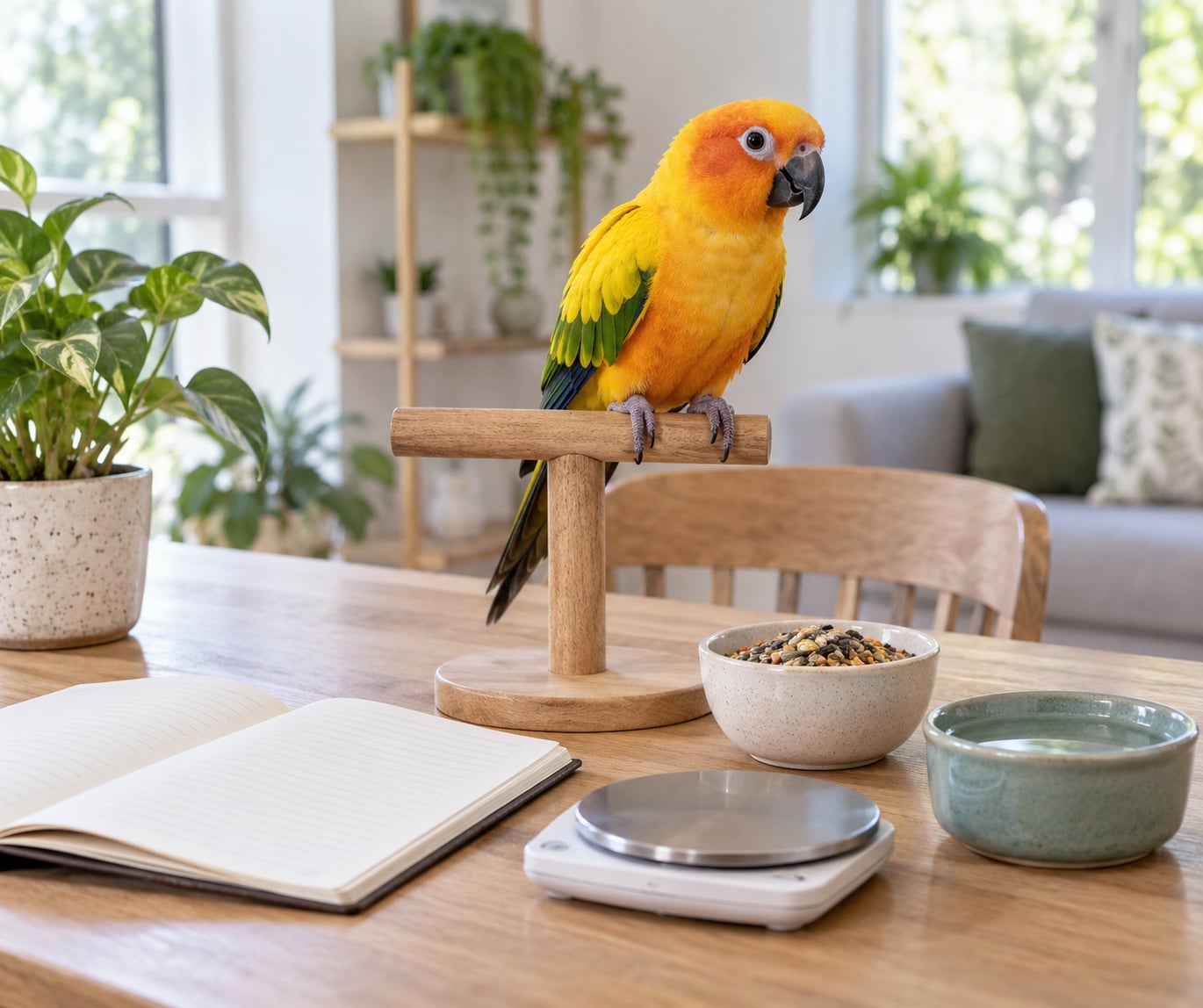
- A gram scale if you can get one. Small kitchen scales with a hook or a platform work; weigh the same way each time, at the same time of day.
- A quiet, warm space away from drafts, TV noise and other birds, with dim lighting and minimal foot traffic.
- Clean observation materials. Paper towels for droppings, your phone to photograph them, good lighting, and a second pair of hands to hold the bird gently if needed.
- An avian veterinarian’s number, saved before you need it. Search the Association of Avian Veterinarians directory or ask a local clinic whether they see birds, because plenty of general practices do not.
- A small carrier lined with a towel, for a trip to the clinic at short notice.
Two minutes a day is enough. I do mine right after the morning food goes in, when the bird is usually most active, so the number and the behavior are comparable.
Step-by-Step
How to tell if a pet bird is sick: compare changes with its normal baseline
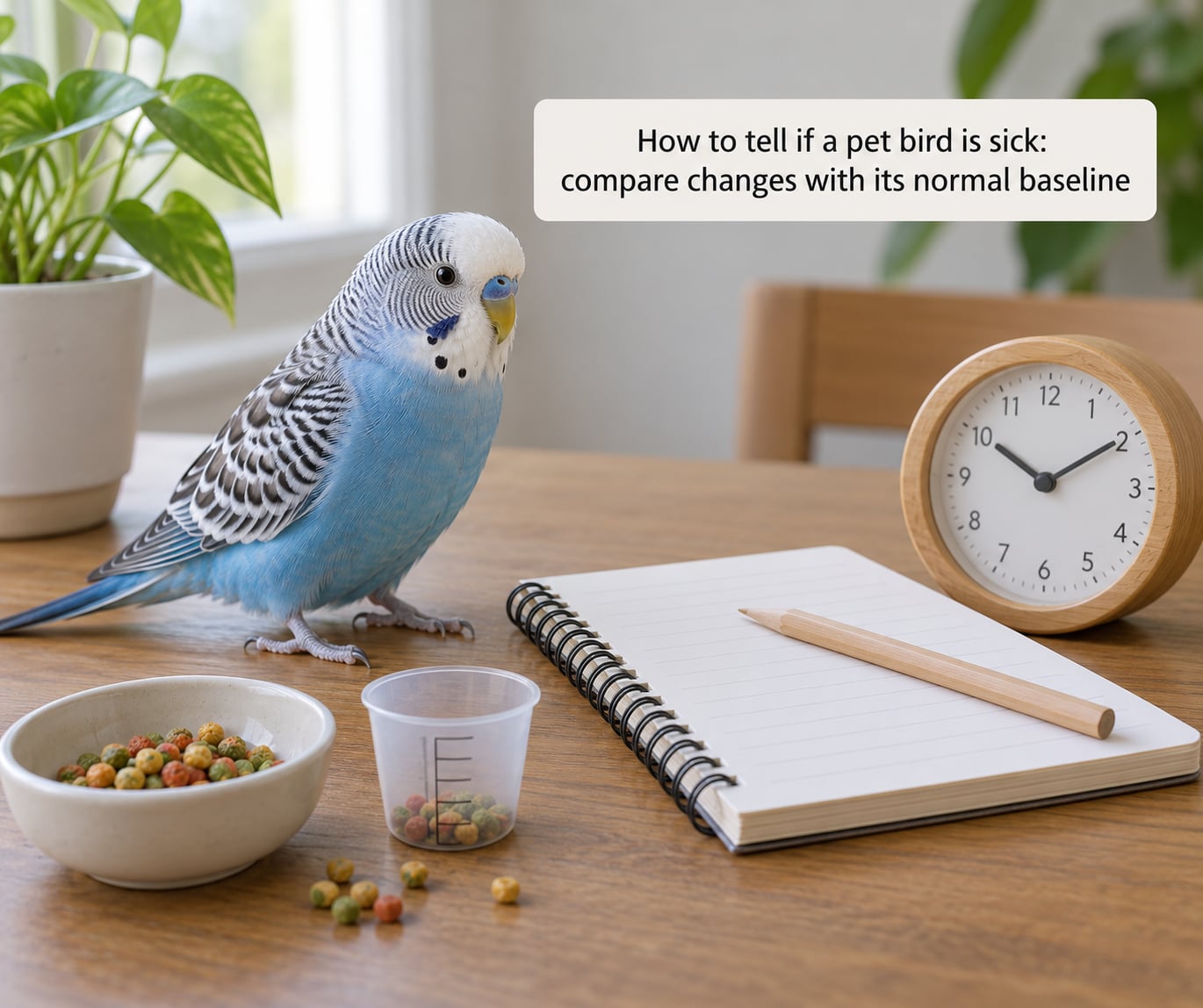
The single most useful thing you can do is know your specific bird. A cockatiel that is quiet every evening and a lorikeet that never sits still are two completely different baselines, and each one’s departure from its own pattern is the signal.
Write down a normal week while the bird is well: approximate weight in grams, normal vocal times, food type and amount, and what a typical dropping looks like. If you find this guide after your bird is already unwell, look back at photos on your phone, because owners often have years of droppings and pose pictures nobody thought to study.
Then judge changes by three things: how big the change is, how long it lasts, and how many systems are affected. A bird that skips one morning meal is nothing. A bird that eats less, drinks more, sits fluffed and stops talking for three days is a bird you take in today.
1. Check for unusual behavior or inactivity
Behavioral change is usually the first sign, because it costs the bird the least energy to fake. Watch for a bird that stays low on the perch, stays in one corner, or does not investigate a new toy or a familiar person.
- Spending more time sleeping than usual, or choosing a flat surface instead of a perch.
- Not vocalizing, or a noticeably lower-volume voice than its normal squawk.
- Withdrawing from the cage mates it usually plays with.
- Flapping the wings or stretching without settling, or sitting hunched with feathers held tight.
- Sudden personality flips, such as a gentle bird becoming erratic or a busy bird going still.
One thing that trips people up: some birds pant or hang around a warm lamp in the afternoon and look half-dead, then bounce at dusk. That is normal if it is the same bird doing the same thing every day, and it is not normal if it happens alongside quiet breathing changes or if it is new.
Owners on bird forums describe the same first sign over and over: the bird stops doing its usual thing and just sits. Multiple threads mention a bird that looked fine one day and much worse the next morning, which is exactly why the daily check matters more than a single worry.
2. Monitor appetite and water intake
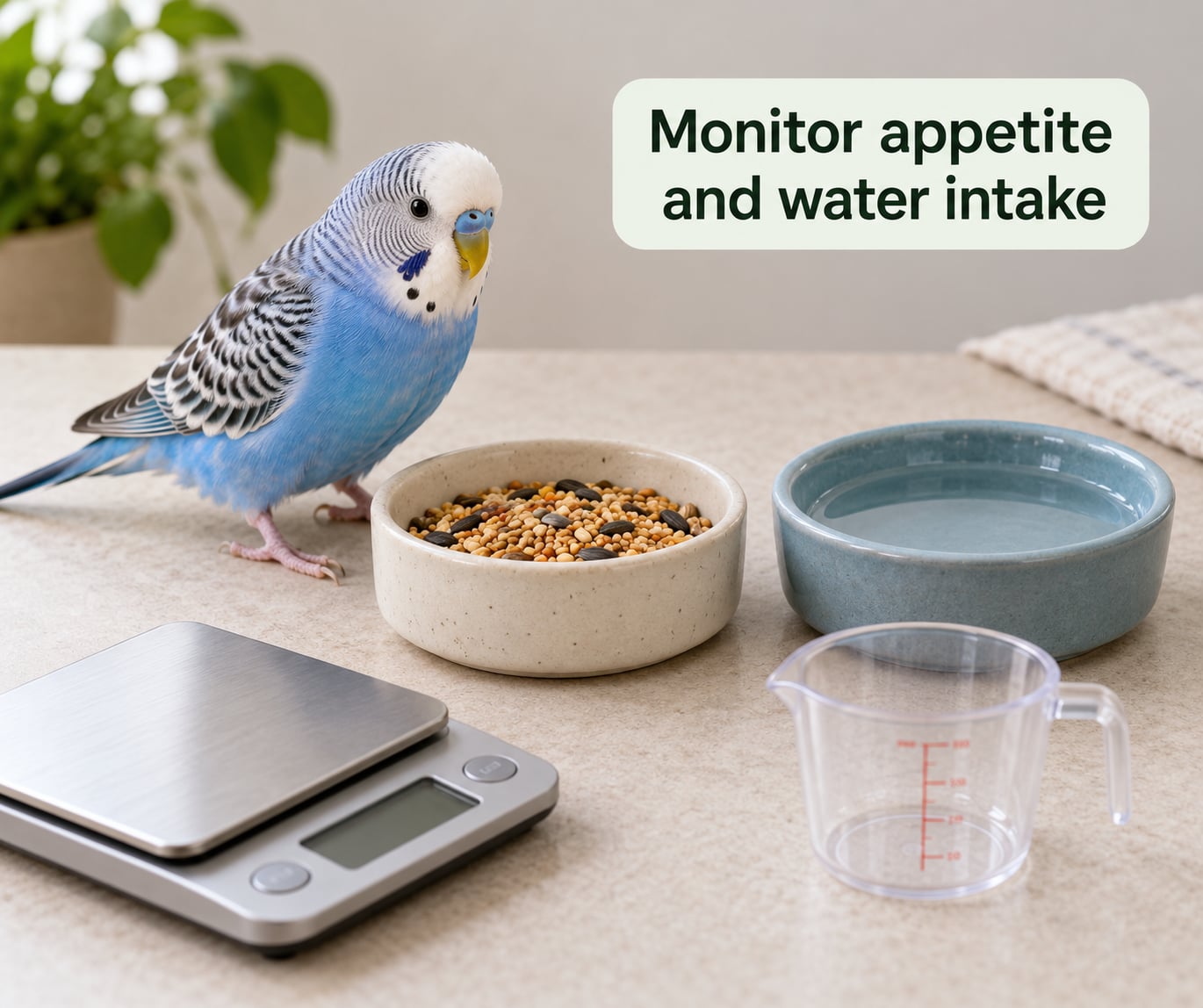
Appetite is easiest to measure because you control the food. Note the level in the bowl at the end of the day. A bird that leaves seed every time, husks large amounts and drops it, or stops coming to the bowl at all has changed.
- Dropping food from the beak, or eating from the floor of the cage rather than the dish.
- Drinking far more than usual, often with wet droppings to match, which can signal fever, pain, or kidney and liver problems.
- Drinking almost nothing, or spending a lot of time near the water without drinking.
- Weight loss. A loss of about 10 percent of body weight is a widely used red flag in avian practice.
For a bird too weak to drink, owners share a simple trick: place a single drop of water on your fingertip against the seam of the beak, and the tongue draws it in by itself. Do not pour or squirt water into the mouth. A weak bird can aspirate, which turns a treatable problem into an emergency.
Never force food or water with a syringe into a bird that is weak or struggling to breathe. That is a job for a vet with the bird sedated safely.
3. Listen to breathing and vocal changes
Breathing is where you stop watching and act. Birds are built to hide respiratory trouble, so anything audible or visible here has been going on longer than you think.
- Open-mouth breathing, or breathing with the mouth open at rest.
- Wheezing, clicking, squeaking or a rattling sound with each breath.
- Tail bobbing, where the tail dips up and down in time with the breath, a classic sign of respiratory or heart strain.
- Fast, shallow, or visibly effortful breathing, with the whole body moving.
- A change in voice, such as a hoarse or strained call, in a species that talks.
Open-mouth breathing is never normal at rest in a healthy bird, and it is not something to observe for a day. A bird that is stretching, panting after being handled, or flapping hard in a hot room is a different situation, but a bird sitting still with its mouth open needs a vet the same day.
4. Examine posture and movement
Look at how the bird holds itself, not just how it behaves. A healthy bird balances on its feet with its head up and its wings tucked. Trouble shows up in the spine first.
- Sitting on the cage floor instead of perching, which usually means it is too weak to perch.
- Drooping wings that hang low or drag on the perch.
- Limping, favoring a foot, or holding a foot up off the perch.
- Tremors, an unsteady or tilting head, or a bird that falls or hangs awkwardly from a perch.
- A swollen or rounded belly, which in a hen can mean egg binding.
Sitting at the bottom of the cage is the sign owners most often ask about, and it is not a sleepy posture. In a thread on r/parrots, owners describe lories and other birds flattened on the cage floor in the sun, unsure whether it was a nap or illness. The deciding question is whether the bird can perch and climb normally the rest of the day, and whether it is eating.
Scaly or swollen feet and toes are worth flagging too, especially in birds that spend a lot of time on a wet or soiled surface. That pattern is often called bumblefoot, and the feet feel warm, swollen, or crusty rather than merely cold.
5. Inspect droppings for meaningful changes
Droppings are the closest thing a bird has to a daily blood test, and they cost you nothing to look at. Learn what yours normally look like, because the range is wide.
- Watery or unusually frequent droppings, sometimes with a strong smell.
- Green droppings when the bird is not eating its normal foods, or bright yellow-green droppings that look like diarrhea.
- Very few droppings in a day, which often accompanies reduced eating.
- Blood, or droppings that are chalky white or gray rather than the normal white-and-green or brownish shape.
Note that a healthy bird’s dropping has two parts, a solid green or brown portion and a white urate cap, and it changes shape constantly depending on what was eaten. A sudden change in color, a change to liquid, or blood is what matters, not the shape of a single dropping.
If you cannot tell whether the change is significant, photograph it and take it to the clinic. Owners report that a photo of the droppings was often the first useful piece of information the vet asked for.
6. Look at feathers, skin, eyes, and nostrils
Feathers and the thin skin around the face show illness quickly, because grooming is one of the first activities a sick bird drops.
- Feathers left permanently fluffed or puffed, so the bird looks like a padded shape rather than a sleek one.
- Dull, dirty, or broken plumage, and a loss of the usual sheen.
- Bare patches or visible pinfeathers that are not coming through, especially around the head, neck, or vent.
- Crusting or a wet, blocked look at the cere, the fleshy band above the beak where the nostrils sit.
- Discharge from the nostrils or eyes, redness, swelling, or crusting that makes the bird look like it is crying.
- Any raw skin, scaly patches around the face or vent, or flaking skin on the feet.
Persistent fluffing is the sign most owners ask about, and it is worth being precise about it. A bird fluffs briefly, then smooths down and moves on, is doing what birds do to manage temperature. A bird that stays fluffed for hours, sits still with it, and looks smaller than usual is not comfortable.
Long, patchy pinfeathers that fail to open can accompany a poor molt, and a bird that has feathered and feathered badly may be working through something other than illness. When in doubt, ask a vet rather than assuming either way.
7. Check for vomiting, swelling, or weight loss
Not every thing coming out of a bird’s mouth is vomiting, and telling the two apart matters. Regurgitation is a normal social and digestive behavior, especially in cockatiels, budgies, and other species that do the head-bobbing, wing-shaking routine before bringing up a small amount of food. It looks dramatic, but the bird goes right back to normal.
Repeated vomiting looks different: it happens without the head bob, comes up repeatedly, the bird looks uncomfortable or shakes afterward, and it is often accompanied by weight loss or an enlarged abdomen. That combination needs a vet.
- A visibly narrower keel bone, or a gap you can feel where breast muscle used to be.
- A rounded, tight, or distended belly, especially in a female bird, where egg binding is a possibility.
- Bruising, a bleeding wing or toe, a swollen lump, or any sign of a bite or a fall.
Weight is the one measurement worth repeating weekly, and a gram scale is a small price for catching a drop of 10 percent before you can see it. A body condition score from a vet gives you a reference number to aim for once the bird recovers.
8. Decide when the bird needs a veterinarian
Sort what you are seeing into three piles. Owners who get this triage right tend to be the ones whose birds recover well, and it takes ten seconds of clear thinking.
Go to an emergency clinic now: labored or open-mouth breathing at rest, tail bobbing, collapse or extreme weakness, a seizure, major bleeding, a broken or dangling toe or wing, a bite from a cat or dog, repeated vomiting, or a bloated belly in a hen that is straining. None of these wait for morning.
Book an avian vet within a day or two: no droppings for most of a day, clearly reduced eating or drinking, a bird living on the cage floor, persistent fluffing, discharge from the eyes or nose, or any two of the softer signs happening together.
Watch and record, then re-check in 24 hours: one skipped meal, one unusual dropping, a quiet evening after a noisy day. Write down what you saw and check again. A change that resolves on its own was probably not illness, and a change that does not is now easier to describe to a vet.
While you wait, keep the bird warm, around 32 degrees Celsius, quiet, and dim, with minimal handling, and keep it separated from other birds in a separate room with its own bowls. A cardboard box with air holes and a towel on the floor makes a serviceable hospital cage. Wash your hands between birds, since some parrot diseases, including psittacosis, can pass to people, and anyone who is pregnant, very young, elderly or immunocompromised should take extra care around a sick bird.
Common Mistakes
Waiting to see if it passes. Owners in bird health forums say it constantly, and it is the wrong instinct. Birds deteriorate quickly, and by the time you know for sure, the easy window has closed. If a sign is on the list above, act on the sign.
Giving human medicine. No over-the-counter pain relievers, no leftover antibiotics, no human cough syrup. The wrong drug or dose can kill a bird quickly, and some are toxic to birds outright. This one deserves repeating because it is a very common and very expensive mistake.
Treating oils and supplements as medicine. Coconut oil, honey, and vitamin drops have no place in treating an undiagnosed illness, and applying grease to feathers or skin makes it worse and harder to examine.
Changing the whole diet at once. Rewriting the diet of a bird that is already stressed adds another variable. Keep the food familiar and let the vet advise on changes.
Diagnosing from a forum or a symptom list, including this one. Symptoms overlap heavily across dozens of conditions, from bacterial infection to mites to organ disease. A symptom guide helps you decide how fast to move, not what the disease is.
Handling a weak bird too much. A bird that is sitting on the cage floor is using its last reserves. Frequent handling, chasing it around the cage, and warm baths all cost energy it does not have.
Monitoring tips after the observation
Keep a simple record while you wait and after treatment starts. Date, weight in grams, food and water situation, droppings, and one line on behavior. Ten seconds a day is enough, and it becomes the most useful thing you can put in front of a vet.
Photograph a normal dropping and a normal posture while the bird is healthy, so you have a reference. Weigh weekly at the same time of day; daily is better during recovery.
Keep the room stable and boring: consistent temperature, no new cage, no new toys, no visitors, no loud TV through an open door. A calm, familiar environment is doing work for a bird that feels unwell.
For travel, use a secure carrier with a towel base, keep it dark and quiet in a temperature-controlled car rather than on a lap or a seat, and keep the climate cool to moderate. Call the clinic on the way so they can tell you which entrance to use and whether someone avian is actually in.
Once the bird is home from treatment, isolate it from other birds for the period your vet recommends, which for many conditions is around six weeks, with separate bowls, separate cleaning items, and handwashing in between.
Frequently Asked Questions
Can a sick bird still eat and appear active?
Yes, and that is one of the traps. Because birds hide illness, a sick one often keeps eating and responds to its name right up until the illness is advanced. What gives it away is the fine detail: eating noticeably slower, dropping food, drinking far more, less vocalizing, fluffing it keeps, or sitting lower than usual. This is why the baseline matters more than any single observation. If the small things have shifted together for more than a day, treat that as a symptom even though the bird still seems bright.
Why is my bird fluffing up its feathers and sitting still?
Birds fluff their feathers to trap warm air, and they do it briefly all the time, especially when cold, relaxed, or sleepy. Persistent fluffing is different. If the bird stays puffed for hours, does not smooth down when you approach, sits on the cage floor rather than a perch, and shows a reduced appetite or quiet voice, that combination usually points to illness or pain. Warmth and rest are the two common innocent explanations. A bird that perks up, perches, and eats normally is probably fine; a bird that stays puffed and quiet is a vet appointment.
What do abnormal bird droppings mean?
Watch for the big shifts rather than the small ones. Watery or much more frequent droppings, a strong smell, very few droppings in a day, a greenish or yellow-green loose stool, blood, or droppings that lose their normal white urate cap all deserve a call. Normal droppings vary enormously with diet, so photograph your bird’s typical ones while it is healthy. A color change after a diet change, a stress move, or a new treat is usually not serious. Droppings that stay liquid, or that contain blood, need an avian veterinarian promptly.
Is open-mouth breathing normal in pet birds?
Not at rest. A healthy bird breathes with its mouth closed and quietly, and you should not see the chest or abdomen working hard. Mouth open during a stretch, a bath, after being handled, or in hot weather is fine. Mouth open while the bird is sitting still and relaxed, with wheezing, clicking, a raspy voice, or a tail that bobs up and down with each breath, is respiratory distress and should be seen by a veterinarian the same day. Tail bobbing and audible breathing sounds are among the most serious signs on this list.
Can I give a sick bird human medicine?
No. Human pain relievers, cough medicines, and leftover antibiotics can be severely toxic to birds, and the dose that works for a person can be fatal for a bird. Over-the-counter products for humans are designed for a body weight of tens of kilograms, not a bird weighing 40 grams. Never medicate a bird without a veterinary prescription, and never apply oils, balms, or salves to feathers or skin, because birds groom themselves and will ingest them. A vet can advise on safe fluids and supportive care for a bird too weak to eat.
How soon should I take a bird to the vet after noticing symptoms?
Call the same day for breathing difficulty, collapse, bleeding, a broken toe or wing, a cat or dog bite, repeated vomiting, or a bloated straining female, and go to an emergency clinic. For softer signs like reduced eating, a bird on the cage floor, persistent fluffing, eye or nostril discharge, or absent droppings, book an avian vet within a day or two rather than waiting a week. If a single odd moment does not repeat within 24 hours, note it and watch. The rule most bird owners regret breaking is the one about waiting.
Conclusion
Notice the change from your bird’s own normal baseline, and treat a meaningful one as a reason to call. Weigh it weekly, look at the droppings, listen to the breathing, and keep the observation habit while the bird is well so you have something to compare against.
Then act on the tiers: breathing difficulty, collapse, bleeding, trauma or repeated vomiting means an emergency clinic now, and softer signs mean an avian veterinarian within a day or two. Save the number of a real avian vet today, and never medicate a bird with anything made for humans.