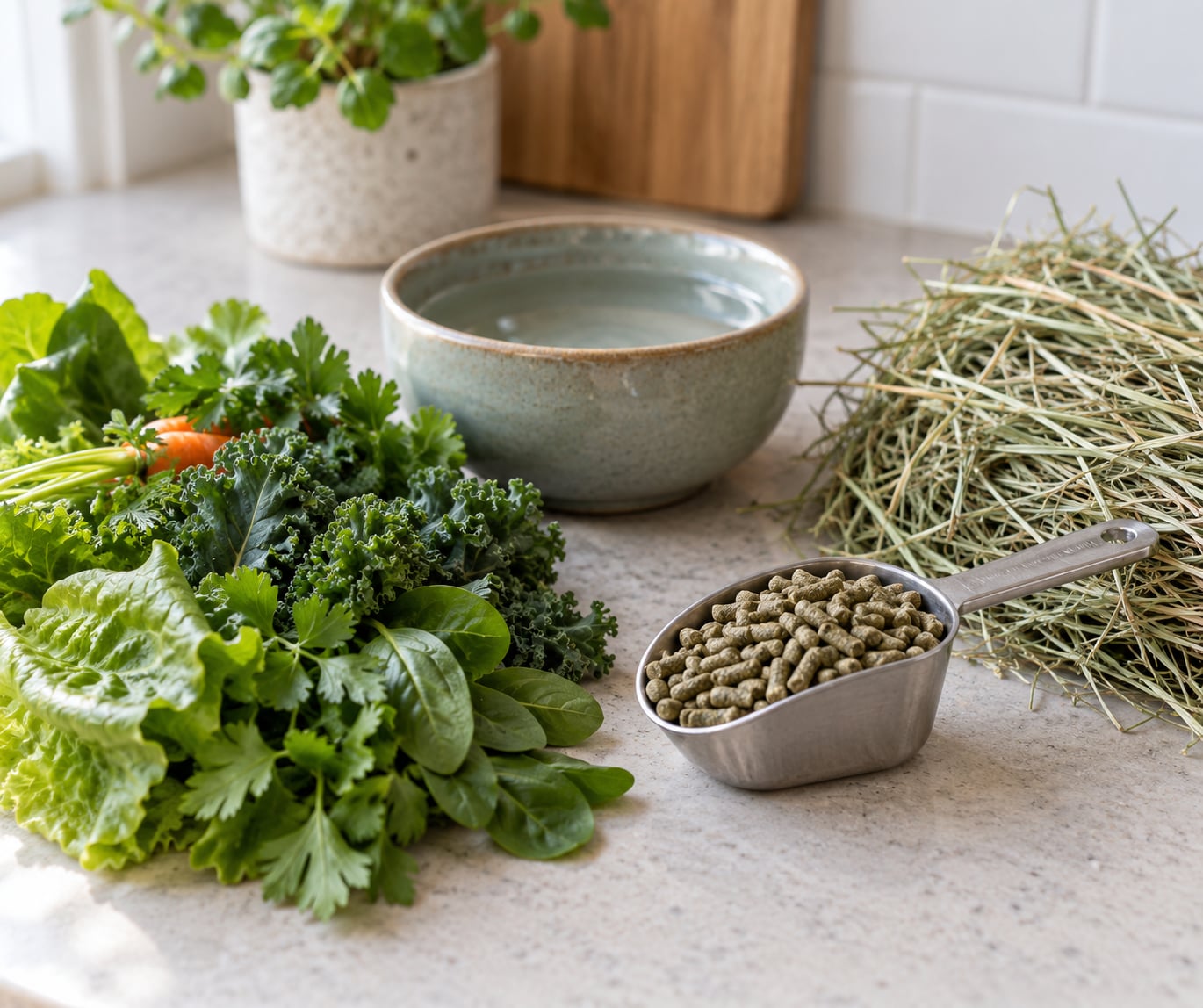
What to feed a pet rabbit daily comes down to one ratio: roughly 80-85% unlimited grass hay, 10-15% fresh leafy greens and herbs, about 5% plain high-fibre pellets, plus water that is available at all times. Hay is not a side dish here, it is the meal, and everything else tops it up.
That split is what vets and rabbit welfare charities land on, and it fixes most feeding problems before they start. Get it right and teeth stay worn down, the gut keeps moving and weight stays steady. Get it wrong and you get dental spurs, obesity or gut stasis, which are the three complaints rabbit vets see most.
Table of Contents
- What You Need
- Step-by-Step: What to Feed a Pet Rabbit Daily
- Step 1: Grass Hay Makes Up Most of What to Feed a Pet Rabbit Daily
- Step 2: Add the Right Amount of Rabbit Pellets
- Step 3: Serve Fresh Leafy Greens and Vegetables
- Step 4: Keep Water Available and Check the Bowl
- Step 5: Adjust the Plan for Life Stage and Body Condition
- Common Mistakes
- 1. Not enough hay, or hay of the wrong type
- 2. Muesli-style mixes
- 3. Unlimited pellets
- 4. New vegetables all at once
- 5. Too many high-oxalate greens
- 6. Carrots and fruit as the main diet
- 7. Changing the diet abruptly
- 8. Foods that look harmless but are dangerous
- Frequently Asked Questions
- How much should a pet rabbit eat in a day?
- What can pet rabbits eat every day?
- What cannot be fed to a pet rabbit?
- Why doesn’t my rabbit want to eat hay?
- Can rabbits eat carrots every day?
- How much pellets should I give my rabbit?
- A Simple Starting Routine
What You Need
You can build a correct daily diet with a short shopping list. The first week is usually the fiddly part, because your rabbit has to learn that hay is the good stuff.
- Unlimited grass hay. Timothy, meadow, orchard, oat or brome. Buy small bags at first, then a larger bale once you know what your rabbit accepts.
- A plain rabbit pellet. Look for a uniform nugget shape, at least 18% fibre, and no seeds, corn, nuts or dried fruit listed on the bag.
- A heavy ceramic or stone bowl. Light plastic bowls get tipped over and are chewed.
- Fresh leafy greens and herbs. Romaine, cilantro, parsley, basil and dandelion leaves are easy starting points.
- A hay rack or pile. Somewhere the rabbit can graze from for hours, ideally not directly above a litter tray.
- A kitchen scale. Useful for weighing pellets during the first few weeks, then for weighing your rabbit.
That is the whole kit. No special supplement is needed for a healthy adult rabbit on a good hay diet, and treats are optional rather than necessary.
Step-by-Step: What to Feed a Pet Rabbit Daily
The routine below follows the order most owners find works: hay first, pellets measured, greens added slowly, water checked, and portions reviewed against body condition.
Step 1: Grass Hay Makes Up Most of What to Feed a Pet Rabbit Daily
Offer hay continuously and replace it rather than topping up, so the bottom of the pile stays fresh. A 6 lb adult rabbit eats roughly a quarter of its body weight in hay each day, which works out at around 1.5 lb of dry hay a day. That sounds like a lot until you notice they graze in short bursts through the night.
Timothy is the safest default. Orchard grass is sweeter and softer, oat hay is crumbly, and brome is coarse and high in fibre. Mixing two types is common among owners precisely because hay gets bought in bulk and rabbits are fussy, so trying a second brand is a reasonable move.
Check quality before you serve it. Good hay smells sweet and green, leaves dust in your palm, and snaps rather than bends. Avoid anything musty, dusty or full of seed heads.
Alfalfa is a different food entirely. It is higher in protein and calcium, so it suits growing babies, pregnant and nursing does, and rabbits recovering from illness, but it is too rich for an adult rabbit’s daily diet. Feed it as a supplement, not as the staple.
Straw is not hay. It is a by-product crop with far less nutritional value and sharp stalks that can injure the mouth, so keep it out of the feeding area.
Step 2: Add the Right Amount of Rabbit Pellets
Pellets are the smallest part of the diet, and the easiest to overfeed. Most rabbit owners overfeed them, which is why so many rabbits refuse hay and gain weight. The measure is around 25 g of plain pellets per kg of body weight per day, which lands near a quarter of a standard cup for a 6 lb rabbit. A rough 60 ml egg cup is another easy reference point.
One measured feeding per day is plenty. Free-access pellet bowls encourage grazing on nothing but pellets, and pellets alone will not keep teeth worn down the way long-stem hay does.
Check the label for fibre of 18% or more, with low protein and no added sugar. Muesli-style mixes are the ones to avoid, because rabbits pick out the high-sugar pieces first and end up with an unbalanced diet that can cause dental problems and obesity.
If your rabbit came home eating muesli, switch gradually over 14 to 28 days. For the first week, mix one part pellets into every three parts muesli, then halve it, then finish with plain pellets. Sudden changes are a common trigger for digestive upset.
Young, pregnant, nursing or medically treated rabbits need individually sized portions. Your rabbit-savvy vet should set those, because the numbers differ a lot from the adult guideline.
Step 3: Serve Fresh Leafy Greens and Vegetables
Leafy greens form the fresh portion of the diet and should make up most of it. A common rule is at least 1 packed cup of greens per 2 lb of body weight, which gives a 6 lb rabbit about 3 cups. The House Rabbit Society puts it as a minimum of 2 cups of chopped vegetables per 6 lb, and plenty of owners do well with around 1 cup per 3 lb.
Good daily greens include romaine lettuce, green and red leaf lettuce, butter lettuce, dandelion leaves, cilantro, parsley, basil, mint, thyme, and carrot tops. Non-leafy vegetables such as bell pepper, cucumber, broccoli florets and sugar snap peas are fine too, in smaller amounts.
Watch the oxalic acid. Spinach, kale, chard, parsley and beet greens are high in oxalic acid, and the sensible habit is to pick only one from that group on any given day rather than serving them all together. This is the daily-versus-weekly argument you will read in different places, and rotation is the compromise most rabbit vets accept.
Introduce anything new one food at a time, in a small portion, and wait two to three days before trying the next one. That way, if your rabbit reacts badly, you know exactly what caused it.
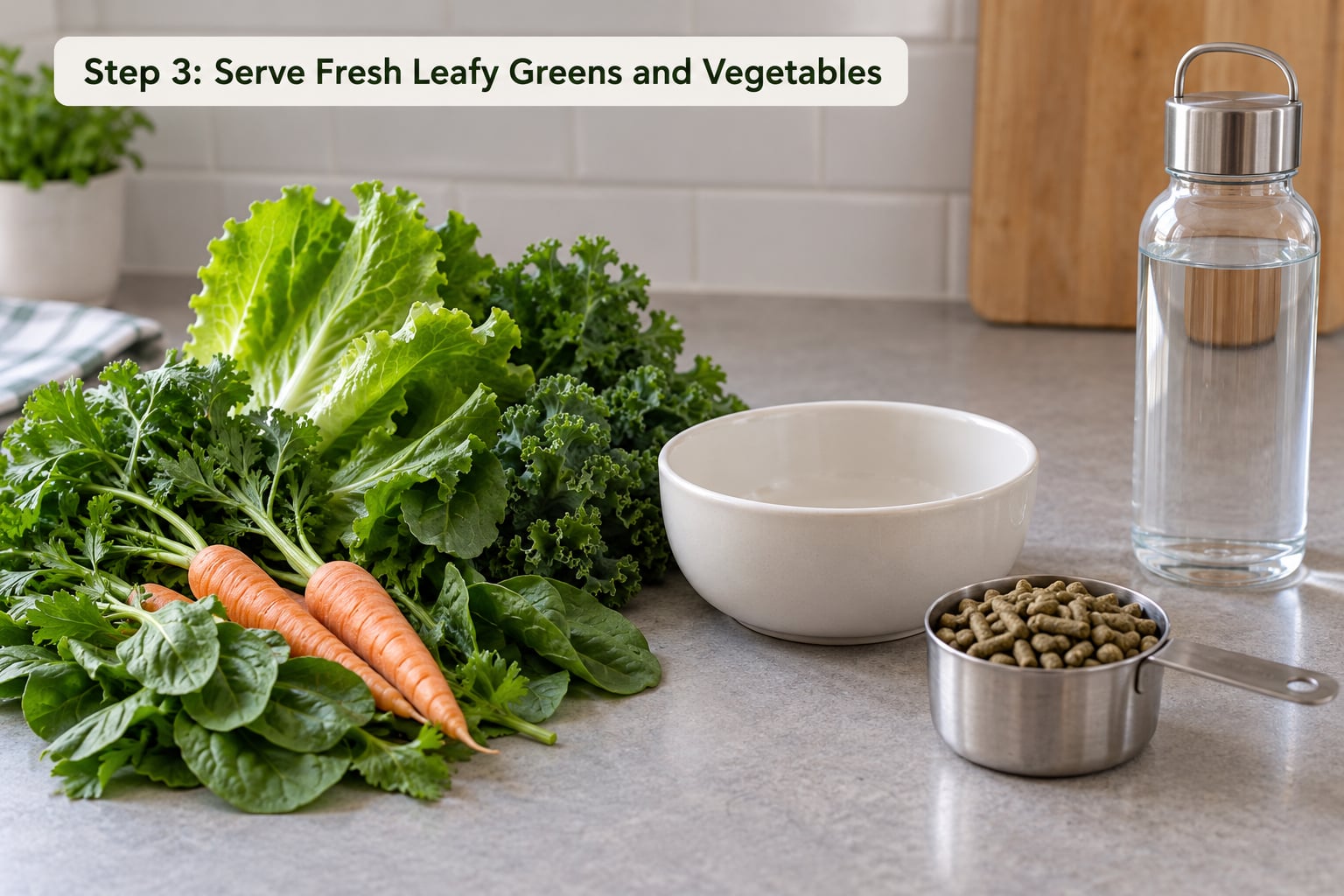
Wash greens under running water for two minutes with the water running the whole time. Rabbit hemorrhagic disease, or RHDV2, survives in droplets and on surfaces, and this two-minute wash is one of the few cheap precautions an owner can take.
Here is a sample week for a 5 lb adult rabbit. Hay is available at all hours, so it is not listed per day.
| Day | Leafy greens (about 1.5 cups total) | Non-leafy vegetable | Pellets |
|---|---|---|---|
| Monday | Romaine, cilantro | Bell pepper, 1 tbsp | 1/4 cup |
| Tuesday | Red leaf lettuce, parsley | Cucumber, 1 tbsp | 1/4 cup |
| Wednesday | Romaine, basil, dill | Broccoli florets, 1 tbsp | 1/4 cup |
| Thursday | Butter lettuce, kale | Bell pepper, 1 tbsp | 1/4 cup |
| Friday | Romaine, mint, dandelion leaves | Carrot, 1 tbsp, carrot tops | 1/4 cup |
| Saturday | Green leaf lettuce, cilantro | Cucumber, 1 tbsp | 1/4 cup |
| Sunday | Romaine, thyme, parsley | Sugar snap peas, 1 tbsp | 1/4 cup |
Carrots are a treat, not a staple, and this is the most common myth on this topic. A carrot is high in sugar, so a few pieces once or twice a week is plenty. Carrot tops are the leafy part and can be fed more often.
Fruit works the same way. A teaspoon per 6 lb once or twice a week is a sensible portion, and apple without seeds or pips, banana, pear and berries are all fine in small amounts. Never feed human medication, chocolate or anything containing xylitol.
Step 4: Keep Water Available and Check the Bowl
Fresh water should be available every hour of the day, and bowls are generally better than bottles because rabbits drink more from an open dish. A heavy ceramic bowl is the easiest setup and it is easy to clean.
Refresh it at least morning and evening, and scrub it a few times a week, since biofilm builds up quickly on a surface rabbits lick. Check the bowl when you check the hay, which is twice a day at least.
What you are looking for is simple: a bowl that is not empty, drinking that looks normal for your rabbit, and droppings that are plentiful and round. Sparser, smaller or misshapen droppings are a reason to pay closer attention and to call a rabbit-savvy vet, because they can be the first sign of gut stasis.
Step 5: Adjust the Plan for Life Stage and Body Condition
Once the daily routine is set, scale the fresh portion and pellets to body weight. Hay stays unlimited at every stage, and the greens and pellet figures move.
| Body weight | Fresh greens per day | Pellets per day | Hay |
|---|---|---|---|
| 2 lb (0.9 kg) | About 2/3 cup | About 1/8 cup | Unlimited |
| 4 lb (1.8 kg) | About 1 cup | About 1/4 cup less a little | Unlimited |
| 5 lb (2.3 kg) | About 1.5 cups | 1/4 cup | Unlimited |
| 6 lb (2.7 kg) | About 2 cups | 1/4 cup | Unlimited |
| 8 lb (3.6 kg) | About 2.5 cups | About 1/3 cup | Unlimited |
| 10 lb and over | About 3 cups | About 1/2 cup | Unlimited |
Age changes the balance. Babies under about 12 weeks still need their mother’s milk and should be with a knowledgeable rescue or vet, since they cannot be hand-reared on this plan. Young rabbits up to around 20 weeks are growing fast and need unlimited alfalfa alongside grass hay. Adult rabbits from about 7 months to 6 years eat the adult plan above, and senior rabbits usually do best with the same hay-heavy diet plus a vet-guided plan, since dental wear and kidney function both tend to change with age.
Pregnant and nursing does need unlimited alfalfa, extra greens and a larger pellet ration. Get exact numbers from your vet rather than guessing, because the requirement climbs quickly in the last week of pregnancy.
Weigh your rabbit weekly and run your hands over the ribs and spine every few weeks. You want a firm feel with a light covering of fat, not sharp bones and not a belly you cannot feel through. A sudden change either way is worth a call to the vet.
Common Mistakes
Almost every feeding problem I see traces back to one of a handful of errors. They are easy to fix once you can name them.
1. Not enough hay, or hay of the wrong type
Hay should be 80-85% of the diet, available around the clock. A pile that empties in an hour is the right idea; a small rationed scoop is not. If your rabbit picks out the soft bits and leaves the stems, offer a coarser hay such as brome or a mixed meadow blend.
2. Muesli-style mixes
Muesli is sugary, and rabbits eat the pieces they like first and leave the rest. Switch to plain pellets over 14 to 28 days rather than in one go, and expect a few days of picking and dropping during the change.
3. Unlimited pellets
A free-access pellet bowl is the single most common cause of an overweight rabbit with dull hay intake. Measure the daily ration, top it up once, and do not refill early.
4. New vegetables all at once
One new food at a time, in a small portion, with two to three days between. It protects the gut and it tells you which food your rabbit handles well.
5. Too many high-oxalate greens
Spinach, kale, chard, parsley and beet greens are fine in moderation. Serving all of them in one bowl is what causes problems, so rotate one per day instead of rotating none.
6. Carrots and fruit as the main diet
Root vegetables and fruit are sugary. Keep carrots to a couple of tablespoons per 6 lb, twice a week at most, and fruit to about a teaspoon per 6 lb on the same schedule.
7. Changing the diet abruptly
Any sudden switch, including a switch between hay brands, can cause gut upset. Overlap the old and new food for at least a week and remove the old one gradually.
8. Foods that look harmless but are dangerous
This is the list to memorise, because most of these items are sitting in an ordinary kitchen right now.
| Food | Why it is a problem |
|---|---|
| Chocolate and coffee | Theobromine and caffeine are toxic to rabbits |
| Onion, garlic, leeks, chives | Allium compounds damage red blood cells |
| Rhubarb | Very high in oxalic acid, and the leaves are more concentrated still |
| Avocado | Persin causes heart and respiratory distress |
| Iceberg lettuce | Has very little nutrition and can upset the gut |
| Potatoes and beans | Starchy and hard to digest safely |
| Sweetcorn | High in starch, causes digestive problems |
| Xylitol-sweetened products | Sweeteners are not safe for rabbits |
| Lawnmower clippings | Cut too fast to digest, and may carry fertiliser or pesticides |
| Poppy, foxglove, bluebells, lilies | Toxic plants that are easy to nibble in a garden |
One more that catches people out: if your rabbit suddenly turns its nose up at hay but happily eats everything else, that is not fussiness to be trained out. Dental disease and gut stasis both start with reduced hay intake, and a rabbit that stops eating needs a rabbit-savvy vet the same day, not the next morning.
A practical hay-refusal routine runs like this. Mix two or three hay types and offer the crunchiest one, such as orchard or oat, alongside timothy. Hide a little hay inside a cardboard foraging box or stuff it under a rug so the rabbit has to work for it. Scatter part of the pellets through the hay so grazing is rewarded, and move the feeding station away from the litter tray so hay never smells of ammonia. If intake is still low after a day or two, or droppings have dropped, call the vet.
Frequently Asked Questions
How much should a pet rabbit eat in a day?
A healthy adult rabbit eats roughly its own body weight in hay each day, so a 6 lb rabbit gets through about 1.5 lb of grass hay. On top of that, offer about 2 cups of fresh leafy greens and roughly 1/4 cup of plain high-fibre pellets per 6 lb of body weight, with water available at all hours. Hay should never be rationed.
What can pet rabbits eat every day?
Grass hay is the everyday food, available around the clock. For fresh food, feed two or three leafy greens daily, such as romaine, dandelion leaves, cilantro, parsley and basil, plus a tablespoon of a non-leafy vegetable like bell pepper or cucumber. Keep fruit, carrots and other sweet treats to once or twice a week, in small portions.
What cannot be fed to a pet rabbit?
Never feed chocolate, coffee, onion, garlic, leeks, avocado, rhubarb, iceberg lettuce, potatoes, beans or sweetcorn. Xylitol-sweetened products are dangerous too, as are toxic garden plants such as poppy, foxglove and bluebells. Lawnmower clippings are unsafe because they ferment too fast in the gut and may carry fertiliser.
Why doesn’t my rabbit want to eat hay?
Try mixing hay types and offering the crunchiest one, such as orchard or oat, next to timothy. Scatter some pellets through the hay so grazing pays off, and hide hay in a foraging box so foraging becomes play. Move the hay away from the litter tray, since ammonia smell puts rabbits off. If hay intake stays low or droppings shrink, call a rabbit-savvy vet.
Can rabbits eat carrots every day?
No. Carrots are high in sugar and should be an occasional treat, roughly 1 to 2 tablespoons per 6 lb of body weight once or twice a week. The leafy carrot top is a different matter and counts as one of the daily greens. Plenty of owners have overdone the carrots because rabbits associate them with being a treat, not because they need them.
How much pellets should I give my rabbit?
Around 25 g of plain pellets per kg of body weight per day, which is roughly a quarter of a cup for a 6 lb rabbit, and a 60 ml egg cup is a handy measure. One measured feeding a day is enough. Give pellets as a supplement to hay, never as free access, and avoid muesli mixes entirely.
A Simple Starting Routine
Start with the hay. Fill a large rack with good quality timothy today, keep it topped up around the clock, and let your rabbit graze for a couple of days before you change anything else.
Then add one measured portion of plain pellets each morning, introduce two or three safe greens over the course of a week, and keep a heavy bowl of fresh water in place at all times. Weigh your rabbit once to set the portions, then check body condition every few weeks and adjust from there.
If your rabbit came home on muesli, or stops eating hay for a day or more, talk to a rabbit-savvy vet before you adjust anything. That single phone call saves a lot of guesswork.