Shrimp are among the easiest invertebrates to keep and the hardest to keep well. The answer to how to care for shrimp in a freshwater tank comes down to one rule: stable water beats perfect numbers. Keep the temperature, hardness and pH steady from week to week, cycle the tank before anything goes in, feed lightly and give them somewhere to hide, and a colony will look after itself.
That sounds simple, but it is where most beginners lose shrimp. A new tank stocked in week one produces ammonia the shrimp cannot escape. A 40% water change with straight tap water swings the hardness hard enough to stall a molt. Neocaridina are famously tough, yet they still die in batches inside a week of arriving from a seller, usually from handling and travel stress rather than anything you did.
This guide walks through the whole setup and daily routine in seven steps, from picking a tank to recognising a molt that has gone wrong. Allow a couple of hours for the setup and about five minutes a day once it is running. Most of the work happens in the first month, mostly waiting rather than cleaning.
Species named throughout: Neocaridina davidi (cherry and other colour grades), Caridina multidentata (Amano), and Caridina cantonensis (crystal and bee shrimp). The numbers below suit those three groups.
Table of Contents
- What You Need
- Step-by-Step: How to Care for Shrimp in a Freshwater Tank
- Step 1: Choose the Right Tank and Shrimp
- Step 2: Prepare the Tank and Cycle the Water
- Step 3: Introduce the Shrimp Slowly
- Step 4: Maintain Clean, Stable Water
- Step 5: Feed a Balanced Diet
- Step 6: Provide Hiding Places and Watch Molting
- Step 7: Check Daily and Respond to Problems
- Common Mistakes
- Frequently Asked Questions
- What temperature should a shrimp tank be?
- What do freshwater shrimp eat?
- How often should I change the water in a shrimp tank?
- Why are my shrimp dying after a water change?
- Is 10 shrimp enough to start a colony?
- Can shrimp live with bettas and other fish?
- Conclusion
What You Need
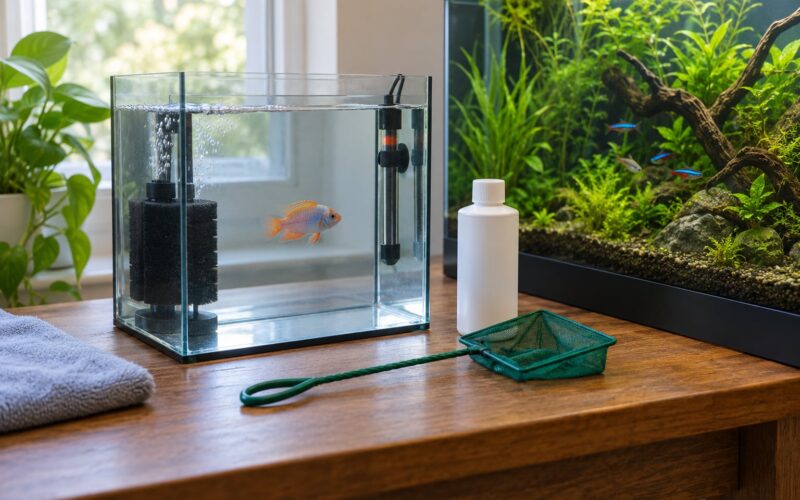
Shrimp are small, so the equipment list is short. Bigger shrimp need a bigger tank mainly because they need room to swim and because a larger volume of water buffers parameter swings far better than a small one.
- Tank. A 10 to 20 gallon glass aquarium with a tight-fitting lid. Shrimp are excellent jumpers and lids matter more than people expect. A lid also limits evaporation, which slowly changes hardness and temperature.
- Filter. A sponge filter is the standard choice for a shrimp-only tank. It has no flow strong enough to suck a small shrimp into the intake, and it hosts the biofilter that keeps ammonia at zero. Air-powered sponge filters with a modest air pump work well for tanks up to about 20 gallons.
- Heater. An adjustable aquarium heater with a thermometer. An undersized heater struggles in a cold room and lets temperature drift overnight, and shrimp are sensitive to that drift.
- Dechlorinator. Chlorine and chloramine destroy the protective slime coat on shrimp and kill the beneficial bacteria in your filter. Every drop of tap water goes through this first.
- Liquid test kits. Ammonia, nitrite, nitrate, pH, and a GH/KH kit. Liquid reagents are worth the extra step over strips, which are too imprecise for values near zero. A TDS pen adds a quick total dissolved solids reading that catches problems a GH test misses.
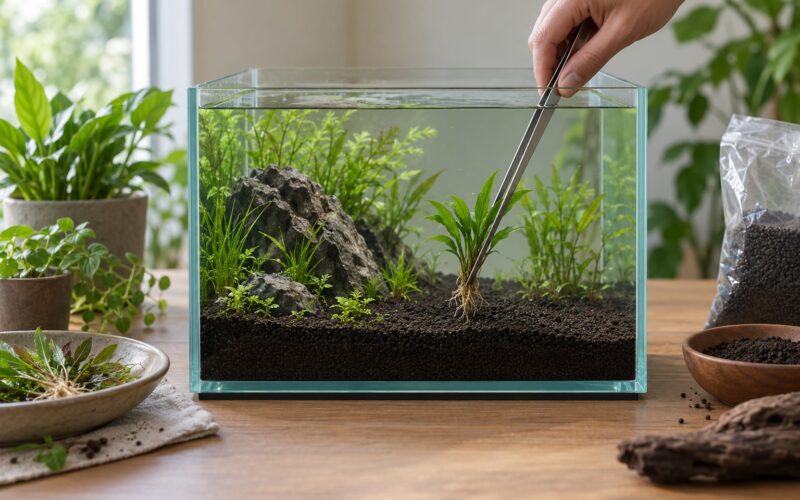
- Substrate and hardscape. Inert gravel or fine sand, plus driftwood and rocks that do not raise hardness. Skip anything calcium-based, like limestone or seashell, unless you specifically want hard water.
- Plants and cover. Java moss, anubias, buce or marimo give surfaces to graze on. Leaf litter on the bottom provides food and shelter.
- Food. A shrimp-specific pellet or flake, an algae wafer for grazing, and small pieces of blanched vegetable such as zucchini or carrot.
- Quarantine tank. A small separate tank, even a 5 gallon, if you plan to add shrimp from sellers regularly.
Tank size changes what you can keep. Amano shrimp grow to about 2 inches and swim hard, so they want more swimming space than a dwarf neocaridina colony. If you want to keep a species with hard water needs, the substrate and rock choice becomes a mineral decision rather than a decoration one. If you want the easiest possible first experience, a planted neocaridina-only tank in a 10 gallon with a sponge filter is hard to beat.
Water parameters at a glance. Aim for the middle of each range, then leave it alone.
| Parameter | Neocaridina (cherry) | Amano | Caridina (crystal, bee) |
|---|---|---|---|
| Temperature | 68–75 °F (20–24 °C) | 72–78 °F (22–26 °C) | 68–74 °F (20–23 °C) |
| pH | 6.8–7.8 | 6.5–7.5 | 5.5–6.8 |
| GH | 6–10 dGH | 5–10 dGH | 4–8 dGH |
| KH | 4–8 dKH | 3–6 dKH | 1–4 dKH |
| Ammonia | 0 ppm | 0 ppm | 0 ppm |
| Nitrite | 0 ppm | 0 ppm | 0 ppm |
| Nitrate | Below 20 ppm | Below 20 ppm | Below 15 ppm |
| TDS | Under 250 ppm, ideally 100–200 | Under 300 ppm | Under 150 ppm |
| Magnesium | Ratio of roughly 1:2 to 1:4 Mg:Ca | Same | Same |
Step-by-Step: How to Care for Shrimp in a Freshwater Tank
Step 1: Choose the Right Tank and Shrimp
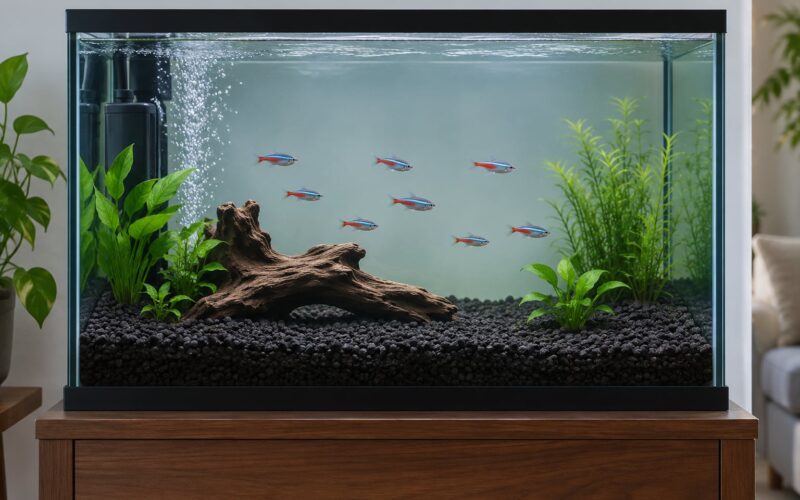
Pick the tank before you pick the shrimp, because the livestock depends on the water. A 10 gallon planted, filtered tank comfortably holds a colony of 15 to 20 neocaridina. Amano shrimp need more room and do not breed in freshwater, so a single group of six or so works well in 20 gallons or more.
Match the water you have to the species you want rather than the other way round. Very hard tap water suits neocaridina and makes caridina difficult. Very soft water suits caridina and needs remineralisation for neocaridina. Test your tap water first: if the TDS reading is 400 ppm or higher, plan for RO or distilled water blended back to your target, or pick an active soil that buffers the tank for you.
Step 2: Prepare the Tank and Cycle the Water
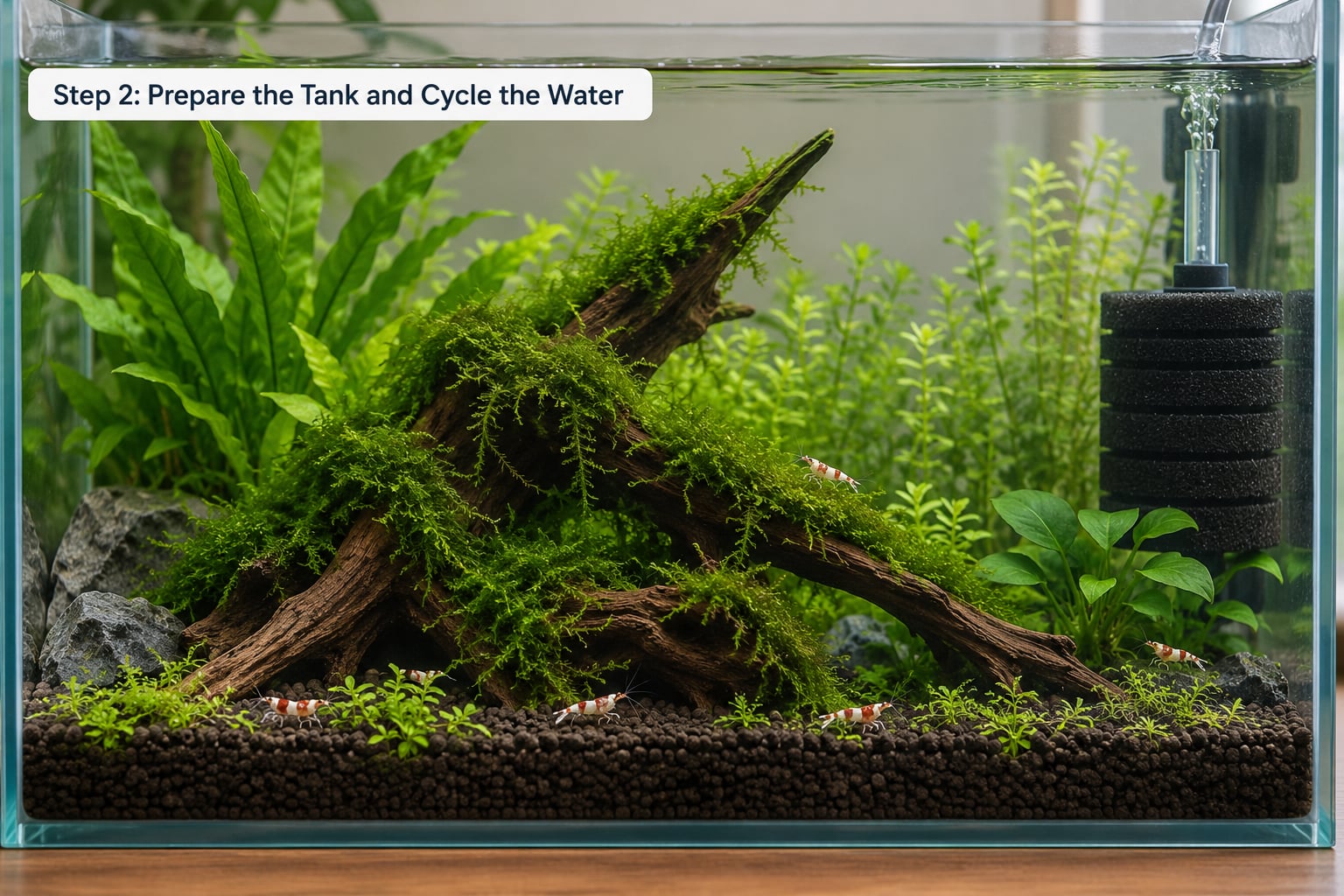
Rinse substrate and hardscape with tank water, never soap, and set the tank up fully before adding livestock. Fill with dechlorinated water, run the sponge filter and heater, plant heavily and set the lights on a timer for six to eight hours a day.
Now cycle it. This is the step most guides skip and the step behind most mass deaths. Your filter needs bacteria processing ammonia into nitrite and then nitrate. Add a small pinch of plain unflavoured fish food as an ammonia source, then test every few days. The cycle is complete when ammonia and nitrite both read zero on a liquid test and nitrate has appeared at some level, usually after four to six weeks on a sponge filter with light stocking.
Running the filter without a food source does nothing, because cycling needs ammonia to feed the bacteria. If you already own fish, moving an established filter across speeds things up considerably.
Step 3: Introduce the Shrimp Slowly
Do not float the bag and pour. For mail-order shrimp, drip acclimate. Float the sealed bag for 15 minutes to equalise temperature, then transfer the shrimp to a clean container. Add the tank water to the shipping water a spoonful at a time for 30 to 60 minutes, discarding the shipping water at the end.
Drip acclimation protects against two things: pH shock, where a small pH jump releases the shipping water’s ammonia as a toxic form, and hardness shock, where shrimp arriving from a soft-water farm meet hard water. Both kill quietly over a few days.
Once the shrimp are in, leave them alone for at least 24 hours. A panicked shrimp hiding behind the filter on day one is normal. Moving them, chasing them with a net or rearranging decor all add stress they do not need.
Step 4: Maintain Clean, Stable Water
Stability beats any single target value. Test the same parameters each week, top off evaporation with dechlorinated water, and change water in a pattern you can hold indefinitely. Most keepers report that small, frequent changes keep a tank steadier than one large weekly change. A 15 to 20% change every two weeks works well for a lightly stocked shrimp tank, and you can climb to smaller changes more often as your confidence grows.
Always match the temperature of your new water before it goes in, and use dechlorinator. Replace filter media gently and never rinse the sponge under the tap, since the bacteria live in that sponge and municipal water can also carry copper traces. A complete strip-out of your biofilter is the fastest route to an ammonia spike.
Nitrate tells you how much waste is building. A slow-rise reading of 5 to 10 ppm is fine. A jump to 40 ppm means doing an extra change and cutting food.
Watch TDS as well as GH. A GH test measures calcium and magnesium, but TDS measures everything dissolved in the water, including salts, chlorides and fertiliser runoff. If your tap water reads 400 ppm and your tank reads 300 while GH looks perfect, the tank is still drifting toward that tap water. Mixing with RO water solves it; blaming the shrimp does not.
Step 5: Feed a Balanced Diet
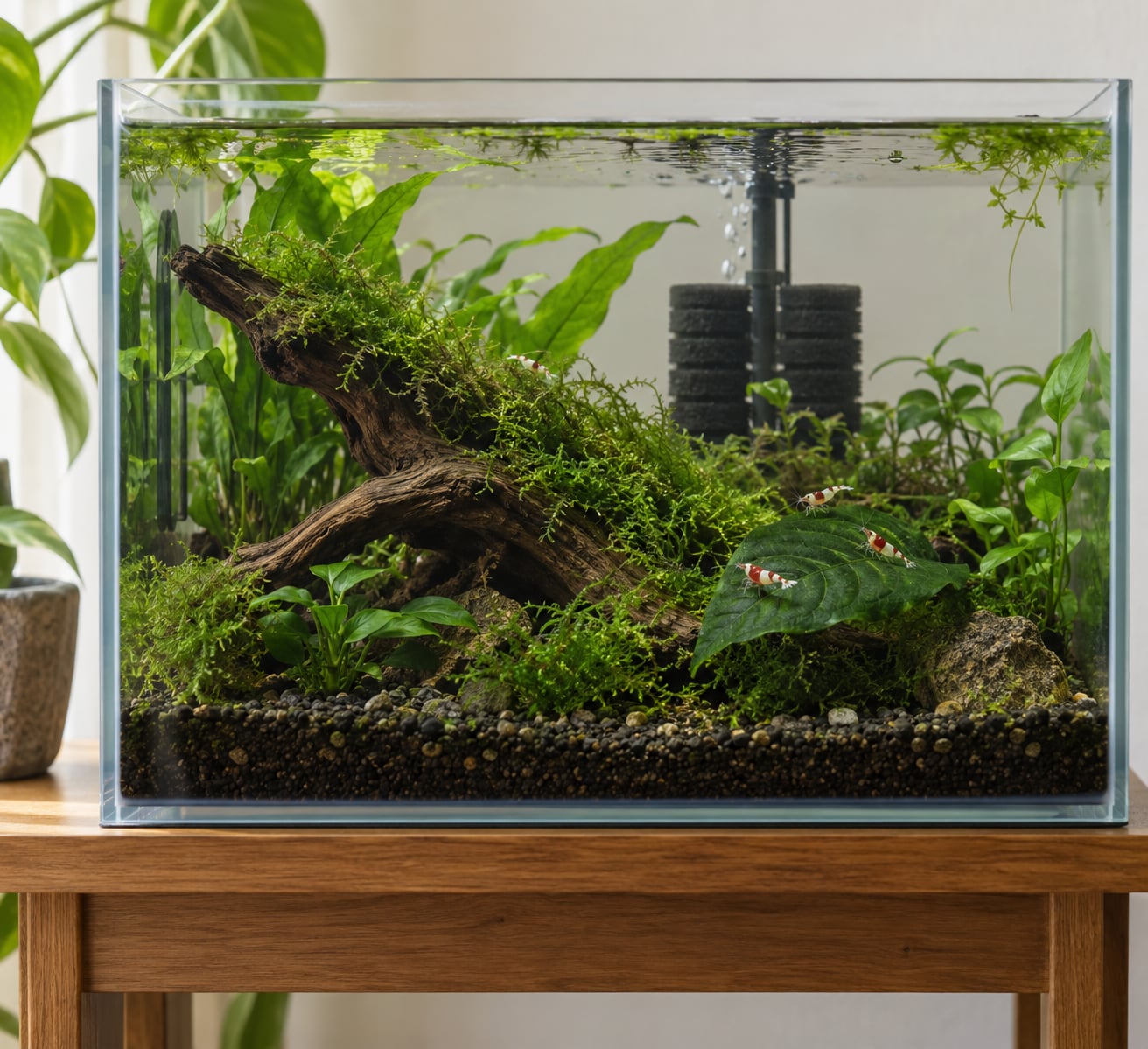
Biofilm is the staple. Shrimp graze the microscopic film that grows on wood, leaves and glass, and a well-planted mature tank can supply most or all of that. On those tanks, regular feeding becomes optional and the colony grows faster than you can feed it. That is normal, not a problem to solve.
When you do feed, use a shrimp pellet or flake and give an amount roughly the size of the colony, once or twice a week. Break up algae wafers as a treat, and offer a small piece of blanched zucchini or carrot now and then for variety. Remove anything uneaten after a few hours, because decaying food is a nitrate and ammonia source you did not plan for.
A protein source matters for breeding. A dusting of fine protein powder or a small amount of fish food supports egg production in a way plain biofilm does not. Overfeeding does the opposite: it fouls the water and invites bacteria that shrimp have no defence against.
Step 6: Provide Hiding Places and Watch Molting
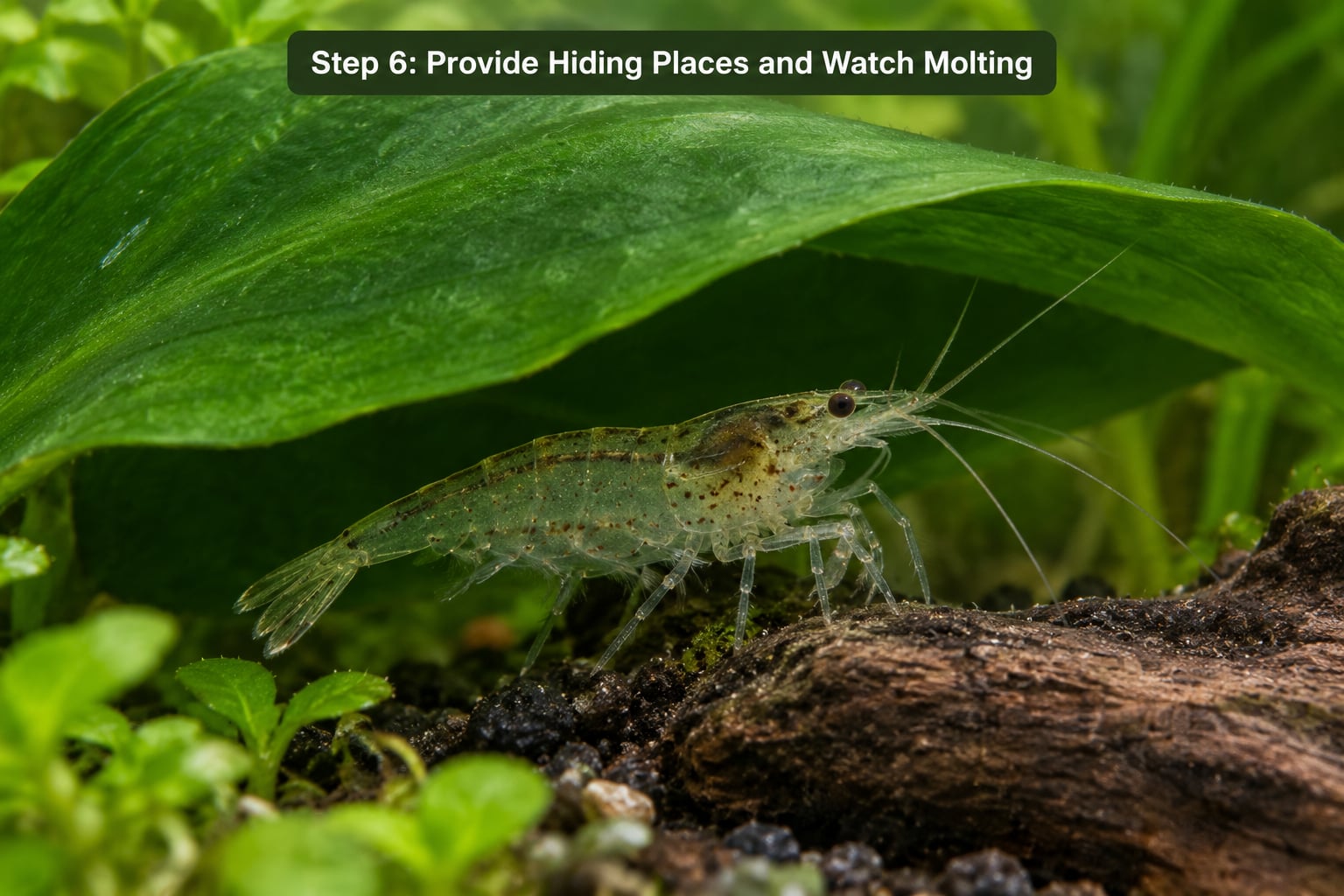
Shrimp need cover from light and from anything that eats them. Dense java moss, anubias, driftwood, rock crevices and a layer of leaf litter give them places to disappear when the tank is disturbed and places to hide while the exoskeleton is soft after a molt.
Shrimp shed and regrow their exoskeleton every few days. A normal molt looks like the shrimp lying on its side, twitching or floating for a few seconds, then dropping to the bottom. Within a day or two it is fully formed, bigger and softer, with white or transparent new shell underneath.
A failed molt is different. The shrimp stays on its back, or lies motionless with the old shell still partly attached, for hours rather than minutes. The usual causes are low GH, low KH, insufficient magnesium relative to calcium, and a pH that swings. A GH reading in range is not enough on its own, because water can be almost entirely calcium and leave magnesium short. Check magnesium, stabilise hardness, and add a calcium and magnesium supplement if your water is soft.
If a shrimp is stuck, do not reach for medication. Nothing over the counter fixes a bad molt, and the products sold for invertebrate disease are frequently copper-based, which kills shrimp outright. Comfortable, well-fed shrimp with good water molt without help.
Step 7: Check Daily and Respond to Problems
Five minutes a day is enough. Look at activity, appetite, colour, shell condition and any bodies in the tank, and run your weekly parameter tests on a schedule.
Stillness is usually not death. Shrimp rest, hide and hang off plants for long stretches, and a tank with heavy cover hides most of its population from view. Check for the signs that do matter: a shrimp that floats upside down and does not move when lifted gently, a soft or partly shed shell, a sudden drop in activity across the whole tank, or any cluster of deaths after a water change.
For anything medical, talk to an aquatic specialist or a veterinarian with exotic experience before you treat. Describe the parameters, the recent change you made and what you saw. Never use fish medication on an invertebrate tank without confirming it is copper-free, and never introduce plant-safe products containing copper, which kills shrimp even at trace levels.
Common Mistakes
Stocking before the cycle is finished. An uncycled tank produces ammonia from day one and shrimp cannot tolerate any. Correct it by cycling with no livestock, using liquid ammonia or a pinch of food as the source, and waiting for zero ammonia and zero nitrite.
Using untreated tap water. Chlorine kills the bacteria in your filter and the protective coating on the shrimp. Dechlorinate everything, including water used to rinse substrate and gravel.
Changing too much water at once. A large change alters hardness and pH faster than shrimp can adjust, which stalls molts. Correct it by working up to smaller, more frequent changes over several weeks.
Ignoring tap water TDS. Owners in hard-water areas can have TDS above 400 ppm in their supply and never check it. Test the source, then blend RO or distilled water to reach the range for your species.
Overstocking and overfeeding. Colonies grow to match the food supply, so a well-planted tank can outnumber what it feeds. Stock conservatively at first, feed lightly and be ready to remove or rehome surplus.
Using harsh decorations. Copper pipes, fertilisers rich in calcium and limestone rock can raise hardness or leach copper. Stick with inert décor and check that any fert you use is safe for invertebrates.
Treating every odd behaviour as disease. Hiding, resting and a shrimp perched on the filter are normal. Diagnose with parameter tests before you medicate, because most treatments are worse than the problem.
A maintenance tip that covers most of these: keep a written log of parameters and every change you make. When something goes wrong, the log usually points straight at the cause.
Frequently Asked Questions
What temperature should a shrimp tank be?
Keep neocaridina at 68 to 75 F and Amano and Caridina in the low to mid 70s F. Use an adjustable heater with a thermometer and check the temperature weekly, because a small overnight drop stresses shrimp and stalls molts more often than the average temperature does.
What do freshwater shrimp eat?
Biofilm is the staple diet, grazed from plants, wood and glass. Supplement with a shrimp pellet or flake once or twice a week, an algae wafer broken into pieces, and small amounts of blanched vegetable or protein powder for breeding females. Remove uneaten food within a few hours to protect water quality.
How often should I change the water in a shrimp tank?
For a lightly stocked planted tank, a 15 to 20 percent change every two weeks is a good baseline. Smaller and more frequent changes hold parameters steadier than one large weekly change. Always match temperature and use dechlorinated water, and top off evaporation between changes rather than letting the level drop.
Why are my shrimp dying after a water change?
Almost always a shock from the new water: temperature mismatch, chlorine not neutralised, a hard pH or hardness swing, or an ammonia spike after the biofilter was disturbed. Drip acclimate the new water, add dechlorinator first, match temperature within a degree, and test ammonia and nitrite before and after any big change.
Is 10 shrimp enough to start a colony?
Yes. Ten is a good starter group because they will find mates and breed quickly in a mature, well-planted tank. Females berry around 4 to 6 weeks and free-swimming shrimplets appear a few weeks later, so expect fast growth and plan where surplus will go before your numbers outgrow the tank.
Can shrimp live with bettas and other fish?
Sometimes, but not with every fish. Bettas usually tolerate adult neocaridina, while rasboras, ember tetras and otocinclus are safe community partners. Avoid loaches, goldfish, cichlids and any fish that eat invertebrates or grow large enough to swallow them, and skip copper-based fish medication entirely.
Conclusion
Start with a cycled, filtered tank and never skip that wait. Once the shrimp are in, hold the water steady, feed lightly, keep dense cover and leaf litter for molting, drip acclimate every new arrival and test the same parameters every week. That routine covers nearly every problem a beginner runs into, and it is far easier than trying to fix a tank that has already lost its colony.