To bond with a shy rabbit, you sit on the floor in the same room, ignore the rabbit completely, and let it come to you on its own terms — usually over days, often over weeks, sometimes over months. Bonding a shy rabbit works by pairing your presence with good things: soft speech, hand-fed treats, a predictable routine, and touches it asks for. Nothing speeds this up, because a prey animal has to learn that you are not a predator, and that lesson can’t be rushed.
Here’s what people get wrong. They wait for the rabbit to be friendly before they sit with it, which means they never actually sit with it. Or they try to speed things up by picking the rabbit up for a cuddle, and a fortnight of patience disappears in one thump on the floor.
The honest expectation is this: a rabbit used to people may open up in a couple of weeks. A rescue rehomed after rough handling often takes several months. Some rabbits never become lap rabbits, and that’s a normal outcome, not a failure. What you’re aiming for is a rabbit that comes to you, grooms near you, and relaxes when you enter the room.
This guide is about bonding with a human. If you have two rabbits that need pairing up instead, that’s a completely separate process and a different set of risks.
Table of Contents
- What You Need
- Step-by-Step: How to Bond with a Shy Rabbit
- How to Bond with a Shy Rabbit by Letting Trust Come First
- How to Bond with a Shy Rabbit Through Food and Routine
- How to Bond with a Shy Rabbit with Gentle Touch
- How to Bond with a Shy Rabbit Through Play and Shared Space
- How to Bond with a Shy Rabbit Without Rushing Handling
- How to Bond with a Shy Rabbit by Building Independence
- Common Mistakes
- Frequently Asked Questions
- How long does it take to bond with a shy rabbit?
- Is it normal for a shy rabbit to hide most of the time?
- How can I tell if my rabbit is starting to trust me?
- Can I pick up my rabbit to try to bond with it?
- What treats and foods are safe for rabbits?
- When should I contact a veterinarian about a shy rabbit?
- Conclusion
What You Need
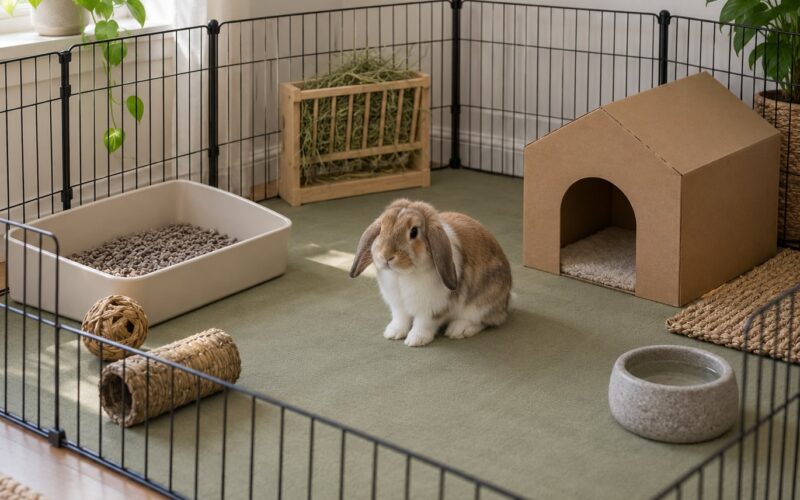
You need very little, and most of it is a place for the rabbit to feel safe and food you already have in the kitchen. The list below is what a calm bonding routine actually depends on.
- A quiet corner of the room. Not a cage in the middle of a busy hallway. A spot with a wall behind it, away from the front door, the television and other pets.
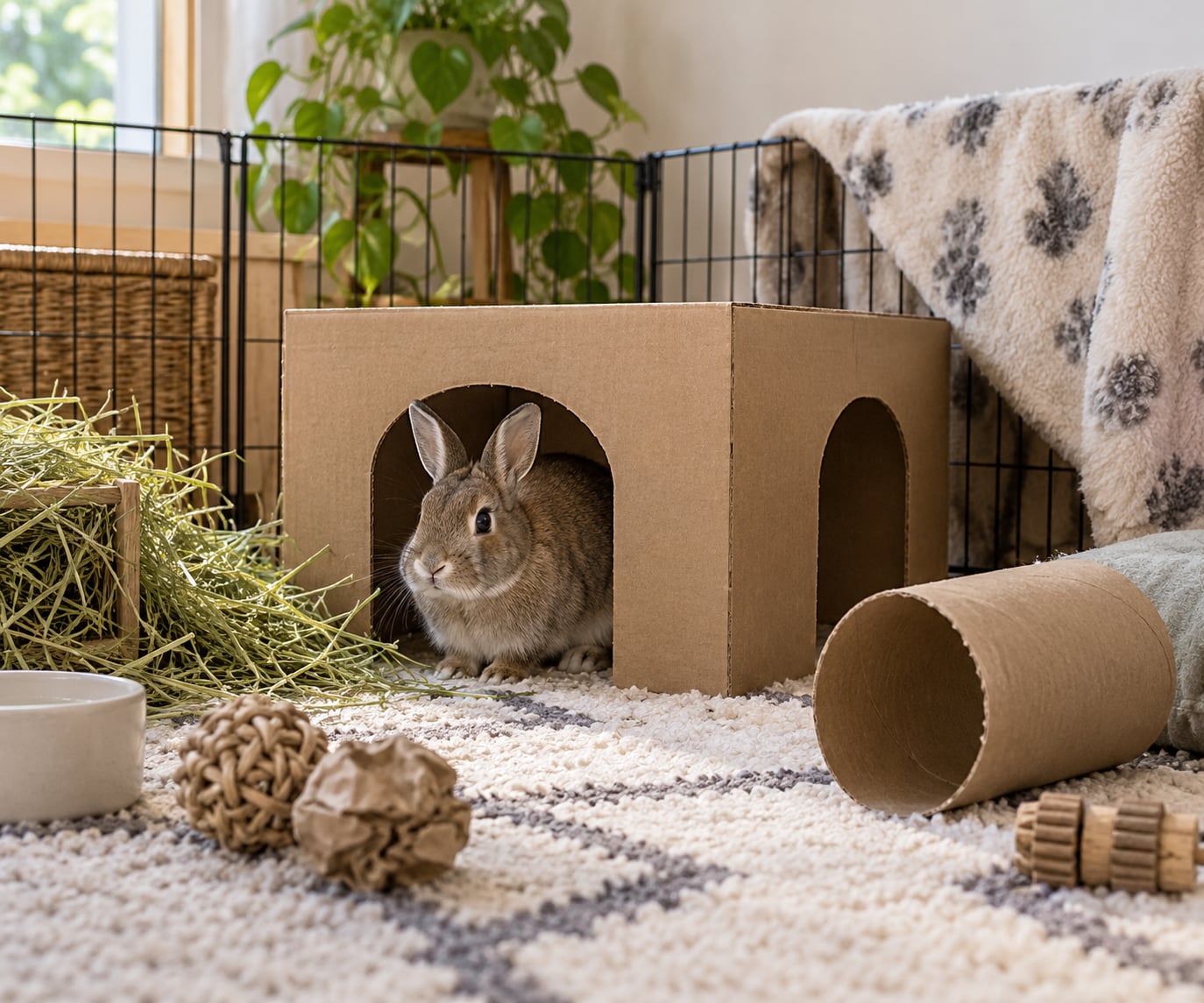
- A hiding place with two exits. A cardboard box with a second opening cut in it, a wooden hide, or a fabric tunnel. Two ways out means a rabbit never feels cornered in its own home.
- A fleece or blanket. Draped over half the pen so the rabbit has shade and cover, with the rest open. It reduces the exposed feeling of a bare wire pen, and a frightened rabbit often calms visibly once it can no longer see the whole room.
- Unlimited grass hay. About 85% of the diet, and the single most useful hand-feeding tool you have. Hay nibbled from your fingers gets a wary rabbit closer than any bought treat.
- Fresh leafy greens. Romaine, cilantro, parsley and basil are everyday safe options. Introduce new greens one at a time, in small amounts.
- A small supply of plain treats. A few unsweetened coreless banana slices, a spoonful of unsweetened applesauce, or a small piece of bell pepper. Treats are a bridge, not a meal.
- Rabbit-safe toys and tunnels. Cardboard boxes, paper-based chew toys, a small ball, a dig box filled with play sand. Unbranded, unstuffed, no plastic eyes to chew off.
- A soft towel or lap pad. For later, once the rabbit is comfortable being touched and you’re ready for short floor-level sits.
- A fixed daily schedule. Same feeding times, same cleaning times, same quiet window for floor time. Predictability is the least glamorous part of bonding and probably the most effective.
Two safety notes before you start. Never give a rabbit human medication — no painkillers, no sleeping tablets, no antihistamines, even a single one can be fatal to a rabbit. And never offer chocolate, coffee, caffeine, alcohol, onions, garlic, avocado, or sugary treats, and keep lilies, potted plants and cut flowers out of reach.
One more check worth doing early. If your rabbit has recently stopped eating, stopped producing droppings, is sitting hunched, or is flopping and hiding more than usual, that is a vet question, not a shyness question. Rabbits in pain hide, and pain looks a lot like fear if you don’t know the difference.
Step-by-Step: How to Bond with a Shy Rabbit
Six stages, in the order that works most often. Each one only begins when the stage before it has settled, and you move on when your rabbit’s behaviour changes rather than when a calendar says so. Most rabbits sit at stage one for several days, which is where people give up.
How to Bond with a Shy Rabbit by Letting Trust Come First
Start by doing almost nothing. This is the stage that feels like it’s not working, and it’s the stage everything else depends on. Sit on the floor in the same room as the rabbit, roughly a metre away, and simply exist there — reading, scrolling, watching something with your own headphones in, talking quietly on the phone.
Do not reach toward the rabbit. Do not pick it up, do not stroke it, do not make eye contact as a way of “being friendly.” A rabbit reads a direct stare as a challenge.
Talk softly if you want to, low and slow, without turning toward it. Reading aloud works better than most people expect, because a steady voice that’s clearly not aimed at the rabbit is easy to stop being afraid of. You can also put on a quiet television at low volume; background noise tires a rabbit’s wariness faster than trying to distract it.
The first new home is harder than most guides admit. A common framework is the 3-3-3 rule: three days of near-total decompression where you only clean and feed, three weeks of getting it eating and using the litter box in your space, and three months before you expect a fully relaxed rabbit. Treat the first three days as almost no interaction at all.
You know this stage is working when the rabbit starts doing relaxed things in your presence: eating hay where it can see you, lying stretched out, grooming itself, or coming out to investigate while you’re not looking. Those are the signals. Curiosity and flopping, not approaching you directly — that comes later.
How to Bond with a Shy Rabbit Through Food and Routine
Use food to build the association, because a rabbit that links you with good things has a reason to be less worried. Hand-feeding is the most reliable accelerant I know of, and it works even with rabbits that refuse every bought treat.
Start by scattering a few pieces of hay on the floor near your hand, then let the rabbit take them from the ground rather than from your fingers. Once it’s comfortable taking food from the floor beside you, offer a small piece from your flat palm, held low and still, fingers together. A cupped or upright hand reads as a grab, and the rabbit will avoid it.
Keep feeding times identical every day. Same morning, same evening, same bowl, same corner. A routine means the rabbit starts predicting your arrival, and predictable animals relax faster than unpredictable ones.
Portion matters. A rabbit that fills up on sweet treats stops eating the hay that actually keeps its gut moving, so keep treats to a small daily allowance — a few pieces, not a handful — and offer them at set points, ideally in a puzzle feeder or hidden around the room so foraging does the work.
Progress here looks like a rabbit that runs to the sound of the treat bag, or waits by the drop-lid feeder at the hour you usually feed. That’s a strong result, and it often shows up before the rabbit will tolerate a touch.
How to Bond with a Shy Rabbit with Gentle Touch
Only start petting once the rabbit comes to you for food and stays still while it eats. The touch has to be the rabbit’s idea, and it has to come from the side.
Move slowly and talk as you move, so the rabbit tracks you with its ears before it tracks you with its whole body. Sit beside it rather than in front of it. Hold your open palm low and still and let the rabbit sniff or lick your fingers — this is the handshake, and skipping it is why so many people get bitten.
If the rabbit leans into your hand or presses its head forward, try two or three slow strokes between the cheeks, along the jawline or on the forehead, and stop while it’s still enjoying it. A stroke that ends when the rabbit is comfortable teaches more than one that continues past that point.
Keep your hands off the back, the base of the tail and the belly. Those areas trigger the mating instinct in many rabbits, and a rabbit that is being mounted or chased mid-stroke will redirect that frustration at you.
Stop immediately if you see freezing, thrashing, lunging, biting, repeated escape attempts, ears pinned flat back, or a tail that starts flicking hard. Freezing is the one to watch for most, because a rabbit that goes very still is not being calm — it’s deciding. Put the pet down and give the whole thing a few days.
How to Bond with a Shy Rabbit Through Play and Shared Space
Shared space builds familiarity faster than any treat. Rabbits are most active around dawn and dusk, so fifteen to thirty minutes of floor time then, on the same days, does more than an hour of evening hovering.
Get down on the floor with them. Sit with your legs out loosely rather than crouching over the pen, and let your hands stay busy — shredding a strip of paper, rolling a ball away, refilling a puzzle feeder. You’re trying to become part of the scenery, not an event.
Let the rabbit explore you rather than steering it. A rabbit that climbs over your leg, sits against your knee or grooms your sock has made its own decision, and that decision is the whole mechanism. You can reward a calm approach by tossing a piece of hay away so the rabbit has to come back, which turns proximity into a small game.
Change the space regularly. A cardboard tunnel, a box with holes cut in it, a paper-based chew, a small ball, a dig box of play sand, or a scatter of hay in a muffin tin keeps a curious rabbit occupied. A bored rabbit is a rabbit with nothing to do but watch you.
Never corner, chase or herd a rabbit to “get a good picture” or catch it for a cuddle. This is the single most common way weeks of progress get undone, and it’s the mistake most often repeated by well-meaning people.
How to Bond with a Shy Rabbit Without Rushing Handling
Handling is not bonding. You can have a rabbit that runs to your hand for hay and still has no interest whatsoever in being held, and that rabbit is perfectly happy.
When you do decide the time has come, wait for consistent comfort: the rabbit approaches freely on most days, eats near you, and doesn’t bolt when you move. Then support both ends of the body — one hand under the chest, one under the hindquarters — and lift together, keeping the whole body supported the entire time. Never support a rabbit by the ears, the scruff alone, or the legs.
Sitting on the floor with the rabbit against your chest is far less frightening than being held up in the air, where a struggling rabbit feels the drop. Keep sessions short, a few seconds at first, and release the rabbit onto the floor rather than back into a high pen where it might fall.
Two things never to do: never restrain a rabbit to force affection, and never punish one. Rabbits cannot be disciplined in any way we understand, and a rabbit that associates handling with restraint will go back to hiding under the furniture for weeks. If your rabbit squirms, put it down. That’s the whole instruction.
Bonding during recovery from spay or neuter surgery takes extra patience, because the rabbit has been handled more than usual and is sore and sedated. Wait until fully recovered and let the routine rebuild before asking for anything.
How to Bond with a Shy Rabbit by Building Independence
The goal isn’t a rabbit that needs you. It’s a rabbit that feels secure enough to go about its day, with you as a safe part of the room rather than the only thing in it.
That means giving the rabbit choices: where to sit, whether to approach, whether to be petted or not. A rabbit that can always walk away will approach more often, not less. If it leaves mid-stroke, let it go and don’t take it personally.
Forage every day, offer cardboard digging areas, rotate two or three toys rather than leaving the same setup in place indefinitely, and let the rabbit browse at floor level for as long as it wants. Daily routines do more for confidence than any single technique.
If you have a bonded pair and one rabbit is much warier than the other, the confident rabbit often helps. An established companion who ignores the newcomer gives the shy one a model of a relaxed rabbit, and there are plenty of accounts of that settling happening fast. Give both rabbits their own hides so the shy one always has somewhere the other can’t follow.
If more than one person in the household wants to bond with the rabbit, decide who does the daily floor sessions and have everyone else stay quiet. A rabbit handled by three people in rotation resets roughly three times over.
Common Mistakes
Nearly every stalled bonding attempt comes down to one of these. Each has a straightforward correction.
- Chasing or catching the rabbit. The fix: the rabbit always ends the interaction. Sit still, let it leave, and try again tomorrow.
- Picking it up from above. A hand descending from overhead is a predator’s approach. The fix: come in from the side, low, with a flat open palm the rabbit can sniff first.
- Forcing contact or crowding the hide. A rabbit that has to be extracted from its own hiding place learns that the hiding place is not safe. The fix: move the hide, not the rabbit.
- Loud noises and sudden household chaos. Vacuuming, door slams and visitors resetting progress are common. The fix: keep the bonding room consistent, and do bonding sessions in the quiet window.
- Isolating the rabbit entirely. Shutting it in a pen alone all day produces a rabbit that is used to people only appearing at mealtimes. The fix: regular free time in the room with you.
- Using unsuitable treats, or too many. Sugary shop treats plus a full stomach means no interest in the hay. The fix: small portions of safe foods, mostly hand-fed hay.
- Treating hiding as failure. A hidden rabbit may be perfectly healthy and simply unwarmed. The fix: check appetite, droppings and posture first, and if all three are normal, keep doing what you’re doing.
- Taking progress personally. The fix: measure behaviour, not affection. Coming to the hand, eating nearby, relaxing, binkying, grooming near you — those count, even with no petting involved.
And if progress really has stopped for weeks, check the basics before you assume the rabbit doesn’t like you. Inconsistent schedule, a loud or exposed pen, a household member working against your routine, or an untreated tooth problem are all more likely than a rabbit holding a grudge.
Frequently Asked Questions
How long does it take to bond with a shy rabbit?
Usually weeks to months, and the honest answer is that nobody can promise a date. A rabbit already used to people may relax in two to three weeks. A rescue rehomed after rough handling often takes several months, and some rabbits take years. What speeds it up is a fixed daily routine, floor time at dawn or dusk, and letting the rabbit choose when to approach.
Is it normal for a shy rabbit to hide most of the time?
Yes, hiding is completely normal for a newly adopted or wary rabbit, especially in the first few days when little is expected of them. A hide box with two exits, a blanket over half the pen and a quiet corner of the room all help. Do not pull a rabbit out to inspect them, and do not reach into the hide. Let the rabbit choose when to come out.
How can I tell if my rabbit is starting to trust me?
Watch for behaviour, not cuddles. Early signs include eating hay in your presence, coming out while you are in the room, and relaxed postures such as stretching out, flopping and grooming. Stronger signs are approaching to take food from your hand, a soft tooth-clicking sound, nudging your leg, and binkying near you. Grunting, thumping, tail flicking and ears pinned flat mean back off.
Can I pick up my rabbit to try to bond with it?
Not as a bonding method. A frightened rabbit struggles, and a fall from height can injure it badly. Wait until the rabbit approaches freely and stays calm on most days, then support the chest and the hindquarters together for a few seconds, close to the floor. Some rabbits never enjoy being lifted, and that is a normal outcome rather than a problem to solve.
What treats and foods are safe for rabbits?
Grass hay should make up around 85 percent of the diet and is the best thing to hand-feed for a wary rabbit. Suitable leafy greens include romaine, cilantro, parsley and basil, introduced one at a time. Small treats such as coreless banana slices, bell pepper or unsweetened applesauce work well in moderation. Never give chocolate, caffeine, alcohol, onions, garlic, avocado or human medication.
When should I contact a veterinarian about a shy rabbit?
Book an appointment if the change is sudden rather than gradual, or if hiding comes with a hunched posture, a dull or absent appetite, fewer or smaller droppings, weight loss, difficulty eating, or any sign of pain. Stress in rabbits can stop gut movement, and a rabbit that stops eating is a medical emergency, not a slow-burn bonding problem. Find a vet with real rabbit experience.
Conclusion
Start with one thing today: pick a quiet corner, put out a hide with two exits, and sit on the floor in that room for fifteen quiet minutes without reaching for the rabbit. Do it at the same time tomorrow, and the day after that.
How to bond with a shy rabbit is not a technique you perform once. It’s a run of small, boring, positive experiences in which the rabbit is always the one who decides how close to get — and every one of those small choices adds up to trust.
If your rabbit stops eating, stops passing droppings, or seems hunched or painful, skip the bonding advice entirely and see a vet with rabbit experience. Fear and illness look similar from the outside, and telling them apart is the first real piece of work in caring for a shy rabbit.